August 14, 2026
The Architecture of Vulnerability: How the Hormuz Chokepoint Became a Diplomatic Battleground
Every generation or so, a single geographic feature becomes the focal point of global geopolitical anxiety. In the mid-2020s, that feature is a narrow strip of water barely 33 kilometres wide at its most constricted point. The Strait of Hormuz has long been understood as a structural fragility in the world's energy supply architecture, but the Iran Oman Hormuz talks now underway represent something genuinely unprecedented: the first formal attempt to institutionalise bilateral governance over the world's most consequential maritime corridor since conflict interrupted its free passage.
Understanding what is at stake requires moving beyond headlines and into the underlying mechanics of how the strait functions, why its disruption cascades so violently through global markets, and why a durable resolution is far more complex than a simple ceasefire agreement. Furthermore, the broader implications for oil price volatility and energy security cannot be overstated.
When big ASX news breaks, our subscribers know first
What Makes Hormuz Irreplaceable in the Global Energy System
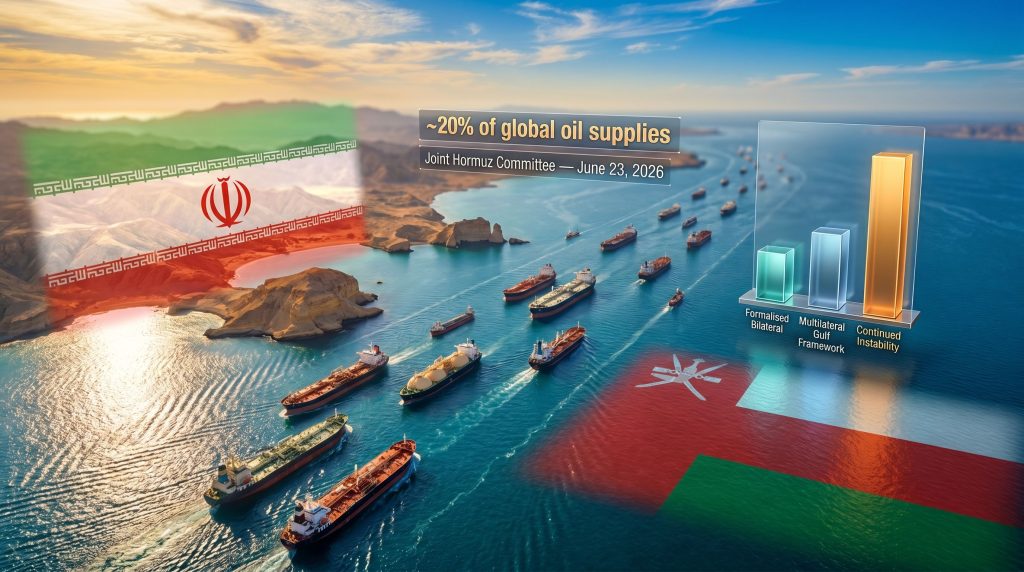
The Strait of Hormuz is not merely strategically important. It is, by most measurable standards, the single most load-bearing maritime chokepoint in the architecture of global energy trade. Approximately 20% of the world's oil supplies transited through Hormuz annually before the outbreak of the West Asia conflict, along with a substantial share of global LNG supply shipments, primarily from Qatar's North Field, the largest single natural gas reservoir on earth.
What makes Hormuz structurally different from other maritime chokepoints is its dual-sovereignty configuration. The navigable waters of the strait fall entirely within the territorial limits of Iran and Oman, with no neutral international passage corridor running through it. This creates a unique legal and operational tension: under the customary international law principle of transit passage, codified in the United Nations Convention on the Law of the Sea (UNCLOS), neither bordering state can lawfully block commercial shipping or impose tolls.
Yet the physical geography means that enforcement of that legal principle depends almost entirely on the political willingness of both nations to respect it. Consequently, the geopolitical trade tensions surrounding this waterway have intensified considerably in recent months.
Before the conflict reshaped the regional order, the strait served as the primary export artery for:
- Saudi Arabia — the world's largest crude oil exporter by volume
- Iraq — whose entire southern production base depends on Gulf terminal access
- The United Arab Emirates — a major refined products and crude exporter
- Kuwait — almost entirely reliant on Hormuz for energy export revenues
- Qatar — whose LNG exports underpin European and Asian gas security
The removal of even a fraction of this combined throughput from global markets triggers immediate price dislocations. The current period of restricted passage has demonstrated exactly this dynamic in real time.
The Joint Hormuz Committee: What the Muscat Meetings Actually Established
The Iran Oman Hormuz talks convened formally on June 29, 2026, when Iranian Deputy Foreign Minister Kazem Gharibabadi confirmed via social media that the inaugural session of the Joint Hormuz Committee had taken place in Muscat. The committee itself was agreed upon on June 23, 2026, representing the first structured bilateral mechanism dedicated specifically to strait governance since the Pakistan-brokered ceasefire framework was established.
Why the Meeting Format Matters
The significance of the meeting format should not be understated. Engagement at deputy foreign minister level, with undersecretaries and technical specialists present, indicates that both parties are treating this as a working governance process rather than a symbolic diplomatic gesture. Iran's chief nuclear negotiator Mohammad Baqer Qalibaf also travelled to Muscat during this period, where he met with Omani Foreign Minister Badr Al Busaidi and Iranian Foreign Minister Abbas Araghchi separately.
The concrete outcomes from the Muscat sessions included:
- Agreement to establish a dedicated hotline and real-time coordination centre between Tehran and Muscat for resolving vessel passage disputes as they arise
- A formal shared commitment to the reopening and securing of commercial maritime traffic as the singular objective of the committee's mandate
- Preliminary discussions around a joint administration framework that would govern corridor management on a permanent basis
- Exploratory conversations around a transit fee mechanism potentially activated following a designated 30-to-60-day de-escalation window
Is a Transit Fee Legally Permissible?
The transit fee proposal is legally the most contentious element. Under UNCLOS, the imposition of tolls on vessels exercising transit passage rights through international straits is not permissible. Any formalised fee structure would therefore represent a contested departure from established maritime law, potentially triggering proceedings before the International Court of Justice or the International Tribunal for the Law of the Sea. Reuters has reported extensively on the legal dimensions of these negotiations.
How the Strait Became a Coercive Instrument
Iran's decision to convert the Strait of Hormuz from an open transit corridor into a coercive instrument did not occur spontaneously. It followed a deliberate strategic logic: by demonstrating its capacity to disrupt approximately one-fifth of global oil supplies, Tehran could impose material costs on adversaries without requiring direct military confrontation on land.
The escalation sequence unfolded across several stages:
| Event | Impact on Hormuz |
|---|---|
| Outbreak of West Asia conflict | Iran initiates partial blockade to generate negotiating leverage |
| Pakistan brokers preliminary ceasefire | Fragile halt to hostilities; strait remains operationally contested |
| US-Iran exchange of strikes | Ceasefire architecture strained; commercial shipping further disrupted |
| US Central Command strikes 10 Iranian military targets | Response to continued Iranian aggression against commercial shipping |
| Iran retaliates against US bases in Kuwait and Bahrain | Both nations formally condemn Iranian strikes |
| First Joint Hormuz Committee session in Muscat | June 29, 2026 — inaugural structured bilateral governance dialogue |
Iran's preferred navigational corridor requires vessels to transit closer to its own coastline, specifically near Larak Island, rather than hugging the Omani side of the strait. When dozens of vessels defied this protocol by choosing the Omani coast route, Iranian Foreign Minister Abbas Araghchi stated explicitly that such behaviour would complicate and delay the strait's reopening.
Iran's Revolutionary Guards confirmed active monitoring of all strait traffic, warning that violations of the designated corridor would draw a more forceful response than previously. Mohammad Mokhber, adviser to Iran's Supreme Leader, reinforced the ideological framing by asserting that Iranian control of the strait directly counters Washington's ambitions for regional dominance.
H.A. Hellyer of the Royal United Services Institute, a London-based security think tank, has observed that a drawn-out negotiation process paired with calibrated pressure in the strait can operate strategically in Iran's favour. This assessment implies that Tehran has rational incentives to sustain controlled instability rather than pursue rapid normalisation.
Oman's Pivotal and Precarious Role
Oman occupies a genuinely unusual position in this dispute. It shares physical sovereignty over the strait's navigable waters with Iran, yet it has maintained a posture of strategic neutrality throughout the West Asia conflict that most regional states have found difficult to sustain.
Muscat's willingness to host the Joint Hormuz Committee is not a neutral act. It positions Oman as the preferred diplomatic intermediary between Tehran and Washington, a role the sultanate has played quietly but effectively in prior back-channel communications between the two adversaries. Oman's participation in any joint administration framework carries a dual implication: it lends measured legitimacy to Iran's governance assertions over the strait while simultaneously providing a moderating influence that Tehran's more hardline factions cannot easily override.
For Oman, the calculus involves its own economic exposure. The sultanate's oil revenues and its broader economic relationships with both Gulf neighbours and Western partners depend on a functional, commercially navigable Hormuz. Extended instability damages Muscat's interests as directly as it damages any other stakeholder's.
Three Scenarios for How Hormuz Governance Could Evolve
The Iran Oman Hormuz talks could produce outcomes ranging from durable institutional governance to prolonged managed chaos. Three plausible scenarios frame the range of possibilities:
Scenario A: Formalised Bilateral Management
Iran and Oman jointly administer designated transit corridors, vessel tracking requirements, and passage protocols. Transit fees are introduced following a de-escalation period, with revenues potentially shared between the two sovereigns. International law compliance is maintained in formal documentation, but operational enforcement remains under Iranian operational control.
Scenario B: Multilateral Gulf Framework
Broader Gulf Cooperation Council involvement dilutes Iranian unilateral authority. A neutral monitoring body, potentially affiliated with the United Nations, oversees corridor compliance. Transit fees are either eliminated or set at nominal levels to preserve commercial shipping confidence across Asian and European import markets.
Scenario C: Continued Controlled Instability
Negotiations stall across multiple rounds. Iran maintains de facto corridor control without achieving formal legal recognition. Periodic military exchanges continue, sustaining elevated oil price risk premiums and war risk insurance surcharges on strait-transiting vessels.
| Scenario | Near-Term Probability | Oil Market Impact | Legal Stability |
|---|---|---|---|
| Formalised Bilateral Management | Moderate | Moderate disruption risk | Legally contested |
| Multilateral Gulf Framework | Lower near-term | Lowest disruption risk | Legally sound |
| Continued Controlled Instability | Highest near-term | Sustained price premium | Legally ambiguous |
The probability weighting toward continued controlled instability reflects the structural incentive misalignment at the heart of these negotiations. Iran benefits from ambiguity. The United States faces competing pressures between protecting freedom of navigation and avoiding escalation that derails nuclear talks. Gulf states have acute economic exposure but limited direct influence over the Iran-Oman bilateral framework.
The next major ASX story will hit our subscribers first
Global Energy Markets: Who Bears the Greatest Exposure
The economic consequences of sustained Hormuz disruption are not distributed equally. They fall most heavily on economies with the highest dependence on Gulf energy imports and the least flexibility to substitute supply from alternative sources. Indeed, the oil price shock already felt across energy markets has demonstrated how swiftly disruption can ripple through the global economy.
The nations facing the greatest structural exposure include:
- India: One of the largest importers of Gulf crude globally, with limited near-term capacity to redirect procurement toward alternative origins without significant price premium absorption
- China: Relies on Middle Eastern crude as a cornerstone of its refinery feedstock mix; any prolonged disruption accelerates strategic petroleum reserve drawdowns and increases procurement costs from alternative suppliers
- Japan and South Korea: Operate with near-total dependence on seaborne energy imports and minimal domestic production capacity, leaving them acutely vulnerable to both price increases and physical supply interruptions
- European Union: Post-Russia energy diversification has increased the EU's structural reliance on Gulf LNG, creating a Hormuz exposure that did not exist at the same scale prior to 2022
For shipping operators, the practical alternative to Hormuz is the Cape of Good Hope route around southern Africa, which adds approximately 10 to 14 days of transit time per voyage and significantly increases fuel and freight costs. War risk insurance surcharges on Hormuz-transiting vessels have escalated sharply through the conflict period, compounding the landed cost of Gulf crude for Asian refiners.
Qatar's LNG Exposure
Qatar's North Field LNG exposure deserves specific attention. Qatar is among the world's largest LNG exporters, and its gas cargo routes pass directly through Hormuz. European buyers who redirected away from Russian pipeline gas now find their alternative supply source exposed to the same chokepoint dynamics they sought to escape.
The human cost of the ongoing instability was underscored when Qatar's interior ministry confirmed that one of its citizens was killed aboard a vessel by shrapnel from military operations in the area, a stark reminder that the consequences of Hormuz instability extend well beyond commodity price charts.
The Ceasefire Architecture and Its Structural Weaknesses
The Pakistan-brokered ceasefire agreement that underpins current diplomatic engagement has been repeatedly tested by exchanges of fire. A US official confirmed that both sides had agreed to stand down and allow vessels to move freely in and around the strait, but this assurance is explicitly contingent on continued progress in broader diplomatic talks.
Technical negotiations between Washington and Tehran are ongoing, with Qatar mentioned as a potential venue for resumed engagement. The published text of the Memorandum of Understanding between Iran and the United States states that Iran will define the future administration of the strait in dialogue with Oman and Gulf States, and in alignment with international law.
The inclusion of the international law clause is significant because it provides a formal anchor for challenging any transit fee mechanism that violates UNCLOS norms. However, the ceasefire's fragility is not simply a product of bad faith on either side. It reflects a genuine structural tension: Iran's strategic interests are partially served by maintaining the strait as a bargaining chip, while the United States cannot indefinitely tolerate restrictions on one of the foundational principles of its maritime order. Bloomberg has noted that the toll system discussions represent precisely this kind of contested territory.
Key Variables That Will Determine the Hormuz Outcome
Several interconnected factors will shape whether the Iran Oman Hormuz talks produce a durable governance framework or remain a process that legitimises controlled instability. The analysis of crude oil geopolitics more broadly suggests that each of these variables carries significant weight:
- Progress in US-Iran nuclear and sanctions negotiations: The broader diplomatic track is the single most important determinant of whether strait governance talks can converge on a binding agreement
- Iran's domestic political dynamics: Hardline factions within the Revolutionary Guards and the Supreme Leader's inner circle retain strong incentives to preserve Hormuz leverage as a long-term strategic asset, independent of the foreign ministry's negotiating positions
- Oman's diplomatic bandwidth: Muscat's ability to sustain its mediating role depends on its domestic political stability and the integrity of its relationships with both Washington and Tehran simultaneously
- International shipping industry economics: Sustained war risk surcharges and the operational costs of alternative routing are creating financial pressures that may ultimately accelerate diplomatic resolution more effectively than political statements
- Gulf state cohesion: Whether Saudi Arabia, the UAE, and Qatar can coordinate a unified position on Hormuz governance will influence whether a multilateral framework becomes viable as an alternative to the bilateral Iran-Oman structure
The inaugural session of the Joint Hormuz Committee represents a meaningful, if structurally fragile, step toward institutionalising dialogue over one of the most consequential maritime corridors in the history of global trade. However, the incentive misalignment between Iran's pursuit of formalised control and the international community's insistence on unrestricted passage rights means that durable resolution remains a medium-term objective at best. The coming 30-to-60-day de-escalation window will serve as the most important early test of whether diplomacy can outpace the strategic logic of managed instability.
Disclaimer: This article contains analysis and scenario projections based on publicly available information as of the date of publication. The geopolitical situation in West Asia remains fluid. Readers should not interpret any scenario modelling or forward-looking analysis as predictive or as financial or investment advice. All projections are subject to material change based on evolving diplomatic, military, and economic conditions.
Want to Stay Ahead of the Resource Discoveries Reshaping Global Markets?
Geopolitical disruptions like the Hormuz crisis ripple directly into commodity prices and mineral valuations — and Discovery Alert's proprietary Discovery IQ model ensures subscribers receive real-time alerts on significant ASX mineral discoveries the moment they are announced, transforming complex market signals into actionable opportunities. Explore how historic mineral discoveries have generated substantial returns and begin your 14-day free trial today to position yourself ahead of the next major market move.