June 29, 2026
The Geopolitics of Scarcity: Why Mineral Stockpiling Is Becoming a Defence Strategy
For most of the post-Cold War era, the prevailing assumption among industrialised democracies was that global commodity markets would reliably deliver raw materials to whoever needed them. Price signals would allocate supply. Comparative advantage would determine who mined what. That assumption is now being systematically dismantled.
What has replaced it is a harder-edged calculation: that concentrated control over the extraction and processing of a small number of minerals represents a genuine leverage point in great-power competition. The Canada and Japan critical minerals stockpile discussions now underway reflect exactly this shift in thinking, from market optimism to strategic realism.
When big ASX news breaks, our subscribers know first
Why Stockpiling Has Re-Emerged as a Geopolitical Tool
Stockpiling as a national security instrument is not new. The United States maintained a National Defense Stockpile throughout the Cold War, accumulating materials deemed essential to wartime production. What is new in 2026 is the explicit coordination of reserve strategies across allied nations, and the extension of that logic from metals like titanium and cobalt into newer categories such as battery-grade graphite and semiconductor-grade gallium.
Furthermore, strategic metals stockpiling is gaining momentum as the core mechanism of a jointly managed reserve becomes conceptually clearer. Participating governments or their designated agencies acquire target minerals during periods of market abundance, when prices are low and supply is plentiful. Those reserves are then available for drawdown during shortage events, effectively acting as a buffer that stabilises both availability and price for downstream industrial users. In practice, however, executing this across two sovereign nations with different legal frameworks, storage infrastructure, and industrial priorities is considerably more complex than the theory suggests.
Three structural questions define the operational challenge:
- Custody and location: Which nation physically holds the reserves, and under what conditions can the other access them?
- Drawdown triggers: What constitutes a qualifying supply disruption, and who has authority to declare one?
- Funding mechanisms: Are reserves financed through government appropriation, levies on downstream industries, or commercial partnerships?
These questions remain under negotiation, but the political momentum behind finding answers is now unmistakable.
How Concentrated Is China's Control Over Critical Mineral Supply Chains?
To understand why the Canada and Japan critical minerals stockpile conversation is happening now, it is necessary to first appreciate the degree of supply concentration that exists across several strategically important materials. Indeed, the critical minerals demand surge currently underway is amplifying these vulnerabilities considerably.
Supply Concentration at a Glance
| Mineral | China's Global Share | Key Industrial Application |
|---|---|---|
| Graphite (mining) | ~78% of global production | Battery anodes, rocket nozzles, missile components |
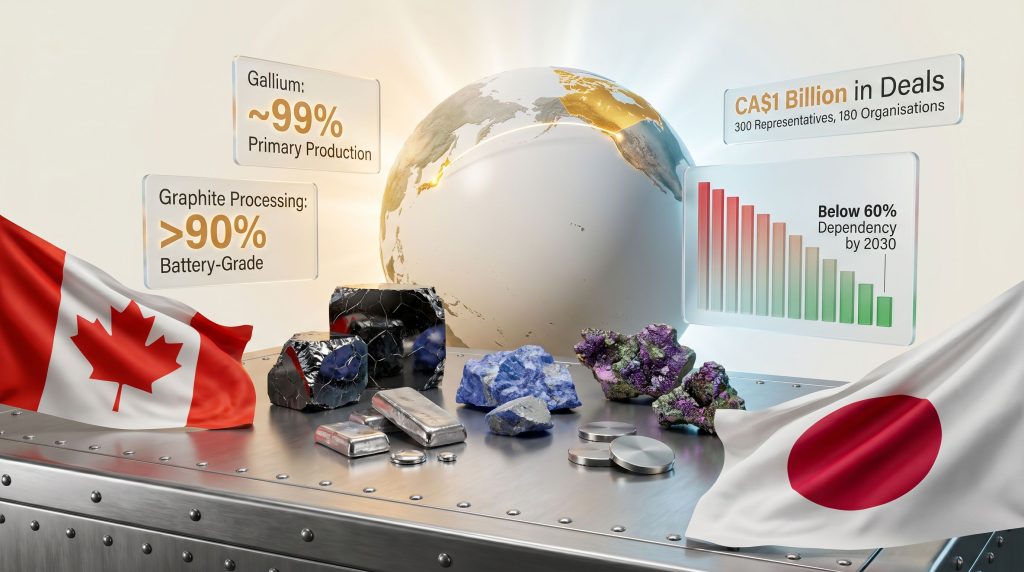
| Graphite (processing) | >90% battery-grade material | EV batteries, defence manufacturing |
| Gallium | ~99% primary production (2024) | Wide bandgap semiconductors, defence electronics |
| Rare Earths (Japan imports) | ~80% of Japan's supply | Permanent magnets, precision electronics |
Sources: US Geological Survey; GlobalData; Benchmark Mineral Intelligence
These figures are not simply economic data points. They represent potential chokepoints in the production chains for electric vehicles, advanced radar systems, missile guidance components, and consumer electronics. The distinction between civilian and military applications is increasingly blurred: battery-grade graphite feeds EV production and also lines the interiors of rocket nozzles. Gallium compounds are central to the wide bandgap semiconductor architectures used in both 5G infrastructure and military-grade electronic warfare systems.
Battery-grade graphite is often discussed purely in the context of energy transition, but its role as a structural refractory material in aerospace and defence manufacturing makes supply security a military readiness question, not merely a clean energy policy matter.
China's Escalating Export Control Timeline
The trajectory of China's export restrictions over the past three years has followed a clear pattern of escalation, with each round of controls targeting materials of higher strategic sensitivity.
- 2023: Export licensing controls introduced on gallium and germanium, two materials with critical roles in semiconductor manufacturing and fibre optics respectively.
- Early 2025: Controls extended to molybdenum, a high-strength metal used in aerospace alloys and nuclear applications.
- February 2026: Beijing prohibited dual-use exports to 20 specific Japanese companies, citing alleged links to Japan's defence sector.
The February 2026 action was notably targeted. Rather than a blanket restriction, it named specific Japanese corporate entities, a move that carries both economic and signalling dimensions. The timing followed remarks by Japanese Prime Minister Sanae Takaichi indicating that Japan would respond if Taiwan faced military action. China, which regards Taiwan as its own territory, interpreted those statements as provocative, and the export controls that followed were widely read as a coercive economic response.
According to Benchmark Mineral Intelligence, China supplies approximately 80% of Japan's rare earth imports as of early 2026. Against that backdrop, Japan's vulnerability to targeted mineral restrictions is not theoretical; it is quantifiable.
Inside the Canada-Japan Tokyo Trade Mission
Canada's International Trade Minister Maninder Sidhu led a delegation of approximately 300 representatives from nearly 180 companies and organisations to Tokyo, making it the largest Canadian trade mission to the Asia-Pacific region to date. During the visit, Canadian and Japanese commercial entities formalised more than CA$1 billion (approximately US$705 million) in business agreements.
Beyond the headline commercial numbers, the substantive work of the mission focused on three proposed pillars of bilateral cooperation:
- Joint upstream development – co-investment in Canadian mining projects to expand extraction capacity for materials of mutual strategic interest.
- Off-take agreements – structured purchase commitments under which Japanese buyers guarantee to acquire defined volumes of output from Canadian producers, providing the revenue certainty needed to justify capital-intensive mine development.
- Shared physical stockpiling – coordinated buffer reserves that both nations can access during supply disruptions, reducing the vulnerability of each to unilateral Chinese export restrictions.
Mitsubishi, already a significant participant in the LNG Canada project (the first liquefied natural gas export facility on North America's Pacific Coast with direct access to Asian markets), signalled interest in extending its Canadian investment footprint into the critical minerals sector during the mission. Consequently, rare earth supply chains are now being viewed as a central element of bilateral economic planning rather than a peripheral trade concern.
The Off-Take Agreement as the Preferred Commercial Instrument
Among the cooperation mechanisms under discussion, the off-take agreement model deserves particular attention because it resolves a structural problem that has historically impeded mine development in allied nations: the gap between the capital required to build a mine and the revenue certainty needed to justify that capital.
Canada has already pointed to an operational example of this model in action. An existing agreement between Nouveau Monde Graphite and Panasonic, under which the Japanese electronics manufacturer commits to sourcing battery-grade graphite from Canadian production, is being cited by policymakers as a replicable template for future bilateral supply arrangements.
The significance of this precedent extends beyond the specific deal. It demonstrates that:
- Japanese industrial buyers are willing to commit to non-Chinese graphite sources at commercial scale.
- Canadian producers can attract credible offtake partners without relying exclusively on domestic demand.
- The gap between Chinese processing dominance and viable alternatives can be bridged through structured purchasing agreements rather than subsidy-dependent industrial policy alone.
For instance, Canada and Japan's joint stockpiling efforts in this space are already being studied by other allied nations as a potential model for broader multilateral adoption.
The next major ASX story will hit our subscribers first
Japan's Institutional Memory: A Nation That Has Done This Before
Japan brings a depth of institutional experience to the stockpiling conversation that most of its G7 partners lack. The country has maintained a rare metals reserve programme since the 1980s, originally designed to protect its electronics and automotive manufacturing base from supply interruptions. That programme covers a range of materials including nickel, cobalt, manganese, chromium, tungsten, and molybdenum.
The experience that most directly shaped Japan's current posture, however, was the 2010 rare earth embargo. Following a maritime incident near disputed islands in the East China Sea, China halted rare earth exports to Japan for several weeks. The economic shock to Japan's electronics and automotive sectors was immediate and severe, and it produced a strategic reorientation that has continued ever since.
In the years following 2010, Japan invested heavily in rare earth recycling technology, diversified its supplier relationships (including investments in Australian, Indian, and North American sources), and developed domestic stockpiling capacity. The country's current engagement with Canada on critical minerals is not a reactive scramble; it is the latest iteration of a supply security strategy that has been under construction for more than a decade.
What has changed is Japan's preference for allied coordination over unilateral action. Managing reserves independently is expensive and strategically suboptimal when allied nations face the same adversarial supply dynamics. A coordinated approach distributes both the cost and the strategic deterrence value of reserves across multiple partners.
The G7 Framework: From Declaration to Implementation
The Canada-Japan bilateral dialogue is unfolding within a broader multilateral architecture that provides it with political context and policy alignment. At the 2026 G7 summit in Évian, France, leaders formalised a critical minerals coordination framework built around a specific and measurable target. In addition, America's rare earth supply chain ambitions are closely aligned with these allied coordination efforts, reinforcing the broader strategic logic.
G7 Critical Minerals Coordination Framework
| Commitment | Target | Timeline |
|---|---|---|
| Reduce rare earth and permanent magnet dependency on any single non-G7 supplier | Below 60% concentration | By 2030 |
| Coordinate allied stockpiling mechanisms | Harmonised reserve protocols | In progress |
| Collective response to economic coercion via export restrictions | Policy alignment across members | Ongoing |
The 60% concentration cap is a notable policy instrument because it creates a quantifiable benchmark against which progress can be measured. Japan's current 80% rare earth import dependency on China means it must reduce that figure by at least 20 percentage points within four years to meet the G7 commitment. Canada's ability to supply alternative sources therefore carries direct policy relevance within the G7 framework.
The G7 declaration was carefully worded to reference concerns about arbitrary export restrictions and economic coercion without naming China directly, a diplomatic formulation that preserves negotiating flexibility while leaving no ambiguity about the intended target of the policy.
Risks and Limitations of the Stockpile Approach
The strategic logic behind the Canada and Japan critical minerals stockpile initiative is compelling, but the practical challenges are substantial and should not be minimised.
What Are the Key Operational Risks?
Logistical complexity is perhaps the most immediate obstacle. Graphite and gallium require different storage conditions, and both present regulatory complexities around cross-border movement, particularly for materials that have dual civilian and military applications. Determining which nation maintains physical custody of shared reserves, and under what legal framework the other nation accesses them, requires treaty-level negotiation.
Price discovery distortion is a subtler but equally real risk. Government-managed stockpiling programmes can create perverse market incentives if buying activity is poorly timed or poorly communicated. Large-scale government acquisition during tight markets can amplify price spikes rather than dampen them, while reserve drawdown during price weakness can undercut the private investment signals needed to incentivise new mine development.
Political continuity risk affects every long-duration government programme. Stockpile strategies that span multiple electoral cycles depend on sustained political commitment across potentially different governing coalitions in both Canada and Japan. The institutional mechanisms designed to insulate reserve management from short-term political pressure will be as important as the initial policy design. However, the IEA's international resource strategy provides a useful multilateral framework that may help insulate such programmes from short-term political volatility.
Frequently Asked Questions
What minerals are Canada and Japan planning to stockpile together?
Graphite and gallium have been specifically identified in discussions as priority materials, given their near-total Chinese production dominance and defence-critical applications. Broader conversations also encompass lithium, cobalt, nickel, copper, and rare earth elements relevant to permanent magnet manufacturing.
How does a joint stockpile differ from each country maintaining its own reserves?
A joint reserve distributes acquisition costs across two national budgets, potentially allows for larger combined volumes, and creates a shared drawdown mechanism that provides both nations with access to a larger combined buffer than either could maintain independently.
Why are graphite and gallium considered defence-critical materials?
Heat-resistant graphite is a structural component in rocket nozzle linings and missile nose cones. Gallium compounds are essential to wide bandgap semiconductor devices used in military radar, electronic warfare, and communications systems. Supply interruptions in either material would have direct consequences for defence manufacturing capacity.
Has Japan stockpiled critical minerals before?
Yes. Japan has operated a national rare metals reserve programme since the 1980s, covering materials including nickel, cobalt, and manganese. The programme was significantly expanded and diversified following the 2010 rare earth supply disruption.
How does the Canada-Japan initiative connect to the broader US-Japan minerals partnership?
The bilateral Canada-Japan framework complements the existing US-Japan critical minerals partnership by extending the allied supplier network northward into Canada's resource base, diversifying supply across multiple allied jurisdictions rather than routing it through a single partner nation.
Key Takeaways: What This Initiative Signals for Global Markets
- Allied nations are moving from policy statements to operational infrastructure, with physical reserve arrangements and commercial off-take agreements replacing diplomatic declarations as the primary instruments of supply security.
- Graphite and gallium represent the highest-urgency tier of strategic concern given Chinese near-monopoly control over both mining and processing stages of the supply chain.
- The off-take agreement model demonstrated by the Nouveau Monde Graphite-Panasonic arrangement is emerging as the preferred mechanism for de-risking Canadian mine development while guaranteeing Japanese industrial access to non-Chinese sources.
- Japan's institutional depth in strategic stockpiling, built over four decades and sharpened by the 2010 embargo experience, gives the Canada-Japan partnership a practical foundation that newer allied frameworks lack.
- The G7's 60%-by-2030 concentration cap elevates the Canada-Japan dialogue from a bilateral trade conversation into a component of a binding multilateral policy architecture.
This article contains forward-looking statements and scenario projections based on publicly available information and policy announcements as of mid-2026. Readers should note that geopolitical developments, commodity markets, and government policy frameworks can change rapidly. Nothing in this article constitutes investment advice.
Want to Know Which ASX Mineral Discoveries Could Benefit From the Critical Minerals Boom?
As allied nations race to secure graphite, gallium, and rare earths outside Chinese supply chains, the search for strategically significant mineral discoveries on the ASX has never been more urgent. Discovery Alert's proprietary Discovery IQ model delivers real-time alerts on significant ASX mineral discoveries — transforming complex geological announcements into actionable insights — so subscribers can position themselves ahead of the broader market; explore historic discovery returns to understand just how transformative the right discovery can be, then begin your 14-day free trial today.