June 29, 2026
The Global Energy System's Most Dangerous Bottleneck Is Being Tested in Real Time
Every major disruption to global energy supply over the past half-century has ultimately traced back to a single geographic reality: a narrow, 33-kilometre-wide corridor at the mouth of the Persian Gulf through which an extraordinary share of the world's hydrocarbon trade must pass. The Strait of Hormuz is not merely a shipping lane. It is the arterial pressure point of the global economy, and when pressure is applied there, the reverberations reach refineries in South Korea, power stations in Germany, and factory floors in India within weeks.
Understanding what is actually happening to Middle East oil and LNG loadings despite Strait of Hormuz ship attacks requires moving beyond headline price movements and into the operational mechanics of supertanker logistics, LNG supply chain architecture, and the geopolitical calculus that drives producers to keep loading even under active threat.
When big ASX news breaks, our subscribers know first
Why the Strait of Hormuz Cannot Simply Be Bypassed
The physical geography of the Persian Gulf creates an energy infrastructure problem with no clean engineering solution. Every barrel of crude oil exported from Saudi Arabia's eastern terminals, every LNG cargo departing Qatar's Ras Laffan complex, and every refined product shipment from UAE facilities must either traverse the Strait of Hormuz or find an alternative route that carries significant capacity and cost constraints.
The Scale of What Flows Through Hormuz Every Day
Under normal operating conditions, the strait processes a remarkably high volume of daily vessel traffic. Shipping data indicated that approximately 84 vessel crossings per day occurred during the 2026 baseline period before the escalation, representing a cross-section of crude oil tankers, LNG carriers, and product vessels serving destinations across Asia, Europe, and beyond.
The commodity volumes at stake span the full spectrum of Gulf energy production:
- Crude oil from Saudi Arabia, the UAE, Kuwait, and Iraq
- Liquefied natural gas from Qatar and the UAE
- Refined petroleum products from GCC refineries
- Condensate cargoes tied to Qatar's gas production
The strait processes approximately one-third of the world's seaborne oil supply, a figure that illustrates why no escalation in this corridor can be treated as regionally contained. Qatar alone contributes meaningfully to global LNG supply, and when combined with UAE volumes, the region accounts for roughly 20% of total global LNG supply capacity. For context, the LNG supply outlook entering 2025 already pointed to tightening conditions that make any Gulf disruption particularly consequential.
The Bypass Routes That Exist and Their Limitations
Two pipeline bypass options exist for Gulf producers, but neither solves the problem completely:
- Saudi Arabia's Petroline (East-West Pipeline): Can redirect approximately 5 million barrels per day westward to Red Sea export terminals at Yanbu, bypassing the strait entirely. However, this capacity falls well short of Saudi Arabia's total export capability, and the route does not serve LNG cargoes.
- Abu Dhabi Crude Oil Pipeline (ADCOP): Provides UAE producers with a bypass route to the port of Fujairah on the Gulf of Oman, sidestepping the strait's most contested waters. Capacity is approximately 1.5 million barrels per day.
Critically, no LNG bypass route exists for Qatar. Ras Laffan's position inside the Gulf means every LNG cargo must pass through Hormuz. Furthermore, as detailed by the Crisis Group's Hormuz analysis, this geographic reality makes Qatar's export operations uniquely exposed to any sustained closure scenario.
The Traffic Collapse: From 84 Vessels to Fewer Than 10
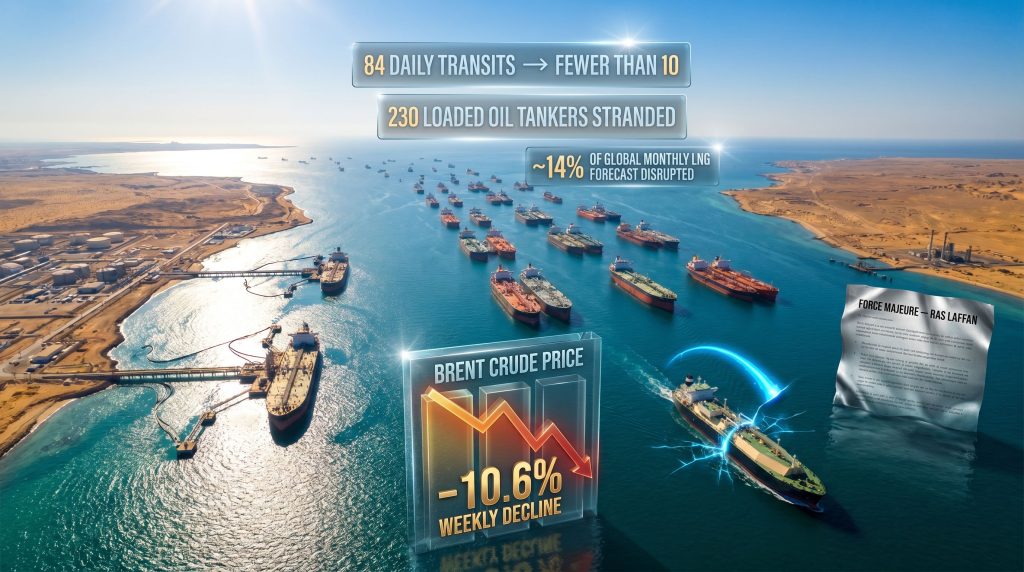
The operational severity of the current disruption is best understood through shipping traffic data rather than political statements. Daily vessel crossings through the strait fell by approximately 90% from the 2026 baseline of 84 transits per day, dropping to fewer than 10 daily passages during the peak escalation period.
This collapse was driven by three converging forces:
- Iran issued explicit warnings to commercial shipping against entering the strait, creating conditions equivalent to a de facto exclusion zone for vessels without military escort capability.
- Marine war risk insurance markets responded with near-total withdrawal of coverage for Gulf-transiting vessels, making commercial transit economically unviable even when physically possible.
- Attacks on a container ship and an oil tanker within days of each other destroyed operator confidence and triggered fleet-wide operational pauses.
The result was a tanker stranding crisis of substantial scale. An estimated 230 loaded oil tankers became trapped inside the Persian Gulf, unable to complete deliveries to Asian customers. Simultaneously, more than 25 ballast vessels accumulated southeast of Oman, positioned outside the strait and waiting for conditions to permit safe entry.
"The tanker stranding crisis creates a form of invisible supply destruction that does not appear in production statistics. Barrels that have been extracted, loaded, and paid for still fail to reach buyers, creating demand shortfalls at destination ports that are structurally similar in their economic effect to outright supply cuts."
Middle East Oil and LNG Loadings Continue Despite Ship Attacks
Against this backdrop, the most significant development in the current crisis is not the attacks themselves, but what Gulf producers have chosen to do in response: keep loading.
VLCC Activity at Ras Tanura and UAE Terminals
Shipping data confirmed that four Very Large Crude Carriers (VLCCs) were actively loading at Saudi Arabia's Ras Tanura terminal, one of the world's largest crude oil export facilities. Each VLCC is capable of carrying approximately 2 million barrels of crude oil, meaning the four vessels represented a combined cargo of up to 8 million barrels in active preparation for delivery.
Three of these supertankers loaded and subsequently went dark after departing the terminal over the weekend, with their Automatic Identification System (AIS) transponders switched off. One of these vessels successfully exited the strait and was later tracked heading toward Japan, providing confirmation that transit was achievable under operational security protocols.
Separately, two additional VLCCs entered the strait and docked at a UAE terminal to take on crude cargoes, according to LSEG shipping data. This simultaneous activity across Saudi and UAE facilities signals a coordinated export effort rather than isolated opportunistic loading.
The AIS Transponder Suppression Tactic: What Does It Mean for Market Intelligence?
The widespread adoption of transponder suppression by Gulf-transiting tankers creates a structural problem for commodity market participants that extends well beyond the current crisis period. When vessels go dark, they disappear from the commercial AIS tracking systems that traders, analysts, and port planners rely on for real-time supply flow monitoring.
The practical consequences include:
- Commodity flow data becomes unreliable or incomplete for periods of days to weeks
- Insurance underwriters lose the vessel position data they require to price risk accurately
- Destination port operators cannot plan berth availability or crew readiness with confidence
- Market price discovery becomes partially decoupled from actual physical supply conditions
The intelligence gap created by systematic transponder suppression means that satellite imaging and port-side intelligence gathering are increasingly essential tools for anyone attempting to track actual throughput volumes through the strait. This represents a structural shift in how energy commodity flows are monitored during geopolitical crises.
Qatar and UAE LNG Exports: Force Majeure and Continued Operations
The LNG dimension of the current crisis carries its own distinct risk architecture. Qatar's Ras Laffan complex, the world's second-largest LNG export facility with approximately 77 million tonnes per annum (mtpa) of production capacity, declared force majeure following Iranian strikes on the facility. The UAE's LNG capacity of approximately 5.8 mtpa was similarly affected by the broader disruption environment.
| Metric | Volume |
|---|---|
| Qatar LNG capacity at risk | ~77 mtpa |
| UAE LNG capacity at risk | ~5.8 mtpa |
| Estimated LNG removed from global supply (single month) | ~5.8 million tonnes |
| Share of global monthly LNG forecast disrupted | ~14% |
| Middle Eastern LNG as share of global supply | ~20% |
Despite this, LNG loadings continued at both Ras Laffan and the UAE's Das Island facility. Shipping data confirmed that the ADNOC-controlled vessel Mraweh, having loaded at Das Island on June 21, was scheduled to deliver its cargo to India's Dahej terminal on July 5. A QatarEnergy-controlled carrier loaded at Ras Laffan on June 18 was scheduled to reach China on July 3, according to LSEG and Kpler data.
Qatar also confirmed that LNG production recovery was anticipated within the coming weeks, suggesting the facility's long-term capacity is not permanently impaired, even as near-term output disruptions removed material volumes from global supply.
Iran's Strategic Paradox: Accelerating Its Own Exports During the Crisis
One of the least reported dimensions of the current Hormuz crisis is the behaviour of Iran itself. While issuing warnings to third-party commercial shipping, Iran simultaneously accelerated its own crude oil export loadings during the same period. Tehran loaded at both export terminals at Kharg Island on the same Saturday that attacks on other vessels were reported, marking the first time both terminals had operated concurrently in nearly a week.
This acceleration was enabled by Washington's decision to waive sanctions on Iranian oil exports for a 60-day period, providing Tehran with both the commercial incentive and diplomatic cover to maximise revenue generation during the crisis window. The strategic implication is significant: Iran was simultaneously the source of the threat to international shipping and a beneficiary of the disruption's effect on global oil prices. Such contradictions are central to understanding the oil market disruptions that geopolitical instability routinely generates.
Oil Price Dynamics: The Paradox of Falling Prices Amid Active Attacks
Brent crude recorded a 10.6% weekly decline during the week prior to the latest reporting period, its third consecutive weekly drop, even as shipping attacks continued. This price trajectory puzzles many observers but reflects a specific market logic. The crude oil price trends emerging across 2025 had already established a pattern of disconnection between headline geopolitical risk and actual price direction.
The market is simultaneously pricing two competing forces:
- Supply recovery signal: Rising export volumes from Saudi Arabia, the UAE, and Iran collectively suggest that the physical supply disruption is manageable and temporary.
- Geopolitical risk premium: The continued threat of attacks and the fragility of the U.S.-Iran ceasefire framework creates an unresolved tail risk that, if it materialised, would cause rapid repricing.
IG Markets analyst Tony Sycamore articulated the market's binary pricing dilemma clearly, noting that "if the strait continues with an uneven reopening over the weeks and months ahead, then crude oil at current levels is reasonably priced with a downward bias. However, if weekend flare-ups lead to the conflict reigniting more broadly, then crude oil prices at current levels are significantly undervalued relative to the risk exposure." (Source: Reuters, via Zawya, June 29, 2026)
Investment Note: The current price environment reflects optimistic scenario pricing. Investors and energy buyers should treat the current Brent price level as carrying substantial embedded tail risk that is not yet reflected in the headline number. A single high-profile infrastructure strike could compress weeks of market re-pricing into a matter of hours.
The recent oil price rally driven by tariff expectations earlier in 2025 further illustrates how quickly sentiment-driven moves can reverse when supply-side realities reassert themselves. Furthermore, OPEC's market influence adds another layer of complexity, as any coordinated production response to the crisis would significantly alter the supply-demand calculus underpinning current price levels.
Asian Energy Security: Differential Vulnerability Across Import Markets
Approximately 84% of blocked energy flows through the strait were destined for Asian import markets. The vulnerability profile varies significantly across the major importing nations:
| Country | Primary Exposure | Alternative Supply Options | Vulnerability Rating |
|---|---|---|---|
| China | Crude oil (Middle East ~45% of imports) | Russia, West Africa, domestic SPR | Moderate-High |
| India | Crude oil + LNG (Gulf ~60% of imports) | U.S. LNG, domestic coal | High |
| Japan | LNG (Qatar ~10% of total supply) | U.S. LNG, Australian LNG | Moderate |
| South Korea | LNG + refined products | Australian LNG, spot market | Moderate |
India faces the most acute near-term exposure given its geographic proximity to the Gulf and the limited availability of alternative pipeline infrastructure. Its heavy dependence on Gulf crude and LNG, combined with relatively modest strategic petroleum reserve capacity compared to China, leaves Indian refiners and utilities particularly vulnerable to sustained supply delays.
China's strategic petroleum reserve provides a meaningful buffer, however analysts estimate it can substitute for sustained supply disruption for a maximum of approximately 60 to 90 days before demand destruction effects begin to emerge in industrial output data.
The next major ASX story will hit our subscribers first
The Force Majeure Cascade: The Underreported Financial Risk
The contractual consequences of Qatar's force majeure declaration represent a dimension of the crisis that will outlast the physical disruption by years. Force majeure clauses in long-term LNG supply agreements relieve the seller of delivery obligations under extraordinary circumstances, but they simultaneously create cascading uncertainty for buyers who have structured their energy procurement, hedging positions, and downstream contracts around guaranteed supply volumes.
The downstream consequences of the force majeure cascade include:
- Asian utilities that had pre-sold forward power contracts based on LNG availability face potential contract breaches of their own
- Industrial gas buyers with interruptible supply contracts will find those interruptions triggered, forcing emergency spot market procurement at elevated prices
- Long-term supply agreement renegotiations will likely include enhanced force majeure provisions and geographic diversification requirements, structurally reducing Qatar's market share over the medium term
The IMF has noted that energy and commodity price normalisation will require extended time even after a formal U.S.-Iran agreement is concluded, a recognition that the financial and contractual aftershocks of the crisis will persist long after the strait's physical reopening. Wood Mackenzie's analysis similarly highlights that Middle East conflict is set to drive oil and LNG prices significantly higher over the medium term, reinforcing the view that contractual and financial risks extend well beyond the immediate disruption window.
The 90-Day Scenario Framework: Three Paths Forward
Scenario 1: Diplomatic Stabilisation
Gradual restoration of transit volumes over 3 to 4 weeks, with LNG flows recovering within 6 to 8 weeks. Brent settles into a lower price band as supply restoration outpaces demand recovery. Insurance markets re-engage at elevated but workable premiums.
Scenario 2: Persistent Low-Level Conflict
Sporadic attacks continue despite ceasefire frameworks. Producers maintain loadings using transponder suppression and naval escort protocols. Markets price in a sustained 10 to 15% risk premium on Gulf-origin crude and LNG. Asian buyers accelerate diversification toward Australian, U.S., and East African supply sources.
Scenario 3: Full Escalation and Extended Closure
A major infrastructure strike triggers complete transit suspension. Global LNG spot prices spike 40 to 60% within weeks. Asian industrial demand destruction begins within 30 to 45 days. Emergency IEA coordinated stock releases are activated alongside U.S. strategic petroleum reserve drawdowns.
Disclaimer: The scenario projections above represent analytical frameworks for risk assessment purposes only. They do not constitute financial advice, price forecasts, or investment recommendations. Energy market conditions are subject to rapid change based on geopolitical developments that are inherently unpredictable.
What the Continued Loadings Actually Signal
The persistence of Middle East oil and LNG loadings despite Strait of Hormuz ship attacks communicates something important about the structural incentives governing Gulf producer behaviour. For Saudi Aramco, ADNOC, and QatarEnergy, the commercial cost of halting exports even temporarily is severe. Sovereign budget dependencies on hydrocarbon revenues, contractual delivery obligations to Asian and European buyers, and the reputational premium attached to supply reliability all create powerful incentives to keep loading regardless of the security environment.
The continued loadings also serve a geopolitical signalling function. Maintaining export operations under active attack conditions communicates operational resilience to global energy markets, helps contain the risk premium embedded in oil prices, and reinforces the message that Gulf producers are not yielding to coercive pressure.
What the current situation reveals most clearly is that the Strait of Hormuz crisis is not a binary open-or-closed event. It is a graduated, dynamic disruption in which operational continuity and security threats coexist simultaneously, and in which the gap between headline risk and actual commodity flow is wider than most market participants appreciate.
For ongoing coverage of Middle East energy flows and Gulf oil and gas market developments, Zawya's Energy section at zawya.com provides continuous reporting across the region's hydrocarbon sector.
Want to Track the Next Major Commodity Discovery Before the Market Does?
Discovery Alert's proprietary Discovery IQ model scans ASX announcements in real time, instantly converting complex mineral data across more than 30 commodities into clear, actionable insights — so subscribers can identify high-potential opportunities the moment they emerge. Explore how historic discoveries have generated substantial returns on Discovery Alert's dedicated discoveries page, and begin your 14-day free trial today to secure a market-leading edge.