June 29, 2026
The Hidden Architecture of a Chokepoint: How Global Oil Flows Through One Narrow Gate
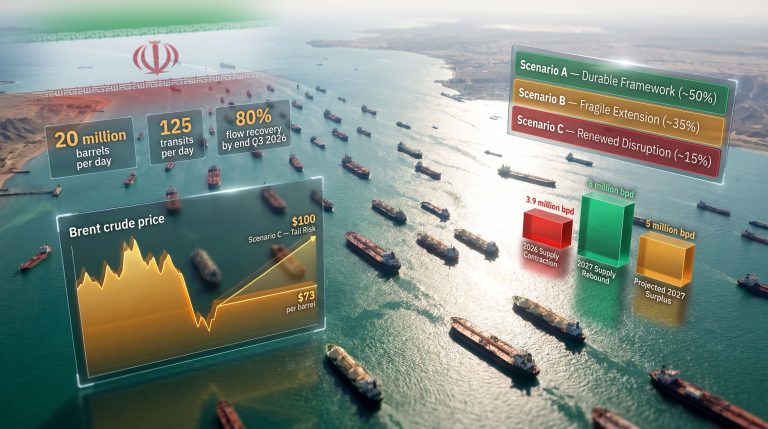
Most commodity markets can absorb regional disruptions through rerouting, substitution, or inventory drawdowns. Oil markets, by contrast, carry a structural vulnerability that has no clean fix: a single maritime corridor roughly 33 kilometres wide at its narrowest point, through which approximately 20% of the world's daily global oil supply must pass. When that corridor becomes contested, no spreadsheet model, strategic reserve, or pipeline workaround fully compensates for what is lost.
That vulnerability moved from theoretical to operational in late February 2026, when US-Israeli military operations against Iran effectively froze normal shipping through the Strait of Hormuz. What followed has been the most sustained closure of this waterway in recorded history, surpassing even the disruptions of the Iran-Iraq War during the 1980s in both duration and downstream economic consequence. Understanding the current state of oil prices and Strait of Hormuz strikes requires looking beyond individual strike events and examining the structural mechanics of why this crisis is so difficult to resolve quickly.
When big ASX news breaks, our subscribers know first
Why the Strait Has No Real Substitute
The geography of Persian Gulf oil exports creates a dependency that alternative infrastructure cannot fully offset. Two partial bypass options exist in theory:
- Saudi Arabia's East-West Pipeline, which carries crude across the Arabian Peninsula to Red Sea terminals
- The UAE's Habshan-Fujairah pipeline, which provides an outlet to the Gulf of Oman without transiting the strait
In practice, however, neither route comes close to matching the volume that ordinarily flows through Hormuz daily. Combined, these pipelines represent a fraction of normal strait capacity. The remaining option, rerouting tankers around Africa's Cape of Good Hope, adds roughly two to three weeks of sailing time per voyage and substantially increases operational costs, fuel consumption, and shipping insurance premiums.
These are not marginal inconveniences; they translate directly into elevated landed costs for crude, particularly for Asian refiners who are most exposed to Middle Eastern supply. Furthermore, crude oil price trends show that even partial supply disruptions in this region have historically produced outsized movements in global benchmarks.
The structural consequence is straightforward: every geopolitical development in or around the strait carries an outsized market signal. A single ship attack, a statement from Iranian military command, or a contradictory US Central Command briefing can move futures prices by percentages that no equivalent incident elsewhere in the world would produce. According to Brookings Institution analysis, the strait's role as a chokepoint makes it uniquely vulnerable to both physical and political disruption.
Mapping the Price Cycle: Three Distinct Phases
The oil price trajectory from late February 2026 to the end of June 2026 illustrates a pattern that energy economists call a conflict price cycle, where escalation, diplomatic signalling, and renewed instability each produce their own distinct market response.
| Phase | Period | Key Trigger | Brent Price Range |
|---|---|---|---|
| Escalation Surge | Late Feb to Mid-May 2026 | Strait closure; US Central Command strikes | Up to ~$95.20/barrel |
| De-escalation Collapse | Mid-May to Late June 2026 | Shipping recovery; interim peace deal signals | Fell 10.6%; third consecutive weekly decline |
| Renewed Instability | Late June 2026 | Qatar-linked tanker attack; fresh strikes | Rose to $72.44/barrel (+0.6%) |
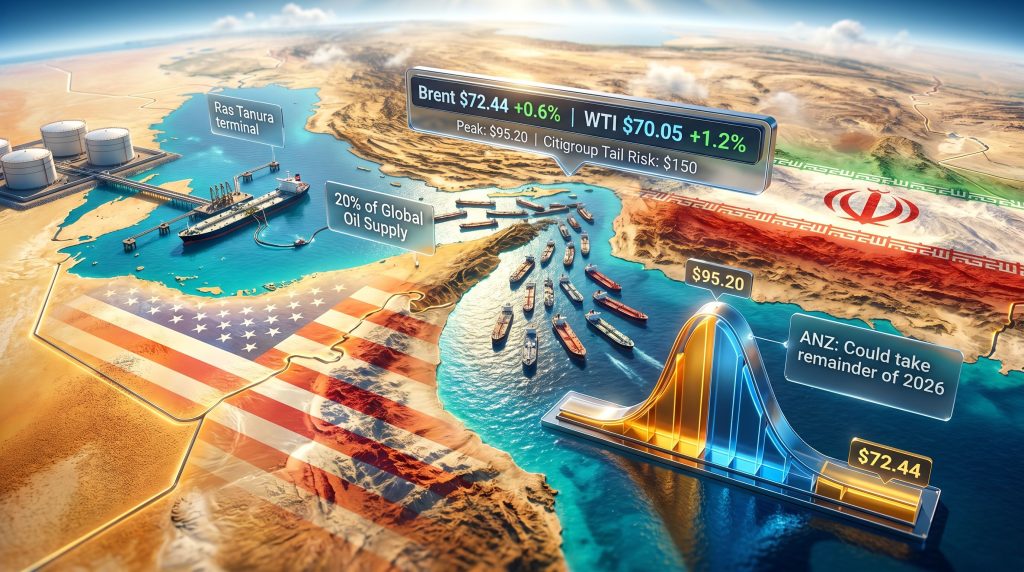
At peak conflict intensity, Brent crude reached approximately $95.20 per barrel and WTI climbed to around $92.30 per barrel, driven by Iran's Joint Military Command announcing a full closure of the strait and US Central Command conducting strikes on Iranian air defence and surveillance infrastructure near the waterway. Monitoring WTI and Brent futures during this period revealed the sheer speed at which geopolitical shocks transmit into benchmark pricing.
The sharpest reversal came when diplomatic back-channels signalled a potential negotiated pause. A planned US strike wave was cancelled to allow negotiations to proceed, and Brent tumbled more than 10% from its May 2026 peak, recording its third consecutive weekly loss by late June as crude shipments through the strait reached their highest volumes since hostilities began. That recovery proved fragile.
By Thursday of the same week, renewed attacks on vessels transiting the strait, including an incident involving a Qatar-linked tanker, triggered fresh military exchanges and sent prices climbing again. As reported by Reuters, Iran's announcement of the strait closure following US strikes sent oil prices up more than 2% in a single session. As of 29 June 2026, Brent traded at $72.44 per barrel, up 0.6%, while WTI reached $70.05 per barrel, a gain of approximately 1.2%.
The Complacency Problem: What Markets May Be Getting Wrong
ING analysts published a note on 29 June 2026 observing that market participants appeared to be concentrating on what a continued recovery in oil flows would mean for the global supply balance, rather than pricing in the genuine fragility of that recovery. The note described this stance as unusual, and highlighted that it creates meaningful upside risk to oil prices if the supply recovery proceeds more slowly than assumed.
This observation points to a recurring pattern in geopolitical commodity markets: the tendency of participants to price in resolution scenarios before those scenarios have been confirmed by physical data. When diplomatic language is available, traders often front-run the supply normalisation that would follow a genuine deal, even when the operational pathway to that normalisation involves months of logistical untangling.
ANZ Research analysts reinforced this concern in their own note from the same period, pointing out that physical flows remain constrained by multiple simultaneous bottlenecks:
- Tanker backlogs accumulated over months of restricted access
- Infrastructure damage at port and terminal facilities sustained during the conflict period
- Production shut-ins across upstream operations that cannot be reversed instantaneously
- Safety, maintenance, and regulatory clearance processes required before restarting complex export infrastructure
ANZ's conclusion was that it could take until the end of 2026 before Persian Gulf supply approaches pre-conflict levels, a timeline that sits well beyond what current futures pricing appears to reflect.
Ras Tanura: The Terminal That Signals Saudi Intent
One of the most concrete signals of producer intent to restore output came from Saudi Aramco's Ras Tanura terminal on the western shore of the Persian Gulf. Ras Tanura is among the world's largest crude export terminals by throughput volume, and its suspension for nearly four months represented one of the more dramatic upstream shutdowns in the history of global oil markets.
The resumption of crude loadings at Ras Tanura on Friday, 27 June 2026, was interpreted by markets as a direct indicator of Saudi Arabia's intention to ramp up exports ahead of any permanent resolution to the strait dispute. Critically, Ras Tanura sits west of the Strait of Hormuz itself, meaning its operational status depends on broader regional security conditions rather than specific transit rights through the narrowest point of the waterway.
Terminal throughput capacity must be matched by available tanker capacity and unobstructed strait access to translate into genuine global supply normalisation. Ras Tanura restarting is a necessary step, but not a sufficient one.
On Sunday, 29 June 2026, an Aramco helicopter crashed at the Ras Tanura facility, killing 14 nationals. The cause of the incident was not immediately determined. Crude oil loadings continued despite the crash, suggesting operational continuity was maintained, though the incident introduced an additional layer of uncertainty into an already fragile market environment.
Iran's Strategic Leverage: The IRGC's Role in Strait Access
A dimension of this crisis that receives less attention in mainstream market commentary is the operational reality of how Iran maintains leverage over strait access even during ostensible ceasefire conditions. Strategic analysts have noted that the Islamic Revolutionary Guard Corps effectively retains control over transit permissions through the waterway, with shipping companies reported to have been required to seek IRGC clearance for safe passage, a system that functions as a de facto toll arrangement on global energy flows.
This creates a specific form of information asymmetry that is difficult for markets to price accurately. US Central Command has stated publicly that commercial vessels continue to transit the strait without interference, while Iranian state media has maintained that the waterway remains under restricted access. When two authoritative sources make contradictory claims about the same physical corridor, traders cannot rely on either account to make confident positioning decisions.
The interim peace deal agreed on 29 June 2026, in which both the US and Iran committed to halting recent hostilities and resuming talks about their oil prices and Strait of Hormuz dispute, has not resolved this ambiguity. The Qatar-linked tanker attack and the subsequent military exchanges occurred after the deal was signed, suggesting that its enforcement mechanisms are either absent or non-binding on all relevant actors.
The IMF noted publicly in late June 2026 that energy and commodity prices would require time to normalise following the interim agreement, an institutional acknowledgment that the disruption's effects are structural rather than immediately reversible. In addition, OPEC market influence during this period has been complex, as member states navigate the competing pressures of capitalising on elevated prices and restoring production credibility.
The next major ASX story will hit our subscribers first
Second-Order Effects: How the Conflict Reshapes Global Supply Chains
The impact of disrupted Hormuz transit extends considerably beyond the spot price of crude. Several second-order effects are reshaping global energy supply chains in ways that will persist even after strait access is formally restored:
- War risk insurance premiums on tanker operations in the Persian Gulf region have risen sharply, increasing the effective landed cost of Gulf crude independent of the commodity price itself
- Asian refinery feedstock shortages have forced facilities in China, Japan, South Korea, and India to source alternative crude grades at a premium, with knock-on effects on refined product availability and margins
- OPEC+ production strategy has become more complex, with members facing divergent incentives between capitalising on elevated prices and managing infrastructure constraints
- Strategic petroleum reserve drawdowns by major consuming nations have provided a short-term buffer but are finite, and replenishment will add demand pressure to markets during the normalisation phase
- LNG market spillovers have intensified competition for flexible cargoes, with Qatar's position as a major LNG exporter creating additional exposure to the same regional instability affecting its oil tanker traffic
Consequently, the LNG supply implications of this crisis extend far beyond the Persian Gulf itself, reshaping how buyers and sellers across Asia and Europe approach long-term energy security planning.
China's response to this volatility has been notable. Reports from 29 June 2026 indicate that Chinese authorities have accelerated plans to establish sulphur futures markets, directly in response to the price volatility amplified by the Iran-related conflict. This suggests that Asian commodity markets are adapting structurally to the risk of repeated Middle Eastern disruptions rather than treating the current episode as a one-off event. Furthermore, the broader oil market disruption caused by geopolitical tensions has compounded pre-existing trade flow pressures across global energy systems.
Scenario Modelling: What Could Oil Prices Do From Here?
| Scenario | Conditions | Brent Estimate |
|---|---|---|
| Base Case: Gradual Recovery | Talks continue; strait partially open; backlog clears over 3-6 months | $65-$78/barrel |
| Upside Risk: Renewed Supply Shock | Negotiations collapse; fresh strikes resume | $95-$110/barrel |
| Extreme Tail Risk: Full Closure | Sustained blockade; no diplomatic resolution | Up to $150/barrel |
| Downside Risk: Rapid Comprehensive Deal | Full agreement; Aramco and OPEC+ ramp-up | $58-$65/barrel |
The $150 per barrel tail-risk scenario has been modelled by Citigroup as a stress case for a sustained full closure. While this outcome is not the base case, its mere existence as a plausible scenario influences how energy-exposed companies, airlines, utilities, and central banks approach their hedging and planning assumptions. The oil prices and Strait of Hormuz strikes dynamic means that even incremental escalations carry consequences well beyond their immediate operational impact.
Key Variables Determining the Recovery Trajectory
Investors and energy market participants monitoring this situation should track the following indicators in the weeks ahead:
- Independent strait transit volume data from tanker tracking services, which will provide the most reliable real-time picture of actual flow recovery
- Formal ceasefire framework details, specifically whether any binding enforcement mechanism exists and which parties have agreed to it
- Ras Tanura loading schedules and VLCC bookings, which will signal Saudi Arabia's production ramp-up intentions
- OPEC+ production ceiling decisions, which may be adjusted in response to recovering Persian Gulf supply
- Tanker war risk insurance premium trajectories, where declining premiums would confirm genuine market confidence in sustained strait access
- IMF and IEA demand forecast revisions, which will shape medium-term price expectations as the extent of demand destruction from elevated prices becomes clearer
Disclaimer: This article contains forward-looking statements, price scenario modelling, and analyst projections that are inherently uncertain. Oil market conditions are subject to rapid change based on geopolitical, diplomatic, and operational developments. Nothing in this article constitutes financial or investment advice. Readers should consult qualified financial professionals before making any investment decisions.
Want to Stay Ahead of the Next Major Commodity Discovery?
While geopolitical shocks like the Strait of Hormuz crisis reshape global energy markets, Discovery Alert's proprietary Discovery IQ model scans ASX announcements in real time, delivering instant alerts on significant mineral discoveries across more than 30 commodities — explore the historic returns major discoveries have generated and begin your 14-day free trial to position yourself ahead of the broader market.