June 29, 2026
The Economics of Value Chain Sovereignty: Why Downstream Aluminium Manufacturing Is Africa's Next Industrial Frontier
Across the global commodities landscape, a quiet but consequential shift is accelerating. Resource-rich nations that spent decades supplying raw materials to industrialised economies are increasingly questioning the mathematics of that arrangement. When a country exports unprocessed bauxite, it captures perhaps 5 to 10 percent of the total value that ore will eventually generate as a finished aluminium product. The remainder flows to refiners, smelters, rolling mills, and fabricators located elsewhere. For economists, this is not merely inefficiency — it is structural wealth transfer embedded in trade policy.
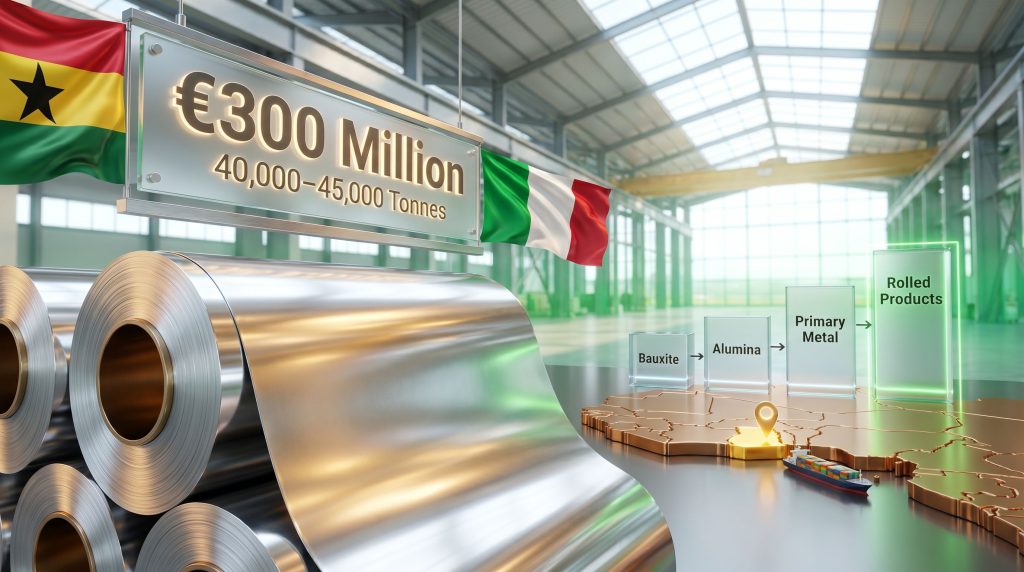
Ghana's latest move in the aluminium sector reflects a deliberate attempt to rewrite that equation. The Ghana Danieli aluminium deal, formalised through a Memorandum of Understanding between the Ghana Integrated Aluminium Development Corporation (GIADEC) and Italian engineering firm Danieli & C. Officine Meccaniche S.p.A., represents one of the most ambitious downstream manufacturing commitments West Africa has seen in the aluminium sector. At approximately €300 million, it is not simply an infrastructure investment — it is a statement about where Ghana intends to position itself in the global industrial order.
When big ASX news breaks, our subscribers know first
Understanding the Value Chain Gap Ghana Is Trying to Close
To appreciate the strategic weight of this agreement, it helps to understand how the aluminium value chain actually works. Bauxite ore is mined and refined into alumina. Alumina is smelted into primary aluminium ingot. That ingot is then processed through rolling mills into sheet, foil, and a wide range of fabricated products. Each transformation stage adds margin, complexity, and economic value.
Ghana has historically operated near the base of this pyramid. The country holds meaningful bauxite reserves and has maintained primary smelting capacity through the Volta Aluminium Company (VALCO), but the downstream conversion stages have remained largely absent. Consequently, Ghana's aluminium-related export earnings have not reflected the true industrial potential of its resource base.
The concept economists sometimes call value chain leakage captures this dynamic precisely. When bauxite leaves Ghana as ore and returns as packaging foil or pharmaceutical blister packs, the manufacturing margin, the employment, and the technical knowledge that generated it were all created somewhere else. The GIADEC-Danieli agreement is a direct institutional response to that leakage.
How Do Peer Economies Compare?
Peer comparisons are instructive. Indonesia effectively banned raw nickel ore exports to force domestic processing investment — a strategy that attracted billions in downstream smelting capital despite initial trade friction. Guinea, despite holding the world's largest bauxite reserves, remains predominantly an extraction economy with minimal downstream conversion. Furthermore, Australia's experience demonstrates that resource wealth alone does not guarantee industrial diversification without deliberate policy architecture.
This broader resource industrialisation trend is reshaping how emerging economies engage with global supply chains. Ghana is attempting to learn from all three trajectories simultaneously.
What the Ghana Danieli Aluminium Deal Actually Involves
The agreement centres on the development of an aluminium sheet and foil rolling facility to be located within the Tema Integrated Industrial Park, positioned in the Tema Heavy Industrial Zone. The investment quantum is approximately €300 million, with projected annual output targeting 40,000 to 45,000 tonnes of value-added aluminium products spanning ten distinct product categories.
Deal Parameters at a Glance
Parameter Detail Agreement Type Memorandum of Understanding (MoU) Investment Value ~€300 million Technology and Investment Partner Danieli & C. Officine Meccaniche S.p.A. (Italy) Ghanaian Counterpart Ghana Integrated Aluminium Development Corporation (GIADEC) Facility Type Aluminium sheet and foil rolling plant Projected Annual Output 40,000 to 45,000 tonnes Product Categories 10 categories across packaging, pharma, food processing, catering, and industrial use Location Tema Heavy Industrial Zone / Tema Integrated Industrial Park Co-Development Partners ARISE IIP and Tema Development Corporation (TDC) Ltd.
It is important to note that this agreement remains at MoU stage. An MoU establishes a framework for cooperation and expresses investment intent but does not constitute a binding construction or financing contract. Advancing to ground-breaking will require subsequent development agreements, confirmed financing arrangements, and the resolution of enabling infrastructure requirements. GIADEC's official signing documentation provides further detail on the terms of the arrangement.
The facility's output is designed to serve industries with strong and growing demand profiles:
- Packaging including flexible packaging films and container foil
- Pharmaceuticals covering blister pack foil and medical-grade barrier materials
- Food processing applications including food-grade wrapping and container products
- Catering and hospitality using commercial foil products at scale
- Industrial manufacturing requiring technical sheet products
A critical but often overlooked economic insight here: aluminium foil and sheet products command dramatically higher per-tonne prices than primary aluminium ingot. The price premium for finished rolled product over commodity ingot can range from 40 to over 100 percent depending on specification and end-market, meaning the margin expansion opportunity from this single processing step is substantial.
The Tema Location: Industrial Geography as Competitive Advantage
Site selection in industrial manufacturing is rarely incidental. The choice of the Tema Heavy Industrial Zone carries specific strategic logic that deserves examination.
Tema is Ghana's principal commercial port city, located approximately 25 kilometres east of Accra. The Tema Port handles the bulk of Ghana's containerised trade. For an export-oriented rolling facility targeting regional and international markets, port-adjacent positioning materially reduces logistics costs and transit time — both of which are critical competitiveness variables in the aluminium products sector where margins are sensitive to freight differentials.
The location also provides proximity to VALCO, Ghana's existing primary aluminium smelter. This geographic alignment between upstream smelting and downstream rolling creates the possibility of an integrated production corridor, where primary metal moves directly into the rolling facility rather than being exported as ingot and re-imported as semi-fabricated product.
ARISE Integrated Industrial Platforms (ARISE IIP) brings established experience developing industrial zones across sub-Saharan Africa, including in Gabon and Togo. Their involvement alongside the Tema Development Corporation (TDC) Ltd. signals a serious commitment to industrial infrastructure quality, though the timeline for full infrastructure readiness will be a key variable to monitor.
The Centre of Excellence: Technology Transfer as a Long-Term Asset
Beyond the rolling facility itself, the agreement includes provisions for a Centre of Excellence dedicated to aluminium processing, research, innovation, skills development, and technology transfer. This component is arguably as strategically important as the production infrastructure.
Advanced aluminium rolling requires specialised metallurgical knowledge, precision process control, and a technically trained workforce. These capabilities do not exist in abundance across West Africa currently. Without deliberate capability-building, a rolling facility can become operationally dependent on expatriate technical staff indefinitely, which constrains long-term productivity and increases operational cost structures.
The Centre of Excellence model addresses this constraint by:
- Establishing formal training pathways for Ghanaian engineers and technicians in aluminium metallurgy and rolling technology
- Creating a research infrastructure capable of supporting product development and process optimisation
- Building institutional knowledge that remains in-country even as equipment suppliers and technology partners rotate
- Positioning Ghana as a potential regional training hub for West African aluminium manufacturing talent over a medium-term horizon
This skills infrastructure dimension is what separates the GIADEC-Danieli model from a purely transactional FDI arrangement. Technology transfer provisions, when genuinely implemented, create compounding industrial returns that outlast the initial capital investment cycle. This mirrors the green metals industrial shift occurring across other resource sectors, where long-term capability building is becoming central to investment strategy.
Danieli's Role: Why the Technology Partner Choice Matters
Danieli & C. Officine Meccaniche S.p.A. is headquartered in Buttrio, Italy, and ranks among the world's leading suppliers of plant and technology solutions for the metals industry. The company designs and builds rolling mills, casting equipment, heat treatment lines, and related systems for steel, aluminium, and non-ferrous metals producers globally.
For a downstream aluminium rolling facility targeting pharmaceutical-grade foil and precision packaging materials, technology partner quality directly determines product quality. Pharmaceutical blister pack foil, for instance, requires extremely tight thickness tolerances, surface quality standards, and alloy consistency that only advanced rolling mill technology can reliably deliver. Danieli's aluminium and non-ferrous metals capabilities make them a credible partner for achieving these product specifications from a greenfield start.
The Italian Ambassador to Ghana, Laura Ranalli, characterised the agreement as evidence of deepening bilateral industrial cooperation between Italy and Ghana. This framing places the deal within a broader context of European industrial partnership with African manufacturing development — a trend that has been gaining momentum as both sides seek supply chain diversification and industrial capacity expansion.
The next major ASX story will hit our subscribers first
Ghana's Position in West Africa's Aluminium Landscape
A regional comparison makes Ghana's strategic differentiation visible.
| Country | Primary Value Chain Stage | Key Infrastructure | Strategic Positioning |
|---|---|---|---|
| Ghana | Bauxite to primary (VALCO) to downstream (planned) | Tema Port, VALCO smelter, Tema Industrial Zone | Integrated value chain development in progress |
| Guinea | Bauxite extraction dominant | Limited downstream infrastructure | Primary commodity export economy |
| Cameroon | Primary aluminium via ALUCAM | Edéa smelter | Partial integration, minimal downstream |
| Nigeria | Negligible primary production | Underdeveloped industrial base | Largely import-dependent |
Ghana's combination of existing smelting capacity, port infrastructure, industrial zone development, and now a committed downstream rolling investment creates a structurally differentiated position that no other West African economy currently replicates. The first-mover advantage implications are material. Furthermore, understanding how top aluminium producers globally structure their value chains provides useful context for assessing Ghana's positioning ambitions.
Critical Risk Variables: What Could Determine Project Outcomes
An honest assessment of this investment requires direct engagement with the enabling conditions that will determine whether the project achieves its targets or faces the multi-year delays that have historically affected large-scale African industrial projects.
Strategic Risk Assessment
Success Factor Current Status Risk Level Reliable Power Supply Historical grid reliability challenges documented High Logistics Efficiency Port proximity is an advantage; inland links require development Medium Skilled Labour Availability Centre of Excellence partially addresses this gap Medium Sustained Market Demand Regional rolled aluminium demand trajectory is positive Low to Medium MoU to Financial Close Requires subsequent binding agreements and financing Medium to High
Power supply is the single most critical variable. Aluminium rolling is an energy-intensive process, and rolling mill operations are sensitive to voltage fluctuation and supply interruption in ways that many other manufacturing categories are not. Ghana has experienced periods of electricity supply constraint, and securing dedicated or preferential power arrangements for the Tema facility will be a non-negotiable prerequisite for commercially viable operations.
Logistics completeness beyond port access also requires attention. Pharmaceutical-grade foil in particular demands specialised storage, quality-controlled handling, and reliable cold-chain packaging logistics — infrastructure requirements that extend well beyond the rolling facility boundary itself.
The MoU-to-execution gap is a well-documented feature of major industrial investment announcements globally. Financing structures, power contracts, logistics agreements, and workforce planning all require resolution before physical development begins. In addition, aluminium tariff impacts from shifting global trade policy add an external variable that project planners will need to monitor carefully.
Three Scenarios for How This Investment Could Unfold
Given the complexity of enabling conditions involved, scenario planning provides a useful framework for understanding the range of possible outcomes.
Scenario 1: Full Execution
Ghana achieves stable power supply, logistics infrastructure matures on schedule, and the Centre of Excellence successfully builds local technical capability. The rolling facility reaches its 40,000 to 45,000 tonne annual output target, generating export revenues, creating skilled employment, and stimulating upstream demand for Ghanaian primary aluminium. Ghana emerges as the dominant regional supplier of rolled aluminium products.
Scenario 2: Partial Execution
The rolling facility reaches operational status but the Centre of Excellence development lags. Technology transfer occurs more slowly than planned, operational dependency on expatriate technical expertise persists in the near term, and output targets are achieved but with higher operating cost structures. This remains a meaningfully positive outcome for Ghana's industrial economy.
Scenario 3: Execution Delays
Infrastructure constraints — particularly power supply uncertainty or financing gaps — push construction commencement timelines out by two to four years. The first-mover advantage window narrows as peer economies accelerate their own downstream ambitions. The project eventually proceeds but at reduced strategic impact relative to the original timeline.
Disclaimer: The scenario analysis presented above is speculative and intended for informational and analytical purposes only. It does not constitute investment advice, and actual project outcomes will depend on a wide range of variables that cannot be predicted with certainty.
Frequently Asked Questions
What exactly is the Ghana Danieli aluminium deal?
The Ghana Danieli aluminium deal refers to a €300 million Memorandum of Understanding signed between GIADEC and Danieli & C. Officine Meccaniche S.p.A. of Italy, covering the development of an aluminium sheet and foil rolling facility at the Tema Integrated Industrial Park in Ghana, with projected annual production capacity of 40,000 to 45,000 tonnes across ten product categories.
Who is Danieli and what expertise do they contribute?
Danieli is an Italian metals engineering and plant technology company recognised globally for designing and building rolling mills and related metals processing infrastructure. In this project, they serve as both the technology provider and a capital investor in the rolling facility.
Is this deal legally binding?
The current agreement is an MoU, which establishes cooperative intent and a framework for development rather than constituting a finalised binding contract. Further agreements covering financing, construction, and operations will be required to advance the project.
What economic benefits could the project deliver for Ghana?
Potential benefits include significant value addition over raw bauxite export, direct and indirect employment creation, technology transfer and skills development, export revenue diversification, and upstream demand stimulus for Ghana's existing primary aluminium production infrastructure at VALCO.
How does this fit Ghana's broader industrial strategy?
The Danieli rolling facility represents the downstream anchor of GIADEC's integrated aluminium value chain programme, which aims to develop every stage from bauxite extraction through alumina refining, primary smelting, and now downstream rolled product manufacturing within Ghana. This approach reflects broader aluminium sector investment trends emerging across the global industry.
The Broader Significance: Industrial Sovereignty as an Economic Model
What makes the Ghana Danieli aluminium deal analytically significant extends beyond its immediate production and employment projections. It represents a particular theory of economic development that prioritises industrial value chain sovereignty over short-term export revenue optimisation.
The conventional critique of this model is that it requires enormous capital, carries execution risk, and may be less efficient than comparative advantage trade theory suggests. However, the counter-argument — increasingly supported by the development economics literature — is that the compounding benefits of industrial capability, skilled workforce development, and technology absorption justify the complexity and the risk.
Ghana's approach through GIADEC attempts to thread this needle by attracting international technology partnerships rather than attempting to build domestic capability entirely from scratch. Danieli's involvement means that world-class rolling technology arrives with the investment rather than having to be independently developed. The Centre of Excellence then works to ensure that knowledge becomes genuinely embedded in Ghana's industrial economy rather than remaining the proprietary asset of a foreign partner.
Whether that ambition is fully realised will depend on execution quality, infrastructure investment discipline, and sustained institutional commitment over a multi-year horizon. Nonetheless, the strategic architecture of the agreement reflects a sophisticated and coherent industrial development logic that warrants serious attention from observers of African economic transformation.
For those tracking West Africa's industrial trajectory, the Tema facility — if it proceeds as structured — could mark a genuine inflection point in how Ghana, and potentially the region, participates in global aluminium value chains.
Readers seeking additional context on Ghana's aluminium sector and broader African downstream aluminium market developments can access further industry coverage through the AL Circle aluminium industry news platform at alcircle.com.
Want to Capitalise on the Next Major Mineral Discovery Before the Market Catches On?
Discovery Alert's proprietary Discovery IQ model delivers real-time alerts on significant ASX mineral discoveries, transforming complex resource data into actionable investment insights for both short-term traders and long-term investors — explore historic discoveries and their exceptional returns to understand what's possible, then begin your 14-day free trial at Discovery Alert to position yourself ahead of the broader market.