June 29, 2026
When a Single Voyage Rewrites the Risk Map for Global Aluminium Trade
Commodity markets have a peculiar relationship with information. Prices rarely move in proportion to actual supply changes alone; they move in response to uncertainty, and more importantly, they respond to the removal of uncertainty. Few developments illustrate this dynamic more clearly than the mechanics of a major shipping chokepoint disruption and the outsized market consequences that follow when even a single cargo successfully navigates a previously contested route.
The broader aluminium market is currently navigating exactly this kind of inflection point. When Vitol ships aluminium cargo through the Strait of Hormuz, the significance stretches far beyond one bulk carrier and one delivery. It signals a potential reordering of risk perceptions across shipping, insurance, commodities trading, and industrial procurement simultaneously. Furthermore, this development intersects with broader shifts in commodity trade volatility that have been reshaping how producers and buyers manage exposure across global supply chains.
When big ASX news breaks, our subscribers know first
The Strait of Hormuz: Why a 33-Kilometre Waterway Controls Billions in Metal Trade
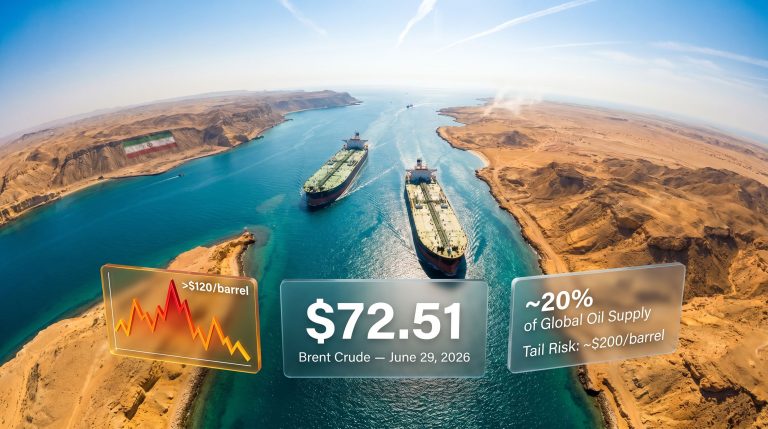
The Strait of Hormuz connects the Persian Gulf to the Gulf of Oman, forming the only maritime exit point for exports originating from the UAE, Qatar, Kuwait, and significant portions of Saudi Arabia's eastern coast. At its narrowest navigable point, the strait measures approximately 33 kilometres wide, yet it functions as a transit corridor for an extraordinary proportion of global energy and industrial commodity volumes.
While the strait's role in oil and liquefied natural gas trade is widely documented, its importance to primary aluminium flows is less frequently discussed in mainstream financial coverage. The Gulf region, particularly the UAE, has developed into one of the world's most significant primary aluminium production hubs outside of China. This matters because Western buyers, particularly in Europe and North America, have actively pursued non-Chinese aluminium sources to reduce strategic supply concentration risk.
The table below illustrates how the Strait of Hormuz compares to other critical global shipping chokepoints in terms of commodity exposure:
| Chokepoint | Key Commodities | Daily Transit Volume (Approx.) | Primary Risk Factor |
|---|---|---|---|
| Strait of Hormuz | Oil, LNG, Primary Aluminium | ~20% of global oil trade | Geopolitical/military conflict |
| Suez Canal | Mixed cargo, crude, manufactured goods | ~12% of global trade | Infrastructure/political disruption |
| Strait of Malacca | Electronics, coal, rubber, LNG | ~25% of global trade | Piracy, geopolitical tension |
| Bab-el-Mandeb | Oil, grain, consumer goods | ~10% of global trade | Houthi attacks, regional conflict |
What makes Hormuz uniquely vulnerable is the absence of practical bypass alternatives for vessels originating from the UAE's deepwater loading terminals. Unlike some chokepoints where cargo can be transferred overland or rerouted through nearby port systems with minimal cost penalty, Hormuz closure compels Gulf producers to make fundamental changes to their export logistics architecture.
How the Iran Conflict Restructured Gulf Aluminium Logistics
When hostilities disrupted commercial shipping confidence through the Strait of Hormuz, the effects on aluminium export operations were immediate and structural. Vessel operators and their war risk underwriters moved quickly to suspend or restrict transit authorisations for the corridor, leaving loaded bulk carriers in an operationally frozen state.
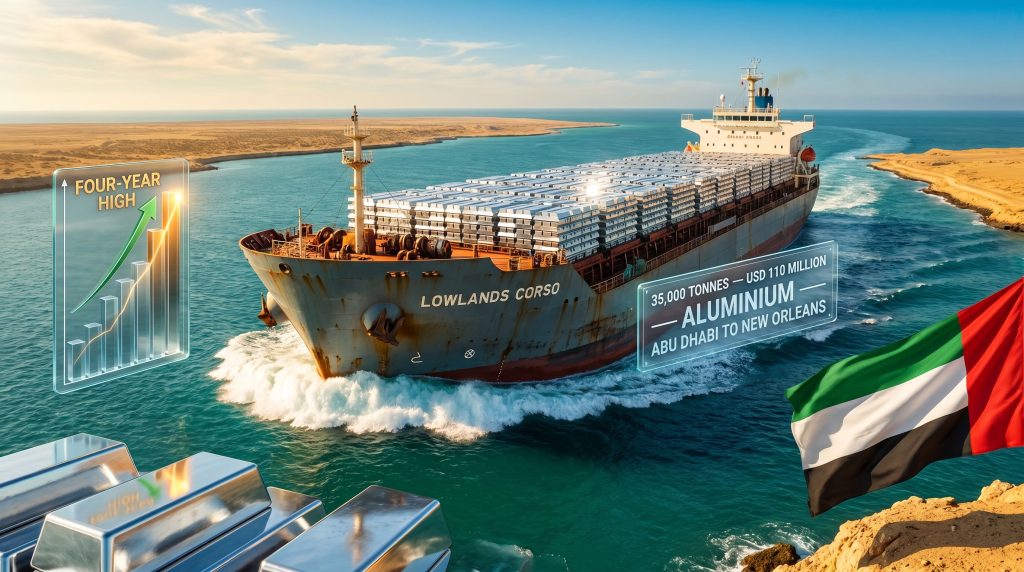
The Lowlands Corso, a bulk carrier loaded with approximately 35,000 tonnes of aluminium in Abu Dhabi during late February, became a visible representation of this broader problem. The vessel sat anchored off the UAE's western coastline as operators assessed the security environment, accruing demurrage costs and financing charges against a cargo valued at roughly USD 110 million at prevailing spot prices. As reported by gCaptain, this stranded cargo quickly became a focal point for market observers tracking the disruption.
For context, demurrage rates for bulk carriers of this class can range from approximately USD 10,000 to USD 25,000 per day depending on vessel size and charter terms. An extended anchorage period measured in weeks translates into millions of dollars in additional carrying costs before a single tonne of metal reaches its buyer.
The disruption did not stop aluminium smelters from producing metal. It severed the mechanism through which that metal reached buyers, creating a physical supply gap that markets began pricing into forward curves almost immediately.
Gulf producers adapted by redirecting export volumes through port infrastructure in Oman and Saudi Arabia, bypassing the strait entirely through longer routing. However, this approach extended transit times and added meaningful logistical cost to each tonne shipped, compressing producer netback margins even as spot prices were rising.
The Lowlands Corso Transit: Unpacking What the Voyage Actually Means
The departure of the Lowlands Corso through the Strait of Hormuz on what was reported as a Friday represented more than a routine cargo movement. It was, according to market sources, the first confirmed bulk aluminium carrier to transit the strait since the onset of the conflict. That distinction carries significant analytical weight.
Why First-Mover Transits Are Disproportionately Influential
In disrupted trade corridors, the first successful transit by a commercial vessel performs a function that formal risk assessments cannot fully replicate: it provides revealed evidence that the route is navigable under current conditions. This matters to several distinct market participants simultaneously:
- War risk underwriters gain concrete data to recalibrate premiums and transit authorisation thresholds
- Vessel operators receive a proof-of-concept that reduces the liability exposure concerns blocking subsequent departures
- Commodity traders can begin pricing reduced route risk into their logistics cost assumptions
- Industrial buyers can plan procurement on the basis that Gulf supply is re-entering the market
The self-reinforcing nature of this dynamic is worth understanding clearly. Each successful transit makes the next one marginally easier to authorise, creating a positive feedback loop that can shift a disrupted corridor from effectively closed to commercially viable within a compressed timeframe.
Emirates Global Aluminium: The Producer Dimension
The cargo originated from Emirates Global Aluminium, which operates as one of the top aluminium producers outside of China. EGA's production facilities in Abu Dhabi process significant volumes of primary metal destined for Western markets, making the company a structurally important node in the non-Chinese aluminium supply chain.
EGA's strategic importance to global buyers has grown in direct proportion to the broader industry push to diversify away from Chinese aluminium dominance. The Gulf region benefits from access to competitively priced energy, which is the single largest variable cost in primary aluminium smelting — a process that is extraordinarily electricity-intensive. This cost advantage means Gulf-origin metal can compete effectively in Western markets even after absorbing long-haul freight costs.
When the strait disruption froze EGA's export pipeline, the consequences extended beyond the immediate financial impact on one producer. It created a gap in the non-Chinese primary aluminium supply available to Western buyers at precisely the moment when supply diversification had become a strategic priority.
Price Mechanics: How Supply Corridor Disruption Drove Aluminium to Four-Year Highs
Aluminium prices on the London Metal Exchange surged to their highest level in approximately four years during the weeks preceding the Lowlands Corso transit. Understanding the mechanics of this price movement requires separating the physical supply impact from the sentiment-driven overlay.
| Price Indicator | Pre-Conflict Level | Peak During Disruption | Market Dynamic |
|---|---|---|---|
| LME Aluminium Spot | Baseline | ~4-year high | Physical supply removal + speculative demand |
| US Physical Premium | Elevated (tariff-driven) | Further amplified | Compounded by tariff structure |
| Gulf Producer Netback | Standard | Compressed | Rerouting cost absorption |
| War Risk Insurance Premium | Minimal | Significantly elevated | Strait closure designation |
The physical supply removal was real but partial. Gulf producers were still manufacturing metal; they were simply unable to deliver it efficiently into global markets. This created the conditions for speculative positioning in futures markets to amplify the underlying physical tightness, a pattern observed in most commodity supply shock events.
The US Market: Tariffs, Premiums, and the New Orleans Delivery
The Lowlands Corso was scheduled to discharge its cargo at New Orleans, a designation that reflects both logistical and market structure considerations. New Orleans hosts LME-registered aluminium warehouse infrastructure, making it a formal delivery point for physical settlement of exchange contracts. It also functions as a primary import gateway for aluminium entering the US domestic market.
The US aluminium market had already been operating under elevated physical premiums before the Hormuz disruption, partly as a consequence of US aluminium tariffs on aluminium imports. This tariff overlay effectively adds a fixed cost to every tonne of imported metal, inflating the physical premium that US buyers must pay relative to the LME benchmark price. When the Hormuz disruption simultaneously reduced available import supply, both forces pressed premiums higher in tandem.
For US industrial buyers relying on Gulf-origin aluminium as part of their raw material procurement mix, the period of strait closure created genuine cost pressure and prompted an accelerated search for alternative sourcing options. The successful delivery of this cargo into New Orleans provides some relief, though full market normalisation requires sustained, not singular, trade flow recovery.
Supply Chain Rerouting: The Operational Economics of Crisis-Period Logistics
The decision by Gulf aluminium producers to redirect exports through Oman and Saudi Arabian port facilities during the disruption was operationally necessary but economically costly. Understanding these cost structures adds important context to the market dynamics at play.
Key logistical cost differentials between standard Hormuz transit and alternative routing include:
- Extended transit distance: Routing through Oman's Salalah port or Saudi facilities adds vessel days to the voyage, increasing fuel consumption and charter costs
- Port handling fees: Additional handling and transshipment costs at alternative loading points
- Cargo transfer complexity: Some bulk cargo movements require transshipment, adding risk of damage and insurance implications
- Contract renegotiation costs: Force majeure clauses in delivery contracts may require renegotiation, creating legal and administrative overhead
- Buyer uncertainty premium: Buyers accepting rerouted cargo often demand price concessions to offset their own planning disruptions
A hypothetical extended closure scenario, modelled across a 90-day window beyond the actual disruption, would have tested production-side storage capacity at Gulf smelters. Primary aluminium production cannot be easily paused and restarted due to the nature of the smelting process, meaning output curtailment becomes unavoidable if export infrastructure remains blocked. Estimates of potential annualised supply removal in such a scenario run into several hundred thousand tonnes, a material quantity relative to global inventory levels.
The next major ASX story will hit our subscribers first
Assessing the Recovery Trajectory: Divergent Scenarios and Monitoring Signals
The Lowlands Corso transit is a meaningful data point, but experienced commodity market participants are careful to distinguish between a corridor reopening and a corridor normalising. These are meaningfully different states, and the distinction matters considerably for how buyers and producers position themselves across the aluminium and alumina markets in the months ahead.
Scenario A: Accelerated Normalisation
Under this pathway, ongoing US-Iran diplomatic negotiations produce durable progress, war risk insurance premiums return toward pre-conflict levels within weeks, and multiple bulk carriers resume regular strait transit. In this scenario:
- Gulf aluminium exports rebuild toward pre-disruption volumes over a 4–8 week period
- LME aluminium spot prices retreat from four-year highs as inventory restocking begins
- US physical premiums compress as import supply returns to the market
- Producer netback margins recover as rerouting costs are eliminated
Scenario B: Prolonged Uncertainty
Under this alternative pathway, residual security incidents maintain elevated risk perceptions among vessel operators and underwriters despite no formal resumption of hostilities. Consequently, in this scenario:
- Insurance premiums remain elevated, making alternative routing economically competitive rather than purely precautionary
- Supply constraints persist through the balance of the year, sustaining price support for aluminium
- Buyers continue to diversify sourcing strategies, potentially accelerating structural shifts in global aluminium trade flows
Key Monitoring Indicators for Market Participants
Traders, procurement managers, and investors tracking this situation should focus on the following real-time signals:
- Vessel tracking data: AIS monitoring of additional bulk carriers transiting the Strait of Hormuz post-Lowlands Corso departure
- LME certified inventory levels: Weekly changes in exchange-registered warehouse stocks as a proxy for physical supply recovery pace
- Forward freight agreement pricing: FFA markets provide a forward-looking view of shipping operator confidence in the corridor
- War risk premium disclosures: Lloyd's of London and specialist marine underwriters' published guidance on Hormuz transit designations
- EGA and Gulf producer export data: Monthly volume data confirming whether sustained trade flow recovery matches or falls short of single-voyage signals
The Structural Argument: Why This Episode Will Reshape Aluminium Supply Chain Strategy
Beyond the immediate price and logistics dynamics, the Hormuz disruption has surfaced a strategic conversation among large aluminium consumers and government procurement planners that is unlikely to conclude when trade flows normalise. In addition, the episode has prompted a broader reassessment of the global metals trade outlook and what supply concentration risk means for industrial economies.
The episode has crystallised awareness that Western markets' growing dependence on Gulf-origin aluminium as a non-Chinese alternative creates a concentrated geographic vulnerability. A single geopolitical event in one narrow waterway demonstrated the capacity to remove meaningful primary aluminium supply from global markets within days.
This reality is likely to accelerate several strategic responses:
- Increased consideration of strategic aluminium stockpiling by governments and large industrial consumers, analogous to strategic petroleum reserve models
- Renewed investment evaluation for primary aluminium capacity in lower-risk jurisdictions, including North America, Australia, and Northern Europe
- Greater contractual emphasis on supply source diversification clauses in long-term aluminium procurement agreements
- Expanded interest in aluminium recycling capacity as a geopolitically insulated supply source for secondary metal consumers
The role played by large commodity trading houses during the disruption period also deserves recognition as an underappreciated element of market infrastructure. As detailed by Mining.com, trading entities with the risk appetite and logistics capabilities to move stranded cargo through recovering maritime corridors provide a genuine market stabilisation function. Their willingness to absorb route risk ahead of full normalisation shortens the period of physical market dislocation and accelerates price discovery.
Frequently Asked Questions
What cargo did Vitol ship through the Strait of Hormuz?
Vitol arranged the transit of approximately 35,000 tonnes of primary aluminium produced by Emirates Global Aluminium, carried aboard the bulk carrier Lowlands Corso. The cargo was valued at around USD 110 million at prevailing spot prices and had been anchored off the UAE coast since the onset of the Iran conflict disruption.
Why was aluminium trade through the Strait of Hormuz suspended?
The outbreak of hostilities associated with the Iran conflict elevated security risks for commercial shipping transiting the strait. War risk underwriters restricted or suspended transit authorisations, leaving loaded vessels unable to depart without incurring prohibitive insurance costs or uninsured risk exposure.
Where was the Lowlands Corso cargo destined?
The vessel was scheduled to discharge at New Orleans, an LME-registered delivery hub and primary US aluminium import gateway, where physical premiums had been elevated by both supply shortages and the existing US import tariff structure on aluminium.
How did the disruption affect global aluminium prices?
Aluminium prices reached their highest level in approximately four years during the period of strait disruption, driven by the effective removal of Gulf export volumes from global supply channels and amplified by speculative positioning in futures markets.
Is the Strait of Hormuz fully open to aluminium trade again?
As of the Lowlands Corso transit, trade flows were showing early signs of recovery but had not reached full normalisation. Residual uncertainty linked to ongoing security conditions and the pace of diplomatic resolution continued to create variability in shipping operator and underwriter risk assessments.
What alternative export routes did Gulf producers use?
During the disruption period, Gulf aluminium producers redirected export volumes through port infrastructure in Oman and Saudi Arabia, accepting higher logistical costs and extended transit times as the operational price of maintaining market access.
Want to Know Which ASX Stocks Stand to Gain From Global Commodity Disruptions Like This?
When shipping chokepoints freeze metal flows and aluminium prices surge to four-year highs, the ripple effects reach ASX-listed explorers and producers well before most investors take notice. Discovery Alert's proprietary Discovery IQ model scans ASX announcements in real time, delivering instant alerts on significant mineral discoveries — including those tied to commodities like aluminium — so subscribers can identify actionable opportunities ahead of the broader market. Explore historic discoveries and their market returns, then begin your 14-day free trial to ensure you're positioned when the next major market-moving event unfolds.