June 29, 2026
The Geological Lottery That Western Economies Cannot Afford to Lose
For most of the past three decades, the global mining industry operated on a straightforward economic premise: extract where it is cheapest, process where labour costs are lowest, and let market forces determine the supply chain architecture. That logic delivered efficient commodity flows but created a structural dependency that is now being unwound at significant cost. The concentration of critical mineral processing capacity within a single geopolitical bloc exposed a fundamental vulnerability in the clean energy transition's raw material foundation.
Canada critical minerals investment is not a short-term policy tweak. It is a systematic repositioning of the country's geological endowment as a strategic national asset, backed by a capital mobilisation framework designed to close the gap between identified mineral potential and market-ready production. Understanding the mechanics of that framework, and the barriers it must overcome, reveals both the scale of the opportunity and the complexity of delivering on it.
When big ASX news breaks, our subscribers know first
Canada's Geological Advantage Is Deeper Than Most Investors Appreciate
Why Deposit Quality Matters as Much as Deposit Size
Canada's relevance to the global critical minerals conversation extends well beyond its land mass. The country holds measurable deposits of more than 30 of the 31 minerals designated as critical by the United States government. This is not a coincidence of geography; it reflects a Precambrian Shield geology that is among the most mineralogically diverse on the planet, combined with a tectonic history that concentrated economically significant grades of cobalt, nickel, copper, rare earth elements, molybdenum, and bismuth across accessible, politically stable jurisdictions.
The geological reality underpinning Canada's investment thesis is that deposit diversity, not just deposit size, determines long-term strategic relevance. A nation that hosts only lithium or only rare earths remains a single-commodity supplier. Canada's multi-mineral endowment positions it as a potential full-spectrum supplier across the clean energy and defence materials value chain.
What is less widely understood is the distinction between resource and reserve in mining terminology. A resource is a geological estimate of mineralisation that may be economically viable; a reserve is a resource for which economic extraction has been demonstrated. Much of Canada's identified critical mineral potential currently sits at the resource stage, which explains the capital intensity of the investment pipeline.
Converting resources into reserves, and reserves into producing mines, requires sustained capital deployment across exploration, feasibility, permitting, and construction phases, each of which carries its own risk profile and timeline. Furthermore, critical minerals and energy security are becoming increasingly intertwined, making the pace of this conversion all the more urgent for allied nations.
How Large Is the Canada Critical Minerals Investment Pipeline?
Quantifying a $72.4 Billion Opportunity Across 67 Projects
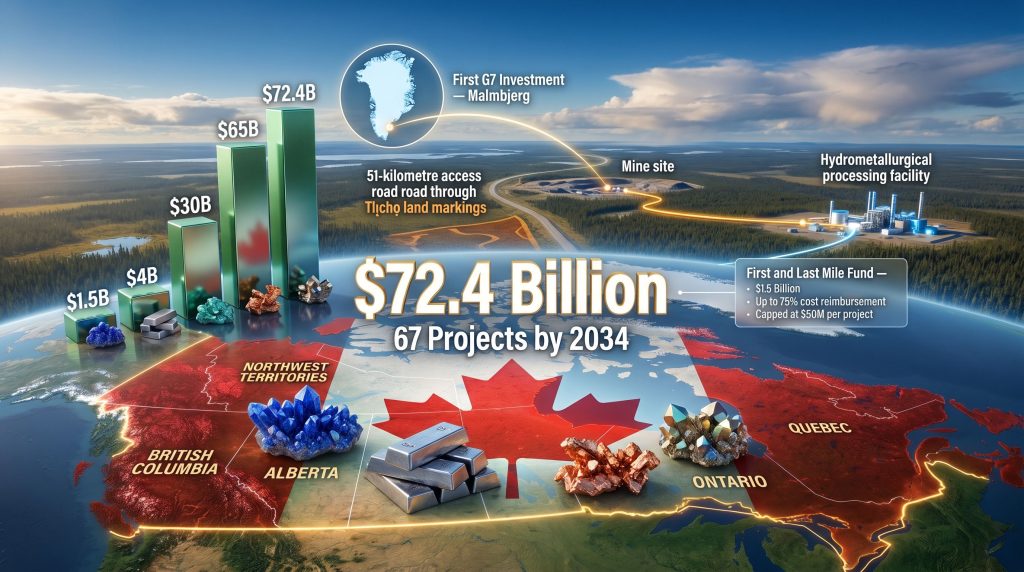
Canada has identified approximately 67 critical mineral projects requiring a combined $72.4 billion in capital investment by 2034. This figure represents one of the most concentrated resource development pipelines in the G7, spanning planned, proposed, and under-construction projects across British Columbia, the Northwest Territories, Quebec, Ontario, and Alberta.
| Investment Metric | Figure |
|---|---|
| Total capital required across ~67 projects | $72.4 billion by 2034 |
| New investment needed to fulfil domestic potential | $30 billion over 15 years |
| Investment required to meet projected global demand growth | $65 billion |
| Federal Critical Minerals Strategy backing | ~$4 billion |
| First and Last Mile Fund allocation | $1.5 billion |
| Planned critical minerals sovereign fund | $2 billion (announced) |
The distinction between the $30 billion domestic potential figure and the $65 billion global demand figure is analytically significant. The $30 billion represents the capital required to bring Canada's own identified deposits into production at full potential. The $65 billion reflects the total investment needed to satisfy the share of projected critical minerals demand growth that Canadian supply chains could realistically serve.
What the Infrastructure Gap Actually Means for Capital Deployment
A substantial portion of the 67-project pipeline faces not a geology problem or a permitting problem, but a logistics problem. Remote deposits in the Northwest Territories, northern Quebec, and British Columbia's interior lack the road, power, and port infrastructure that makes production economics viable. This is the binding constraint that the federal government's infrastructure-focused funding architecture is specifically designed to address.
The critical insight for investors is that enabling infrastructure investment frequently generates higher strategic returns than direct mine investment at this stage of the cycle. A road that unlocks three separate deposits has a multiplier effect on capital deployment efficiency that a single mine investment cannot replicate.
Canada's Multi-Layered Federal Funding Architecture
How the Government Is Deploying Capital Across the Value Chain
The Critical Minerals Strategy: Policy Foundation and Tax Incentives
Launched in December 2022, Canada's Critical Minerals Strategy committed nearly $4 billion in federal funding across a range of instruments. Among the least-discussed but most commercially significant mechanisms is the Critical Mineral Exploration Tax Credit, which covers up to 30% of eligible capital costs for qualifying exploration activities.
For junior miners and exploration companies with limited balance sheet capacity, this tax credit materially reduces the risk-adjusted cost of early-stage drilling programmes. The strategy also embedded $3.8 billion in mining infrastructure funding and established explicit national security review criteria that restrict certain categories of foreign investment in Canadian critical mineral assets.
The First and Last Mile Fund: Bridging the Infrastructure Gap
The $1.5 billion First and Last Mile Fund represents the most direct mechanism for converting stranded deposits into accessible production assets. The fund reimburses up to 75% of eligible infrastructure costs, capped at $50 million per project, with a focus on access roads, processing linkages, and supply chain connectivity between remote mine sites and established transport corridors.
This is not a grant programme in the conventional sense. The reimbursement model means project proponents must commit their own capital first, with federal funding flowing as construction milestones are achieved. This structure aligns incentives and reduces moral hazard, but it also means companies need sufficient balance sheet strength to carry costs ahead of reimbursement.
The Canada Infrastructure Bank: De-Risking Large-Scale Project Activation
For larger infrastructure requirements, the Canada Infrastructure Bank operates with a minimum investment threshold of $100 million per project (reduced to $5 million for Indigenous-owned projects). Its mandate covers access roads, clean power generation, and transmission infrastructure, effectively providing concessional capital that reduces the cost of debt for qualifying projects and lowers the return threshold required to attract private co-investment.
The G7 Critical Minerals Production Alliance: Multilateral Capital Mobilisation
Canada's most ambitious capital mobilisation initiative operates at the multilateral level. The G7 Critical Minerals Production Alliance has to date generated 56 investments, with 30 new partnerships delivering more than $12 billion for mining and processing operations across allied jurisdictions. A dedicated joint Canada-U.S. Task Force has produced five co-funded projects, demonstrating that bilateral mineral security commitments can be operationalised beyond policy declarations.
"What distinguishes the G7 alliance model from earlier bilateral trade frameworks is its explicit integration of private capital alongside public funding. Rather than relying solely on government balance sheets, the alliance is structured to crowd in institutional investment by reducing sovereign and project risk to levels acceptable to pension funds and infrastructure investors."
Project-Level Activation: The NICO Project Case Study
Infrastructure as the Primary Unlock for Stranded Mineral Deposits
Fortune Minerals' NICO project in the NWT illustrates the practical application of Canada's infrastructure-led investment model. The deposit hosts a genuinely unusual combination of critical minerals: cobalt, gold, bismuth, and copper within a single orebody. Bismuth, in particular, deserves attention; it is one of the least-discussed critical minerals yet serves as a non-toxic substitute for lead across a range of industrial applications, and its global supply is highly concentrated.
The project's joint venture structure with the Tłı̨chǫ Government adds both commercial and governance dimensions that are increasingly central to Canadian mining investment.
The NICO Project Access Road: Technical and Financial Parameters
The NICO Project Access Road (NPAR) is a 51-kilometre road connecting the mine site to the NWT highway network near the community of Whatì. The road traverses Tłı̨chǫ private lands, which is why the joint venture structure is not merely an ethical consideration but a practical prerequisite for construction access.
- The federal government has provided conditional approval for up to $50 million through the First and Last Mile Fund
- The fund will reimburse 75% of eligible construction costs under the reimbursement model
- Metal concentrates produced at NICO will be transported via the NPAR to a dedicated hydrometallurgical facility in Alberta for downstream processing
- The road serves the dual purpose of construction access and long-term operational logistics
The Alberta processing link is a strategically important detail. By establishing a mine-to-refinery pathway entirely within Canadian territory, the NICO project demonstrates domestic value capture across multiple stages of the critical minerals value chain, from extraction in the Northwest Territories to hydrometallurgical processing in Alberta.
Canada's First G7 Investment in Greenland: The Malmbjerg Programme
Why Arctic Mineral Development Is Becoming a Strategic Priority
Greenland's geological endowment has been understood for decades, but its commercial development has been constrained by logistics, climate, and sovereignty complexities. The increasing pace of Arctic ice retreat, combined with intensifying great-power interest in the region's resource base, has elevated Greenland's critical minerals importance beyond what most mainstream mining coverage reflects.
Canada's decision to commit $7 million through Natural Resources Canada's Critical Minerals Research, Development and Demonstration programme to Greenland Resources' Malmbjerg metallurgical programme makes Canada the first G7 government to invest directly in Greenland's mining sector. The geopolitical signal this sends, particularly in the context of broader Western interest in Arctic resource access, extends well beyond the dollar value of the contribution.
Technical Scope of the Malmbjerg Metallurgical Programme
The programme addresses a set of processing questions that are technically non-trivial and commercially significant:
- Evaluating the feasibility of processing primary molybdenum using both saline and fresh water flotation methods
- Assessing the recovery potential of magnesium and rare earth elements as by-products from the Malmbjerg orebody
- Evaluating saline water as a secondary rare earth recovery source
- Programme timeline: running through to March 2028
The saline water flotation question is particularly interesting from an engineering standpoint. Many remote Arctic and subarctic deposits face freshwater scarcity as a practical processing constraint. Demonstrating economic molybdenum recovery using saline water would substantially expand the range of deposits that can be brought into production without freshwater infrastructure investment.
The next major ASX story will hit our subscribers first
Indigenous Partnership as a Structural Feature of the Investment Model
Why Co-Ownership Is Both an Ethical Imperative and a Commercial Advantage
The Indigenous Natural Resource Partnerships programme directs approximately $2 million toward Indigenous-led critical minerals governance, with a particular focus on enabling Indigenous governments to co-develop, assess, and participate substantively in decision-making on major resource projects. The Tahltan Central Government's programme for structured participation in critical mineral project approvals is among the most advanced examples of this model in practice.
| Partnership Model | Example | Primary Function |
|---|---|---|
| Co-development and decision-making | Tahltan Central Government | Structured role in project approval processes |
| Land access and joint venture | Tłı̨chǫ Government and NICO Project | Road construction across private Indigenous lands |
| Equity co-ownership | Emerging across multiple provinces | Direct financial participation in project economics |
What is not commonly understood outside the Canadian mining sector is the direct correlation between the quality of Indigenous partnership structures and project approval timelines. Regulatory processes that proceed without meaningful Indigenous co-design routinely face legal challenges that can add years and tens of millions of dollars in carrying costs. Conversely, projects structured from the outset with genuine governance co-ownership tend to navigate approval processes with substantially greater predictability.
The Four Structural Barriers to Scaling Canada Critical Minerals Investment
Understanding the Constraints That Determine Scenario Outcomes
1. Commodity Price Volatility and the Long-Lead-Time Problem
Mining projects in the critical minerals sector typically require 10 to 15 years from initial discovery to first production. During that period, commodity prices can cycle through multiple bull and bear phases. Institutional investors accustomed to infrastructure-style return profiles struggle to price this volatility appropriately, which is why government risk-sharing mechanisms like contracts for difference and equity co-investment are essential rather than optional.
2. Multi-Jurisdictional Regulatory Complexity
Canadian mining projects frequently require approvals from federal environmental assessment bodies, provincial land-use regulators, and territorial governments simultaneously. When Indigenous consultation processes overlay these requirements, the sequencing and coordination of approvals becomes a project management discipline in its own right.
3. Remote Infrastructure Deficits
The most mineralogically endowed regions of Canada are often the least accessible. Power costs at remote mine sites can be three to five times higher than at grid-connected operations, materially affecting the economics of energy-intensive processing stages.
4. Foreign Acquisition Risk and National Security Considerations
Canada has explicitly expanded its national security review criteria to encompass economic security, enabling the government to block or impose conditions on foreign acquisitions of critical mineral companies where the transaction could compromise long-term supply chain sovereignty. This framework creates important protections but also introduces regulatory uncertainty for cross-border transactions that were previously considered routine.
| Barrier | Federal Response Mechanism |
|---|---|
| Price volatility | Contracts for difference, equity co-investment, offtake agreements |
| Regulatory complexity | Coordinated federal-provincial permitting frameworks |
| Infrastructure deficits | First and Last Mile Fund, Canada Infrastructure Bank |
| Foreign acquisition risk | Expanded national security reviews, economic security criteria |
The Clean Energy Transition's Mineral Intensity Problem
Why Decarbonisation Accelerates Mining Demand Rather Than Reducing It
One of the most counterintuitive dynamics in the energy transition narrative is that the shift away from fossil fuels dramatically increases demand for mined commodities. A single onshore wind turbine requires approximately 260 tonnes of steel, 1,300 kilograms of copper, and meaningful quantities of rare earth elements for permanent magnets. A battery electric vehicle contains roughly six times the mineral content of a conventional internal combustion engine vehicle.
Canada's Energy Innovation Programme has allocated $19.6 million across five projects advancing clean energy and industrial decarbonisation technologies specifically within the mining sector itself. This dual mandate — producing the minerals that enable decarbonisation while simultaneously decarbonising the production process — positions Canada's mining sector as both a supplier of clean energy inputs and a demonstrator of low-emission extraction practices. In addition, a well-structured critical minerals trade strategy can further amplify these benefits across allied nations.
Strategic Scenarios for Canada's Critical Minerals Sector to 2034
Three Pathways and Their Determining Variables
The trajectory of Canada critical minerals investment through 2034 will be shaped by the interaction of capital availability, regulatory velocity, and infrastructure deployment speed. Three plausible scenarios illustrate the range of outcomes.
Scenario 1 (Optimistic): Full deployment of the $72.4 billion pipeline across 67 projects. Allied-nation offtake agreements reduce price volatility risk, Indigenous co-ownership models become sector standard, and Canada emerges as the G7's primary non-processing critical minerals supplier.
Scenario 2 (Moderate): Between 40 and 50 projects reach production, with approximately $40 to $50 billion deployed by 2034. Infrastructure gaps in remote jurisdictions remain the binding constraint. Canada establishes strong positions in cobalt, molybdenum, and rare earths but underperforms relative to potential in lithium and nickel.
Scenario 3 (Downside): Regulatory complexity, commodity price cycles, and infrastructure deficits slow aggregate deployment to $25 to $30 billion. Allied nations accelerate investment in alternative jurisdictions, and Canada retains strategic importance but captures a smaller share of the energy transition supply chain than its geology warrants.
The variable that most consistently differentiates optimistic from moderate outcomes in comparable national mining investment programmes is not geology, capital availability, or commodity prices. It is, however, the speed and quality of enabling infrastructure deployment. Canada's First and Last Mile Fund exists precisely because policymakers understand this relationship. Furthermore, the IEA has noted that Canada is well positioned to play a leading role in supplying responsibly produced critical minerals to global markets.
Disclaimer: The scenario projections outlined above are analytical constructs based on publicly available information and structural analysis of the Canadian mining sector. They do not constitute investment advice. Actual outcomes will depend on numerous variables including global commodity markets, regulatory developments, and geopolitical conditions that cannot be predicted with certainty.
Frequently Asked Questions: Canada Critical Minerals Investment
What is Canada's total critical minerals investment target?
Canada has identified approximately 67 critical mineral projects requiring $72.4 billion in combined investment by 2034. Fulfilling domestic production potential requires $30 billion in new investment over 15 years, while meeting Canada's share of projected global demand growth requires $65 billion in total capital deployment.
What is the First and Last Mile Fund and how does it work?
The First and Last Mile Fund is a $1.5 billion federal programme designed to finance enabling infrastructure connecting remote critical mineral deposits to existing supply chain networks. It reimburses up to 75% of eligible costs, capped at $50 million per project, operating on a milestone-based reimbursement model that requires proponents to commit capital before federal funding flows.
Why is the NICO project significant beyond its deposit size?
The NICO project is notable for three reasons beyond its cobalt, gold, bismuth, and copper resource base: its joint venture structure with the Tłı̨chǫ Government establishes a replicable co-ownership template; its integrated mine-to-refinery model captures value within Canada from extraction to hydrometallurgical processing; and its conditional $50 million road funding approval demonstrates the practical application of the First and Last Mile Fund's infrastructure-first investment logic.
What makes Canada's Greenland investment historically significant?
Canada's $7 million contribution to the Malmbjerg metallurgical programme makes it the first G7 government to invest directly in Greenland's mining sector. Beyond the dollar value, the investment signals Canada's intention to extend its critical minerals partnership model beyond its own borders into allied Arctic jurisdictions, establishing a technical partnership framework that could be replicated across other Western-aligned mineral-rich territories.
How does Canada protect critical mineral assets from foreign acquisition?
Canada has expanded its national security review framework to include economic security as a qualifying criterion, enabling the federal government to block or impose conditions on foreign acquisitions of critical mineral companies where transactions could compromise Canada's long-term supply chain sovereignty or collective allied-nation security interests. For a broader overview of federal support mechanisms, the federal support for critical mineral projects page outlines additional programme details and eligibility criteria.
Want to Track the Next Major Critical Mineral Discovery Before the Market Catches On?
Discovery Alert's proprietary Discovery IQ model delivers real-time ASX alerts on significant critical mineral discoveries — translating complex geological data into actionable investment insights for both short-term traders and long-term investors. Explore historic examples of major mineral discoveries and their returns to understand the scale of opportunity, then begin your 14-day free trial to position yourself ahead of the market.