
June 29, 2026
The Refinery War Nobody Is Watching: Why Diesel Is the Real Energy Story of 2026
Commodity markets have a well-documented tendency to fixate on the most visible price signal rather than the most consequential one. In the second half of 2026, that instinct is leading a significant portion of market participants toward Brent crude while the more structurally important story unfolds several steps downstream, inside the diesel market. Understanding why requires stepping back from geopolitical headlines and examining how refined product markets actually work, and why the mechanisms governing diesel supply operate on a fundamentally different clock than crude oil.
Refinery capacity is not a tap that can be turned on or turned off. It is physical infrastructure built over decades, requiring specialised materials, engineering expertise, and sustained capital investment to construct or restore. When that infrastructure is destroyed, the consequences are not measured in days or weeks. They are measured in months and years. This is the lens through which the Russia diesel export ban must be understood, and it is why the current energy market setup is considerably more complex than Brent near $72 implies.
When big ASX news breaks, our subscribers know first
Brent's War Premium Has Evaporated. Diesel's Supply Deficit Has Not.
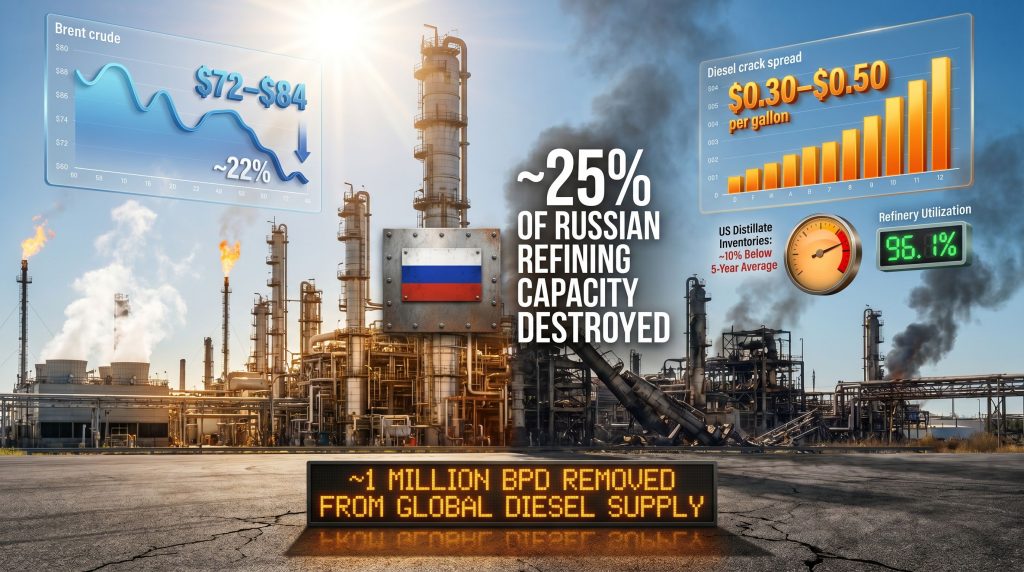
Brent crude's roughly 22% decline over June 2026, settling near $72.20 per barrel, reflects a textbook geopolitical risk unwind. Following the Strait of Hormuz tanker incident and subsequent US-Iran hostilities, crude markets briefly absorbed a significant conflict premium. When a ceasefire was agreed and diplomatic talks resumed, that premium compressed rapidly, pulling Brent sharply lower from its conflict-era peak.
This price behaviour is entirely consistent with historical precedent. Geopolitical war premiums in crude oil are almost always temporary. Markets price in worst-case supply disruption scenarios at the outbreak of conflict, then systematically reprice lower as those scenarios fail to fully materialise. The speed of that repricing is often faster than fundamentals would suggest, driven by algorithmic trading, options market dynamics, and the reflexive unwinding of speculative long positions. Furthermore, oil price movements in recent years have repeatedly demonstrated this pattern of rapid premium compression.
Geopolitical risk premiums in crude oil evaporate when conflict risk recedes. Structural supply deficits in refined products resolve on an entirely different, far slower timeline because they are determined by physical infrastructure capacity, not diplomatic agreements.
Diesel does not follow this pattern. Unlike crude, which responds to geopolitical signals almost in real time, diesel supply is constrained by the physical availability of refining capacity. When refineries are damaged or destroyed, the crude-to-diesel conversion chain is broken regardless of what happens between governments. No ceasefire rebuilds a cracking unit. No diplomatic communique restores atmospheric distillation towers.
How Ukrainian Drone Strikes Reshaped Russian Refining Capacity
The sustained Ukrainian drone campaign targeting Russian energy infrastructure has inflicted damage that extends well beyond battlefield optics. Key downstream facilities have been hit across multiple regions, with refineries in the Krasnodar and Yaroslavl areas sustaining significant damage. Major complexes including the Ryazan, Kirishi, and NORSI installations have all been affected to varying degrees.
The cumulative impact of these strikes represents a meaningful reduction in Russia's refining throughput. When assessed against the country's total downstream capacity, the scale of the damage is significant enough to create genuine domestic fuel shortages rather than marginal tightening. Indeed, Russia bracing for diesel export bans after these attacks illustrates just how severe the infrastructure disruption has become.
| Refinery Impact Metric | Estimated Scale |
|---|---|
| Share of Russian refining capacity affected | ~25% |
| Daily diesel volume effectively removed from global supply | ~1 million barrels per day |
| Estimated combined affected capacity | ~238,000 tonnes per day |
| Share of global diesel supply represented | ~3-4% |
What makes this situation particularly consequential is its irreversibility on a short to medium-term horizon. Repairing or rebuilding refinery infrastructure under active conflict conditions is not feasible. Even under peacetime conditions, major refinery restoration projects typically require 12 to 36 months depending on the scope of damage. This means the supply removal being discussed is not a temporary shock that self-corrects over a quarter or two. It is a structural dislocation.
Russia's Domestic Fuel Deficit and the Export Ban Logic
President Putin has publicly acknowledged that Russia faces a domestic fuel deficit, framing it as a temporary condition while simultaneously advancing planning for a comprehensive ban on diesel and aviation fuel exports. The political logic is straightforward: with domestic supply constrained, maintaining export volumes at prior levels would mean allowing domestic shortages to deepen, which carries its own political risks. The export ban is a reactive instrument, not a proactive strategy.
This is not without precedent in Russian energy policy. Russia previously imposed a gasoline export ban that ran from April through July during the same period, using export restriction as a domestic supply stabilisation tool. The diesel ban would represent a broader and more globally significant version of the same approach. Considering the trade war impact on oil markets already unfolding in parallel, the combined pressure on global energy supply chains is considerable.
The US Distillate Deficit: A Problem That Maximum Refinery Output Cannot Solve
While the Russian supply dynamic commands attention, the US distillate inventory picture adds another dimension to the diesel tightness story. American refineries operated at 96.1% utilisation with crude inputs averaging 17.1 million barrels per day during the relevant period, representing near-maximum operational capacity. Despite this output effort, US distillate fuel inventories remained approximately 10% below the five-year seasonal average even after recording a 3.1-million-barrel weekly build.
This is a technically important data point. A 3.1-million-barrel weekly build would, under normal inventory conditions, represent meaningful progress toward restocking. The fact that it barely moved the needle relative to the five-year average deficit indicates that underlying demand is absorbing supply at a pace that near-maximum refinery output cannot keep up with.
| US Energy Inventory Snapshot | Figure |
|---|---|
| Weekly crude inventory change | -6.1 million barrels |
| Total US crude stocks | 412.1 million barrels |
| Crude deviation from five-year average | ~7% below |
| Distillate deviation from five-year average | ~10% below |
| Refinery utilisation rate | 96.1% |
| Crude inputs | 17.1 million barrels per day |
| Crude import rate | 5.6 million barrels per day |
The simultaneous drawdown in both crude and distillate inventories, even as crude imports rose to 5.6 million barrels per day, points to demand conditions that are absorbing incoming supply faster than the system can build buffer stocks. With refinery utilisation already at 96.1%, there is very limited capacity to increase domestic diesel production further. The ceiling has effectively been reached.
US distillate inventories are running approximately 10% below the five-year seasonal average as of late June 2026, despite refinery utilisation reaching 96.1%. This combination signals a structural tightness that weekly inventory builds alone are unlikely to resolve quickly.
Macro Headwinds Complicate the Energy Market Picture
The broader macroeconomic environment adds layers of complexity to how diesel and crude price signals interact with financial markets. The US dollar index holding near 101.25, close to a one-year high, creates a structural headwind for dollar-denominated commodities including crude oil. A stronger dollar makes oil more expensive in local currency terms for importing nations, which exerts downward pressure on global demand and, by extension, crude prices.
The Federal Reserve policy backdrop has also shifted materially. Markets repriced from an expectation of two rate cuts in 2026 to pricing in at least one rate hike, a reversal driven in part by the inflationary implications of the US-Iran conflict period. Higher-for-longer interest rates carry bearish implications for growth-sensitive commodities. Moreover, commodity market volatility has intensified as these macro variables interact with already-strained supply dynamics.
Macro pressure matrix for energy markets in mid-2026:
| Factor | Direction | Implication for Oil and Diesel |
|---|---|---|
| USD Index near 101.25 | Elevated | Bearish for dollar-denominated crude |
| Fed rate hike expectations | Rising | Bearish for growth-sensitive commodities |
| Russian diesel export ban | Supply contraction | Bullish for distillate crack spreads |
| US distillate inventory deficit | Persistent | Bullish for diesel prices |
| US-Iran ceasefire | De-escalation | Bearish for crude war premium |
The interaction between these forces creates a divergent outcome: conditions that are broadly bearish for crude oil are simultaneously coexisting with conditions that are structurally bullish for diesel. This is the fundamental decoupling that defines the current market environment and that headline Brent watchers are likely to miss.
Market commentary from strategists has noted that lower oil prices could provide support to the broader global economy, potentially lifting growth-sensitive sectors. However, the durability of that positive read-through depends entirely on the ceasefire holding and oil prices remaining at lower levels, conditions that are subject to rapid reversal given the geopolitical instability that characterises the current environment.
Separately, rising infrastructure costs have created cash flow pressure across energy-linked equities, with capital reallocation toward defensive and cyclical positions making it harder for investors to cleanly isolate the impact of lower oil prices on specific energy sector exposures.
Who Captures the Value in a Tight Diesel, Softer Crude Market
The divergence between crude and diesel prices creates a bifurcated landscape for different energy sector participants.
Refiners with diesel-heavy product slates are positioned to benefit from:
- Crude input costs suppressed by the post-ceasefire Brent decline
- Diesel output prices elevated by structural supply constraints
- US distillate inventories remaining 10% below the five-year average
- Russian supply removal reducing competition in global diesel trade
- Domestic refinery utilisation already near its ceiling, limiting incremental supply response
The diesel crack spread, which measures the margin refiners earn converting crude into diesel, is the key financial metric to monitor in this environment. When crude input costs compress while diesel output prices remain supported by supply deficits, crack spreads widen, expanding refiner profitability regardless of where Brent settles.
For pure-play crude producers, the picture is more challenging. With Brent having declined approximately 22% over June 2026, upstream economics are under pressure. The benefit of lower crude prices flows primarily to refiners and end consumers rather than producers, compressing margins at the wellhead.
Fuel-intensive industries, including mining, agriculture, long-haul freight, and construction, face a particularly complex input cost environment. While crude-linked energy costs may ease, diesel-specific costs could rise materially if the Russia diesel export ban is fully implemented. In addition, commodity prices and mining performance are closely correlated with diesel input costs, meaning mining operators face a compounding squeeze from both sides. Furthermore, the Russian strategic resources dimension adds yet another layer of geopolitical complexity to energy market positioning.
The next major ASX story will hit our subscribers first
Three Scenarios for Diesel Market Direction
How the diesel market resolves over the next several months depends on a relatively small number of high-impact variables. Three distinct pathways are worth mapping.
Scenario 1: Full Russian Export Ban with Continued Drone Strikes
Russia implements a comprehensive ban on diesel and aviation fuel exports. Ukrainian drone campaigns continue targeting remaining refinery infrastructure. US distillate inventories fail to recover meaningfully toward the five-year average. Under this scenario, global diesel prices appreciate materially, crack spreads widen significantly, and fuel-intensive industries face meaningful cost headwinds.
Scenario 2: Partial Ban or Selective Exemptions
Russia implements targeted export restrictions rather than a comprehensive ban, maintaining flows to priority trading partners such as Turkey while curtailing volumes to less strategically significant buyers. Domestic fuel subsidies partially offset the supply loss. Under this scenario, diesel prices see moderate support, crack spreads widen but not dramatically, and the impact on global supply is meaningful but manageable. Analysts have previously noted that Turkey and Brazil would be among the hardest-hit nations under such a partial restriction framework.
Scenario 3: Ceasefire Extension Enables Refinery Restoration
Drone campaign activity pauses as part of broader conflict dynamics, allowing Russian refinery operators to begin repair and restoration work. Global diesel supply gradually normalises over 12 to 18 months. Under this scenario, diesel prices ease over time, crack spreads compress toward historical norms, and the structural tightness dissipates.
The countries most exposed to downside risk across all scenarios are those historically dependent on Russian diesel supply flows. Turkey has long been a major recipient of Russian diesel. Brazil supplements its domestic refining capacity with diesel imports, a portion of which has historically sourced from Russian suppliers. Multiple sub-Saharan African nations depend on cost-competitive Russian diesel for agricultural and transport applications where no ready alternative supplier exists at comparable pricing.
Analysts estimate that a full Russian export ban would translate into a $0.30 to $0.50 per gallon increase in global diesel prices, transmitted through the following chain:
- Russian diesel volumes exit global trade
- Middle Eastern, US, and Indian suppliers face increased demand from displaced buyers
- Freight and logistics costs rise as supply routes lengthen to accommodate new trade flows
- End-market diesel prices adjust upward across major importing nations
- Fuel-intensive industries absorb higher input costs, compressing margins or passing costs downstream
The Two Data Points That Resolve Near-Term Uncertainty
With scenario outcomes contingent on a small set of observable variables, investors and operators tracking the Russia diesel export ban story should focus on two primary information sources.
The first is the weekly EIA distillate inventory report. The recent 3.1-million-barrel build represents either the beginning of a genuine restocking trend or a one-week anomaly within a persistent deficit. Subsequent weekly releases will clarify which interpretation is correct. If inventories continue building toward the five-year average, some of the diesel price support narrative weakens. If the deficit persists or widens despite high refinery utilisation, the structural tightness thesis strengthens considerably.
The second is any formal Kremlin announcement on the scope and timing of the diesel export ban. A full ban represents a maximum-impact supply shock. Partial restrictions or an indefinite deferral would represent lesser versions of the same pressure. The distinction between these outcomes could be the difference between moderate and significant diesel price appreciation over the second half of 2026.
The next oil market catalysts are not geopolitical events or OPEC decisions. They are EIA weekly distillate inventory data and any Kremlin decision on the diesel export ban, both of which will determine whether the global diesel supply deficit deepens or begins to resolve.
Key Takeaways: The Crude-Diesel Decoupling in Numbers
| Metric | Current Status | Market Implication |
|---|---|---|
| Brent crude price range | ~$72-$84 post-ceasefire | Crude war premium removed |
| Russian refining capacity lost | ~25% | Structural diesel supply reduction |
| Russian diesel removed from global market | ~1 million barrels per day | ~3-4% global diesel supply deficit |
| US distillate inventory deficit | ~10% below five-year average | Demand absorbing supply faster than replenishment |
| Estimated diesel price increase from full ban | $0.30-$0.50 per gallon | Significant cost pressure for fuel-intensive sectors |
| US refinery utilisation | 96.1% | Near-maximum output, limited domestic upside |
The central analytical conclusion that emerges from examining these dynamics together is that crude price benchmarks and diesel market fundamentals have structurally decoupled in the current environment. Monitoring Brent near $72 without simultaneously tracking the Russia diesel export ban and US distillate inventory deficits provides an incomplete and potentially misleading picture of where energy market stress is actually concentrated. The more consequential signal is downstream, in the distillate market, where physical infrastructure destruction, export policy shifts, and persistent inventory deficits are interacting in ways that no ceasefire agreement can quickly resolve.
This article contains forward-looking analysis, scenario projections, and market commentary for informational purposes only. It does not constitute financial or investment advice. Commodity market conditions can change rapidly, and readers should conduct their own research and consult qualified advisors before making investment decisions.
Want to Capitalise on the Next Major Commodity Market Shift Before the Broader Market Catches On?
While diesel and crude markets decouple in real time, Discovery Alert's proprietary Discovery IQ model scans ASX announcements daily, delivering instant alerts on significant mineral discoveries — including those in energy and resource sectors directly exposed to shifting commodity dynamics — so subscribers can identify actionable opportunities ahead of the crowd. Explore historic examples of how major discoveries have generated substantial returns and begin your 14-day free trial at Discovery Alert to position yourself at the forefront of the next major market move.