June 30, 2026
When Markets Fail to Self-Correct: Nigeria's Petrol Pricing Problem Explained
In theory, deregulated commodity markets are elegant mechanisms. When input costs rise, prices at the point of sale follow. When input costs fall, the same logic should apply in reverse. In practice, however, fuel markets across the developing world have repeatedly demonstrated that price transmission is rarely symmetrical. Costs climb quickly and visibly; reductions move slowly, quietly, and often incompletely. Nigeria is now confronting this asymmetry at full force, and the Nigeria petrol pricing crackdown is reshaping how regulators, investors, and consumers understand what deregulation actually means in Africa's largest oil-producing economy.
When big ASX news breaks, our subscribers know first
The Numbers That Triggered a Government Response
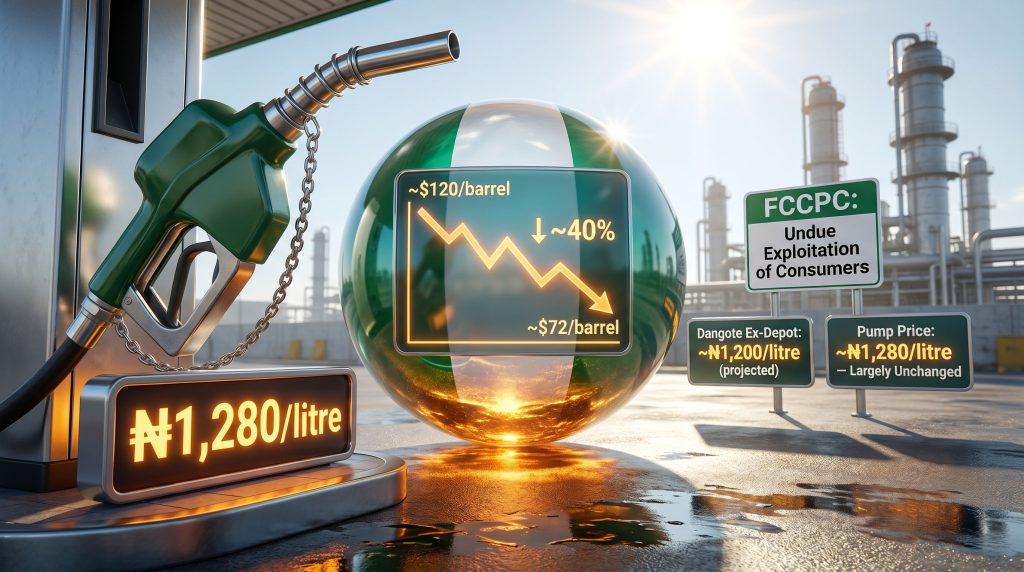
The catalyst for Nigeria's current situation is a dramatic movement in global crude oil benchmarks. International crude prices surged to approximately $120 per barrel during a period of heightened geopolitical tension centred on the Middle East, before retreating sharply to around $72 per barrel following the de-escalation of the Iran-United States standoff. That represents a decline of roughly 40% in a relatively compressed timeframe. Furthermore, current crude prices in the global market reflect ongoing volatility that has direct downstream consequences for consumers in emerging economies.
In a functioning competitive market, a correction of that magnitude would be expected to produce meaningful relief at the fuel pump. In Nigeria, the retail price of Premium Motor Spirit (PMS) has remained broadly static, with filling stations making at best token downward adjustments.
| Market Indicator | Peak Level (Mid-2026) | Current Level | Change |
|---|---|---|---|
| Global Crude Oil Price | ~$120/barrel | ~$72/barrel | Down ~40% |
| Dangote Refinery Ex-Depot (PMS) | Elevated | Projected ~₦1,200/litre | Declining |
| Typical Retail Pump Price | ~₦1,280/litre | ~₦1,280/litre | Largely unchanged |
| Retail Price Adjustments by Marketers | N/A | Token reductions only | Insufficient |
Speaking at the 2026 NMDPRA General Counsel and Legal Advisers Forum in Abuja on June 29, 2026, Nigeria's Minister of State for Petroleum Resources (Oil), Senator Heineken Lokpobiri, made the government's position explicit. He stated that following the easing of tensions between Iran and the United States, a corresponding downward adjustment in the prices of PMS and other petroleum products had been expected but had not materialised.
He directed the Nigerian Midstream and Downstream Petroleum Regulatory Authority (NMDPRA) to exercise its statutory powers under the Petroleum Industry Act (PIA) to prevent market liberalisation from becoming a vehicle for profiteering at the expense of ordinary Nigerians.
Understanding the Structural Asymmetry in Price Transmission
The pricing stagnation Nigeria is experiencing is not simply a story of bad actors. It reflects a structural dynamic that economists refer to as rockets and feathers pricing behaviour, a phenomenon documented across deregulated fuel markets globally. In addition, commodity market volatility of this nature tends to expose the weaknesses in markets where enforcement mechanisms are inconsistently applied.
The pattern works as follows:
- When crude oil prices rise, fuel retailers pass costs onto consumers rapidly and in full, citing tight margins and import cost pressures.
- When crude oil prices fall, retailers absorb the benefit as margin recovery, citing inventory costs, currency hedging positions, or operational expenses as justification for delayed pass-through.
- The net effect over time is that consumers pay more on average than a perfectly competitive market would produce, and the gap widens every time a price spike occurs.
In Nigeria's specific context, this dynamic carries amplified consequences. Transport and energy costs represent a disproportionately large share of household expenditure for lower and middle-income Nigerians. When pump prices rise sharply, the cost of goods, food distribution, and public transport all follow. The reverse, where falling input costs reduce living expenses, does not materialise with the same speed or completeness.
Structural insight: Partially liberalised markets that lack robust real-time price transparency and consistent enforcement tend to exhibit stronger upward price transmission than downward. Nigeria's current situation is a textbook illustration of this dynamic, and the government's enforcement response is aimed directly at correcting it.
The Regulatory Architecture: Who Is Enforcing and Under What Authority
The NMDPRA's Statutory Role
The NMDPRA functions as Nigeria's primary downstream petroleum regulator, established under the framework of the Petroleum Industry Act. Its mandate covers licensing, market conduct oversight, consumer protection within the fuel supply chain, and enforcement against operators that abuse their market position.
The current directive from the Ministry of Petroleum Resources is not a new legal power but an instruction to actively deploy existing statutory authority that has arguably been under-utilised during the post-deregulation transition period.
NMDPRA Chief Executive Rabiu Umar reinforced this position at the same forum, stating that while compliance remains the foundational requirement, the broader institutional objective is to build a petroleum regulatory environment defined by certainty, predictability, transparency, and investor confidence.
The FCCPC's Independent Assessment
Operating separately from the NMDPRA, the Federal Competition and Consumer Protection Commission (FCCPC) conducted its own review of the downstream petroleum market. According to Bloomberg, the commission arrived at a pointed conclusion: operators have engaged in conduct that constitutes undue exploitation of consumers.
The commission's finding is significant because it comes from Nigeria's antitrust authority rather than the sector-specific regulator, signalling that the pricing issue is being assessed through a competition law lens as well as a sector regulation lens. Consequently, when both a sector regulator and an antitrust body independently converge on findings of consumer harm, the enforcement risk for marketers becomes substantially more credible.
The "Old Stock" Justification: Valid or Expired?
The most commonly cited explanation from fuel retailers for maintaining elevated pump prices is inventory cost. Filling stations that purchased product when crude was trading near $120 per barrel argue that immediate price reductions would require them to sell below their acquisition cost, which is commercially unsustainable.
This argument has genuine merit within a limited window. However, several factors are narrowing that window rapidly:
- Stock turnover rates at active filling stations mean that product sourced at peak prices should cycle through inventory within weeks, not months.
- The Dangote Petroleum Refinery, Africa's largest refining facility, has already moved to reduce its ex-depot prices, with projections pointing toward ₦1,200 per litre or below for PMS. As domestically refined product at lower prices enters the supply chain, the cost justification for high pump prices weakens materially.
- Regulators have explicitly signalled that the inventory justification has an expiry date, and continued inaction will trigger formal enforcement measures.
Beyond the inventory argument lies a simpler economic reality: in markets where enforcement has been inconsistent, there is a rational commercial incentive to hold prices high while input costs fall. The Nigeria petrol pricing crackdown is designed specifically to change that risk-reward calculation by reintroducing credible enforcement consequences.
How the Dangote Refinery Is Reshaping Nigeria's Downstream Pricing Power
The operational scaling of the Dangote Petroleum Refinery represents one of the most consequential structural shifts in Nigeria's energy economy in decades. As the largest refinery on the African continent, its influence on the downstream market extends well beyond its physical output volumes.
What Domestic Refining Capacity Changes
Prior to meaningful domestic refining, Nigeria's pump prices were structurally anchored to import parity pricing, meaning the cost of refined petroleum products shipped from international markets, inclusive of freight, insurance, foreign exchange conversion, and port handling. This meant Nigerian consumers were paying not just for crude oil and refining, but for an entire international logistics chain.
The Dangote facility disrupts this model in several ways:
- It creates a domestic pricing reference point that competes directly with import parity
- It reduces Nigeria's vulnerability to international shipping disruptions and foreign exchange volatility
- Its decision to lower ex-depot prices in response to falling crude benchmarks creates direct commercial pressure on import-dependent marketers
- It demonstrates that the downstream supply chain can respond to global price movements, at least at the refinery level
Why the Gap Between Ex-Depot and Pump Prices Matters
How pricing flows through Nigeria's downstream chain:
- Global crude benchmark sets the input cost foundation
- Refinery ex-depot price reflects refining margins, logistics, and operational costs
- Wholesale and distribution margins add transport and handling
- Retail pump price is the final consumer-facing number
When a domestic refinery reduces ex-depot prices but retail pump prices remain static, the margin being retained at the retail level becomes analytically visible. This is precisely the gap that regulators are now focused on.
The next major ASX story will hit our subscribers first
Nigeria's Deregulation Story: A Necessary Historical Lens
Nigeria maintained one of Africa's most politically entrenched fuel subsidy systems for several decades. At its peak, the subsidy regime consumed enormous fiscal resources, distorted the downstream market, created chronic fuel shortages through arbitrage and smuggling, and locked the country into a model where the government was effectively transferring wealth from the national budget to fuel consumers and, inevitably, to the middlemen who extracted value from the subsidised price gap.
The removal of subsidies and the formal transition to a deregulated downstream market was presented on two premises: fiscal relief for the government, and the creation of a competitive market that would respond efficiently to global price signals. The current pricing stagnation tests both premises simultaneously.
Minister Lokpobiri notably acknowledged that deregulation has strengthened Nigeria's energy security, pointing to the fact that the country avoided fuel shortages during the period of geopolitical tensions, partly attributable to increased domestic refining capacity and a more commercially responsive supply chain. This is a meaningful data point: the deregulated model delivered supply security where the subsidy regime repeatedly failed.
The unresolved question is whether it can also deliver price fairness, which remains the more politically sensitive test. Indeed, geopolitical trade tensions have played a direct role in shaping the crude price swings that ultimately exposed these structural pricing weaknesses.
How Nigeria Compares to Regional Peers on Downstream Reform
| Country | Subsidy Status | Price Adjustment Mechanism | Consumer Oversight Body |
|---|---|---|---|
| Nigeria | Fully deregulated (2023 onwards) | Market-driven with regulatory oversight | FCCPC and NMDPRA |
| Ghana | Partial deregulation | Bi-weekly pricing formula review | National Petroleum Authority |
| Kenya | Deregulated with administered price caps | Monthly Energy Regulatory Commission review | ERC |
| South Africa | Regulated pricing | Monthly government-set pump price | NERSA |
What this comparison reveals is that Nigeria has chosen one of the most liberalised downstream models on the continent, without the monthly price cap mechanisms or administered pricing formulas that softer deregulation models retain. This maximises potential efficiency gains but also maximises the consumer exposure risk when enforcement is inconsistent. Kenya and Nigeria, for instance, are both facing renewed pressure on fuel costs, highlighting how regional peers are grappling with similar downstream challenges.
The Investment Dimension: Why Regulatory Culture Matters More Than Legislation
The forum at which Minister Lokpobiri and NMDPRA Chief Executive Rabiu Umar delivered their remarks was not primarily a consumer protection event. It was a legal and regulatory forum focused on the implementation of the Petroleum Industry Act. The audience included legal advisers and industry stakeholders whose assessments of Nigeria's regulatory environment directly influence capital allocation decisions.
Both officials used the occasion to deliver a message with investment implications that extend beyond the immediate pricing dispute. The PIA provides the legislative architecture; what the market needs to see is whether that architecture translates into consistent, transparent, and politically insulated regulatory behaviour. Umar acknowledged that portions of the regulatory framework remain open to interpretation, committing to ongoing stakeholder engagement to close those interpretive gaps.
For investors evaluating Nigeria's oil and gas sector, the critical question is not whether a legal framework exists but whether regulatory decisions are made predictably and transparently over time. The handling of the Nigeria petrol pricing crackdown, whether it produces measurable consumer outcomes or fades without enforcement action, will be read by the investment community as a signal of institutional credibility.
Furthermore, the oil price rally earlier in the cycle and subsequent reversal have demonstrated how exposed Nigeria's downstream consumers can be when global benchmarks shift rapidly. Nigeria is simultaneously managing a push to attract fresh upstream and downstream investment, public pressure over fuel costs, and the need to demonstrate that market liberalisation produces benefits for consumers, not only for commercial operators. These objectives are not inherently in conflict, but they require a regulatory culture that is both firm and consistent.
Fuel Dispensing Accuracy: The Overlooked Consumer Protection Issue
Beyond pricing, the government's enforcement directive specifically targets fuel dispensing accuracy at filling stations. Minister Lokpobiri was direct on this point: consumers who pay for ten litres of PMS should receive precisely ten litres, not a volume that falls short due to miscalibrated dispensing equipment.
This issue, while less headline-grabbing than pump price levels, compounds the financial burden on consumers. Moreover, the trade war oil impact on global supply chains has already strained household budgets, making accurate dispensing enforcement even more consequential for ordinary Nigerians.
- Dispensing shortfalls of even 5 to 10% per transaction represent a meaningful additional cost that is invisible to consumers at the point of sale
- Calibration fraud undermines trust in the deregulated market model, reinforcing public scepticism that liberalisation benefits operators rather than consumers
- Accurate dispensing enforcement is a baseline consumer protection obligation that exists independently of any pricing policy debate
The inclusion of this issue in the regulatory directive signals that the Nigeria petrol pricing crackdown is conceived as a broad consumer protection exercise, not simply a response to one commodity price movement.
What Consumers and Market Participants Should Expect Next
The immediate trajectory of the crackdown will depend on how quickly regulatory pressure translates into observable market behaviour change. Several signposts are worth watching:
- Ex-depot price movements at the Dangote Refinery will serve as the clearest benchmark against which retail prices can be assessed
- FCCPC enforcement actions, if any operators are formally investigated or sanctioned, will determine whether the crackdown carries real consequences or remains primarily rhetorical
- NMDPRA compliance inspections at filling stations will indicate whether the regulatory response has operational teeth
- Consumer price data across major urban centres will reveal whether pump prices begin to adjust in the weeks following the government directive
Disclaimer: This article is intended for informational purposes only and does not constitute financial, investment, or policy advice. Price projections and regulatory outcomes referenced herein involve uncertainty and should not be relied upon as definitive forecasts. Readers are encouraged to consult primary sources and professional advisers when making decisions based on energy market conditions.
Want to Spot the Next Major Resource Opportunity Before the Market Does?
Discovery Alert's proprietary Discovery IQ model delivers real-time alerts on significant ASX mineral discoveries, instantly cutting through complex data to surface actionable investment opportunities — explore the historic returns major discoveries have generated and begin your 14-day free trial to position yourself ahead of the market.