
June 21, 2026
Understanding the New Regulatory Architecture
Global energy trade systems face unprecedented complexity as regulatory frameworks expand beyond traditional sanctions models. Modern restrictions target specific product streams based on their origin and processing characteristics, creating intricate compliance requirements that reshape international refining economics. These evolving measures represent a fundamental departure from conventional import restrictions, establishing sophisticated tracking mechanisms that penetrate deep into supply chain operations.
The transformation affects multiple layers of the petroleum value chain, from crude oil procurement to final product distribution. Companies must now navigate documentation requirements that trace product origins through complex processing networks, fundamentally altering how refineries manage their crude slates and product flows.
When big ASX news breaks, our subscribers know first
Scope of Prohibited Petroleum Products
Modern sanctions frameworks encompass comprehensive categories of refined petroleum derivatives, targeting products classified under international harmonised system codes. The EU sanctions on refined product flows create restrictions that cover an extensive range of petroleum products forming the backbone of global energy commerce.
Primary Product Categories
The regulatory scope includes several critical petroleum product streams:
- Distillate fuels: Including diesel, gasoil, and heating oil products
- Light petroleum products: Motor gasoline, aviation fuels, and jet fuel
- Heavy fuel products: Marine bunker fuels and industrial heating oils
- Petrochemical feedstocks: Naphtha and specialised refining intermediates
- Industrial petroleum products: Specialised lubricants and processing oils
Technical Classification Complexities
Refineries operating integrated processing systems encounter significant operational challenges under enhanced documentation protocols. The regulatory framework establishes lookback periods requiring detailed provenance tracking for crude inputs processed over extended timeframes. This creates particular complications for facilities that blend multiple crude streams or operate continuous processing units where product segregation becomes technically challenging.
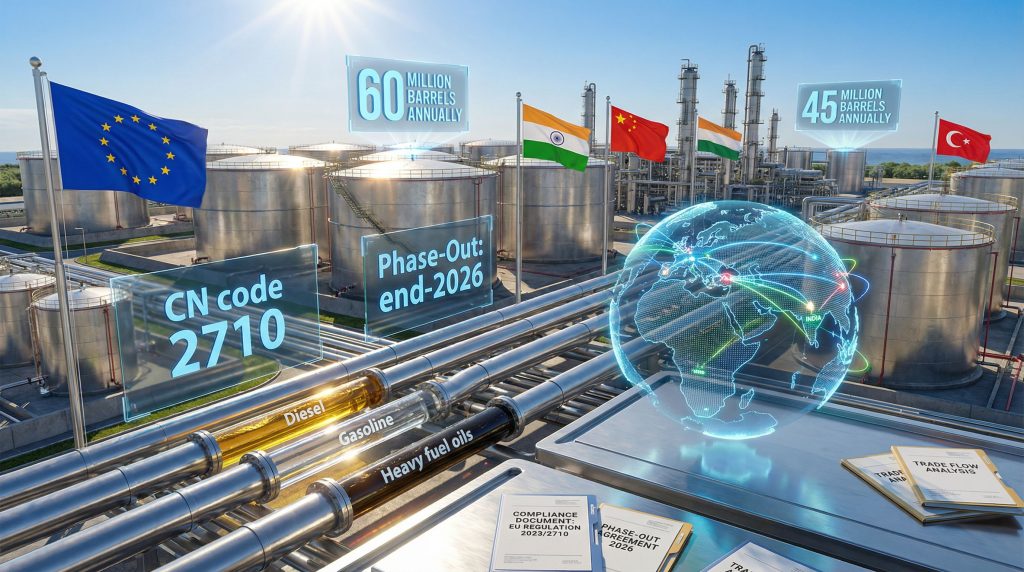
The Combined Nomenclature classification system provides the technical foundation for these restrictions. CN code 2710, which covers petroleum oils and bituminous mineral oils, serves as the primary regulatory framework. This classification encompasses light oils (CN 2710 12), other petroleum oils (CN 2710 19), and waste oils (CN 2710 20), creating a comprehensive coverage framework according to EU documentation.
Modern refineries must implement sophisticated tracking mechanisms to maintain transparency across their processing operations. These systems must demonstrate clear segregation between compliant and potentially restricted product streams throughout the refining process.
Third-Country Refinery Impact Assessment
Several major refining centres face significant operational adjustments due to evolving regulatory requirements. These facilities, which process substantial volumes for international markets, must adapt their operations to maintain compliance whilst preserving commercial viability.
Regional Processing Center Analysis
Table: Major Refining Facilities Under Regulatory Scrutiny
| Region | Key Processing Centers | Estimated Impact Scope | Primary Market Routes |
|---|---|---|---|
| South Asia | Jamnagar Complex, Regional HPCL Facilities | Substantial diesel/gasoil streams | Mediterranean, Northwest Europe |
| East Asia | Zhenhai, Dalian Processing Centers | Integrated product flows | Northern European import terminals |
| Western Asia | TUPRAS Refining Network | Regional product distribution | Black Sea, Southeast European markets |
Note: Capacity figures require verification against current regulatory definitions and may represent affected product streams rather than total facility capacity.
Supply Chain Disruption Patterns
Southeast European markets demonstrate particular vulnerability to supply disruption risks, especially through established regional trade corridors. The Turkey-Romania energy trade relationship, historically significant for regional fuel security, faces substantial reconfiguration requirements.
Northwest European markets benefit from greater supply diversification, reducing immediate vulnerability to regulatory changes. These markets maintain access to multiple supply sources, including West African exports, North American products, and Middle Eastern streams via Mediterranean routes.
Furthermore, the Baltic region represents another critical adjustment zone, where traditional supply arrangements must evolve to accommodate new compliance requirements whilst maintaining energy security objectives. The OPEC meeting impact on global production strategies adds another layer of complexity to these regional adjustments.
Enhanced Due Diligence Implementation Framework
Modern regulatory structures establish presumptive frameworks based on historical trade patterns and crude export data. These systems create asymmetric compliance requirements across different supplier categories, fundamentally altering documentation and verification protocols.
Presumption-Based Regulatory Mechanisms
The regulatory architecture establishes presumptions derived from historical crude export patterns, particularly focusing on 2024 baseline data. Authorities must demonstrate specific origin characteristics through comprehensive documentation, creating differential compliance burdens across various supplier categories.
This framework requires importers to maintain detailed extraction country records, processing facility documentation, and product segregation evidence. Enhanced due diligence protocols apply specifically to products originating from designated high-risk processing locations.
Documentation and Verification Standards
Companies face unprecedented record-keeping requirements covering:
- Crude origin documentation: Detailed extraction country verification
- Processing facility records: Comprehensive facility-level tracking
- Segregation protocols: Evidence of product stream separation
- Chain of custody documentation: Complete supply chain traceability
The complexity extends beyond simple origin tracking, requiring sophisticated systems that can demonstrate product provenance through multiple processing stages and intermediate storage facilities. This regulatory scrutiny aligns with broader EU sanctions developments targeting comprehensive trade restrictions.
Broader Energy Security Transformation
Parallel regulatory developments target natural gas imports through coordinated implementation schedules. These measures create interconnected compliance requirements that reshape European energy procurement strategies comprehensively, particularly affecting the natural gas price forecast outlook.
Coordinated Implementation Timeline
The regulatory framework establishes staggered implementation across different energy sectors:
Liquefied Natural Gas Restrictions
- Phase-out completion targeted for late 2026
- Accelerated implementation potential by mid-2026
- Alternative supply arrangement requirements
Pipeline Gas Import Modifications
- Implementation deadline: September 2027
- Interim restrictions: Mid-2026
- Infrastructure adaptation requirements
Emergency Waiver Mechanisms
- Available under specific circumstances
- Application procedures under development
- Limited duration and scope provisions
Member State Adaptation Requirements
European Union member states must submit comprehensive energy diversification strategies by early 2026. These plans must outline alternative supply arrangements, infrastructure modifications, and timeline compliance measures necessary for regulatory adherence.
The planning process requires detailed analysis of current energy import dependencies, alternative supplier identification, and infrastructure capacity assessments to ensure energy security maintenance throughout the transition period.
Market Adaptation Mechanisms and Price Discovery
The regulatory framework creates new arbitrage opportunities between compliant and non-compliant product streams, potentially establishing dual pricing mechanisms in global markets. These developments affect freight costs, insurance premiums, and documentation requirements across international trade routes.
Emerging Price Dynamics
Enhanced documentation requirements create additional cost layers throughout the supply chain. Freight costs face upward pressure due to complex verification procedures, whilst insurance premiums adjust to accommodate compliance risks and documentation requirements.
The sanctions framework extends comprehensive restrictions across technical assistance, brokering services, financing arrangements, and insurance coverage, creating integrated barriers throughout the entire petroleum product value chain. This development coincides with concerns about the US oil production decline, which could further complicate global supply dynamics.
Alternative Supply Route Development
Market participants actively develop new trade flow patterns to maintain supply security:
West African Export Expansion
- Increased diesel export capacity to European markets
- Enhanced refinery utilisation rates
- Improved logistics infrastructure development
Middle Eastern Product Flows
- Enhanced Mediterranean route utilisation
- Expanded product export terminal capacity
- Improved shipping logistics coordination
North American Capacity Enhancement
- US Gulf Coast export infrastructure expansion
- Canadian product export development
- Enhanced transatlantic shipping capacity
Southeast European Supply Diversification
- Alternative supply chain development
- Regional refining capacity utilisation
- Enhanced storage and distribution networks
However, these alternative routes must contend with the broader challenges of energy export challenges affecting global markets.
The next major ASX story will hit our subscribers first
Operational Compliance Challenges
Companies face unprecedented operational complexity in maintaining compliance whilst preserving commercial viability. The challenges span technical implementation, financial arrangements, and comprehensive value chain management.
Segregation and Processing Complexities
Refineries with integrated processing systems must implement sophisticated tracking mechanisms to maintain product origin transparency throughout their operations. These facilities face particular challenges in demonstrating clear segregation between different crude slates and their resulting product streams.
The operational complexity requires substantial infrastructure investment in tracking systems, documentation protocols, and verification mechanisms. Many facilities must retrofit existing operations to accommodate enhanced transparency requirements.
Comprehensive Value Chain Restrictions
The regulatory framework extends restrictions across multiple service categories:
- Technical assistance services: Engineering and operational support limitations
- Brokering and intermediation: Trading and facilitation service restrictions
- Financial services: Banking, credit, and payment system limitations
- Insurance coverage: Marine, cargo, and facility insurance restrictions
These comprehensive restrictions create interconnected compliance requirements that affect every aspect of petroleum product trade operations.
Effectiveness Assessment and Circumvention Risks
Despite comprehensive regulatory coverage, potential circumvention risks remain through various operational and structural mechanisms. Understanding these vulnerabilities helps assess long-term regulatory effectiveness.
Potential Evasion Mechanisms
Several circumvention approaches may challenge regulatory effectiveness:
Product Re-export Operations
- Utilisation of exempt jurisdictions for product laundering
- Complex shipping routes obscuring ultimate origin
- Enhanced documentation concealment techniques
Ownership Structure Complexity
- Sophisticated corporate structures obscuring beneficial ownership
- Multiple intermediary arrangements
- Enhanced legal entity complexity
Documentation Enhancement
- Sophisticated record alteration techniques
- Complex audit trail manipulation
- Advanced concealment methodologies
Long-term Strategic Effectiveness
The regulatory measures aim to achieve specific revenue reduction objectives whilst maintaining regional energy security. Effectiveness depends significantly on global compliance coordination and enforcement capability development across multiple jurisdictions.
Success requires sustained international cooperation, sophisticated monitoring systems, and continuous adaptation to evolving circumvention techniques. The broader implications extend to the oil price crash analysis affecting global market dynamics.
Industry Participant Strategic Positioning
Companies must balance immediate operational adjustments with long-term strategic planning to navigate the evolving regulatory landscape successfully.
Short-term Market Adjustments
Market participants should anticipate several immediate developments:
- Enhanced compliance costs: Substantial increases in documentation and verification expenses
- Regional supply disruptions: Temporary shortages in Southeast European markets
- Price volatility increases: Enhanced market uncertainty during transition periods
- Alternative arrangement acceleration: Rapid development of compliant supply chains
Strategic Competitive Positioning
Organisations with diversified supply chains and robust compliance systems gain significant competitive advantages in the evolving market environment. Companies heavily dependent on affected trade routes face substantial operational restructuring requirements and associated costs.
Successful navigation requires sophisticated supply chain management capabilities, enhanced documentation systems, and strategic positioning across alternative trade routes and supplier relationships.
Investment in compliance infrastructure, diversified supplier networks, and flexible logistics capabilities becomes critical for maintaining market position throughout the regulatory transition period.
The regulatory evolution represents a permanent shift in global petroleum product trade dynamics, requiring sustained adaptation rather than temporary adjustment strategies. EU sanctions on refined product flows fundamentally reshape how companies approach international energy trade, necessitating comprehensive strategic realignment across operational, financial, and compliance frameworks.
Disclaimer: This analysis is based on publicly available information regarding EU sanctions on refined product flows. Implementation details, enforcement mechanisms, and specific regulatory interpretations may evolve. Companies should consult official regulatory guidance and qualified legal counsel for compliance planning purposes.
Ready to Navigate Complex Energy Market Disruptions?
Discovery Alert's proprietary Discovery IQ model provides immediate insights into ASX mineral discoveries, helping investors identify opportunities amid global energy market volatility and regulatory shifts. Start your 30-day free trial today to stay ahead of market developments and position yourself for success in an increasingly complex investment landscape.