August 25, 2026
Regulatory Transformation in Southeast Asian Secondary Metal Markets
Global secondary metal markets face unprecedented disruption as regulatory frameworks evolve rapidly across Southeast Asia. The convergence of international environmental protocols, domestic policy enforcement, and supply chain security concerns has created a complex landscape where traditional waste processing models confront systematic restructuring pressures. Furthermore, these developments align with broader industry transformation trends reshaping global commodity sectors.
The transformation extends beyond isolated policy adjustments, representing fundamental shifts in how nations balance economic development with environmental protection. These changes cascade through multiple commodity sectors, affecting everything from battery material processing to base metal recycling operations.
When big ASX news breaks, our subscribers know first
Understanding Malaysia's Strategic Policy Transition
Malaysia's February 4, 2026 implementation of absolute electronic waste import restrictions marks a decisive departure from conditional regulatory frameworks. This transition eliminates the discretionary exemption system previously administered by the Department of Environment, creating unambiguous enforcement parameters under Customs Order 2023.
The policy evolution reflects Malaysia's position as a principal destination for electronic waste streams from developed nations. According to Reuters, Malaysia received substantial waste volumes primarily from the United States, Japan, Germany, the United Kingdom, and Australia.
Enforcement Structure and Multi-Agency Coordination
The Malaysia Border Control and Protection Agency (MCBA) leads enforcement operations under the direction of Port Klang commander Datuk Nik Ezanee Mohd Faisal. This multi-agency framework coordinates through the Malaysian Anti-Corruption Commission, eliminating previous regulatory ambiguities that permitted illegal shipment infiltration.
MACC Chief Commissioner Azam Baki emphasized the enforcement imperative, stating that electronic waste importation is no longer permitted under any circumstances. The coordination structure represents recognition that conditional frameworks created enforcement gaps exploited by non-compliant operators.
Historical Context and Regulatory Evolution
Malaysia's current policy builds upon previous restriction attempts in 2012 and 2017. The persistence of illegal importation despite these earlier measures demonstrates the inadequacy of conditional prohibition frameworks, necessitating the absolute ban approach.
Key regulatory milestones include:
• May 2024: SIRIM guidelines requiring Certificate of Approval for all incoming scrap cargoes
• January 2025: Basel Convention amendments expanding electronic waste classification scope
• February 2026: Implementation of absolute import prohibition
Battery Recycling Supply Chain Reconfiguration
The Malaysia e-waste import ban creates immediate feedstock constraints for lithium-ion battery processing facilities throughout Southeast Asia. Malaysian battery recyclers historically depended on imported end-of-life battery streams, lacking sufficient domestic collection volumes to support existing processing capacity. Moreover, recent battery recycling breakthrough developments demonstrate the strategic importance of maintaining processing capabilities.
Processing Capacity and Market Dependencies
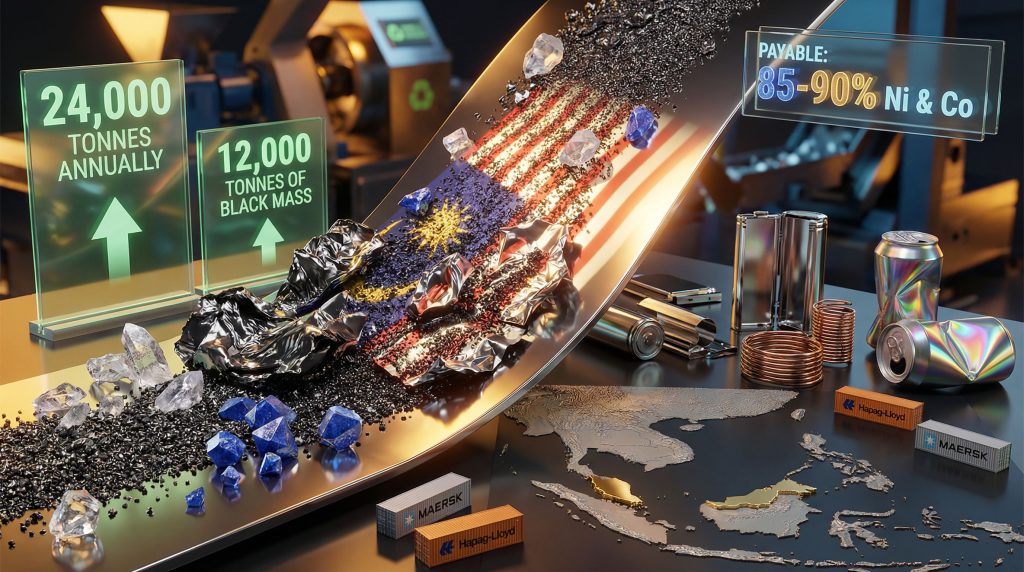
Malaysia's battery recycling infrastructure processes 24,000 tonnes annually of battery scrap and 12,000 tonnes of black mass through facilities concentrated in Perak state. This processing capacity positioned Malaysia as a strategic midstream hub connecting Western oversupply with Asian demand.
EcoNiLi Battery New Energy operates the primary processing facility, employing hydrometallurgical processes that accept high-fluoride content black mass. This technical capability addresses the less-than-0.4% water-soluble fluoride limit imposed by Chinese importers, creating competitive advantages in processing Western materials.
Black Mass Market Dynamics
Black mass payable indicators demonstrate immediate market response to supply constraints. Nickel and cobalt payables reached 95-100% on February 4, 2026, representing substantial increases from 85-90% levels in January 2026.
| Payable Metric | January 2026 | Early February | Post-Ban (Feb 4) |
|---|---|---|---|
| Nickel Payable (% LME) | 85-90% | 91-96% | 95-100% |
| Cobalt Payable (% Standard-grade) | 85-90% | 91-96% | 95-100% |
| Lithium Payable (% Li2CO3) | 0% | 0% | 0% |
The lithium payable remaining at zero percent since October 15 reflects distinct market dynamics where lithium carbonate pricing mechanisms differ from nickel and cobalt recovery economics.
Supply Chain Arbitrage and Processing Hub Strategy
Malaysian processors leverage geographic positioning between Western black mass oversupply and Chinese cathode active material demand. This arbitrage opportunity emerged following China's August 1, 2025 opening of black mass imports, creating competitive bidding dynamics for high-quality materials.
EcoNiLi CEO Jayden Goh articulated the strategic positioning, explaining that their hydrometallurgical processes solve Western export challenges while addressing Chinese supply requirements simultaneously. The facility produces specification-grade lithium carbonate and mixed hydroxide precipitate meeting Chinese manufacturing standards.
Cost Structure Implications
Southeast Asian trading sources indicate that enhanced enforcement makes alternative smuggling pathways significantly more expensive. These increased transportation and compliance costs create upward pressure on black mass production expenses, contributing to higher payable rates even when physical supply volumes remain stable.
Domestic Market Transformation and Processing Investment
Domestic collection entities view the import prohibition as a catalyst for local capacity expansion. Regulated Malaysian operators anticipate increased domestic e-waste recovery rates as processing facilities seek feedstock gap-filling opportunities. In addition, this shift aligns with broader sustainability transformation initiatives across the mining sector.
Market Vacuum and Collection Incentives
ERTH founder Mohamed Tarek El-Fatatry characterised the regulatory shift as addressing systematic disadvantages faced by domestic collectors. Previously, large import volumes created container inspection challenges, mixing compliant and non-compliant materials in ways that prevented effective policing.
The absolute ban creates regulatory clarity that benefits regulated market participants while eliminating the dilution effects of illegal import streams on domestic supply chains.
El-Fatatry noted that illegal shipment flows previously diverted attention from domestic supply development, leaving regulated local participants competing for processing capacity occupied by foreign materials. The ban creates processing demand that domestic operators can fulfil through scaled collection operations.
Strategic Processing Hub Development
Malaysia maintains competitive advantages as a midstream processing location despite supply uncertainties. Lower operating costs compared to European and US facilities, combined with strategic geographic connectivity, support continued investment in processing technology and capacity expansion.
The policy alignment with Malaysia's strategic positioning leverages cost structure advantages while addressing Western export problems and Chinese supply requirements through intermediate processing capabilities.
Aluminium Scrap Market Pressures and Container Detention Crisis
The regulatory tightening extends beyond battery materials, creating collateral disruption across aluminium scrap processing operations. US aluminium exports to Malaysia declined 16.59% over January-November 2025, with Malaysia's share of total US aluminium exports falling from 19.53% to 14.18%.
SIRIM Certification Requirements and Port Delays
The May 2024 SIRIM guideline update mandating Certificate of Approval for all incoming scrap cargoes created systematic inspection bottlenecks. Malaysian port authorities conduct tedious inspections on each inbound scrap shipment, generating extended delays and detention risks.
Combined with January 2025 Basel Convention amendments creating classification uncertainty, these factors have resulted in container detention periods approaching two years at Port Klang for some shipments.
Zorba Pricing Response and Market Exits
Zorba (recycled aluminium) pricing increased substantially from June 2025 troughs, reaching $2,400-2,480 per tonne on February 3, 2026. This represents a $480-520 per tonne increase, approximately 26-27% above previous levels.
The pricing pressure coincided with a major zorba processor shutdown in April 2025, demonstrating how container detentions and tightened customs inspections eroded operational viability for Malaysian smelters.
Ocean Carrier Liability Shifts
Major shipping companies responded to enforcement risks by transferring compliance burdens to shippers. Hapag-Lloyd implemented Letter of Indemnity requirements for all Southeast Asian scrap bookings from February 2026, while Maersk enhanced misdeclaration fee enforcement for cargoes with undeclared waste content.
These carrier policies reflect systematic risk avoidance strategies, legally insulating shipping companies from Malaysian port authority enforcement actions through shipper liability transfer mechanisms.
Copper Secondary Supply Constraints and Infrastructure Impacts
The prohibition creates broader implications for copper recycling operations, where electronic waste represents a critical secondary supply source. Malaysia's role in processing copper-containing materials faces disruption at a time when the global copper supply forecast emphasises the strategic importance of secondary supply channels.
Market Response and Pricing Dynamics
No1 copper material premiums expanded to 29-41 cents per lb by January 26, 2026, representing increases of 3-9 cents per lb from December 2025 levels. This pricing response reflects tightening secondary supply availability amid robust demand from China, India, and Japan.
Infrastructure Theft Correlation
The surge in London Metal Exchange copper futures during January 2026 correlated with increased infrastructure theft incidents in Malaysia. Illegal operators targeted copper-containing cables and infrastructure, responding to elevated metal values through enhanced recovery activities.
This phenomenon demonstrates how regulatory restrictions on legitimate secondary supply channels can incentivise alternative recovery methods, creating unintended consequences for infrastructure security.
The next major ASX story will hit our subscribers first
International Regulatory Convergence and Trade Pattern Evolution
Malaysia's policy shift reflects broader international regulatory tightening, including Basel Convention amendments and EU export restrictions creating systemic pressure on global waste trade flows. The January 2025 Basel Convention updates expanded electronic waste classification scope, leading Southeast Asian authorities to adopt stricter interpretation protocols. However, according to Eco-Business, environmental concerns remain the primary driver for these policy changes.
EU Export Restrictions and Market Access
The 2025 EU ban on WEEE exports to non-OECD nations including Malaysia represents parallel regulatory development restricting traditional waste trade patterns. These concurrent policy changes eliminate multiple supply pathways, concentrating pressure on remaining processing locations. Consequently, the development of an European CRM facility becomes increasingly critical for European supply security.
Regional Enforcement Coordination
Thailand and Malaysia's adoption of stricter Basel Convention interpretations demonstrates regional enforcement coordination. This convergence suggests systematic rather than isolated policy development, indicating sustained pressure on traditional waste processing models throughout Southeast Asia.
Strategic Market Structure Implications and Investment Drivers
The prohibition catalyses fundamental restructuring of regional recycling ecosystems, potentially accelerating domestic processing investment while creating supply chain vulnerabilities. Market participants face immediate adaptation requirements through alternative sourcing, technology investment, or operational restructuring.
Capacity Development and Technology Investment
Domestic processing infrastructure investment acceleration represents the primary adaptation strategy for Malaysian operators. Enhanced processing technology adoption for local waste stream optimisation becomes essential as import-dependent facilities lose feedstock access.
The regulatory framework creates competitive advantages for processors with domestic collection capabilities while disadvantaging facilities dependent on imported materials.
Supply Chain Resilience and Market Concentration
Reduced dependence on imported feedstock streams enhances supply chain resilience but may contribute to market concentration as smaller processors lacking domestic collection networks face operational challenges.
Processing facilities with integrated collection and processing capabilities gain competitive positioning through vertical integration advantages, potentially accelerating industry consolidation trends.
Long-Term Outlook and Policy Uncertainty
The duration of Malaysia's import moratorium remains unclear, with government agencies required to present economic impact assessments before final policy determination. The Ministry of Investment, Trade and Industry, National Solid Waste Management Department, and Solid Waste and Public Cleansing Management Corporation must evaluate sector contributions to economic development and national revenue.
Prime Minister Datuk Seri Anwar Ibrahim's office awaits comprehensive analysis of industry needs and economic implications, indicating that current restrictions may be subject to modification based on assessment findings.
Market Adaptation Strategies
Battery recyclers dependent on imported feedstock pursue multiple adaptation pathways:
• Domestic collection scaling through enhanced local waste stream development
• Alternative regional sourcing from Southeast Asian countries maintaining import capacity
• Processing technology investment optimising local material utilisation
• Supply chain diversification reducing single-source dependencies
Strategic Positioning Considerations
Despite short-term supply constraints, the policy potentially strengthens Malaysia's strategic midstream processing role through enhanced domestic capacity development. The elimination of illegal import streams creates processing demand that regulated operators can fulfil through scaled domestic collection operations.
Malaysian processing facilities maintaining cost advantages and geographic connectivity between Western suppliers and Asian consumers retain competitive positioning despite feedstock uncertainties.
This analysis incorporates market data and industry research available through February 2026. Regulatory frameworks and market conditions continue evolving rapidly across Southeast Asian secondary metal markets. Investment and operational decisions should consider ongoing policy uncertainty and supply chain adaptation requirements.
Ready to Capitalise on Southeast Asian Metal Market Disruptions?
Discovery Alert's proprietary Discovery IQ model instantly identifies ASX-listed companies positioned to benefit from global supply chain shifts like Malaysia's e-waste import ban, providing subscribers with immediate insights into emerging opportunities across critical metals and recycling sectors. Start your 14-day free trial today and gain the market edge needed to navigate rapidly evolving commodity landscapes before broader market recognition drives prices higher.