August 4, 2026
India's Energy Import Crisis Is Forcing a Structural Rethink at the Conglomerate Level
Every major industrial economy has faced a defining moment when the cost of energy dependency becomes too high to ignore. For the United States, it was the 1973 oil shock. For Japan, it was the post-Fukushima reckoning. For India, that inflection point is arriving now — not through a single crisis, but through the accumulating weight of a structural reality that has become impossible to manage through incremental policy responses alone.
India imports more than 70% of its total energy requirements from overseas markets. This single figure carries enormous consequences: it means that every major geopolitical disruption, every supply chain dislocation, and every commodity price spike translates almost immediately into domestic inflation, currency pressure, and industrial cost escalation. When crude oil markets tighten, India does not merely pay more at the pump — it watches its current account deteriorate, its rupee weaken, and its manufacturing competitiveness erode in real time.
It is within this context that the concept of the Reliance energy supercycle becomes meaningful. Understanding what this term implies, how the strategy is being constructed, and what it could mean for India's industrial future requires looking well beyond the individual project announcements and examining the deeper structural logic that underlies the entire investment thesis.
When big ASX news breaks, our subscribers know first
The Strategic Architecture: Why Reliance's Approach Is Different From Conventional Renewable Investment
Most renewable energy investments operate within a single vertical. A company builds solar farms, or develops wind projects, or invests in battery storage expansion. What Reliance Industries has assembled is categorically different in its architectural ambition. The strategy is built around vertical integration across the entire clean energy value chain — from raw material processing through to generation, storage, and distribution — treating energy not as a utility business but as a manufacturing and industrial competitiveness challenge.
The seven pillars of Reliance's new energy strategy reflect this breadth:
| Energy Vertical | Technology Focus | Strategic Role |
|---|---|---|
| Solar Power | Heterojunction Technology (HJT) Modules | Domestic manufacturing and utility generation |
| Battery Storage | Lithium Iron Phosphate (LFP) Cells | Grid stability and EV supply chain |
| Wind Energy | Onshore and Offshore Development | Diversified renewable generation |
| Green Hydrogen | Electrolysis and Green Ammonia | Export revenue and industrial decarbonisation |
| Compressed Biogas (CBG) | Agricultural waste conversion | Rural energy and import substitution |
| Bioenergy | Biomass processing | Baseload renewable complement |
| Underground Coal Gasification (UCG) | In-situ gasification | Transitional domestic fuel security |
The logic connecting these verticals is energy security achieved through domestic production abundance — not just through a single technology pathway but through multiple redundant systems that collectively reduce the points of failure in India's energy supply.
The Geopolitical Stress Test: What Middle East Volatility Revealed About India's Exposure
The vulnerability of India's energy supply chains is not theoretical. Earlier this year, tensions in the Middle East created measurable stress across India's import-dependent energy infrastructure. Reliance's Jamnagar refinery, the world's largest single-location oil refining complex, maintained near-full utilisation during this period — a technically impressive outcome that simultaneously highlighted the systemic fragility it was operating within.
Furthermore, critical minerals and energy security have become increasingly intertwined with geopolitical risk management, adding another layer of complexity to India's import dependency.
"The fact that India's largest refiner had to manage supply chain disruptions while increasing domestic LPG output to offset import shortfalls is not a success story in energy security terms. It is a demonstration of how close to the margin India already operates."
The cost architecture of this dependency is layered. Price volatility is the most visible dimension, but currency exposure compounds it significantly. When global oil prices rise, India pays more in dollar terms, and the resulting current account pressure simultaneously weakens the rupee, increasing the effective cost of those imports even further. Supply chain fragility adds a third dimension: any disruption to the Persian Gulf shipping lanes, which handle the majority of India's crude imports, has no readily available domestic substitute at present scale.
This is the structural argument underpinning the Reliance energy supercycle thesis. The company's leadership has publicly framed this dependency as unsustainable over the long run, positioning the entire new energy investment programme as a response to a systemic national vulnerability rather than simply a business opportunity.
Inside the Dhirubhai Ambani Green Energy Giga Complex
What Makes the Jamnagar Complex Unique?
The most capital-intensive element of Reliance's renewable energy buildout is centred at Jamnagar, at a facility called the Dhirubhai Ambani Green Energy Giga Complex. What makes this complex strategically distinct from conventional solar manufacturing is its commitment to full vertical integration within a single geographic footprint.
Solar module manufacturing is typically a disaggregated industry. Polysilicon is produced in one country, wafers are cut in another, cells are fabricated elsewhere, and modules are assembled in yet another facility. Each transfer point in this chain represents a cost, a logistics risk, and a potential geopolitical exposure. Reliance's approach is to collapse this entire chain into one location.
The complex has already begun operations, with nearly 1 GW of heterojunction technology (HJT) solar modules currently in production. HJT is technically noteworthy because it achieves higher conversion efficiencies than conventional PERC technology by combining monocrystalline silicon cells with thin amorphous silicon layers, typically reaching module efficiencies above 22%. This positions Reliance's manufacturing output at the premium end of the global solar module market rather than in the commoditised low-efficiency segment where Chinese producers dominate on cost.
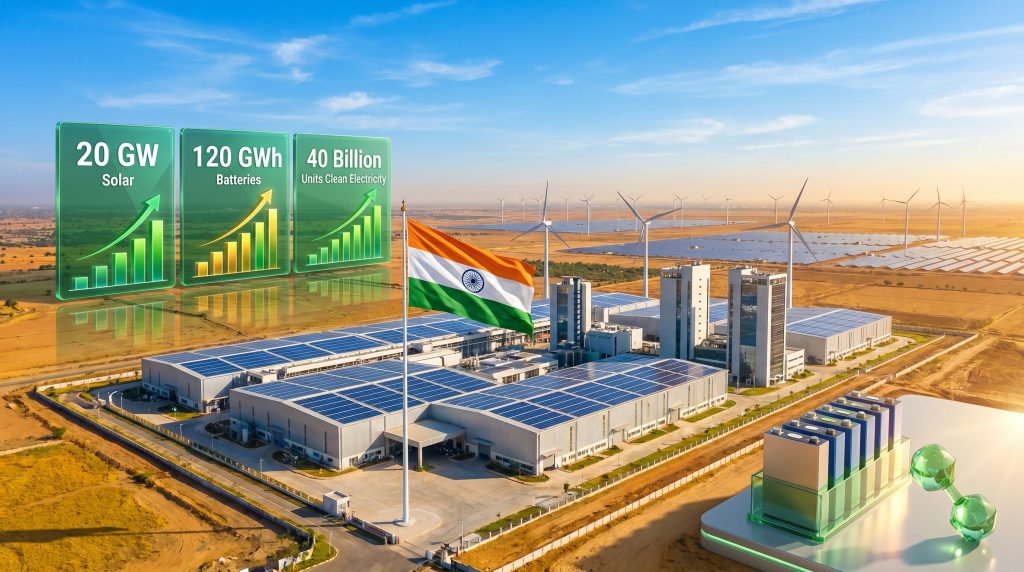
The long-term manufacturing target is 20 GW of fully integrated annual capacity spanning polysilicon production, wafer slicing, cell fabrication, and module assembly — making this one of the most vertically integrated solar manufacturing facilities globally when completed.
Alongside the manufacturing buildout, the company is deploying artificial intelligence and automation across Jamnagar's refining operations, with a stated ambition to develop what would be the world's first fully autonomous refinery. This AI integration across both clean and conventional energy operations reflects a broader industrial philosophy: that the next competitive advantage in energy is not just what you produce, but how efficiently your production systems can operate without human intervention.
The Battery Manufacturing Race: Where India Could Compete at Global Scale
Perhaps the most strategically significant individual element of Reliance's renewable investments is its battery manufacturing programme. The first phase of a 40 GWh annual battery cell factory is expected to be commissioned in FY2026, with a long-term target of scaling capacity to 120 GWh annually.
To understand the significance of that figure, consider where it sits within the global battery manufacturing landscape:
| Manufacturer | Country | Annual Capacity Target (GWh) | Chemistry Focus |
|---|---|---|---|
| CATL | China | 600+ GWh | LFP and NMC |
| BYD | China | 400+ GWh | LFP |
| LG Energy Solution | South Korea | 200+ GWh | NMC |
| Reliance Industries | India | 120 GWh (target) | LFP |
| Northvolt | Sweden | 60 GWh (planned) | NMC |
Reliance's selection of Lithium Iron Phosphate (LFP) chemistry over alternatives like NMC (Nickel Manganese Cobalt) is a considered technical decision. LFP cells offer lower energy density than NMC but deliver superior thermal stability, longer cycle life, and lower raw material cost. Critically, LFP chemistry does not depend on cobalt — a geopolitically concentrated mineral with its own supply chain risks. For a company building battery production in India to address energy security concerns, choosing a chemistry that avoids cobalt dependency represents a structurally coherent decision.
In addition, India's lithium investment push is accelerating in parallel, further reinforcing the country's ambition to control more of the battery supply chain domestically. If the 120 GWh target is achieved, Reliance would rank as one of the four largest battery cell manufacturers in the world outside China — a position that would have seemed implausible for an Indian company as recently as five years ago.
The Kutch Renewable Energy Hub: Contextualising 550,000 Acres
Scale is genuinely difficult to contextualise in renewable energy projects, because the numbers involved exceed ordinary frames of reference. The renewable energy hub Reliance is developing across 550,000 acres in Gujarat's Kutch region is a useful example.
To put 550,000 acres in perspective: that is approximately 860 square miles — a land area larger than the entire metropolitan footprint of Mumbai. Across this footprint, Reliance is deploying integrated solar generation and battery storage infrastructure designed to produce more than 40 billion units of renewable electricity annually upon full completion.
"Once fully operational, the Kutch hub's projected output of 40 billion units annually represents approximately 3% of India's total current power consumption, making it one of the largest single renewable energy infrastructure projects undertaken by a private corporation anywhere in the world."
The geographic logic of Kutch is sound. The region receives among the highest solar irradiance levels in India, offers vast uninhabited land suitable for large-scale development, and sits within Gujarat — a state with well-developed industrial infrastructure and port access relevant to both supply chain logistics and potential green hydrogen export operations.
The next major ASX story will hit our subscribers first
Green Hydrogen and Green Ammonia: Building an Export Business From Clean Energy
One of the less immediately obvious dimensions of Reliance's renewable energy strategy is its orientation toward clean fuel exports. Green hydrogen is expensive to transport in molecular form, so the most commercially practical pathway for international trade is conversion to green ammonia, which can be handled using existing shipping and port infrastructure developed for conventional ammonia trade.
Reliance has already signed a long-term $3 billion supply agreement with Samsung C&T for green ammonia, described as one of the largest such agreements concluded globally. The company is also in advanced discussions with prospective buyers in Japan, South Korea, and Europe — all of which are jurisdictions actively seeking to import green hydrogen derivatives to meet their own decarbonisation commitments.
The long-term production target is 3 million tonnes of green hydrogen by 2032. At current projections for green hydrogen economics, this represents a business with the potential to generate substantial export revenue while simultaneously providing a domestic demand anchor for Reliance's renewable electricity generation capacity.
A detail worth understanding here: green ammonia production requires very large quantities of renewable electricity, because electrolysis is energy-intensive. This creates a logical interdependency between the Kutch renewable hub, the green hydrogen production ambition, and the battery storage infrastructure — all three segments reinforce each other's economics within the integrated system. The broader energy transition mining sector is similarly grappling with these supply chain interdependencies at a global scale.
Chemicals Expansion: The Industrial Bridge Between Fossil Fuels and Clean Energy
Reliance's chemicals expansion programme occupies a strategically interesting position within the broader investment thesis. It generates near-term cash flows from domestically produced higher-value materials while simultaneously providing the industrial infrastructure relevant to the clean energy transition.
Key projects under active development include:
- A 3 million tonne purified terephthalic acid (PTA) facility at Dahej, which reduces India's dependence on imported PTA used in polyester and packaging production.
- A carbon fibre manufacturing plant at Hazira, producing materials critical for wind turbine blades, aerospace structures, and lightweight EV components. Carbon fibre is one of the most strategically significant advanced materials in the clean energy transition and currently remains heavily import-dependent across most markets.
- A 1.2 million tonne PVC plant at Nagothane, targeting reduction of construction materials import dependency at a time when India's infrastructure build-out requires vast quantities of polymer-based products.
Carbon fibre deserves particular attention because it sits at the intersection of multiple megatrends simultaneously: the expansion of wind energy (turbine blades), the lightweighting of electric vehicles, and the decarbonisation of aviation. Domestic carbon fibre production in India would represent a significant industrial capability upgrade that goes well beyond the clean energy sector.
The BP Joint Venture: Managing the Transition Without Abandoning Energy Security
Reliance's joint venture with BP in the KG-D6 deepwater basin currently produces approximately 30% of India's total domestic natural gas output. This position is significant for understanding how the company is managing the transition between its legacy fossil fuel business and its clean energy ambitions.
Natural gas occupies a structurally important role in India's energy transition pathway. It burns more cleanly than coal, can provide dispatchable generation capacity that complements intermittent renewables, and can potentially be substituted with green hydrogen in industrial applications over time. Continued investment in domestic gas production reduces India's exposure to liquefied natural gas import prices, which have been among the most volatile commodity markets globally since 2021.
The BP JV therefore functions as a transition asset: it generates cash flows that help fund the new energy capital programme, it reduces one category of energy import dependency in the near term, and it provides a bridge fuel supply that can support grid stability during the years when renewable capacity is still ramping up.
Compressed Biogas: The Overlooked Rural Dimension
Among all of Reliance's energy verticals, compressed biogas (CBG) receives the least analytical attention despite having some of the most interesting structural characteristics. CBG is produced by anaerobic digestion of agricultural waste, food waste, and organic matter — converting material that would otherwise generate methane emissions as it decomposes into a controlled, usable fuel source.
Reliance has set a target of more than 500 CBG plants operational by 2030. This is significant for several reasons:
- CBG produces dispatchable energy unlike solar and wind, meaning it can be produced on demand regardless of weather conditions.
- It creates a rural economic infrastructure by giving farmers a revenue stream from organic waste that currently has little commercial value.
- It provides import substitution for LPG and natural gas in rural applications where grid connectivity is limited.
- Each plant generates local employment in construction, operations, and feedstock collection.
The combination of baseload characteristics, rural economic multipliers, and import substitution benefits makes CBG the most overlooked high-impact component of the overall programme.
Financial Timeline and the Investment Horizon Investors Need to Understand
Commercial revenue from the solar manufacturing business is expected to begin in 2026, with battery cell production scheduled to come online in FY2027. Reliance's New Energy division is expected to begin making a meaningful contribution to consolidated group financial performance from FY2027 onward.
Furthermore, technologies such as direct lithium extraction are expected to improve battery input economics over this same period, potentially benefiting producers who have locked in LFP chemistry strategies.
"Investor Note: The ₹5 trillion investment commitment across clean energy, chemicals, and advanced materials is deployed over a 10 to 15 year horizon. Investors evaluating Reliance's new energy position should understand that near-term earnings contributions will be modest, with the financial weight of the strategy shifting progressively toward cleaner revenue streams through the late 2020s and into the 2030s. This is a structural repositioning thesis, not a near-term earnings catalyst."
Employment and Economic Multiplier Effects
Reliance estimates that its clean energy investments will generate approximately 200,000 direct jobs over time across the full programme. Reliance's green energy ecosystem has been publicly cited as a major driver of this employment ambition. Employment distribution is expected to concentrate in several key segments:
- Manufacturing operations at the Jamnagar Giga Complex and battery factory
- Construction and engineering across the Kutch renewable hub development
- CBG plant operations distributed across rural Gujarat, Uttar Pradesh, and Maharashtra
- Operations and maintenance for utility-scale solar and wind assets
The regional economic impact is likely to be most concentrated in Gujarat, given the density of Jamnagar, Kutch, and Dahej facilities within the state. Uttar Pradesh's 10 GW renewable commitment also positions it as a significant secondary beneficiary of the broader investment programme.
Comparing Reliance's Ambition Against India's National Renewable Targets
India has committed to achieving 500 GW of non-fossil electricity capacity by 2030 — a target that requires sustained deployment across solar, wind, hydropower, and nuclear at a pace the country has not previously achieved. Private capital at the scale Reliance is deploying is an essential component of closing that gap.
| Metric | India National Target | Reliance Contribution (Planned) |
|---|---|---|
| Renewable Capacity | 500 GW by 2030 | 100 GW (long-term) |
| Solar Manufacturing | Domestic supply chain development | 20 GW annual capacity |
| Battery Storage | Grid-scale deployment | 120 GWh annual production |
| Green Hydrogen | 5 MMT by 2030 | 3 MMT by 2032 |
| Employment (Clean Energy) | Millions across sector | ~200,000 direct jobs |
It is important to note that these national targets represent policy frameworks and aspirational goals. Reliance's contribution represents the company's own planned investment commitments, not formally designated government projects or guaranteed outcomes. The alignment between Reliance's strategy and India's national energy policy direction creates favourable market conditions, but investors should not interpret this alignment as project-specific government backing or guaranteed regulatory support.
Key Risks: What Could Disrupt the Supercycle Thesis
No analysis of Reliance's renewable investment programme would be complete without a clear-eyed assessment of the execution risks involved:
Technology execution risk is perhaps the most acute near-term concern. Scaling HJT solar manufacturing and LFP battery cell production from current levels to the multi-gigawatt targets planned requires technical mastery that has historically challenged even well-resourced manufacturers. China's dominance in both sectors reflects decades of iterative improvement, not simply capital deployment.
Capital allocation risk is structural. Reliance is simultaneously managing a world-scale refining business, one of India's largest telecom operators (Jio), a vast retail network, and now a new energy platform. Each of these divisions competes for management attention and capital at a time when all are in active investment phases.
Cost competitiveness against Chinese solar and battery manufacturers represents the benchmark Reliance must match to achieve commercial viability without long-term dependence on domestic market preferences. Chinese LFP battery producers have compressed costs to levels that most non-Chinese manufacturers have found structurally difficult to replicate.
Policy continuity is a long-term consideration. The economics of green hydrogen, domestic solar manufacturing, and CBG all benefit from supportive domestic energy policy, and any significant shift in the regulatory environment could affect project returns.
Scenario Analysis: Three Pathways for the Reliance Energy Supercycle
Scenario 1: Accelerated Execution
Manufacturing scale-up proceeds on schedule, green hydrogen export economics improve faster than anticipated, and India becomes a net clean energy exporter in select product categories by 2035. The Reliance energy supercycle thesis is validated as a full industrial transformation.
Scenario 2: Moderate Progress
Core renewable manufacturing achieves its targets, domestic energy security improves materially, but export ambitions in green ammonia face delays due to global pricing pressures or infrastructure constraints. New Energy becomes a significant but not dominant contributor to group revenue by the early 2030s.
Scenario 3: Execution Shortfall
Technology scale-up lags, cost competitiveness against Chinese producers proves elusive, and capital demands from other group businesses constrain New Energy investment pacing. Import dependency in specific sectors persists beyond 2030, and the supercycle thesis requires a multi-year timeline extension.
This scenario analysis is speculative and presented for illustrative purposes only. It does not constitute financial advice. Past corporate strategy outcomes are not indicative of future results.
Frequently Asked Questions: Reliance Energy Supercycle and Renewable Investments
What does Reliance mean by an energy supercycle in India?
The term refers to Reliance's view that India is entering a prolonged structural phase of rapidly expanding energy demand driven by industrialisation, population growth, and rising living standards — creating conditions where sustained long-term investment in domestic energy production becomes both economically compelling and strategically necessary.
How much is Reliance investing in renewable energy overall?
Reliance has committed approximately ₹5 trillion across its clean energy programme, deployed over a 10 to 15 year investment horizon spanning solar manufacturing, battery production, green hydrogen, CBG, and utility-scale generation.
When will Reliance's battery factory begin production?
The first phase of the 40 GWh battery cell factory is expected to be commissioned in FY2026, with the broader 120 GWh capacity target representing a longer-term expansion objective.
What is the Kutch renewable energy project and how big is it?
The Kutch project covers 550,000 acres of land in Gujarat and combines solar generation with battery storage to target annual output of more than 40 billion units of renewable electricity — equivalent to approximately 3% of India's current total power consumption.
Is Reliance's green hydrogen business focused on domestic use or exports?
Both. Green hydrogen and green ammonia are positioned as domestic industrial decarbonisation tools and as export products targeting buyers in Japan, South Korea, and Europe. The $3 billion Samsung C&T green ammonia agreement represents the first major export commercial arrangement to be formalised.
How does Reliance's clean energy strategy affect India's energy import dependency?
If fully executed, the strategy would reduce India's reliance on imported crude oil, LNG, and refined products through domestic renewable generation, domestic battery storage, domestic gas production via the BP JV, and CBG as a substitute for imported LPG in rural applications.
What chemicals projects is Reliance developing alongside its renewables push?
Key projects include a 3 million tonne PTA facility at Dahej, a carbon fibre plant at Hazira, and a 1.2 million tonne PVC facility at Nagothane — each targeting import substitution in strategically significant material categories.
This article is intended for informational purposes only and does not constitute financial or investment advice. Projections, targets, and timelines referenced represent company statements and forward-looking assumptions that are subject to material execution, market, and regulatory risks. Readers should conduct independent research before making investment decisions. For further coverage of India's energy transition and renewable sector developments, ET EnergyWorld provides ongoing reporting at energy.economictimes.indiatimes.com.
Want to Track the Next Major Resource Discovery Powering India's Energy Transition?
As India's clean energy supercycle accelerates demand for lithium, critical minerals, and battery materials, the ASX companies supplying those resources could represent significant investment opportunities — and Discovery Alert's proprietary Discovery IQ model delivers real-time alerts the moment significant mineral discoveries are announced, ensuring subscribers are positioned ahead of the broader market. Explore historic discovery returns on Discovery Alert's discoveries page and begin your 14-day free trial today to secure a genuine market-leading edge.