August 4, 2026
The Tantalum Supply Chain Is Quietly Fracturing — and One Namibian Project Is Perfectly Positioned
Most industrial commodities command attention through price spikes, headlines, or geopolitical flashpoints. Tantalum operates differently. It is a metal that quietly underpins some of the most sophisticated technologies on the planet, yet its supply chain receives a fraction of the scrutiny afforded to lithium, cobalt, or copper. That invisibility is now changing, and the implications for construction-ready projects like the Swanson Tantalum Project in Namibia are significant.
Tantalum is a refractory metal prized for its exceptional resistance to heat and corrosion, its high melting point of approximately 3,017°C, and its ability to form ultra-thin oxide layers that make it ideal for capacitor manufacturing. These properties make it functionally irreplaceable in a range of critical applications, including:
- Tantalum electrolytic capacitors used in smartphones, laptops, and medical devices
- Aerospace and defence components requiring high-temperature stability
- Superalloys for jet engine turbine blades
- Medical implants including pacemakers and bone repair devices
- Next-generation power management circuits in electric vehicles and data centre infrastructure
What makes tantalum especially strategically sensitive is the extreme geographic concentration of its production. A handful of countries, primarily the Democratic Republic of Congo (DRC), Rwanda, and a small number of other producers, have historically accounted for the overwhelming majority of global output. Much of this supply originates from artisanal and small-scale mining operations that face persistent scrutiny under conflict-mineral regulations, including provisions of the US Dodd-Frank Act and the EU Conflict Minerals Regulation. This regulatory environment has structurally embedded a premium for ethically sourced, traceable tantalum that goes beyond ordinary spot-market pricing.
When big ASX news breaks, our subscribers know first
What the Swanson Tantalum Project Actually Represents Geologically
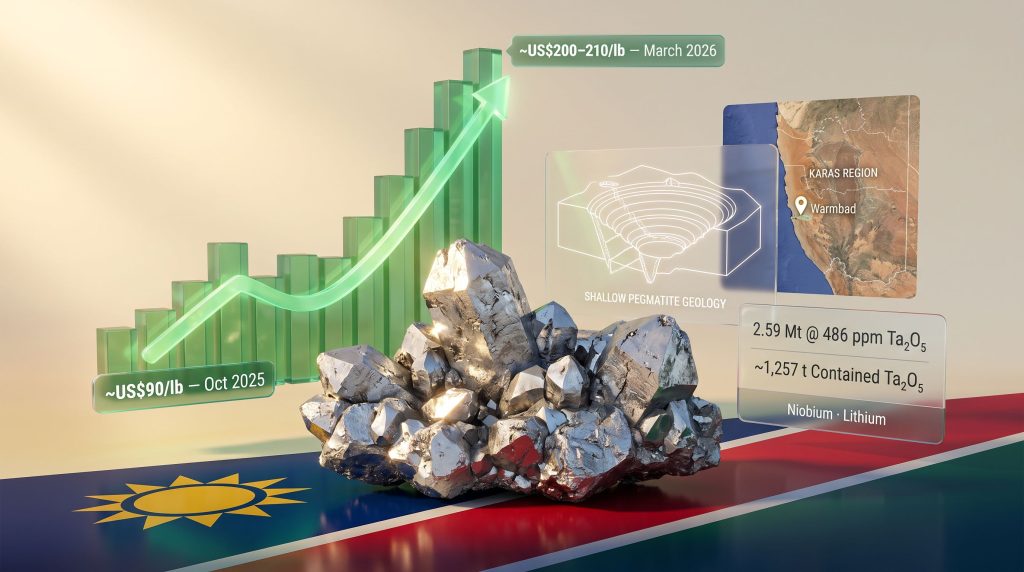
The Swanson Tantalum Project in Namibia is operated by Arcadia Minerals through its Namibian subsidiary, Orange River Pegmatite (ORP). It sits in the Karas Region of southern Namibia, approximately 15 kilometres north of the Orange River near the town of Warmbad — a location with established regional infrastructure and relatively straightforward logistics compared to many remote African mining projects.
What Geological Features Make This Deposit Compelling?
Geologically, the project is hosted within lithium-caesium-tantalum (LCT) pegmatite bodies, a deposit type well-known in the critical minerals demand sector for its capacity to concentrate rare and valuable elements including tantalum, niobium, and lithium within coarse-grained crystalline rock formations. What is less commonly understood is that LCT pegmatites often host multiple co-located bodies with irregular geometry, meaning systematic exploration of the surrounding ground can materially expand a resource without requiring entirely new discovery work.
The project holds a JORC 2021-compliant mineral resource estimate that anchors its investment thesis:
| Resource Metric | Value |
|---|---|
| Total Resource Tonnage | 2.59 million tonnes |
| Grade (Ta₂O₅) | 486 ppm |
| Contained Ta₂O₅ | ~1,257 tonnes |
| By-products Identified | Niobium, Lithium |
| Deposit Type | Shallow LCT Pegmatite |
| Mining Method | Open-Pit (confirmed viable) |
The 486 ppm Ta₂O₅ grade deserves some contextualisation. Tantalum resources are typically measured in parts per million because the metal occurs in very low concentrations relative to the host rock. At this grade level, Swanson sits within a commercially viable range for gravity-based processing methods, which is a critical point for understanding the project's capital intensity profile.
The planned processing flowsheet relies on spiral and gravity concentration circuits rather than chemical leach processes. This distinction matters enormously from an investor and environmental standpoint. Gravity-based processing is mechanically simpler, requires less reagent input, generates a lower environmental footprint, and typically commands a lower capital expenditure relative to hydrometallurgical alternatives. For a junior miner seeking to minimise upfront capital requirements, this design choice meaningfully reduces the financing burden.
From Licence to Construction-Ready: The Regulatory Journey
A mining licence was granted by the Namibian government in June 2022, authorising progression from exploration to active mining operations. This milestone places Swanson in a genuinely rare category among African critical minerals projects. The vast majority of assets being marketed to investors globally remain at exploration or pre-feasibility stage, carrying substantially higher technical, regulatory, and timeline risk.
A definitive feasibility study was completed in 2023, establishing baseline economic parameters and confirming open-pit extraction as technically viable across the project's key mineralised zones. The planned operation targets a processing throughput of approximately 12,500 tonnes of run-of-mine ore per month, supporting an initial mine life of roughly eight years under the base-case resource and production assumptions.
"A fully permitted, DFS-complete project in a stable African jurisdiction is substantially de-risked compared to the typical peer group in the junior tantalum space. The absence of permitting risk removes one of the most common and unpredictable sources of project delay."
The Tantalum Price Surge: What Happened and Why It Changes the Economics
The single most consequential development affecting the Swanson Tantalum Project in recent months has been a dramatic repricing of tantalum pentoxide concentrate on global markets. Understanding this move requires a brief explanation of how tantalum is priced and traded.
Why Is Tantalum Pricing So Opaque?
Unlike base metals such as copper or nickel, tantalum does not trade on a public exchange with transparent real-time pricing. Instead, it is priced through a combination of industry benchmarks, direct negotiation between producers and consumers, and reference prices published by specialist consultancies. This opacity means price moves can be significant before they are widely understood by generalist investors.
The pricing trajectory since late 2025 has been striking:
| Price Benchmark | Concentrate Grade | Price (USD/lb) | Timeframe |
|---|---|---|---|
| Market Baseline | 25% Ta₂O₅ | ~US$90 | October 2025 |
| Market Recovery | 25% Ta₂O₅ | ~US$200–210 | March 2026 |
| Chinese Market Premium | 30% Ta₂O₅ | >US$225 | Current (2026) |
This represents a price increase of more than 120% in approximately five months for standard 25% concentrate. The move has been attributed to a combination of factors: supply disruptions from artisanal-dominated production regions, growing demand from consumer electronics manufacturers accelerating procurement ahead of potential further supply constraints, and heightened interest from defence and aerospace buyers seeking conflict-free material.
The 2023 DFS explicitly identified tantalum price as the single most sensitive variable in the project's net present value (NPV) and internal rate of return (IRR) calculations. Consequently, a doubling of the tantalum price does not merely add incremental value to the Swanson project; it has a disproportionately large leveraged impact on project economics relative to changes in operating costs or capital expenditure.
An important caveat accompanies this improved pricing environment: Arcadia Minerals has confirmed that the capital and operational cost assumptions embedded in the 2023 DFS have not yet been updated to reflect current construction input prices, labour costs, or logistics conditions. A revised or updated DFS may therefore be required before financing parties will commit to a final investment decision.
Dual-Track Financing: Two Pathways, One Goal
Arcadia Minerals is pursuing financing through two parallel tracks simultaneously, a structure that reflects both the complexity of funding African critical minerals projects and a considered effort to avoid single-counterparty dependency.
The Xinhai Mining Services Pathway
Hong Kong Xinhai Mining Services has completed a formal technical review of the Swanson project and has prepared draft definitive terms calibrated to the improved tantalum pricing environment. Xinhai is a Chinese mining services and technology company with experience delivering processing plants and project execution services across African jurisdictions.
The proposed structure is understood to involve a funding and development agreement designed to minimise upfront equity dilution for existing Arcadia shareholders, with Arcadia's effective project interest potentially reducing to approximately 49.6% under certain financing and construction arrangements. The precise structure, however, remains under negotiation, and no binding agreement has been executed.
The European Development Finance Pathway
Concurrently, Arcadia is engaged with European Development Finance Institutions (DFIs) as an alternative or complementary financing channel. The EU's Global Gateway for Raw Materials initiative provides a broader geopolitical framework through which European capital has been directed toward African critical minerals projects meeting ethical sourcing and ESG standards. Furthermore, energy security concerns across Europe have heightened the urgency of securing reliable, traceable supply chains for materials like tantalum.
Swanson's conflict-free status, valid mining licence, and Namibian jurisdiction position it as a credible candidate for European DFI consideration. DFI financing typically offers longer debt tenors and lower cost of capital than commercial lending, while also creating strategic linkages to European industrial offtake consumers.
"The dual-track approach reflects a broader trend among African junior miners who have recognised that relying on a single financing counterparty in a market with elevated geopolitical sensitivities around critical mineral supply chains creates unacceptable concentration risk."
A third possibility exists: a hybrid or blended capital structure combining Xinhai's technical and operational expertise with European concessional finance. Such arrangements have precedent elsewhere in African critical minerals development, where Chinese technical partners and Western financiers have co-invested in projects that serve both Asian processing chains and Western supply security objectives.
Swanson vs. the Peer Group: Understanding the Competitive Positioning
The ethical sourcing dimension of tantalum procurement is not well understood outside specialist circles, but it carries measurable financial value. Technology manufacturers in Europe and North America subject to conflict-mineral due diligence obligations must document and audit their tantalum supply chains. Sourcing from a licensed, regulated Namibian operation eliminates this compliance burden and the reputational risk attached to it. In addition, the broader critical minerals trade landscape increasingly rewards projects that can demonstrate full supply chain traceability.
| Project Attribute | Swanson (Namibia) | Typical Artisanal Source (Central Africa) |
|---|---|---|
| Mining Licence | Granted (June 2022) | Often informal or absent |
| Feasibility Study | Completed (2023 DFS) | Rarely available |
| Conflict-Mineral Status | Conflict-free | High-risk designation |
| Processing Flowsheet | Defined (gravity/spiral) | Rudimentary |
| Financing Structure | Institutional/DFI eligible | Informal |
| ESG Auditability | Full supply chain traceability | Limited |
Namibia as a jurisdiction also warrants specific recognition. The country maintains one of Africa's most established and transparent mining regulatory frameworks, with clearly defined licence processes, a history of major international mining investment, and a political environment that has remained stable across multiple government transitions.
The next major ASX story will hit our subscribers first
Key Risks Every Investor and Stakeholder Should Understand
The project's improving economics should be considered alongside a clear-eyed assessment of the material risks that remain unresolved:
- Financing risk — No definitive funding agreement has been executed with Xinhai or any European DFI. Arcadia has explicitly cautioned that there is no certainty current negotiations will result in a binding agreement.
- DFS currency risk — Capital and operating cost estimates from 2023 may require material revision before lenders will commit to project finance, potentially altering the project's economics.
- Ownership dilution risk — Depending on the structure ultimately agreed with Xinhai or other parties, Arcadia's effective project interest could be materially reduced from its current position.
- Commodity price volatility — The tantalum price surge that has dramatically improved project economics is not guaranteed to persist through the construction and ramp-up period.
- Resource uncertainty — Multiple pegmatite bodies at Swanson remain undrilled, meaning the resource estimate could change in either direction with further exploration work.
"Arcadia Minerals has explicitly stated there is no certainty that current negotiations with any financing counterparty will result in a binding agreement. All timelines to production remain contingent on successful capital raising."
What Namibia Gains From Swanson Reaching Production
Beyond the investment thesis for Arcadia shareholders, the Swanson Tantalum Project in Namibia carries broader significance for the country's economic development agenda. Namibia has articulated ambitions to capture more value from its mineral endowment through downstream processing rather than simply exporting raw concentrate.
A gravity-circuit tantalum operation in the Karas Region would generate direct employment, local procurement activity, and tax revenue for one of Namibia's less economically developed regions. Namibia is increasingly recognised within the global critical minerals conversation as a jurisdiction that combines geological richness with institutional reliability — a combination that is genuinely scarce in the African context.
The Path Forward: What Needs to Happen Before Production Begins
Several concrete steps stand between the current negotiations and first production at Swanson:
- Execution of a binding financing agreement with Xinhai, European DFIs, or a combined capital structure
- Determination of whether the 2023 DFS requires updating to satisfy lender bankability requirements
- Finalisation of offtake terms that reflect the current tantalum pricing environment
- Mobilisation of construction activities at the fully permitted Swanson site
- Potential resource expansion through systematic drilling of undrilled pegmatite bodies
The combination of a valid mining licence, a completed feasibility study, a gravity-based processing design, a rising price environment, and active engagement from both Asian and European financing counterparties gives the Swanson Tantalum Project in Namibia a development profile that is uncommon among junior African critical minerals assets. Whether that profile translates into production will depend on the financing negotiations that now sit at the critical path of the project's timeline. For those monitoring tantalum market developments, the coming months are likely to be defining ones for this sector.
This article is intended for informational purposes only and does not constitute financial advice. Statements regarding project timelines, commodity prices, and financing outcomes involve forward-looking assumptions that may not be realised. Readers should conduct independent due diligence before making any investment decisions.
Want to Track the Next Major Critical Minerals Discovery Before the Broader Market?
Discovery Alert's proprietary Discovery IQ model scans ASX announcements in real time, instantly identifying significant mineral discoveries across tantalum, lithium, and more than 30 other commodities — turning complex data into actionable insights for investors at every level. Explore historic examples of exceptional discovery returns and begin your 14-day free trial today to position yourself ahead of the market.