
August 4, 2026
The Grid Reliability Imperative Behind the World's Largest Battery Storage Buildout
Every electricity grid operates on a deceptively simple principle: supply must match demand at every moment. For decades, this balance was managed through dispatchable generation — coal, gas, hydro — that could be ramped up or down on command. The arrival of variable renewables at scale has fundamentally disrupted this model. Wind turbines and solar arrays produce power when the weather allows, not when the grid needs it.
At high penetration levels, this mismatch between generation timing and demand timing creates curtailment events, frequency instability, and reliability gaps that no amount of additional generation capacity can solve on its own.
This is the structural problem that has elevated battery energy storage from a supplementary tool into a core pillar of grid architecture. Nowhere is this transformation more consequential than in China, where the world's largest deployment of renewable energy now sits alongside the world's largest fleet of battery storage systems. Understanding China battery storage renewable energy strategy requires examining not just the headline numbers, but the underlying policy logic, market mechanics, and unresolved tensions that will determine whether installed capacity translates into genuine grid value.
When big ASX news breaks, our subscribers know first
From Compliance Tool to Grid Infrastructure: A Strategic Reclassification
For much of the early 2020s, battery storage in China was primarily a compliance mechanism. Provincial mandates required new wind and solar developers to pair their projects with storage, typically at 5% to 20% of project capacity. This drove rapid installation but produced a fleet with limited operational purpose. Assets were built, connected, and then underutilised because the dispatch rules and revenue mechanisms to monetise their services had not kept pace with construction.
The 15th Five-Year Plan for Renewable Energy Development (2026–2030), jointly released by China's National Development and Reform Commission (NDRC) and National Energy Administration (NEA), represents a deliberate departure from this compliance-first paradigm. The plan does not assign storage a standalone gigawatt target. Instead, it measures storage performance through its contribution to system-wide reliability — a fundamental reframing of how storage value is defined at the national planning level.
Furthermore, this shift matters enormously for investors and project developers. Storage assets that can demonstrate measurable grid service delivery are being positioned to access more durable, market-based revenue streams than those built purely to satisfy renewable project co-location requirements. The intersection of critical minerals and energy transition priorities makes this reframing even more strategically significant.
China's Battery Storage Fleet: Scale, Composition, and Structural Trends
The numbers describing China's storage buildout are genuinely extraordinary, but the structural details within those numbers carry as much analytical weight as the totals.
Operational Capacity at the Start of the Planning Period
| Metric | Value (End of 2025) |
|---|---|
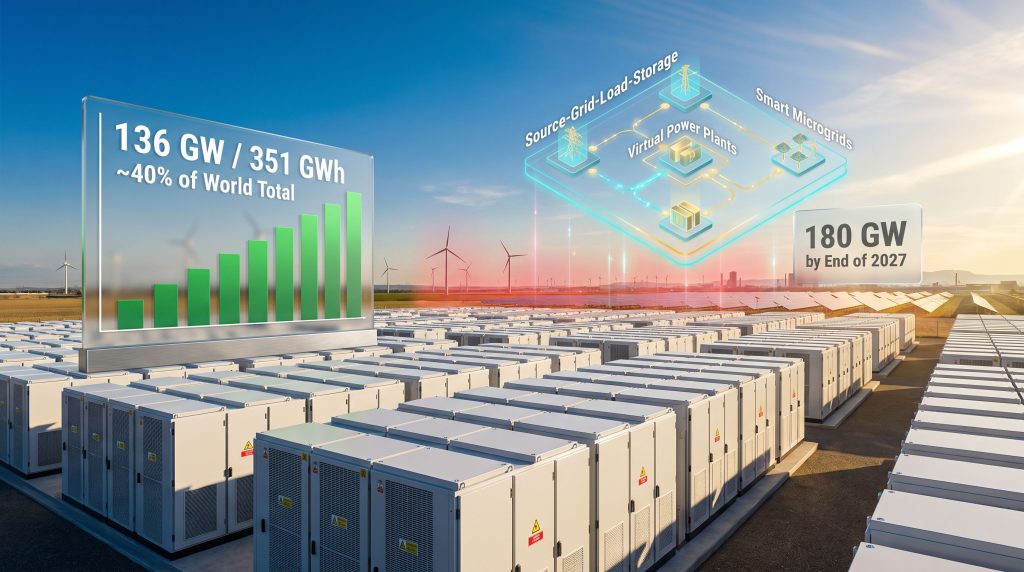
| Total operational new energy storage | 136 GW / 351 GWh |
| Year-on-year growth rate | 84% |
| Growth since end of 2020 | More than 40-fold |
| Average storage duration | 2.58 hours |
| Pumped hydro capacity (for comparison) | 66 GW |
| New energy storage vs. pumped hydro | More than 2x |
| National average equivalent utilisation | 1,195 hours |
| Year-on-year utilisation improvement | ~300 hours |
Several aspects of these figures deserve closer examination:
- Independent storage now accounts for 51.2% of cumulative installed capacity, signalling a move beyond pure co-location dependency.
- Projects with durations of four hours or longer represent 27.6% of the fleet, reflecting growing recognition that evening peak reliability requires longer storage windows.
- Lithium iron phosphate (LFP) technology retains a 96.1% market share, creating significant supply chain concentration around lithium and related critical minerals. The wider battery raw materials market is consequently being shaped by China's procurement decisions at every level.
- The utilisation improvement of approximately 300 hours year-on-year to reach 1,195 average equivalent hours is an early sign of operational maturation, though it still implies meaningful idle capacity across portions of the fleet.
China's storage fleet now represents approximately 40% of the world's total battery energy storage capacity, positioning the country as the dominant force in global BESS market development. This scale creates industrial learning curves that directly reinforce China's export competitiveness in battery technology and system integration.
Decoding the 15th Five-Year Plan's Storage Targets
What the Plan Actually Says
A common misconception in media coverage is that China has set a specific storage gigawatt target for 2030. The 15th Five-Year Plan does not work this way. The plan targets approximately 3.5 TW of total renewable generation capacity by 2030, including more than 2.8 TW of wind and solar, but storage performance is expressed through reliability contribution metrics rather than installed capacity thresholds.
The target architecture looks like this:
- Wind and solar projects, including source-side storage, must deliver average firm capacity equivalent to at least 8% of installed capacity by 2030.
- New centralised wind and solar plants must achieve firm capacity of at least 10%, with an explicit encouragement to exceed 20% where site conditions allow.
- Renewable energy's share of electricity supplied during summer and winter evening peak periods must exceed 20%, roughly 10 percentage points above 2025 levels.
- China targets the addition of more than 300 GW of reliable renewable peak-generation capability during the five-year period.
A separate national action plan, distinct from the renewable energy plan itself, mandates new energy storage capacity exceeding 180 GW by end of 2027. The widely cited projection of more than 370 GW by 2030 originates from an industry white paper rather than any official government planning document, a distinction that carries material implications for forecasting accuracy.
The Firm Capacity Framework: Why It Changes the Investment Logic
The shift to measuring storage through firm capacity delivery rather than installed megawatts is one of the most underappreciated elements of the 15th Five-Year Plan. Under a compliance-volume model, developers could build storage to satisfy permit conditions and then operate it minimally. Under a firm capacity performance framework, storage assets must demonstrably contribute to grid reliability during peak demand windows — creating accountability that did not previously exist at the national planning level.
For project economics, this is a structural inflection point. Storage assets that cannot demonstrate reliable peak delivery will face regulatory exposure, while those that can are positioned to capture the capacity payment revenue streams that authorities are now moving to formalise.
Technical Architecture: Grid-Forming Technology and Multi-Timescale Forecasting
Beyond policy targets, the 15th Five-Year Plan introduces specific technical requirements that reshape how storage systems must function within the grid.
Grid-forming inverter technology is explicitly mandated for wider deployment across new renewable projects. The distinction between grid-following and grid-forming inverters is technically significant but rarely discussed in policy coverage:
- Grid-following inverters — the current standard for most solar and wind installations — passively synchronise to an existing grid signal. They require a stable grid to operate.
- Grid-forming inverters actively generate the voltage and frequency reference that other devices can synchronise to. They can support grid stability, and in principle allow renewable assets to operate in islanded or low-inertia environments.
Mandating grid-forming capability across new installations represents a meaningful shift in the technical baseline for China's renewable fleet. It also signals that planners are designing for a future where variable renewable penetration is high enough that passive grid-following behaviour becomes a systemic vulnerability.
Multi-timescale power forecasting requirements address a different but related problem. Coordinating storage dispatch with variable generation requires accurate predictions across second, minute, hour, and day-ahead timeframes simultaneously. Improved forecasting reduces the frequency of curtailment events and improves the economic efficiency of storage utilisation.
Storage Integration Across the Full System Architecture
| Application Domain | Storage Role |
|---|---|
| Distributed solar | Behind-the-meter and community storage integration |
| Green power direct connections | Firm power delivery to industrial offtakers |
| Source-grid-load-storage projects | Coordinated multi-asset optimisation |
| Virtual power plants (VPPs) | Aggregated flexible capacity dispatch |
| Smart microgrids | Islanded and semi-islanded reliability |
| Data centres | Flexible load coordination with renewable generation |
The inclusion of data centres as flexible loads coordinated with renewable generation is a noteworthy addition. As artificial intelligence infrastructure expands power demand globally, integrating large-scale computing facilities into grid balancing strategies represents an emerging frontier in demand-side management.
Revenue Reform: The Missing Piece of China's Storage Equation
Why the Economics Have Lagged the Deployment
The rapid physical buildout of storage capacity in China has outpaced the development of the revenue mechanisms needed to make those assets economically viable on a standalone basis. Storage built for renewable co-location compliance generates limited independent revenue. Provincial electricity market rules vary significantly, creating fragmented and often unpredictable revenue environments for project developers and investors.
The 15th Five-Year Plan signals a deliberate intent to address this gap through:
- Improvement and formalisation of capacity payment mechanisms for both pumped hydro and new energy storage systems.
- Gradual introduction of compensation for reliable capacity delivery, moving away from a model where storage revenues derive primarily from energy arbitrage in provincial spot markets.
- Development of harmonised dispatch rules that allow storage assets to participate consistently in grid services across regional boundaries.
Technology Economics by Storage Duration Class
| Storage Duration | Current Market Position | Revenue Outlook |
|---|---|---|
| 2–3 hours (standard LFP) | Dominant (96.1% of fleet) | Dependent on provincial arbitrage rules |
| 4+ hours (long-duration LFP) | 27.6% of fleet, growing | Positioned for capacity payment reform upside |
| Flow batteries | Early commercial stage | Supported by diversification policy |
| Sodium-ion batteries | Emerging at scale | Improving cost trajectory |
| Compressed air / thermal | Niche deployment | Included under multi-technology planning |
The revenue reform agenda is the critical variable for whether China's installed fleet delivers operational value or becomes a partially stranded infrastructure investment. Capacity payments that reward reliable peak delivery would fundamentally change the economics of four-hour-plus systems relative to the current standard two-to-three-hour configuration.
The next major ASX story will hit our subscribers first
Beyond Lithium-Ion: China's Multi-Chemistry Diversification Strategy
While LFP technology dominates at 96.1% of installed capacity, Chinese industrial policy explicitly supports technology diversification across multiple storage chemistries. This is both a technical hedge and an industrial strategy.
Sodium-ion batteries are advancing toward commercial-scale deployment, with CATL and other domestic manufacturers leading industrialisation efforts. A notable development includes CATL partnering with Dutch storage provider Alfen to deploy 5 GWh of sodium-ion battery storage systems across Europe, signalling that domestic technology confidence is sufficient to pursue international commercial markets. Sodium-ion chemistry reduces dependence on lithium while using widely available materials, addressing supply chain concentration risk at a systemic level. The Chinese battery recycling breakthrough further reinforces this supply chain resilience agenda.
Vanadium and iron-based flow batteries are gaining traction for longer-duration applications, particularly where the ability to independently scale power and energy capacity offers project-specific advantages. Flow battery technology does not degrade with cycle count in the same way lithium-ion does, making it attractive for high-utilisation applications.
Compressed air energy storage and thermal storage systems are included in planning frameworks as complementary long-duration solutions, particularly relevant for seasonal storage needs that short-duration lithium-ion systems cannot cost-effectively address.
Pumped hydro remains the bedrock of long-duration reliability at 66 GW of existing capacity, providing the baseline against which new energy storage systems are benchmarked operationally.
The strategic logic of technology diversification is straightforward: lithium-ion dominance creates supply chain concentration risk at exactly the moment when storage deployment is accelerating most rapidly. Building industrial capability across multiple chemistries hedges that risk while simultaneously expanding China's export technology portfolio.
Structural Risks That Could Limit Strategic Ambitions
The Utilisation Gap and Its Investment Implications
The improvement in national average equivalent utilisation hours to 1,195 hours in 2025 is an encouraging trend, but it also reveals the scale of the remaining gap. At 1,195 hours annually, the average storage asset operates at meaningful capacity for only a fraction of the year. Systems built to satisfy co-location mandates in provinces with underdeveloped dispatch frameworks may operate at significantly lower utilisation than the national average.
For investors, low utilisation translates directly into extended payback periods and compressed internal rates of return. The economic viability of China's China battery storage renewable energy strategy depends heavily on whether capacity payment reform and dispatch rule harmonisation can close the gap between physical deployment and operational value.
Provincial Market Fragmentation
Storage revenue in China remains heavily dependent on province-level electricity market rules, which vary substantially across the country. Inconsistent capacity payment structures, differing curtailment dispatch rules, and variable ancillary service market designs create an uneven investment landscape. Projects in provinces with well-developed market rules can generate competitive returns; projects in less mature regulatory environments face genuine bankability challenges.
Safety and System Integration at Scale
Large-scale BESS deployment introduces thermal management and fire safety challenges that intensify as fleet size grows. China has experienced high-profile battery storage fire incidents, and the operational safety record of grid-scale lithium-ion systems at the density and scale now being deployed remains an active concern for system operators and insurers.
As storage is embedded across distributed, grid-scale, and virtual power plant architectures simultaneously, system integration complexity increases in ways that operational protocols and software platforms are still catching up to.
How China's Strategy Compares to Global Peers
| Dimension | China | European Union | United States |
|---|---|---|---|
| Installed BESS capacity | ~136 GW / 351 GWh (2025) | 45 GW target approved (2026) | Rapidly scaling, policy-driven |
| Policy driver | Five-year planning + mandatory co-location | Member-state obligations + market reform | IRA incentives + state-level mandates |
| Technology focus | LFP dominant, diversifying | LFP imports + domestic R&D | LFP + long-duration investment |
| Revenue model | Transitioning to market-based | Capacity markets + ancillary services | Wholesale markets + capacity payments |
| Industrial strategy | Domestic supply chain + export leadership | Reduce import dependency | Re-shoring manufacturing |
| Global fleet share | ~40% of world total | Growing | Significant but below China |
The comparison illuminates a critical dynamic. China's ~40% share of global BESS capacity means that its policy evolution, technology choices, and industrial cost curves directly shape the economics of storage deployment everywhere else. When China's domestic LFP manufacturing scales to meet a 15th Five-Year Plan mandate, the resulting cost reductions flow through global battery supply chains.
Consequently, when China's capacity payment reforms establish new revenue benchmarks for independent storage, those frameworks influence how project finance models are structured in markets worldwide. The battery storage-driven lithium boom is one clear downstream effect of this dynamic, as demand signals originating in Chinese planning documents ripple outward across global commodity markets.
The battery manufacturing expansion occurring in economies such as South Korea illustrates how China's scale is prompting strategic responses from competitor manufacturing hubs seeking to preserve market relevance.
The central question for the planning period ahead is not whether China can continue building storage at scale. The 40-fold expansion since 2020 and the 84% single-year growth rate in 2025 confirm that deployment capability is not the binding constraint. The defining challenge is whether the market design, dispatch infrastructure, and revenue mechanisms surrounding that installed capacity can mature quickly enough to convert gigawatts into genuine, durable grid reliability. Furthermore, the broader global energy transition will be closely watching whether China's China battery storage renewable energy strategy succeeds in bridging that gap — not merely as a model to emulate, but as the world's primary driver of battery technology cost reduction for every nation pursuing a low-carbon grid.
This article is for informational purposes only and does not constitute financial or investment advice. Projections and targets referenced from industry white papers and planning documents are subject to revision and should not be relied upon as confirmed government commitments. Readers should conduct independent research before making investment decisions related to the energy storage sector.
Want to Capitalise on the Mineral Discoveries Powering the Energy Storage Revolution?
The battery storage buildout reshaping grids worldwide depends on a continuous supply of critical minerals — and Discovery Alert's proprietary Discovery IQ model delivers real-time ASX alerts the moment significant mineral discoveries are announced, turning complex data into actionable investment insights. Explore how major discoveries have historically generated substantial returns on Discovery Alert's dedicated discoveries page, and begin your 14-day free trial today to position yourself ahead of the market.