
August 4, 2026
Why the Structure of a Manganese Offtake Deal Matters More Than the Headlines Suggest
Long-term offtake agreements in the mining sector rarely generate the same investor attention as discovery announcements or resource upgrades. Yet for project-stage and early-production miners, a well-constructed offtake contract can be the single most consequential commercial document a company signs. It determines whether lenders will open their credit facilities, whether cash flow projections hold under stress scenarios, and whether a project survives the transition from construction into sustained operations.
Understanding what separates a structurally robust offtake from a superficially similar but weaker arrangement requires looking beyond the headline volume numbers and examining the mechanics underneath.
The Element 25 OM Materials manganese supply contract, formalised in August 2026, is a case study in how a binding take-or-pay structure can anchor an entire project financing strategy. It also reveals something less commonly discussed: the way a dual-track commercial strategy, combining conventional concentrate sales with a reserved pathway into battery materials, can simultaneously satisfy near-term lender requirements while protecting longer-term value optionality.
When big ASX news breaks, our subscribers know first
The Geological Foundation: What Makes Butcherbird a Long-Duration Asset
Before examining the commercial architecture of the deal, it is worth understanding why the Butcherbird deposit commands the kind of offtake commitment that OM Materials has made. Located in Western Australia's Pilbara region, the Butcherbird Mine sits within a sedimentary manganese system rather than the hydrothermal or metamorphic deposit types more commonly associated with high-grade African producers.
This geological distinction carries practical consequences. Sedimentary manganese deposits of the Butcherbird type typically exhibit lower head grades but deliver highly consistent, laterally continuous mineralisation across large surface footprints. This predictability is commercially valuable because it reduces grade variability risk during processing and supports steady product quality across long operational periods.
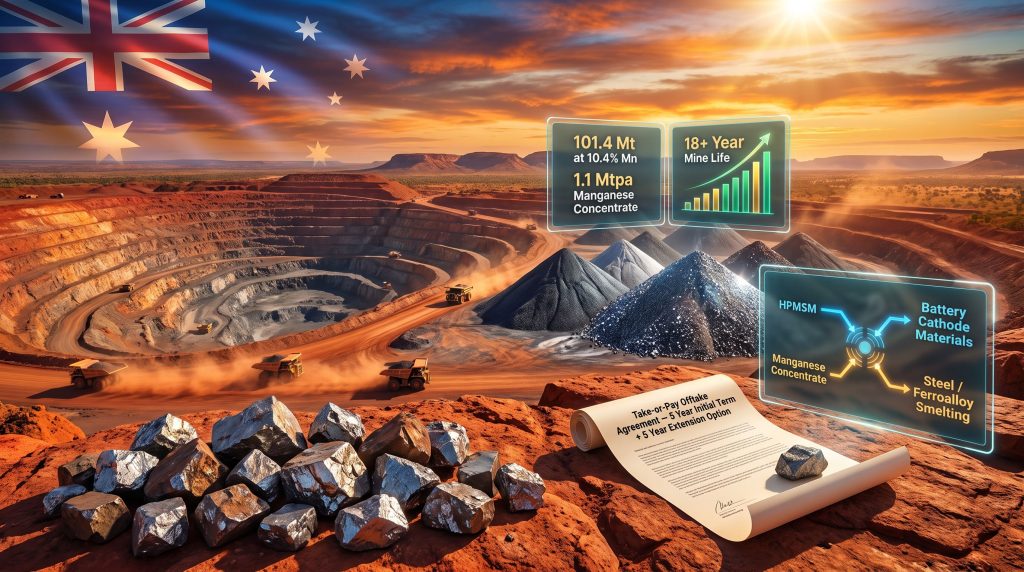
The updated ore reserve reflects this scale: 101.4 million tonnes at 10.4% manganese, a figure that underpins more than 18 years of production at the targeted rate of 1.1 million tonnes per annum of manganese concentrate. The concentrate grade range of approximately 28% to 35% manganese aligns with product specifications commonly accepted by Asian ferroalloy smelters, which is precisely the market that OM Materials serves through its parent group's downstream processing operations. The Butcherbird expansion approval also reflects the regulatory confidence underpinning this long-duration asset.
| Butcherbird Ore Reserve and Production Profile | Detail |
|---|---|
| Total Ore Reserve | 101.4 Mt at 10.4% Mn |
| Targeted Annual Output | 1.1 Mtpa manganese concentrate |
| Concentrate Grade Range | ~28% to 35% Mn |
| Supported Mine Life | 18+ years |
| Stage 1 Annual Volume (prior agreement) | ~365,000 tpa |
One lesser-appreciated aspect of the Butcherbird geology is its processing simplicity. The mineralisation responds well to relatively low-cost beneficiation methods, including wet screening and dense media separation, without requiring energy-intensive pyrometallurgical or hydrometallurgical treatment at the mine site. This keeps the operating cost structure lean and the concentrate product commercially competitive against higher-grade but more processing-intensive African sources.
How the Take-or-Pay Mechanism Functions as a Financing Tool
A take-or-pay offtake agreement is a contractual instrument that obligates the buyer to either receive the agreed volume of product or compensate the seller financially for the shortfall. What makes this structure particularly powerful in a project finance context is the way it transforms uncertain future production revenue into something that resembles a contracted receivable.
For lenders evaluating whether to commit capital to the Butcherbird Expansion Project, including through facilities such as the Northern Australia Infrastructure Facility, the presence of a binding take-or-pay offtake covering 100% of compliant production fundamentally changes the risk calculus. Instead of stress-testing a project against volatile spot market assumptions, lenders can model debt service coverage ratios against contracted volumes tied to a benchmark pricing formula.
"A take-or-pay structure does not eliminate commodity price risk, but it does collapse the volume risk dimension almost entirely. For project financiers, removing one of the two primary revenue risk factors can be the difference between a fundable project and one that stalls at the term sheet stage."
The pricing mechanism adopted in the Element 25 OM Materials manganese supply contract uses international manganese ore benchmarks, including the manganese ore pricing index referenced by Fastmarkets for 44% manganese ore, as its reference point. Quality adjustments are then applied to reflect the actual grade of concentrate delivered relative to the benchmark specification. Periodic pricing reviews are built into the framework, providing both parties with protection against prolonged divergence between contract terms and prevailing market conditions.
The agreement also incorporates prepayment provisions calibrated to support Element 25's cash flow requirements during the ramp-up phase targeting commissioning in Q1 calendar year 2027. Prepayment terms in offtake agreements are less standard than take-or-pay obligations and signal a higher degree of commercial integration between buyer and seller than a purely transactional arrangement would suggest.
The OM Holdings Connection: Why Counterparty Quality Reshapes the Risk Profile
Does the Buyer's Structure Matter as Much as the Contract Terms?
Not all offtake counterparties carry the same commercial weight. A trading house that purchases concentrate for resale introduces an additional layer of execution risk: if the trader cannot place the material in the end market at an acceptable price, the financial penalty provisions of a take-or-pay agreement become the primary protection mechanism rather than the buyer's genuine demand for the product.
OM Materials occupies a structurally different position. As a subsidiary of OM Holdings (OMH), a vertically integrated manganese and ferroalloy group with smelting operations across Asia, OM Materials can absorb Butcherbird concentrate directly into its own processing chain. This means the demand for the product is operationally driven rather than commercially intermediated, substantially reducing the practical risk of volume shortfalls. Furthermore, Element 25's first manganese sale to market demonstrated the commercial readiness of this supply relationship well ahead of the full-scale offtake formalisation.
The commercial relationship between Element 25 and OM Holdings also has an established history. A non-binding memorandum of understanding was established in 2020, followed by a binding offtake signed for Stage 1 in January 2021, covering approximately 365,000 tonnes per year. The expansion of this arrangement into the full-scale Butcherbird offtake reflects a multi-year track record of commercial interaction rather than a first-time counterparty introduction.
OM Holdings' downstream smelting capability is particularly relevant given that manganese's primary industrial application remains in steel production, where it functions as a critical deoxidiser and alloying agent. Approximately 90% of global manganese consumption is directed toward the steel sector, and Asian ferroalloy smelters represent the dominant end-market for Australian manganese concentrate exports. An offtake buyer with direct smelting capacity is therefore not purchasing manganese for speculative repositioning but for integrated industrial consumption.
The Battery-Grade Carve-Out: Preserving Optionality Without Sacrificing Bankability
One of the more strategically nuanced elements of the Element 25 OM Materials manganese supply contract is the explicit reservation of production volumes for future high-purity manganese sulphate processing. This carve-out reflects a bifurcated commercial strategy that few manganese miners have successfully articulated at the project level.
| Product Stream | Destination | End Market |
|---|---|---|
| Manganese concentrate (standard grade) | OM Materials binding offtake | Steel / ferroalloy smelting |
| High-purity manganese sulphate (HPMSM) | Reserved for downstream processing | EV battery cathode materials |
The rationale for maintaining this bifurcation connects to fundamental shifts occurring in battery chemistry. Manganese-rich cathode formulations, including lithium manganese iron phosphate (LMFP) and high-manganese variants of nickel manganese cobalt (NMC) chemistry, are gaining commercial traction in electric vehicle applications. LMFP in particular has attracted significant investment from Chinese cell manufacturers seeking to reduce cobalt and nickel dependency while maintaining acceptable energy density.
High-purity manganese sulphate, the form required for battery cathode precursor production, commands a substantially different price point than conventional manganese ore concentrate. The conversion pathway from Butcherbird concentrate to HPMSM would require downstream hydrometallurgical processing, representing additional capital investment but also a fundamentally different margin profile. In addition, the broader context of critical minerals demand in 2025 and beyond strengthens the strategic case for preserving this optionality.
"The battery-grade carve-out is less a near-term revenue strategy and more a long-dated option on cathode chemistry evolution. If LMFP adoption accelerates meaningfully in the second half of this decade, the reserved volumes could represent significant incremental value that the conventional offtake structure would otherwise have permanently locked away."
Is the Battery Pathway a Near-Term Revenue Driver?
This optionality is speculative in the near term. HPMSM market development timelines remain subject to automotive OEM adoption curves, battery pack design decisions, and competitive pressure from alternative chemistries. Investors should treat the battery-grade pathway as a potential upside scenario rather than a near-term revenue contributor. However, the battery storage expansion occurring across multiple markets does reinforce the long-term strategic logic of maintaining this reserved capacity.
Manganese's Concentrated Supply Geography: A Structural Backdrop
Global manganese ore production is heavily concentrated in three jurisdictions: South Africa, Gabon, and Australia. South Africa alone accounts for roughly 33% of global manganese ore output, with the Kalahari Manganese Field representing the largest known land-based manganese resource on Earth. Gabon contributes a significant share through operations such as the Moanda mine, operated by Eramet.
This geographic concentration creates supply chain vulnerability for downstream buyers in Asia and Europe seeking to diversify procurement away from single-region dependency. Western Australian manganese supply, with its established export infrastructure, consistent regulatory environment, and proximity to Asian smelting markets, represents a credible diversification option for buyers like OM Materials. Consequently, projects like Butcherbird, which also qualifies as a strategic manganese deposit by global standards, are well-positioned to capture this demand.
From a strategic supply chain perspective, the Butcherbird Expansion Project adds meaningful new production capacity to the Western Australian manganese supply base at a time when steel sector demand remains structurally supported and battery sector demand is an emerging incremental driver. The combination of a large ore reserve, competitive processing economics, and a binding offtake with an integrated downstream buyer positions Butcherbird as a long-duration supply asset capable of underpinning sustained commercial relationships well beyond the initial contract term.
The next major ASX story will hit our subscribers first
Project Timeline and Conditions Precedent
The Element 25 OM Materials manganese supply contract is binding but remains conditional on several precedent requirements being satisfied before it becomes unconditional.
Key conditions include:
- Board-level approvals from both Element 25 and OM Materials
- Project financing arrangements being finalised, which may include facilities from the Northern Australia Infrastructure Facility
- Regulatory clearances under applicable Australian and international frameworks
| Project Milestone | Target / Status |
|---|---|
| Mining and haulage contracts signed | May 2026 (completed) |
| Binding offtake agreement executed | August 2026 |
| Outstanding contracts finalised | H2 2026 (anticipated) |
| Mechanical completion and commissioning | Q1 calendar year 2027 |
The progression from mining and haulage contracts in May 2026 to the offtake execution in August 2026 reflects a sequenced approach to de-risking the project's commercial and operational foundation. Each contract layer reduces a specific category of execution risk and, cumulatively, these agreements establish the commercial stack that project financiers require before committing capital.
How This Agreement Compares to Sector Norms
| Feature | Element 25 / OM Materials | Typical Industry Offtake |
|---|---|---|
| Volume coverage | 100% of production (with carve-outs) | 50% to 100% |
| Pricing basis | Benchmark-linked with quality adjustments | Spot, fixed, or index-linked |
| Initial term | 5 years plus 5-year extension option | 3 to 10 years |
| Take-or-pay obligation | Yes | Common in project finance contexts |
| Prepayment provisions | Yes | Less common |
| Buyer downstream integration | Yes (OMH smelting operations) | Variable |
The combination of 100% volume coverage, a take-or-pay obligation, prepayment provisions, and a vertically integrated buyer places this agreement toward the stronger end of the spectrum for junior miner offtake arrangements. The exclusive global marketing rights granted to OM Materials for specification-compliant material further consolidate the commercial relationship, reducing the administrative and logistical complexity of managing multiple buyers across different geographies.
Disclaimer: This article contains forward-looking statements and projections relating to project timelines, production targets, and market conditions. These statements are subject to material risks and uncertainties, including commodity price movements, project financing outcomes, and regulatory developments. Nothing in this article constitutes financial or investment advice. Readers should conduct their own due diligence and consult qualified advisers before making investment decisions.
Want to Identify the Next Major ASX Mineral Discovery Before the Market Does?
Discovery Alert's proprietary Discovery IQ model delivers real-time alerts on significant ASX mineral discoveries, transforming complex mineral data into actionable insights for both short-term traders and long-term investors. Explore how historic discoveries have generated substantial returns and begin your 14-day free trial today to position yourself ahead of the broader market.