
August 24, 2026
When Chokepoints Become Profit Engines: Understanding Oil's Conflict Premium
Few economic relationships confound casual observers more than the connection between armed conflict and corporate profitability in the energy sector. The instinct is to equate war with disruption, and disruption with loss. Yet the architecture of global oil markets operates on fundamentally different logic. When supply routes are threatened, prices rise. When prices rise fast enough and far enough, the revenue gains for producers who keep delivering can dwarf the operational costs of rerouting.
This is not a paradox so much as a structural feature of commodity markets, and it has rarely been demonstrated more vividly than in Saudi Aramco's second-quarter 2026 earnings. The Aramco net profit rise driven by oil prices during the Iran war is not simply a corporate finance story. It is a window into how geopolitical risk translates into energy market mechanics, how decades of infrastructure investment pay off under duress, and why the world's largest crude exporter remains an indispensable variable in global energy pricing.
When big ASX news breaks, our subscribers know first
The Financial Scorecard: What Aramco's Q2 2026 Numbers Actually Reveal
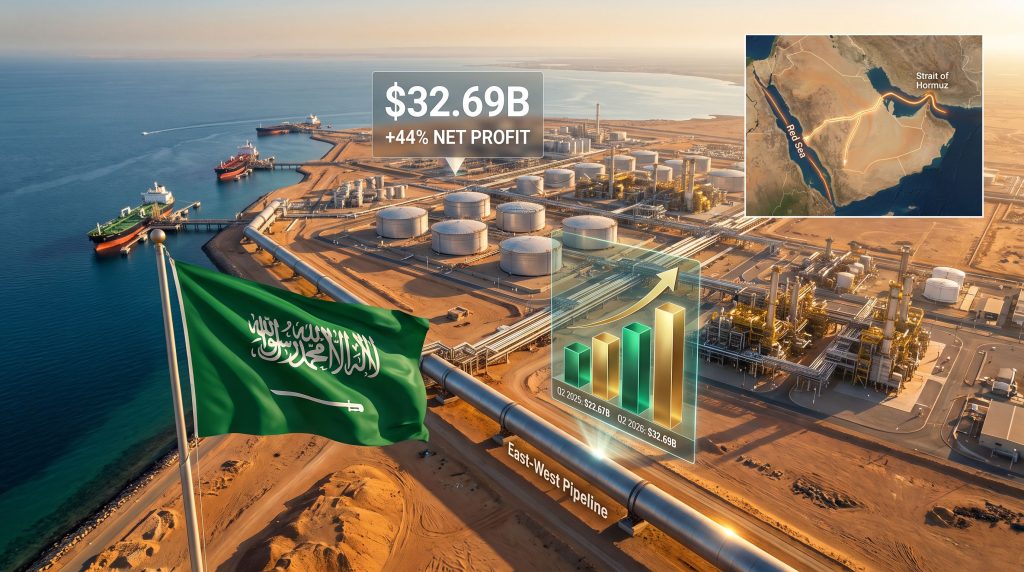
Saudi Aramco reported a net profit of $32.69 billion for the second quarter of 2026, reflecting a 44% increase compared to the $22.67 billion recorded in the same period of 2025. The scale of this earnings expansion is striking by any measure, but its significance deepens when viewed against the backdrop of simultaneous operational disruption. Furthermore, understanding the broader oil price shock context helps explain why these figures exceeded most analyst expectations.
| Metric | Q2 2025 | Q2 2026 | Change |
|---|---|---|---|
| Net Profit | $22.67B | $32.69B | +44% |
| Supply Reliability Rate | ~96-97% (estimated) | 98.4% | Improved |
| Primary Export Route Status | Unobstructed | Disrupted (Hormuz) | Major shift |
| Alternative Route Activated | No | Yes (East-West Pipeline) | Strategic pivot |
This performance did not emerge in isolation. First-quarter 2026 data pointed to a similar trajectory, with adjusted net income of approximately $33.6 billion, representing a 25-26% year-on-year increase. Taken together, the full first half of 2026 confirmed a sustained structural earnings uplift rather than a one-quarter anomaly.
What makes these figures analytically interesting is that they were achieved not despite the Iran war, but in substantial part because of the price dynamics it unleashed. Higher realised prices across crude oil, refined products, and petrochemicals offset the logistical friction of rerouting. The war, in effect, functioned as a revenue catalyst for a producer positioned to keep supplying when others could not.
Disclaimer: All earnings figures referenced here are drawn from reported corporate results and Reuters reporting via Arab News (August 4, 2026). Forward-looking projections and scenario modelling in this article represent analytical frameworks only, not financial forecasts or investment advice.
The Strait of Hormuz: Why One Waterway Can Move Global Oil Prices
The Chokepoint's Structural Importance
To understand why the Iran war triggered such a significant repricing of crude oil globally, it is necessary to appreciate what the Strait of Hormuz actually represents in the architecture of international energy supply. Approximately 20% of global oil trade passes through this narrow waterway between the Persian Gulf and the Gulf of Oman. No comparable volume of energy moves through any other single geographic point on the planet.
When the US-Israeli military conflict with Iran disrupted normal shipping operations through the Strait, the market did not simply reprice for reduced supply. It repriced for uncertainty across an entire category of supply that had previously been treated as reliable. That distinction matters enormously in commodity markets, where forward pricing is driven as much by risk expectation as by current volumes. These geopolitical trade tensions have consequently redrawn assumptions that energy markets had long taken for granted.
How Price Elevation Compensated for Volume Constraints
A fundamental asymmetry operates within oil economics during supply-shock events: the percentage gain in price per barrel tends to exceed the percentage loss in export volume, particularly for producers with the infrastructure to keep shipping. This is because demand for crude is relatively inelastic over short timeframes. Refiners cannot simply switch fuels when supply contracts. They pay the higher price.
For Aramco, this dynamic played out across several dimensions simultaneously:
- Higher realised crude prices increased revenue per barrel even where volumes faced temporary routing constraints
- Refined product margins expanded as downstream buyers competed for available supply
- Chemical feedstock pricing followed crude higher, adding a third revenue stream to the earnings uplift
- The company's cost base remained relatively stable, as rerouting through existing infrastructure did not require major new capital expenditure
The net result was an earnings expansion that significantly outpaced anything achievable through volume growth alone. In addition, the trade war oil impact from broader geopolitical tensions compounded upward price pressure throughout the period.
Infrastructure as Strategy: The East-West Pipeline's Critical Role
From Contingency Asset to Primary Artery
Aramco's East-West Pipeline stretches approximately 1,200 kilometres across the Arabian Peninsula, connecting the oil-rich eastern provinces to the Red Sea port of Yanbu. Under normal operating conditions, this pipeline functions as a complementary export route, running well below its capacity ceiling. When the Strait of Hormuz became operationally compromised, it was transformed almost overnight into the company's primary export corridor.
CEO Amin Nasser has publicly characterised this pipeline as a critical lifeline for the company's operations under wartime conditions. That framing reflects a genuine operational reality: without this pre-existing infrastructure, Aramco's ability to maintain supply continuity would have been materially compromised, and its 98.4% supply reliability rate would have been impossible to achieve. Saudi Aramco's Q1 results further illustrated how rapidly this infrastructure advantage translated into financial outperformance.
The Three Pillars of Aramco's Operational Resilience
Aramco's ability to sustain near-complete supply reliability during what analysts have described as the most consequential energy market disruption in modern history rests on three interconnected capabilities:
- Pipeline redundancy – The East-West corridor provides a complete bypass of Persian Gulf shipping lanes, enabling full decoupling from Hormuz transit when necessary
- Distributed storage capacity – Strategically positioned reserves at multiple points along the supply chain allow the company to buffer production against short-term export bottlenecks without affecting customer deliveries
- Multiple export terminal access – Rather than dependence on any single loading facility, Aramco operates across several terminal locations, reducing single-point-of-failure vulnerability
This infrastructure portfolio did not materialise in response to the current crisis. It represents the accumulated output of multi-decade capital allocation decisions made precisely because Aramco's planning frameworks have consistently identified Hormuz disruption as a category of risk requiring structural mitigation.
Aramco's 98.4% supply reliability rate during active regional conflict stands as one of the highest continuity metrics recorded by any major national oil company operating through a regional war period. It reflects institutional preparedness that cannot be replicated quickly by competitors.
The Second Chokepoint: Houthi Forces and the Red Sea Dimension
A Compounding Risk Architecture
In July 2026, a significant strategic complication emerged that extended the disruption calculus well beyond the Strait of Hormuz. Iran-aligned Houthi forces announced a blockade targeting Saudi Arabia's oil industry operations in the Red Sea, directly threatening the same alternative export corridor that Aramco had activated to bypass Hormuz.
This development introduced what energy analysts describe as a dual-chokepoint constraint with limited historical precedent. Aramco now faces simultaneous disruption threats at both its primary historical export route and the alternative route constructed specifically to provide Hormuz independence. The implications for geopolitical oil pricing are consequently far-reaching, extending well beyond Saudi Arabia's immediate operational concerns.
The strategic implications extend across several layers:
- The port of Yanbu, terminus of the East-West Pipeline, sits within the Red Sea maritime zone now subject to Houthi interdiction risk
- Saudi export terminals along the Red Sea coast face elevated insurance and shipping costs as war risk premiums are repriced
- The threat to both corridors simultaneously removes the clean internal resolution that rerouting through the East-West Pipeline provided for the Hormuz disruption alone
Global Winners and Losers Under Dual Disruption
The compounding effect of two compromised waterways reshapes the competitive landscape for oil producers and creates significant pressure points for import-dependent economies. The distribution of impacts is uneven:
| Category | Impact |
|---|---|
| US shale producers | Benefit from elevated price floors and reduced Middle East competition |
| North Sea and West African exporters | Gain market share and pricing power with Asian buyers |
| China, Japan, South Korea, India | Face sustained energy cost inflation and supply diversification pressure |
| Global shipping and marine insurance | Price elevated war risk premiums across all Middle East routing |
| Saudi Arabia (fiscal position) | Higher revenues offset operational complexity from dual disruption |
Oil Price Sensitivity and Aramco's Conditional Earnings Strength
What History Tells Us About Aramco's Price Exposure
Aramco's earnings record across previous market cycles makes one structural characteristic unmistakably clear: profitability is acutely sensitive to crude price movements in both directions. During demand contraction cycles and OPEC+ oversupply episodes, Aramco's net profit has declined sharply. The current earnings surge is therefore best understood as conditionally dependent on sustained price elevation rather than as a structural shift in the company's earnings base. Furthermore, OPEC market influence continues to shape the boundaries within which these price dynamics operate.
Three Scenarios for Aramco's Earnings Trajectory
The following scenario framework illustrates earnings sensitivity across plausible oil price outcomes. These are analytical constructs, not forecasts.
| Scenario | Assumed Brent Range | Implied Profit Direction | Key Variable |
|---|---|---|---|
| Conflict Escalation | $100-$130/bbl | Strong upward pressure | Red Sea blockade expansion |
| Negotiated Ceasefire | $75-$90/bbl | Moderate compression | Rapid supply return to Hormuz |
| Prolonged Stalemate | $85-$100/bbl | Elevated but stabilising | Sustained rerouting cost burden |
A diplomatic resolution or ceasefire that reopened the Strait of Hormuz would likely produce a rapid downward correction in the geopolitical risk premium embedded in crude prices. The speed and magnitude of that correction would depend on how quickly physical supply volumes could return to pre-war routing patterns, but the directional impact on Aramco's per-barrel realised prices would be immediate and significant.
The next major ASX story will hit our subscribers first
Aramco, Saudi Fiscal Health, and the Vision 2030 Connection
The Kingdom's Financial Architecture
Saudi Aramco functions as the primary engine of Saudi Arabia's sovereign revenue base. The Saudi government holds a majority stake in the company through a combination of direct government ownership and the Public Investment Fund, meaning that Aramco's earnings cycle flows directly into state fiscal capacity.
A 44% profit increase translates into materially higher dividend flows and tax revenues for the Saudi state at a moment when Vision 2030 infrastructure and economic diversification programmes require sustained capital commitment. The war-driven earnings windfall provides a fiscal buffer that partially offsets the economic disruption costs the conflict imposes on Saudi Arabia in other domains.
Dividend Sustainability Under Conflict Conditions
Aramco's dividend commitments rank among the largest absolute dividend payouts of any publicly listed company globally. Sustaining those commitments requires consistent earnings strength. The current profit environment provides a credible buffer, but the dual-chokepoint risk introduces material uncertainty into forward guidance, particularly if the Red Sea blockade threat were to intensify into active interdiction of Saudi export infrastructure.
Investors monitoring Aramco's dividend trajectory should note that the company's earnings model is structurally exposed to the same geopolitical dynamics that are currently driving its outperformance. The factors generating record profits today are the same factors introducing the most significant operational uncertainty the company has faced in its modern history. Detailed financial analysis from the Financial Times provides further context on the longer-term implications for Aramco's balance sheet resilience.
Frequently Asked Questions
Why did Aramco's net profit rise despite supply disruptions caused by the Iran war?
Higher global crude prices driven by the Iran war's impact on supply expectations more than compensated for the logistical costs and volume constraints imposed by Strait of Hormuz disruptions. Aramco's successful activation of the East-West Pipeline to the Red Sea port of Yanbu allowed it to maintain a 98.4% supply reliability rate, preserving customer relationships while benefiting from elevated per-barrel realised prices.
What is the East-West Pipeline and why has it become strategically important?
The East-West Pipeline is a 1,200-kilometre infrastructure asset connecting Saudi Arabia's eastern oil fields to the Red Sea port of Yanbu. It was designed specifically to provide export capacity independent of Strait of Hormuz routing. Following the Hormuz disruption triggered by the Iran war, it became Aramco's primary export artery rather than a backup contingency.
How does the Houthi Red Sea blockade complicate Aramco's operations?
The Houthi declaration of a blockade targeting Saudi oil industry operations in the Red Sea in July 2026 introduced a second layer of export route vulnerability, threatening the same alternative corridor Aramco had activated to bypass Hormuz. This dual-chokepoint situation creates operational exposure that cannot be resolved through internal rerouting alone.
How sensitive is Aramco's profitability to oil price movements?
Extremely sensitive. Aramco's historical earnings cycles track closely with crude price movements in both directions. The current profit surge is conditionally dependent on sustained price elevation. Any significant diplomatic resolution or supply normalisation could compress margins rapidly.
What were Aramco's Q2 2026 earnings?
Aramco reported a net profit of $32.69 billion in Q2 2026, up 44% from $22.67 billion in Q2 2025, as reported by Reuters via Arab News on August 4, 2026.
Want to Track the Next Major Resource Discovery Before the Market Moves?
Discovery Alert's proprietary Discovery IQ model scans ASX announcements in real time, delivering instant alerts on significant mineral discoveries across more than 30 commodities — so whether you're monitoring energy, metals, or emerging resource plays, you're positioned ahead of the broader market. Explore historic discovery returns on Discovery Alert's discoveries page and begin your 14-day free trial today.