August 24, 2026
The Invisible Cost That Determines Who Wins in Global Aluminium Markets
Few industrial sectors are as deeply exposed to energy economics as primary aluminium production. Unlike most manufacturing processes where raw material costs dominate, aluminium smelting is fundamentally an electrochemical operation, one where electricity is not merely an input but the defining determinant of whether a smelter remains globally competitive or becomes a stranded asset. Understanding this dynamic is the essential starting point for appreciating why the Hydro and Statkraft power purchase agreement in Norway carries strategic weight far beyond a standard procurement announcement.
The aluminium industry has long operated on the principle that access to cheap, reliable, and increasingly clean electricity separates the winners from the losers over multi-decade production cycles. In today's market, a third dimension has been added: the carbon intensity of that electricity supply is becoming just as commercially relevant as its price. Aluminium industry leaders have recognised this shift and are repositioning their energy strategies accordingly.
When big ASX news breaks, our subscribers know first
Why Electricity Is the Central Variable in Primary Aluminium Economics
The Energy Cost Structure of Smelting Operations
Primary aluminium is produced through the Hall-Heroult electrolytic process, a method that has remained fundamentally unchanged for over a century despite incremental efficiency gains. The process requires continuous, high-amperage electrical current to reduce aluminium oxide into metallic aluminium, making power consumption an unavoidable structural feature of the business.
In practical terms, electricity typically accounts for 30 to 40 percent of total cash production costs at a primary smelter, and in some high-cost energy environments that figure climbs even higher. This cost profile means that a smelter's energy arrangement is not simply a utility decision; it is a core strategic variable that shapes margin structures across decades.
Key factors that determine energy cost competitiveness in aluminium smelting include:
- The contracted price per megawatt-hour relative to prevailing spot market rates
- The duration of pricing certainty and whether it extends through full asset depreciation cycles
- The physical proximity of generation assets to smelter locations, which affects transmission costs
- The grid zone allocation, particularly in markets like Norway where regional price areas create distinct cost environments
- The carbon intensity of the power source, which increasingly carries a monetised compliance cost
How Power Purchase Agreements Function as Strategic Instruments
A power purchase agreement in the industrial context is not simply a contract for electricity delivery. For a continuous-process industry like aluminium smelting, a long-term PPA functions as a financial hedge, an operational guarantee, and increasingly, a green credential mechanism all rolled into one instrument.
When structured correctly, a PPA converts an unpredictable and volatile input cost into a fixed or semi-fixed line item, allowing capital allocation decisions, customer pricing strategies, and emissions reporting frameworks to be built on a stable foundation. The multi-decade nature of smelting assets, which typically carry 30 to 40 year operational lifespans, makes long-term power contracting particularly well suited to the industry's planning horizons. Furthermore, Statkraft's corporate PPA solutions demonstrate how these agreements are increasingly tailored to the specific needs of energy-intensive industries.
Long-term PPAs are not simply procurement tools for industrial energy buyers. In capital-intensive industries like aluminium, they are structural competitive advantages that lock in cost predictability across production cycles that span entire decades.
Norway's Regional Price Zone Architecture
Norway's electricity market is divided into five regional price zones, designated NO1 through NO5. These zones reflect the physical topology of Norway's transmission grid, including the location of hydropower generation assets and the capacity constraints between regions. Each zone can trade at a different spot price depending on local supply and demand conditions and transmission bottlenecks.
For aluminium producers, matching contracted power delivery to the specific zone where a smelter is physically located is critical. Mismatches between delivery zone and consumption point introduce basis risk, where the contract settlement price diverges from the actual cost of power consumed. The geographic specificity embedded in the Hydro and Statkraft power purchase agreement in Norway reflects precisely this operational discipline.
What the Hydro-Statkraft Agreement Structure Actually Covers
A Layered Architecture of Contracts
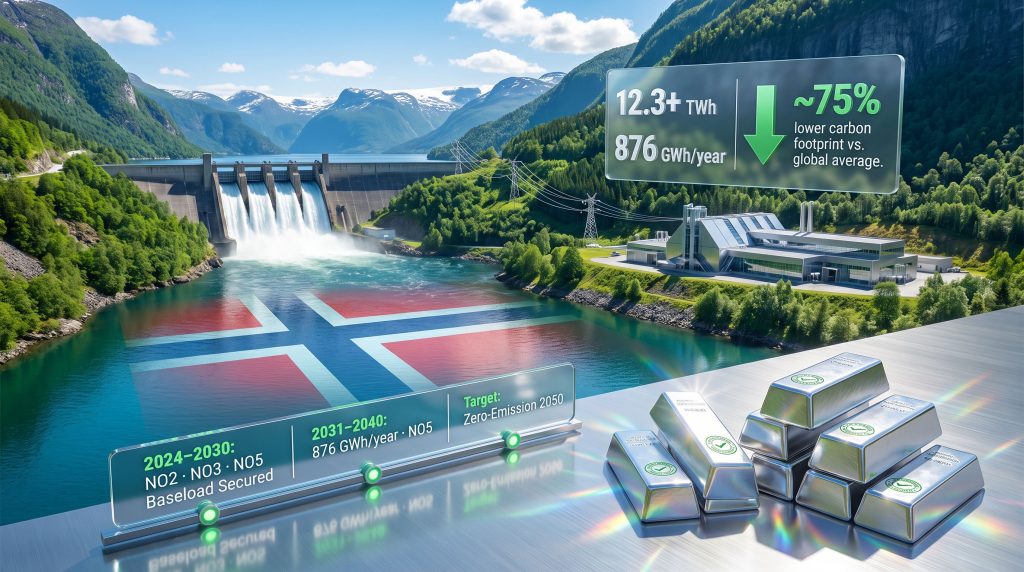
The most recent agreement between Hydro Energi and Statkraft, announced in August 2026, covers an annual electricity volume of 876 GWh across the period from 2031 to 2040, delivering a total of approximately 8.8 TWh within Norway's NO5 price area. However, understanding this contract in isolation misses the broader strategic architecture it completes.
Two earlier agreements concluded in April 2026 established the foundation upon which this third contract was layered. Those arrangements cover:
- 0.9 TWh per year for deliveries in 2029 and 2030
- 1.3 TWh per year for the period spanning 2031 to 2038
A further agreement predating the 2026 trio covered 1.28 TWh of deliveries running from May 2024 through to December 2027, allocated within the NO3 price zone in central Norway.
When the full portfolio of active agreements is tallied, the cumulative contracted electricity volume secured by Hydro across all Statkraft agreements exceeds 12.3 TWh, spanning delivery zones across Norway's power market geography.
| Contract Component | Details |
|---|---|
| Latest PPA annual volume | 876 GWh per year |
| Latest PPA contract period | 2031 to 2040 |
| Latest PPA total delivery | ~8.8 TWh |
| Latest PPA delivery zone | NO5 (Norway) |
| April 2026 PPA combined volumes | 0.9 TWh/year (2029-2030); 1.3 TWh/year (2031-2038) |
| 2024 preceding contract | 1.28 TWh (May 2024 – December 2027, NO3 zone) |
| Cumulative contracted volume | 12.3+ TWh across all active agreements |
| Number of Hydro-Statkraft PPAs signed in 2026 | 3 |
The Logic Behind Sequential Contracting
Hydro's decision to pursue three separate agreements rather than a single consolidated contract reflects sophisticated energy procurement strategy. Staggered contracting provides several structural advantages that a single monolithic agreement cannot:
- It allows volume scaling to be calibrated against operational ramp-up timelines
- It distributes pricing risk across different contracting periods and market conditions
- It provides flexibility to incorporate production technology evolution into future agreement structures
- It enables zone-specific optimisation as smelting operations in different regions come online or expand
Statkraft, as one of Europe's largest renewable energy producers with an extensive hydropower portfolio across Norway, is a counterparty with the generation scale and balancing capability to make multi-decade delivery commitments credible. This generator-offtaker pairing is particularly well suited to continuous process industries where power interruption is operationally damaging. In addition, the broader context of green metals pricing dynamics illustrates how renewable energy contracting is reshaping cost structures across the metals industry.
Norway's Hydropower Advantage and What It Means for Carbon Accounting
Why Hydro-Backed PPAs Carry Unique Reliability Characteristics
Not all renewable PPAs are created equal. Wind and solar agreements expose industrial offtakers to intermittency risk, the possibility that generation output falls short of contracted volumes during periods of calm weather or low irradiance. Hydropower, by contrast, can be dispatched on demand from reservoir storage, making it far more suited to continuous industrial loads like aluminium smelting, which cannot be interrupted without significant operational consequences.
Norway's geography has endowed it with an extraordinarily deep hydropower resource base. Approximately 90 percent of Norway's electricity generation comes from hydropower, a structural characteristic that makes its grid fundamentally different from most European electricity systems, and a key reason why aluminium smelting has historically concentrated in the country.
The Carbon Footprint Differential That Changes Commercial Conversations
Hydro has stated publicly that aluminium produced using Norway's renewable electricity carries a carbon footprint approximately 75 percent lower than the global industry average. This differential is not simply a marketing claim; it is the product of measurable physics.
Global aluminium production is dominated by coal-fired electricity in regions including China, which accounts for the majority of world output. When a European automotive manufacturer or packaging producer compares the lifecycle emissions of aluminium sourced from a Norwegian smelter against material from a coal-heavy producer, the gap is enormous and increasingly carries a financial value as carbon pricing mechanisms tighten. Consequently, the Alcoa clean energy venture represents another example of how major aluminium producers are acting decisively to secure their renewable energy positions.
Aluminium produced using Norway's hydropower-backed renewable grid carries a carbon intensity approximately 75 percent below the global industry average, a differential that is rapidly transitioning from a sustainability marketing point to a hard commercial pricing variable in European supply chains.
The Decarbonisation Roadmap This Agreement Enables
Milestones Toward Zero-Emission Aluminium Production
Hydro has articulated a technology roadmap aimed at achieving zero emissions from aluminium production by 2050. Long-term renewable power agreements are not an end destination in that roadmap; they are enabling infrastructure that makes the subsequent technology steps possible.
The phased trajectory supported by the Statkraft PPA portfolio can be understood across three distinct periods:
- Near-term (2024-2030): Establishing baseload renewable supply through staggered contracts across NO2, NO3, and NO5 zones, securing competitive power pricing during the current smelting technology paradigm
- Mid-term (2031-2038): Scaling certified low-carbon output under long-term price stability, supporting growth in European green aluminium demand as CBAM mechanisms embed carbon costs into import pricing
- Long-term (2040-2050): Enabling deployment of next-generation production technologies including inert anode systems, which eliminate process CO2 emissions entirely but require guaranteed renewable power supply to deliver meaningful decarbonisation
Inert Anode Technology: The Next Frontier
A lesser-known dimension of why renewable power security matters for Hydro's decarbonisation roadmap involves the development of inert anode technology. Conventional aluminium smelting uses carbon anodes that are consumed during the electrolytic process, generating CO2 as a direct process emission separate from electricity-related emissions. Inert anodes, made from non-consumable materials, would eliminate this source of process emissions entirely, producing oxygen instead of CO2.
For inert anode technology to deliver its maximum decarbonisation potential, the electricity powering the smelting process must itself be renewable. A smelter running on inert anodes but powered by fossil-generated electricity would still carry substantial scope 2 emissions. This is precisely why long-term renewable power contracts are not simply complementary to Hydro's zero-emission technology ambitions; they are a prerequisite for them. Similarly, Gladstone aluminium repowering illustrates how producers globally are confronting the same renewable energy imperative.
European Carbon Policy and the Commercial Value of Green Power Contracts
How CBAM Is Restructuring Aluminium Import Economics
The European Union's Carbon Border Adjustment Mechanism is progressively embedding the cost of carbon into imported goods, with aluminium among the first sectors within scope. As CBAM transitions from its transitional reporting phase toward full financial implementation, the emissions intensity embedded in imported aluminium will attract a levy calibrated against the EU carbon price. The broader EU metals action plan further underscores how European policy is restructuring competitive dynamics across the entire metals sector.
For global aluminium producers relying on carbon-intensive grid electricity, CBAM represents a compounding cost disadvantage in European markets. For Norwegian producers with verified renewable energy contracts, however, it represents a potential pricing premium and a competitive moat.
| PPA Feature | Industrial Benefit |
|---|---|
| Long-term price certainty | Protects margin against spot market energy volatility |
| Balancing services included | Reduces operational risk for continuous smelting |
| Renewable certification | Enables CBAM compliance and green product labelling |
| Staggered contract structure | Aligns volume with production ramp-up schedules |
| Hydropower-backed delivery | Ensures reliability unmatched by intermittent renewable sources |
Demand-Side Pressure From Industrial End Users
European manufacturers across the automotive, construction, and packaging sectors are operating under their own carbon reduction commitments, many tied to Science Based Targets or regulatory product-level emissions standards. These buyers are increasingly treating the verified carbon intensity of aluminium as a procurement criterion, not merely a sustainability preference.
This demand-side dynamic creates a direct commercial incentive chain: end-user carbon commitments drive purchasing specifications toward certified low-carbon aluminium, which in turn rewards aluminium producers with verified renewable energy contracts through pricing premiums and long-term supply agreements.
As European carbon pricing mechanisms intensify through the late 2020s and into the 2030s, aluminium producers locked into uncontracted or carbon-intensive power arrangements face compounding competitive disadvantages, while those holding decade-long renewable PPAs are positioned to capture both margin protection and premium market access simultaneously.
The next major ASX story will hit our subscribers first
What This Framework Signals for Industrial Energy Strategy Broadly
Three Structural Lessons With Industry-Wide Applicability
The Hydro and Statkraft power purchase agreement in Norway offers a replicable framework for other energy-intensive industrial producers navigating the intersection of decarbonisation pressure and energy cost management:
- Stagger contracts to match production scaling – Sequential agreements reduce volume mismatch risk and allow pricing to reflect evolving market conditions across different contracting windows
- Match delivery zones to physical consumption points – Zone-specific contracting eliminates basis risk and optimises transmission economics in regional electricity markets
- Treat renewable certification as a commercial asset, not just a compliance cost – Origin guarantees attached to renewable power contracts are increasingly becoming prerequisites for access to premium market segments and for navigating carbon border adjustment mechanisms
Summary of Critical Data Points
| Metric | Figure |
|---|---|
| Annual supply under latest agreement | 876 GWh |
| Total energy across all active PPAs | 12.3+ TWh |
| Carbon footprint reduction vs global average | ~75% |
| Zero-emission production target year | 2050 |
| Number of Hydro-Statkraft PPAs signed in 2026 | 3 |
| Earliest delivery commencement | May 2024 (1.28 TWh, NO3 zone) |
| Latest agreement delivery zone | NO5, Norway |
Frequently Asked Questions: Hydro and Statkraft Power Purchase Agreement in Norway
What is the total electricity volume covered by the Hydro and Statkraft power purchase agreement in Norway?
Across all active agreements including contracts signed in 2024 and the three agreements concluded in 2026, the combined contracted electricity volume exceeds 12.3 TWh, delivered across Norway's NO2, NO3, and NO5 price zones through to 2040.
How does sourcing renewable power reduce aluminium's carbon footprint so significantly?
Aluminium production is an electrochemical process, meaning its emissions profile is dominated by the carbon intensity of its electricity source. By drawing exclusively from Norway's hydropower-based renewable grid, Hydro's smelting operations carry an emissions intensity roughly 75 percent below the global industry benchmark, which remains heavily weighted toward coal-fired electricity predominantly in Asia.
Why has Hydro structured energy procurement through multiple separate contracts rather than one agreement?
Sequential contracting allows Hydro to align energy volumes with operational ramp-up timelines, manage price exposure across different contracting windows, and maintain flexibility as smelting technology evolves toward zero-emission processes. A single monolithic agreement would sacrifice all of these strategic degrees of freedom. Hydro's own announcement confirms this phased approach as a deliberate procurement strategy rather than circumstance.
What role does Norway's price zone structure play in this agreement?
Norway's electricity market is divided into regional price zones that can trade at different prices depending on local generation, demand, and transmission constraints. Specifying delivery in NO2, NO3, and NO5 zones allows Hydro to match contracted power to the physical location of its smelting operations, eliminating basis risk and optimising the economics of each agreement relative to the smelter it serves.
How does this agreement connect to the EU Carbon Border Adjustment Mechanism?
CBAM applies a levy to aluminium imports based on their embedded carbon emissions. Producers relying on carbon-intensive grid electricity face escalating costs as the mechanism approaches full implementation. Hydro's verified renewable energy contracts position its Norwegian output to avoid these levies and potentially command a pricing premium in European markets as carbon costs become more explicit in aluminium trade economics.
Readers seeking broader context on renewable energy contracting trends within European industrial markets and aluminium sustainability developments can find additional reporting and analysis at alcircle.com.
Want to Capture the Next Major Minerals Discovery Before the Market Moves?
Discovery Alert's proprietary Discovery IQ model scans ASX announcements in real time, instantly translating complex mineral data into actionable opportunities across 30+ commodities — the same kind of edge that has underpinned historic discoveries generating extraordinary returns. Begin your 14-day free trial today and position yourself ahead of the broader market.