August 24, 2026
West Africa's Bauxite Boom and the Race to Control Export Infrastructure
The global bauxite trade is not driven by discovery alone. Ore bodies are abundant across West Africa, Southeast Asia, and Australia, yet the companies that consistently win in this market are those that control the logistics corridor between mine and ship. Port access, berth scheduling, and vessel throughput capacity frequently determine which exporters can scale and which remain constrained by infrastructure bottlenecks outside their control. This operational reality frames the strategic logic behind Ashapura Minechem's deepening commitment to Guinea and its accelerating programme of captive port investment.
Understanding Ashapura Minechem Guinea bauxite exports requires looking beyond quarterly revenue figures and examining the physical infrastructure, trade structure, and commodity demand forces that are reshaping global aluminium supply chains in real time.
When big ASX news breaks, our subscribers know first
Guinea's Structural Position in the Global Bauxite Supply Chain
Guinea is estimated to hold approximately one-third of the world's proven bauxite reserves, a concentration that gives the country an outsized influence over global bauxite production economics. What distinguishes Guinean deposits is not simply their scale but their quality. The bauxite found across Guinea's laterite-rich geological formations is characterised by high aluminium oxide content, typically in the range of 40 to 45 percent, combined with relatively low reactive silica levels.
This geochemical profile matters enormously to alumina refineries. Reactive silica is the principal quality enemy in bauxite processing. It consumes caustic soda during the Bayer process, the dominant industrial method for converting bauxite into alumina, raising chemical costs and reducing refinery efficiency. Guinea's low-silica deposits therefore offer Chinese refineries a material cost advantage compared with processing lower-grade ores from alternative origins.
Why Indonesia's Export Restrictions Changed Everything
A structural shift that has received insufficient attention outside specialist circles is Indonesia's decision in 2023 to reimpose restrictions on raw bauxite exports. Indonesia had previously been a significant supplier to Chinese alumina refineries, and its withdrawal from the raw bauxite export market created an immediate supply gap that West African producers, Guinea chief among them, have been filling ever since.
This trade flow redirection is not a temporary adjustment. Chinese refineries have reformulated their procurement strategies around Guinean supply, and the logistical infrastructure investments made by exporters operating in Guinea are calibrated to serve this demand over decade-long time horizons, not quarterly cycles. The combination of Indonesia's restrictions and Guinea's geological advantage has created a structurally elevated demand environment for high-grade Guinean bauxite that underpins the volume ambitions of operators like Ashapura Minechem.
Furthermore, the bauxite and alumina market continues to evolve rapidly, with Guinea's role becoming increasingly central to global supply chain planning.
Guinea's bauxite dominance is partly a geological lottery and partly a logistics story. The country's coastal geography, with navigable river systems and accessible deep-water anchorage points, makes it possible to build and operate captive port facilities at a scale that landlocked mineral provinces simply cannot match.
Q1 FY27 Financial Results: Reading Between the Revenue Lines
Ashapura Minechem's Q1 FY27 consolidated results present an interesting split narrative. Revenue growth was impressive at 19.22 percent year-on-year, with consolidated revenue reaching INR 16.16 billion (approximately USD 169 million). Yet net profit growth of 5 percent to INR 1.15 billion (approximately USD 12 million) tells a more nuanced story about where the earnings leverage is being absorbed.
| Metric | Q1 FY27 | Q1 FY26 | Change |
|---|---|---|---|
| Consolidated Revenue | INR 16.16bn (USD 169M) | ~INR 13.55bn | +19.22% |
| Net Profit | INR 1.15bn (USD 12M) | ~INR 1.10bn | +5.0% |
| EBITDA Margin | 11.7% | Broadly flat YoY | Flat |
| Guinea Bauxite Exports | 2.34 MMT | 2.05 MMT | +14.1% |
The CIF Structure and Why Freight Costs Hit Margins Directly
A critical technical detail that separates Ashapura's margin profile from that of many other mining exporters is its sales structure for China-bound bauxite. A significant portion of these sales are conducted on a CIF basis, which stands for Cost, Insurance, and Freight. Under CIF terms, the seller bears the cost of ocean freight and marine insurance until the cargo arrives at the destination port.
This is the opposite of FOB, or Free on Board, pricing, where the buyer assumes freight risk once cargo clears the origin port. For Ashapura, selling CIF means that ocean freight rates are not an abstract market variable but a direct line item in their cost of goods sold. With ocean freight running at USD 6.3 per tonne during Q1 FY27, and with the company shipping millions of tonnes to Chinese ports, the aggregate freight bill represents a substantial drag on EBITDA.
This structural exposure explains precisely why EBITDA remained broadly flat year-on-year despite a near-20 percent revenue uplift. The volume growth generated incremental revenue, but elevated freight rates consumed a disproportionate share of the incremental margin. According to analysis of Ashapura's Guinea bauxite performance, the company's FY2026 results demonstrated how strongly Guinea operations can drive profitability when freight conditions are more favourable.
When revenue grows by nearly one-fifth but profitability barely moves, the logical question is where the value is leaking. In commodity shipping, CIF contract structures transfer freight market risk from buyer to seller, and during periods of elevated ocean rates, this transfer can neutralise the financial benefit of strong volume growth entirely.
Export Volume Trajectory: Scaling Toward a USD 1 Billion Revenue Milestone
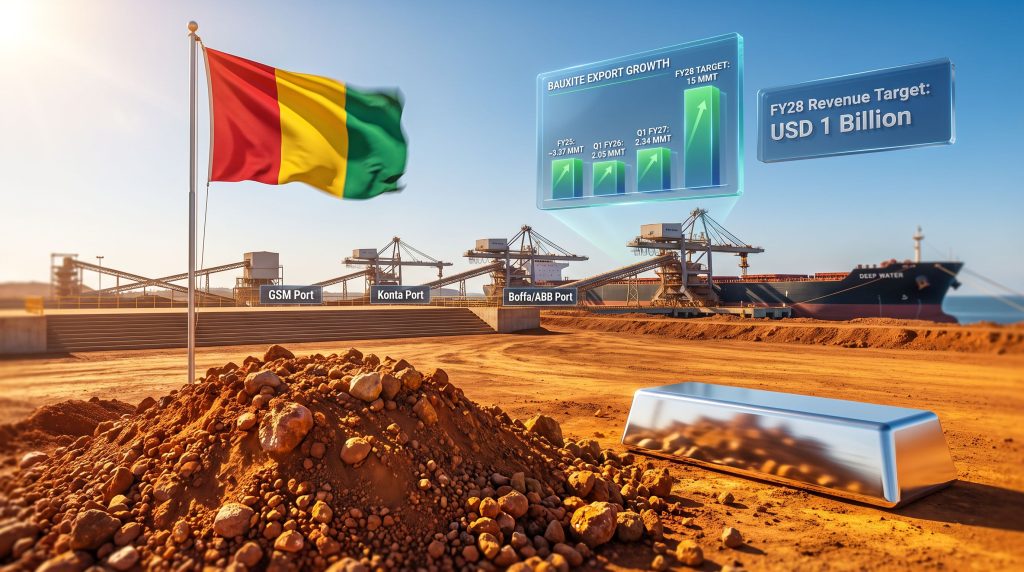
The multi-year volume progression for Ashapura Minechem Guinea bauxite exports illustrates a company in an active capacity ramp phase rather than a steady-state operation.
| Period | Guinea Bauxite Export Volume |
|---|---|
| Full Year FY25 | ~3.0 to 3.37 MMT |
| Q1 FY26 | 2.05 MMT (quarterly record at the time) |
| H1 FY26 | 3.38 MMT (near full FY25 annual volume) |
| Q1 FY27 | 2.34 MMT (+14.1% YoY) |
| FY27 Full-Year Target | 9 to 11 MMT (revised from 10 to 12 MMT) |
| FY28 Full-Year Target | 15 MMT (~USD 1bn in annual sales) |
The Q1 FY27 quarterly run-rate of 2.34 MMT, if annualised, implies approximately 9.36 MMT for the full year, which sits at the lower boundary of the revised FY27 guidance range. Sustaining or improving on this pace across the remaining three quarters will be necessary to reach the midpoint of the 9 to 11 MMT target.
What a 15 MMT Target Really Means in Operational Terms
The FY28 ambition of 15 MMT represents a volume increase of roughly 4.5 times the FY25 annual output achieved just two to three years earlier. This kind of scaling is operationally rare in the mining sector outside of greenfield mega-projects. For Ashapura, it is being attempted through a combination of existing deposit access, captive infrastructure expansion, and optimised vessel scheduling rather than through large-scale new mine construction.
Achieving 15 MMT would require quarterly export volumes averaging approximately 3.75 MMT, which is materially above Q1 FY27's 2.34 MMT result. The gap between current run-rate performance and the FY28 target defines the infrastructure and operational execution challenge over the next 18 to 24 months. In this context, the bauxite export production models adopted by other regional operators offer a useful benchmark for what is achievable within similar timeframes.
Captive Port Infrastructure: The Competitive Moat That Numbers Cannot Fully Capture
Few competitive advantages in the mining export sector are as durable and high-barrier as captive deep-water port infrastructure. Third-party port access introduces scheduling uncertainty, berth congestion risk, and cost unpredictability, particularly during periods of elevated regional export activity when port queues lengthen and demurrage charges accumulate.
Ashapura's three-port Guinea infrastructure network substantially eliminates these constraints.
| Port Facility | Location | Current Annual Capacity |
|---|---|---|
| GSM Port | Guinea | 6 MMT |
| Konta Port | Guinea | 5 MMT |
| Boffa / ABB Port | Guinea | 8 MMT (upgraded from 5 MMT) |
| Combined Current Capacity | ~16 MMT per annum | |
| Planned Combined Capacity | ~27 MMT (by FY27-FY28) |
The Boffa Port upgrade from 5 MMT to 8 MMT represents a 60 percent capacity increase at a single facility, achieved through investment in loading equipment, stockpile management systems, and vessel berthing improvements. This is an important detail because port capacity expansions in West Africa's coastal mining zones are logistically complex and capital intensive, involving not just physical infrastructure but also regulatory coordination with Guinean port authorities.
The combined 16 MMT of current throughput capacity provides meaningful headroom above the FY27 target of 9 to 11 MMT, reducing the risk that logistical constraints rather than mining or market factors limit export delivery. The planned expansion pathway toward 27 MMT combined capacity is explicitly sized to accommodate the 15 MMT FY28 target with buffer capacity remaining.
The FY27 Guidance Revision: Timing Delay or Structural Signal?
Ashapura Minechem revised its FY27 bauxite volume guidance downward from 10 to 12 MMT to a new range of 9 to 11 MMT. Guidance revisions in mining and resource companies are frequently interpreted by markets as a signal of deeper operational or demand-side problems. In this case, however, the context suggests a more measured interpretation is appropriate.
Several factors likely contributed to the revision:
- Ocean freight market conditions creating near-term uncertainty around CIF contract economics
- Operational ramp-up timelines for newly expanded port infrastructure requiring calibration before full throughput is achievable
- Broader Guinea mining policy environment, which can introduce permit timing variability
- The inherent complexity of coordinating multi-site mine production with multi-port logistics scheduling at increasing volumes
Critically, the FY28 target of 15 MMT has been maintained without revision. This sequencing — where the near-term target is trimmed but the medium-term ambition is preserved — typically reflects management confidence that the underlying capacity and demand fundamentals remain intact and that the revision represents a timing shift rather than a structural capacity ceiling.
The next major ASX story will hit our subscribers first
Risk Framework: What Investors and Industry Observers Should Monitor
| Risk Category | Specific Risk | Potential Impact |
|---|---|---|
| Freight Markets | Elevated ocean rates (USD 6.3/tonne) | Direct EBITDA margin compression under CIF structure |
| Currency | INR/USD and USD/CNY fluctuations | Revenue realisation volatility on China-bound sales |
| Guinea Policy | Mining regulation or export levy changes | Volume disruption and cost base inflation |
| Shareholder Dynamics | Eriska Investment Fund +5.21% stake; Albula Investment Fund divestment | Sentiment and share liquidity signals |
| Corporate Structure | Dissolution of Singapore subsidiary | Minor structural simplification with no core operational impact |
Guinea's Regulatory Landscape: A Risk That Rewards Monitoring
Guinea's government has historically demonstrated a willingness to adjust mining royalties, export conditions, and concession terms in response to commodity price cycles and domestic revenue priorities. This is not unique to Guinea; most major mining jurisdictions periodically recalibrate the fiscal relationship between governments and foreign miners. However, companies with high volume concentration in a single country face amplified exposure when policy adjustments occur.
Ashapura's captive infrastructure investment in Guinea functions simultaneously as a competitive moat and a concentration risk. The capital committed to port facilities and mine logistics creates operational stickiness that cannot easily be redeployed to alternative jurisdictions. Consequently, any sustained adverse shift in Guinea's mining policy framework would have a proportionately larger impact on Ashapura than it would on a more geographically diversified bauxite exporter.
Electric Vehicles, Aluminium Demand, and the Long-Term Demand Thesis
Bauxite demand projections are ultimately anchored to aluminium consumption forecasts, and aluminium consumption forecasts are increasingly shaped by electric vehicle adoption rates. The average battery electric vehicle uses significantly more aluminium than an equivalent internal combustion engine vehicle, with estimates suggesting BEVs require 20 to 40 percent more aluminium by weight due to lightweighting requirements, battery enclosure structures, thermal management systems, and structural component designs that prioritise weight reduction to extend driving range.
China remains the world's largest alumina refining market and the dominant destination for Guinean bauxite exports. Chinese alumina refiners have been investing aggressively in refinery capacity while simultaneously confronting the reality that domestic Chinese bauxite reserves are of declining grade and increasing extraction depth. This structural dynamic makes imported high-grade Guinean bauxite not merely a preference but an operational necessity for maintaining Chinese refinery utilisation rates.
In addition, leading bauxite mines globally are increasingly being benchmarked against Guinea's output quality, further reinforcing the country's central role in the aluminium value chain.
The confluence of Indonesian export restrictions, declining domestic Chinese bauxite grades, and accelerating EV-driven aluminium demand has created what can be described as a structurally supported demand environment for West African bauxite. Whether this translates into sustained price appreciation depends on the pace of new mine supply entering the market from Guinea and other West African producers over the next five years.
Business Diversification: Domestic Operations as a Strategic Buffer
Beyond its Guinea bauxite operations, Ashapura Minechem maintains a domestic Indian minerals business with bentonite as its primary product. Bentonite serves a broad range of industrial applications including foundry sand binding, oil and gas drilling fluid formulation, civil engineering containment systems, and agricultural soil conditioning.
The domestic segment provides two forms of strategic value. First, it generates revenue with significantly lower freight cost exposure than Guinea bauxite exports, offering a partial natural hedge against ocean freight market volatility. Second, it provides operational continuity during periods when Guinea-specific factors, whether logistical, regulatory, or geopolitical, create disruptions to the export programme.
The voluntary liquidation and dissolution of Ashapura Holdings Fareast Pte. Ltd., the company's non-operational Singapore subsidiary, completed in August 2026, represents a corporate housekeeping exercise with no material operational implications. Furthermore, among the major aluminium mining companies globally, Ashapura's dual-segment structure stands out as a model for balancing export ambition with domestic revenue stability.
Key Takeaways for Evaluating Ashapura's Guinea Bauxite Export Outlook
- Volume momentum is established but margin realisation remains the critical variable given CIF contract structure and USD 6.3 per tonne ocean freight costs
- Captive port infrastructure totalling 16 MMT combined annual capacity provides the logistical foundation to support the FY27 export target with meaningful headroom
- The FY28 ambition of 15 MMT and approximately USD 1 billion in sales represents a transformational revenue milestone that requires sustained quarterly execution above current run-rates
- Guinea's geological and trade flow advantages, including high-grade deposits and the structural demand shift created by Indonesia's export restrictions, support the long-term demand thesis
- The guidance revision from 10-12 MMT to 9-11 MMT for FY27 warrants monitoring as subsequent quarterly results will clarify whether this reflects a timing delay or a more persistent operational constraint
This article is intended for informational purposes only and does not constitute financial or investment advice. Forward-looking statements regarding production targets, revenue projections, and market conditions involve inherent uncertainty and should not be relied upon as guarantees of future performance. Readers should conduct their own independent research and consult qualified financial advisers before making any investment decisions.
For readers seeking deeper quantitative analysis of global bauxite and alumina trade flows, supply-demand balances through 2036, and price outlook modelling, AL Circle's Global Bauxite and Alumina Market Forecast to 2036 report provides detailed coverage of the bauxite-to-aluminium value chain. Available at: alcircle.com/specialreport/2477/global-bauxite-alumina-market-forecast
Want to Capitalise on the Next Major Mineral Discovery Before the Broader Market?
Discovery Alert's proprietary Discovery IQ model scans ASX announcements in real time, instantly identifying significant mineral discoveries across bauxite, aluminium, and over 30 other commodities — translating complex data into clear, actionable investment opportunities. Explore historic examples of extraordinary discovery-driven returns and begin your 14-day free trial today to position yourself ahead of the market.