August 24, 2026
The Infrastructure Logic Behind Green Ammonia Export Projects
Long before a single electrolyser is commissioned or a tonne of green ammonia loads onto a carrier vessel, the commercial viability of any large-scale green hydrogen project is determined by geography. Proximity to deep-water ports, access to world-class renewable resources, and the existence of established industrial corridors are not peripheral advantages. They are the structural prerequisites that separate projects which reach financial close from those that remain perpetual feasibility studies.
Against this backdrop, the Hive Hydrogen project in Nelson Mandela Bay has attracted significant attention from energy transition observers, infrastructure investors, and green hydrogen market participants. Valued at between $4.6 billion and $5.8 billion (approximately R105 billion), it represents one of the most capital-intensive green energy export initiatives currently in advanced development on the African continent.
When big ASX news breaks, our subscribers know first
Why the Coega SEZ Is Central to the Project's Commercial Logic
The decision to locate the Hive Hydrogen project within the Coega Special Economic Zone adjacent to the Port of Ngqura in Gqeberha (formerly Port Elizabeth) is not incidental. The Coega SEZ offers a combination of pre-zoned industrial land, established utility corridors, and proximity to one of South Africa's most capable deep-water export terminals that few locations in southern Africa can match.
The Port of Ngqura is particularly significant. As a purpose-built deep-water facility capable of accommodating large cargo vessels, it provides the export infrastructure backbone that an ammonia export project at this scale requires. Green ammonia is a cryogenic liquid that demands specialist storage and loading infrastructure, and proximity to an existing deep-water terminal materially reduces the capital required to build out that logistics chain.
Geographically, Nelson Mandela Bay sits at the convergence of Atlantic and Indian Ocean shipping routes, positioning it favourably for supply into both European and Asian markets. This dual-ocean access is a strategic differentiator that projects located further north or inland cannot easily replicate.
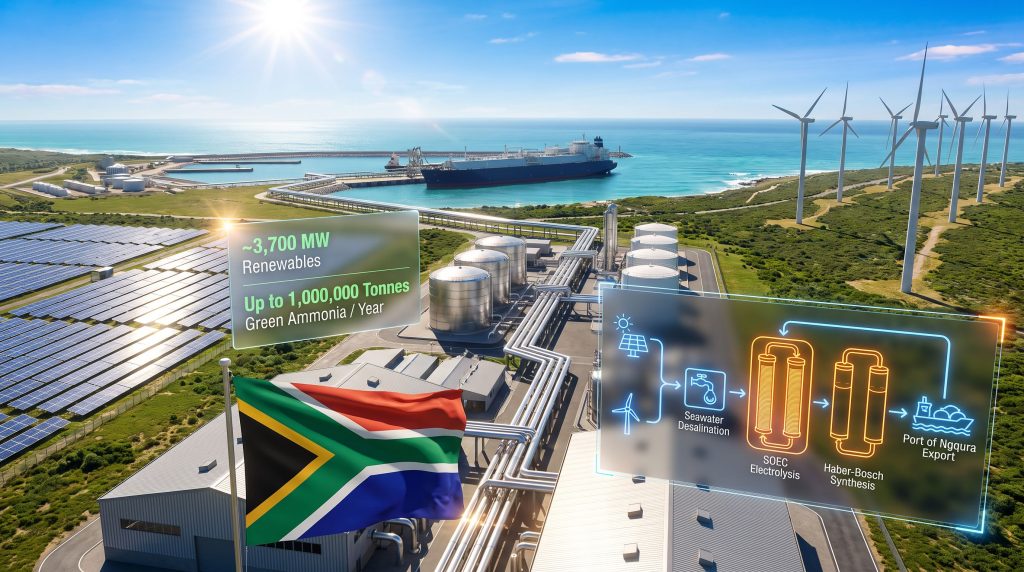
Beyond port logistics, the Eastern Cape's renewable resource endowment is among the strongest in South Africa. High solar irradiation levels combined with consistent coastal and onshore wind patterns create conditions where a combined renewable capacity of approximately 3,700 MW across the full project build is technically achievable. For a project whose entire production economics depend on the cost and availability of renewable electricity, this matters enormously.
Green Ammonia as the Export Vector of Choice
One of the less-understood aspects of the global green hydrogen trade is why pure hydrogen is rarely the commodity being shipped. The physics of hydrogen storage and transport create fundamental economic barriers. Liquefying hydrogen requires cooling it to approximately -253 degrees Celsius, just above absolute zero, which demands cryogenic infrastructure of extraordinary complexity and energy intensity.
Green ammonia sidesteps this constraint entirely. Ammonia (NH3) contains hydrogen atoms that can be released through a cracking process at the destination, and it liquefies at a comparatively manageable -33 degrees Celsius at atmospheric pressure. This makes it far more tractable as a shipping commodity using infrastructure that has well-established precedents in the global fertiliser trade.
The end-use applications for green ammonia are also expanding rapidly. Furthermore, demand signals from European and Asian buyers continue to strengthen across multiple sectors:
- Fertiliser production: Ammonia is a primary feedstock for nitrogen-based fertilisers, where green ammonia can directly substitute grey ammonia produced from natural gas.
- Shipping fuel: Ammonia is being developed as a zero-carbon maritime fuel, with several major shipping companies trialling ammonia-capable vessel designs.
- Power generation: Ammonia co-firing in coal and gas power plants is being piloted in Japan and South Korea as a near-term decarbonisation pathway.
- Hydrogen reconversion: Cracking facilities at destination ports can extract hydrogen from ammonia for industrial and mobility applications.
Green ammonia allows large-scale hydrogen to cross oceans without the cryogenic infrastructure burden of liquid hydrogen, making it the dominant format for intercontinental green hydrogen trade at the volumes being discussed by European and Asian importers.
Project Identity, Sponsorship, and Scale
The Hive Hydrogen project is being developed by Hive Energy, a UK-based renewable energy developer, in partnership with BuiltAfrica, a South African infrastructure development company. The project is classified as an export-oriented green ammonia production facility, with its primary target markets being European industrial hubs and Asian energy importers seeking to decarbonise heavy industry supply chains.
The scale of what is being proposed is significant by any measure. The following table summarises the key project parameters as currently reported:
| Metric | Reported Range | Notes |
|---|---|---|
| Total Capital Value | $4.6bn to $5.8bn (~R105bn) | Variation reflects phasing and financing structure |
| Annual Ammonia Output | 800,000 to 1,000,000 tonnes | Phase-dependent production targets |
| Total Renewable Capacity | ~3,700 MW (full build) | Approximately 1.4 GW solar + 1.5 GW wind initially |
| Electrolyser Technology | Solid Oxide (SOEC) | Topsoe selected as technology provider in mid-2026 |
| Target Export Markets | Europe and Asia | Aligned with EU green hydrogen import targets |
| Construction Start | Early 2027 (projected) | Subject to financial close and regulatory approvals |
| Commercial Operations | 2029 to 2031 | Phase-dependent |
Data Note: The discrepancy between the $4.6 billion and $5.8 billion capital figures reflects different project phases rather than conflicting estimates. The upper bound represents the full-build scenario, while lower figures correspond to initial phase commitments. Readers should treat all projections as subject to revision pending financial close.
The Five-Step Production Process: From Sunlight to Export Terminal
Understanding how green ammonia is actually produced at an industrial facility helps contextualise the scale of infrastructure investment required. The Hive Hydrogen project involves a fully integrated production chain across five distinct stages:
-
Renewable Power Generation: Solar PV arrays and onshore wind turbines totalling approximately 3,700 MW at full build supply electrical power to the facility. The renewable generation is designed to power the electrolysis loads independently of the national grid, a critical design feature that insulates production economics from grid tariff volatility and load-shedding exposure.
-
Seawater Desalination: The Eastern Cape is a water-scarce region, and the project addresses this directly by incorporating seawater desalination units to supply purified feedwater for electrolysis. This eliminates dependency on freshwater resources and removes a potential regulatory and social licence constraint.
-
Green Hydrogen Production via Electrolysis: Purified water is split into hydrogen and oxygen using Topsoe's solid oxide electrolyser cell (SOEC) technology. SOEC systems operate at high temperatures of between 700 and 900 degrees Celsius, enabling significantly higher electrical efficiency than room-temperature alternatives such as PEM or alkaline electrolysers.
-
Ammonia Synthesis: The hydrogen produced is combined with nitrogen extracted from the atmosphere through the well-established Haber-Bosch process in an ammonia synthesis loop. The output is liquid green ammonia ready for storage.
-
Port Export via Ngqura: Liquid ammonia is loaded onto specialist carriers at the Port of Ngqura for shipment to European and Asian offtake destinations.
How Does SOEC Compare to Other Electrolyser Technologies?
The selection of Topsoe as the SOEC electrolyser technology provider, confirmed in mid-2026, is one of the most consequential development milestones the project has reached. It resolves a fundamental technology risk question that lenders and equity investors require answered before committing capital at this scale. According to reporting from Enerdata, Topsoe's involvement significantly strengthens the project's technical credibility.
The thermal integration advantage of SOEC technology is particularly relevant to this project's specific configuration. Because the Haber-Bosch ammonia synthesis loop generates significant waste heat during operation, that heat can in principle be recycled back to maintain the electrolyser's operating temperature range. This closed-loop thermal integration has the potential to improve overall system efficiency beyond what standalone electrolyser efficiency figures suggest, consequently improving the levelised cost of hydrogen (LCOH) that underpins the project's competitive positioning in European and Asian markets.
The following comparison illustrates how SOEC stacks up against alternative electrolyser technologies:
| Technology | Operating Temp | Efficiency | Commercial Maturity | Best Suited For |
|---|---|---|---|---|
| Solid Oxide (SOEC) | 700 to 900°C | Very High | Emerging Commercial | Large-scale, heat-integrated plants |
| PEM | 20 to 80°C | High | Commercially Mature | Flexible, fast-response applications |
| Alkaline (AEL) | 60 to 90°C | Moderate to High | Most Mature | Large baseload production |
The key risk associated with the SOEC choice is one that the project's developers must manage carefully with lenders: SOEC technology has not yet been deployed at the scale proposed by this project. Stack degradation rates, replacement cycle economics, and long-term performance warranties at gigawatt scale remain areas of active commercial negotiation in the broader industry. This is a technology de-risking challenge, not a fundamental viability question, but it will influence the terms and cost of project finance.
Development Milestones Already Achieved
The Hive Hydrogen project has progressed meaningfully beyond the conceptual stage. Key milestones that have been reached include:
- Environmental Impact Assessment work completed within the Coega SEZ regulatory framework.
- Front-End Engineering and Design (FEED) activities progressed, covering electrolyser configuration and ammonia synthesis loop design.
- Topsoe appointed as SOEC electrolyser technology provider in mid-2026.
- Renewable energy package defined at approximately 1.4 GW solar and 1.5 GW wind for initial phases.
- Active engagement with European and Asian offtake counterparties ongoing.
However, what remains before construction can begin centres on four critical pathways:
- Achieving financial close on a project finance structure spanning debt and equity at the $4.6 billion to $5.8 billion range.
- Finalising grid interconnection arrangements with the Nelson Mandela Bay metro under the proposed power-banking model.
- Securing final regulatory approvals and environmental authorisations across water use licences and other permitting requirements.
- Executing anchor offtake agreements with European or Asian buyers sufficient to satisfy project finance lenders on revenue certainty.
The next major ASX story will hit our subscribers first
The Power-Banking Concept: A Dual-Purpose Infrastructure Asset
One dimension of the Hive Hydrogen project that receives insufficient attention in most analyses is the proposed power-banking arrangement with the Nelson Mandela Bay municipality. Under this model, the project's renewable generation capacity could provide grid support to the Gqeberha metro, with potential to reduce load-shedding exposure for residential and business electricity consumers.
This transforms the project's social and political profile in a meaningful way. Rather than being perceived solely as an export-oriented facility whose economic benefits flow primarily to international buyers, the power-banking arrangement creates a tangible local benefit that strengthens community and municipal support for the project during the approvals and construction phases. Financial modelling cited in industry coverage suggests the arrangement could generate measurable cost savings for the municipality, though specific figures remain subject to finalisation of the commercial structure.
Competitive Positioning Within Africa's Green Hydrogen Landscape
The Hive Hydrogen project in Nelson Mandela Bay does not operate in isolation. Several other African and southern African projects are competing for the same European and Asian offtake contracts, financing pools, and skilled development resources. In addition, the role of critical minerals energy transition requirements is increasingly shaping which projects attract development finance first.
| Project | Location | Scale | Primary Output | Status (2026) |
|---|---|---|---|---|
| Hive Hydrogen | Coega SEZ, Eastern Cape | ~3,700 MW renewables | Green Ammonia (~1Mt/yr) | FEED / Pre-FID |
| Boegoebaai Green Hydrogen | Northern Cape | Multi-GW proposed | Green Ammonia / H2 | Pre-Feasibility |
| HYPHEN Hydrogen Energy | Tsau //Khaeb, Namibia | 3 GW Phase 1 | Green Ammonia | Development |
| HyDeal South Africa | Western Cape | TBC | Green Hydrogen | Early Development |
The EU's REPowerEU framework targets 10 million tonnes of green hydrogen imports annually by 2030, creating a theoretically vast addressable market. However, competition from Australian, Chilean, Middle Eastern, and North African producers is intensifying simultaneously. First-mover advantage in executing long-term offtake agreements with European industrial buyers is commercially decisive, as anchor contracts provide the revenue certainty that unlocks project finance.
Key Risks That Will Define the Project's Trajectory
What Are the Primary Financial and Commercial Risks?
Financial complexity is the most immediate challenge. Mobilising $4.6 billion to $5.8 billion in project finance for an emerging technology application in an emerging market requires a blended finance structure likely involving development finance institutions, export credit agencies, green bonds, and commercial project finance lenders. Each financing layer introduces negotiation complexity and timeline risk.
Technology scale risk associated with SOEC at commercial scale must be managed through robust performance guarantees and contractor warranty structures. Lenders will scrutinise this closely.
Green ammonia price competitiveness against conventionally produced grey ammonia remains constrained without meaningful carbon pricing or offtaker mandates. The EU's Carbon Border Adjustment Mechanism (CBAM) and evolving hydrogen import regulations are improving the commercial case, but green ammonia production costs and grey ammonia price dynamics remain the most significant market risk variable.
Regulatory and timeline risk across water licences, environmental authorisations, and grid access arrangements each carry the potential to extend the path to construction commencement beyond the currently projected early 2027 start date.
What Success Would Mean for South Africa's Energy Transition
If the Hive Hydrogen project reaches financial close and achieves commercial operations within its projected 2029 to 2031 window, its significance extends well beyond the direct economic outputs of jobs created and ammonia exported. It would establish a replicable execution template for South Africa's broader green hydrogen ambitions, demonstrating that a first-generation green ammonia mega-project can be financed, constructed, and operated at commercial scale. Furthermore, the renewable energy solutions and green transition materials frameworks that underpin this project will directly inform how energy transition in mining and heavy industry evolves across the region.
The parallel with LNG infrastructure development in Australia and Qatar is instructive. Those markets required anchor projects to prove the concept and establish the export infrastructure before subsequent projects could be developed at lower risk and cost. The Hive Hydrogen project in Nelson Mandela Bay is positioned to play an analogous role for South Africa's emerging green ammonia export industry, provided it can navigate the substantial financing, technology, and regulatory challenges that remain ahead of it. Consequently, the mining decarbonisation benefits associated with successfully scaling this kind of infrastructure extend well beyond the project boundary itself.
This article contains forward-looking statements and projections related to project timelines, capital costs, production targets, and market conditions. These are subject to material uncertainty and should not be construed as investment advice. Readers should conduct independent due diligence before making any investment decisions related to companies or projects discussed herein.
For ongoing coverage of the Hive Hydrogen project and South Africa's broader green hydrogen sector, Mining Weekly at miningweekly.com provides regular reporting on energy transition developments across the region.
Want to Spot the Next Major Resource Discovery Before the Market Does?
The energy transition driving demand for green ammonia and critical minerals is also reshaping ASX mineral exploration, and Discovery Alert's proprietary Discovery IQ model delivers real-time alerts the moment significant ASX discoveries are announced — explore historic discoveries and their returns to see what early positioning can mean, then begin your 14-day free trial at Discovery Alert to secure your market-leading edge.