August 24, 2026
When State-Backed Mining Companies Go Global: A Capital Markets Turning Point
The global mining finance landscape has been quietly undergoing a structural reorientation. Across resource-rich nations, state-linked mineral producers are no longer content to rely solely on domestic banking networks to fund their expansion ambitions. From South America's copper giants to Southeast Asia's nickel producers, the appetite to access diversified international capital has become a defining characteristic of the modern mining conglomerate. This shift reflects not just financial sophistication, but a fundamental change in how governments are positioning their mineral assets within the global economic order.
Against this backdrop, Saudi Arabia's national mining champion has completed a financing transaction that marks a genuine inflection point — not just for the company itself, but for how international capital markets are beginning to price Gulf mineral credits. Furthermore, this deal arrives at a moment when Saudi critical minerals are attracting growing global attention from both lenders and strategic investors.
When big ASX news breaks, our subscribers know first
Understanding the Transaction: Saudi Maaden's $1 Billion International Loan Facilities
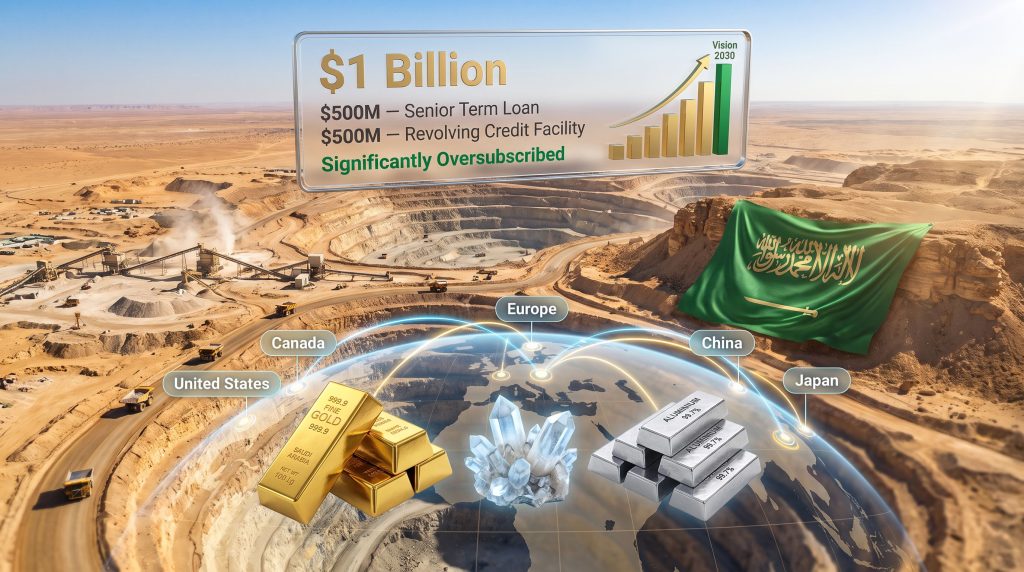
Saudi Arabian Mining Company, known as Maaden, has completed its first-ever internationally syndicated credit package, securing the Saudi Maaden $1bln international loan facilities in a structure that splits equally between a $500 million senior term loan and a $500 million revolving credit facility (RCF). The transaction was oversubscribed, with lender demand exceeding the target raise, drawing participation from financial institutions spanning five distinct geographic regions: the United States, Canada, Europe, China, and Japan.
This is not merely a headline financing event. The structural and geographic characteristics of the deal carry significant implications for how Maaden, and potentially other GCC industrial champions, will access capital in the years ahead.
The Dual-Tranche Architecture: More Than Just Mechanics
The choice to structure the facility as two distinct tranches reflects a treasury management philosophy consistent with globally rated investment-grade corporates. Understanding the functional difference between the two instruments is essential for grasping why this structure was chosen:
| Facility Type | Amount | Primary Function | Deployment Status |
|---|---|---|---|
| Senior Term Loan | $500 million | Capital deployment and growth initiatives | Drawn at close |
| Revolving Credit Facility | $500 million | Liquidity buffer and operational flexibility | Expected to remain undrawn |
| Combined Total | $1 billion | Diversified funding and corporate purposes | Dual-tranche |
The term loan component provides immediate, deployable capital for Maaden's expansion priorities, whether that involves scaling existing operations, progressing greenfield projects, or funding general corporate requirements. The revolving credit facility, by contrast, operates more like a corporate insurance policy than an active spending tool. It gives the company rapid access to liquidity in the event of unexpected operational requirements without carrying the interest burden of a fully drawn facility.
The presence of an undrawn revolving credit facility on a corporate balance sheet is frequently interpreted by credit analysts as a sign of financial discipline. It signals that the borrower is not reaching for liquidity it needs immediately, but rather engineering structural resilience into its treasury framework.
This bifurcated approach mirrors practices used by major mining multinationals such as BHP, Rio Tinto, and Vale — all of which maintain large undrawn revolving credit facilities as a core feature of their capital structure management.
The Lender Syndicate: Reading the Geographic Tea Leaves
Perhaps the most analytically revealing dimension of the Saudi Maaden $1bln international loan facilities is the composition of the lender group. Participation from the United States, Canada, Europe, China, and Japan in a single mining credit syndication is uncommon. Most regional corporate syndications, even for well-rated borrowers, tend to draw predominantly from one or two geographic clusters.
The multi-continental nature of this deal suggests several things:
- Asian lender participation, particularly from China and Japan, reflects a strategic calculation. Both nations are significant consumers of the minerals that Maaden produces, including phosphate-based fertilisers and aluminium. Lenders from these jurisdictions often pursue relationship-building with upstream producers as a form of supply chain proximity.
- North American and European participation indicates that Western institutional credit desks are becoming comfortable underwriting Gulf sovereign-adjacent corporate credits — a development that would have been far less certain a decade ago.
- Oversubscription implies that Maaden could have raised a larger facility had it chosen to. In syndicated loan markets, oversubscription creates pricing leverage for the borrower in future transactions and typically compresses the credit spread relative to initial guidance.
This geographic breadth is qualitatively different from what most GCC corporate syndications have historically achieved, and it elevates the transaction's significance within the regional financing narrative. In addition, the timing aligns with a broader wave of Saudi exploration licences being issued as the Kingdom accelerates its mining sector development.
What Is Driving International Appetite for Saudi Mining Credit?
To understand why global lenders are actively competing for exposure to Maaden, it is necessary to examine the underlying commodity and institutional fundamentals at play.
Maaden's Commodity Portfolio: Strategic Minerals With Global Relevance
Maaden is not a single-commodity producer. Its operational portfolio spans:
- Phosphate and fertilisers through its Ma'aden Wa'ad Al Shamal Phosphate Company, one of the world's largest integrated phosphate complexes
- Aluminium via a large-scale smelting and rolling operation at Ras Al Khair, a joint venture with Alcoa
- Gold through mining activities at sites including the Ad Duwayhi and Al Amar deposits in the Arabian Shield
- Exploration-stage assets in copper, zinc, and rare earth elements, where Saudi Arabia's geological endowment remains significantly underexplored by global standards. The ongoing Arabian Shield survey is actively mapping these untapped formations to better quantify their commercial potential.
The Arabian Shield, a Precambrian geological formation stretching across much of western Saudi Arabia, is estimated to contain mineral wealth that has been subjected to only a fraction of the exploration intensity applied to comparable formations in Canada, Australia, or West Africa. This geological frontier quality represents a long-duration optionality argument that sophisticated credit investors have begun to incorporate into their assessment of Maaden's intrinsic value.
The phosphate business alone carries strategic weight. Global food security pressures and the energy transition are both increasing demand for phosphate-derived fertilisers. Saudi Arabia holds some of the world's largest phosphate reserves, and Maaden controls the primary production platform for converting those reserves into exportable product.
The Sovereign Adjacency Premium in Credit Pricing
One underappreciated dynamic in GCC corporate debt markets is what practitioners informally describe as the sovereign adjacency premium. Maaden is majority-owned by the Saudi government's Public Investment Fund (PIF), which provides an implicit credit backstop that international lenders factor into their risk assessment, even in the absence of an explicit sovereign guarantee.
This structure creates a credit profile that sits between pure corporate risk and sovereign risk, typically attracting more favourable pricing than a standalone private-sector mining company of comparable size would achieve. For international lenders, exposure to Maaden represents an efficient way to gain proxy access to Saudi sovereign credit quality while participating in the upside of a growing industrial business.
Three Strategic Rationales Behind the Capital Raise
The deployment rationale for the Saudi Maaden $1bln international loan facilities can be organised around three interconnected objectives:
- Operational growth funding: Maaden has been systematically expanding its production capacity across multiple commodity lines. Capital allocated through the term loan supports the next phase of this expansion, which includes downstream processing ambitions in phosphate derivatives and potential new mining developments. The Maaden rare earths expansion represents one of the most closely watched elements of this broader growth agenda.
- Funding source diversification: Concentration in domestic Saudi banking relationships, while operationally convenient, introduces refinancing risk. If domestic credit conditions tighten or specific lender relationships change, a company without international credit relationships faces acute pressure. By establishing an international credit track record now, Maaden builds optionality for future refinancing across a broader lender base.
- Cost of capital optimisation: An inaugural international syndication, when successfully oversubscribed, establishes a reference pricing point for all future borrowing. The oversubscription here implies that Maaden achieved competitive terms, creating a benchmark that should lower the cost of subsequent capital raises.
Structural Risks Worth Monitoring
While the transaction represents a clear positive milestone, informed observers should consider several embedded risk dimensions:
- Interest rate sensitivity: Syndicated loans in international markets are typically structured on floating rate terms, often referencing SOFR (the Secured Overnight Financing Rate, which replaced LIBOR as the global benchmark). In an environment where central bank rate trajectories remain uncertain, floating rate exposure adds earnings variability.
- Commodity price correlation: Maaden's debt service capacity is ultimately underpinned by revenue from phosphate, aluminium, and gold sales. Each of these markets carries its own supply-demand cyclicality. A simultaneous downturn across multiple commodity lines, while statistically uncommon, represents the most acute stress scenario for the credit.
- Commitment fees on undrawn facilities: The $500 million RCF, even if never drawn, incurs ongoing commitment fees. While these are typically modest as a percentage of the notional amount, they represent a real carrying cost that accumulates over the facility's life.
- Covenant compliance reporting: International syndicated loan agreements typically impose more rigorous financial reporting and covenant maintenance requirements than domestic bilateral lending arrangements. For Maaden, meeting these obligations will require sustained transparency with a globally diverse lender group.
The next major ASX story will hit our subscribers first
A Precedent That Extends Beyond Maaden
The broader significance of this transaction may be most visible in what it signals for other GCC industrial operators considering their first step into international syndicated markets. Maaden has effectively served as a proof-of-concept, demonstrating that a Gulf-based mining company with strong sovereign links, a diversified commodity base, and credible expansion plans can attract oversubscribed demand from a globally representative lender group.
This is structurally comparable to moments in the development of other national mining champions. In Chile, Codelco's early international debt market access helped establish the template for Chilean corporate borrowers more broadly. In Australia, the internationalisation of Rio Tinto's balance sheet in the 1990s opened pathways for a generation of mid-tier Australian producers. Maaden's inaugural syndication may serve a similar catalytic function for the GCC's emerging industrial credit universe. Furthermore, the expansion of Saudi mining licences is creating additional investment-grade opportunities that could follow a similar financing path.
For international investors and lenders tracking the intersection of sovereign credit quality, strategic mineral endowment, and long-duration industrial development stories, the GCC mining sector is beginning to present a genuinely distinctive opportunity set that warrants serious analytical attention.
Consequently, as the London Metal Exchange and other global commodity benchmarks increasingly reflect tightening supply dynamics in phosphate and rare earth elements, Maaden's strengthened capital structure positions it well to capitalise on favourable market conditions.
Frequently Asked Questions: Saudi Maaden's $1 Billion International Loan
What exactly are the Saudi Maaden $1bln international loan facilities?
The Saudi Maaden $1bln international loan facilities refer to Maaden's inaugural internationally syndicated credit package, comprising a $500 million senior term loan and a $500 million revolving credit facility, totalling $1 billion. The deal was oversubscribed by lenders from the United States, Canada, Europe, China, and Japan.
Why was the facility oversubscribed?
Oversubscription indicates that lender demand exceeded Maaden's target raise. This outcome typically reflects strong institutional confidence in the borrower's creditworthiness, business fundamentals, and growth trajectory. In Maaden's case, the sovereign adjacency factor, combined with a diversified commodity portfolio and Vision 2030 alignment, likely contributed to competitive lender appetite.
Is the revolving credit facility being used immediately?
No. The $500 million RCF is expected to remain undrawn at this time, functioning as a strategic liquidity reserve rather than an immediate funding instrument.
How does this deal connect to Saudi Vision 2030?
Vision 2030 identifies mining as a core pillar of Saudi Arabia's non-oil economic diversification. Maaden is the primary vehicle through which the Kingdom's mineral wealth is being commercialised. The international loan facilities provide Maaden with the capital structure to pursue the next phase of operational and geographic expansion consistent with those broader economic targets.
What minerals does Maaden produce?
Maaden's production portfolio includes phosphate, aluminium, gold, and copper, with ongoing exploration across the Arabian Shield targeting additional base metals and potentially rare earth elements.
Disclaimer: This article is intended for informational purposes only and does not constitute financial, investment, or legal advice. Forecasts, projections, and market analysis contained herein involve inherent uncertainty and should not be relied upon as the basis for investment decisions. Readers should conduct their own due diligence and consult qualified financial advisers before making any investment decisions.
Want to Stay Ahead of the Next Major Mineral Discovery?
Discovery Alert's proprietary Discovery IQ model delivers real-time alerts on significant ASX mineral discoveries, transforming complex geological and commodity data into actionable investment insights for both short-term traders and long-term investors. Explore how historic discoveries have generated substantial returns on Discovery Alert's dedicated discoveries page, and begin your 14-day free trial today to position yourself ahead of the broader market.