August 24, 2026
The Political Economy Paradox That African Markets Have Long Struggled to Price
There is a foundational assumption baked into the way global capital allocators have historically approached sub-Saharan African sovereign risk: that structural reform and electoral survival are mutually exclusive. The logic runs that cutting subsidies, letting currencies adjust, and negotiating painful debt restructuring are activities a government can survive in office or perform competently, but rarely both within the same term.
This assumption has shaped risk premiums, deterred long-horizon institutional capital, and kept African frontier markets at a structural discount relative to their economic fundamentals. However, Zambia's 2026 presidential election outcome does not just complicate that assumption. It upends it in ways that carry implications far beyond the Copperbelt.
When big ASX news breaks, our subscribers know first
What the Vote Count Actually Tells Investors
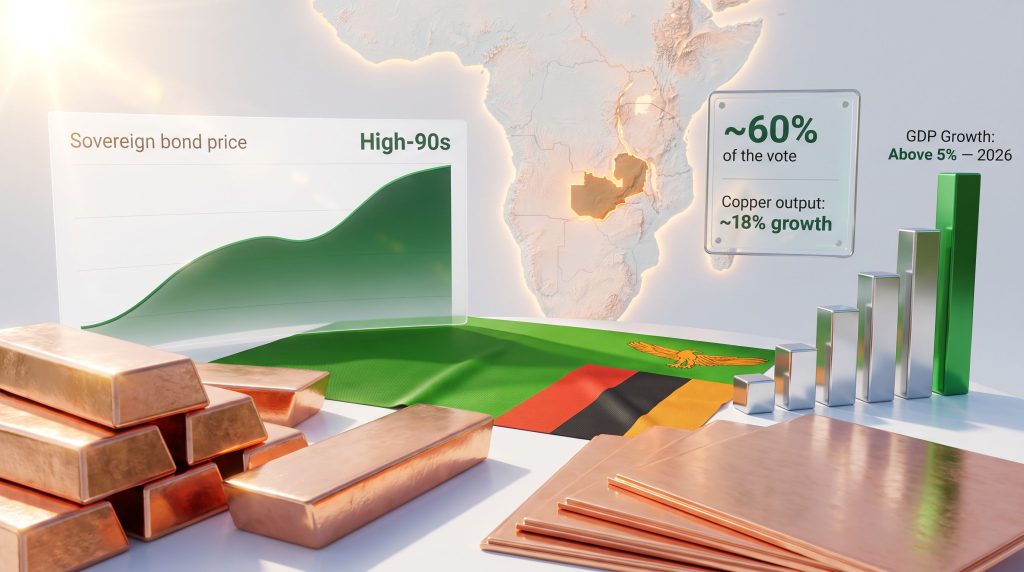
The headline numbers are striking enough on their own. President Hakainde Hichilema was returned to office with approximately 60% of the vote, compared to roughly 38% for his nearest challenger, Brian Mundubile. That is not a narrow re-election. It is an expanded mandate, delivered specifically after a term defined by some of the most politically costly economic medicine any African government has voluntarily administered in recent memory.
The result was independently verified at the polling station level by domestic monitors, observed as orderly by regional electoral missions, and accepted by the principal opposition bloc. That bloc holds approximately 60 parliamentary seats and has committed to functioning as a formal legislative opposition rather than contesting the outcome through extra-parliamentary channels. That institutional acceptance matters as a standalone governance signal, separate from the economic story.
What makes this a Zambia election investor signal rather than simply a domestic political story is the sequence: the reforms came first, the mandate came second. That ordering is unusual by any regional standard, and it forces a recalibration of how markets model political risk in reform-oriented African sovereigns.
From Default to Stabilisation: Retracing a Remarkable Macroeconomic Arc
To understand what voters were ratifying, it helps to understand the depth of the hole from which the recovery was dug. Zambia became the first African sovereign to default during the COVID-19 period, an event that cut the country off from international capital markets and triggered a complex, multi-year creditor negotiation that would have tested any finance ministry in the world.
What made the restructuring particularly demanding was its architecture. The government had to negotiate simultaneously across three structurally incompatible creditor categories:
- Paris Club bilateral lenders, operating under established multilateral frameworks with their own conditionality expectations
- Chinese bilateral creditors, whose engagement with sovereign debt restructuring historically followed different procedural timelines and transparency norms than Western creditors
- Private international bondholders, who hold different legal standing and negotiating leverage than bilateral lenders
Managing all three concurrently, without allowing one creditor group's settlement to undermine another's confidence, required a level of diplomatic and technical sophistication that is rarely acknowledged in market commentary. The process stretched across a six-year IMF programme that concluded in January 2026 with external reserves at their strongest recorded level and the bulk of restructured obligations addressed.
The macroeconomic scorecard by the time voters went to the polls looked like this:
| Indicator | Outcome |
|---|---|
| Pandemic-era default | Resolved through multi-creditor restructuring |
| IMF programme | Concluded January 2026, six-year duration |
| External reserves | Strongest recorded level at programme conclusion |
| Copper output growth | Approximately 18% in H1 of the preceding year |
| GDP growth forecast (2026) | Comfortably above 5% |
| Inflation trajectory | Progressively moving toward central bank target band |
Critically, none of those numbers were locked in before the election. Pre-election periods in emerging markets have a well-documented tendency to produce fiscal loosening, subsidy reinstatement, or currency intervention as governments attempt to manage voter sentiment. The Hichilema administration maintained its reform discipline through the campaign period without reverting to populist spending, which is itself a credibility signal that markets should price separately from the vote outcome.
How Bond Markets Priced the Signal Before and After
Zambia's international capital market footprint is currently limited to a single dollar-denominated sovereign bond, which creates a concentrated but clear lens through which to read market sentiment. Following the election result, that instrument traded steadily in the high-90s price range.
The absence of meaningful movement is the analytically important element here. Bond markets had already incorporated a Hichilema victory based on consistent pre-election polling, which means the steady post-result pricing reflects confirmation of continuity rather than surprise at the outcome. When a result matches what credible polling has been signalling for months and bond prices hold firm, investors are communicating that institutional credibility is intact.
Furthermore, as Zambia voters headed to the polls, the broader question being tested was whether economic reforms could survive democratic scrutiny — and the bond market's measured response suggests creditors believed they could.
The scarcest asset in emerging market governance is a government that does not need to look over its shoulder while it governs. Zambia enters its second term holding exactly that. (Business Insider Africa, Frank Bwalya, August 2026)
Several second-order currency and borrowing cost implications follow from this:
- The removal of electoral uncertainty eliminates the risk premium that had been embedded in kwacha pricing ahead of the vote, creating conditions for measured appreciation
- Reduced perceived political risk translates mechanically into lower government borrowing costs on any future bond issuances
- A successor IMF arrangement, which the government has already indicated it intends to pursue, becomes materially easier to negotiate from a position of democratic strength than from political fragility
A decisive parliamentary majority also removes a structural risk that a narrow win would have introduced: the need to make policy concessions to coalition partners in order to hold a fractured legislative base together. That kind of coalition arithmetic routinely causes fiscal targets to slip in ways that undermine IMF programme compliance.
Copper, Power, and the Commodity Engine Beneath the Macro Story
No analysis of Zambia's investment thesis is complete without engaging seriously with copper, because it is not merely an export commodity for this economy. It is the primary mechanism through which Zambia services its restructured debt obligations, funds its fiscal position, and generates the foreign exchange that underpins kwacha stability. Indeed, the Zambia copper growth outlook heading into the election was already drawing renewed attention from commodity-focused institutional investors.
The approximately 18% growth in copper output recorded in the first half of the year prior to the election demonstrated meaningful recovery momentum in the sector. That growth trajectory intersects favourably with structural demand dynamics that extend well beyond Zambia's domestic policy environment:
- Energy transition infrastructure requires copper intensively, particularly in grid expansion and renewable generation systems
- Electric vehicle manufacturing uses significantly more copper per unit than conventional internal combustion engine vehicles
- Data centre construction, driven by AI infrastructure investment, is emerging as an underappreciated copper demand driver that most commodity forecasts were slow to incorporate
In addition, the broader copper supply crunch unfolding globally positions Zambian production growth as strategically significant for industrial buyers seeking to diversify sourcing away from concentrated supply geographies.
What a Second Term Means Operationally for Mining Investors
Political continuity matters for mining investment in ways that go beyond general sentiment. Specific operational considerations include:
- Regulatory stability: A renewed mandate substantially reduces the probability of mid-cycle changes to mining royalty structures, export frameworks, or local content requirements that force project economics to be re-modelled
- Power sector progression: Electricity supply constraints remain the single largest operational bottleneck for copper producers in Zambia. A stable government with a strong parliamentary majority is better positioned to advance independent power producer frameworks and grid investment without the political interference that has historically delayed energy sector reform
- Greenfield and brownfield approvals: Political continuity reduces bureaucratic uncertainty across project approval pipelines, which shortens the effective timeline from investment commitment to production ramp-up
Investment Note: Regulatory risk in mining is often underpriced during periods of political stability and dramatically repriced during transitions. A decisive re-election result compresses that repricing risk across the medium term.
The Power Constraint Problem That the Election Cannot Solve Alone
It would be analytically irresponsible to present the election outcome as resolving Zambia's structural challenges. Power supply is the clearest example of a constraint that requires sustained investment and execution over years, not a political mandate that delivers it automatically.
Zambia's hydroelectric generation capacity has been periodically compromised by below-average rainfall in the Zambezi basin, and the country has faced serious load-shedding episodes that have directly constrained copper production volumes. Investors should treat the election result as removing one layer of risk from a multi-layered risk stack, not as a comprehensive resolution of the operational environment.
The Broader Reassessment: African Sovereign Risk Premiums Under Scrutiny
The investment case that extends beyond Zambia's borders is arguably the most significant long-term implication of this result. African sovereign debt and equity markets have historically carried political risk premiums that are structurally elevated relative to comparable institutional performance metrics in other frontier and emerging market regions.
That premium has persisted partly because of historical precedent, partly because of information asymmetries, and partly because of a genuine analytical assumption that African electorates will favour short-term spending over structural discipline when given a choice at the ballot box. Consequently, the African mining finance trends that preceded this election already hinted at a slow but discernible reassessment of risk appetite among institutional allocators.
The Zambia election investor signal provides a concrete counterexample to that assumption. It is one data point, not a continental trend, and rigorous investors should resist extrapolating from a single result. But it is a meaningful data point because of the conditions under which it was produced: contested polling, credible domestic monitoring, regional observer acceptance, and institutional opposition recognition all combine to make this a clean signal rather than an ambiguous one.
Furthermore, understanding the geopolitical mining landscape more broadly helps contextualise why Zambia's political stability carries weight well beyond its own borders, particularly as Western capital seeks reliable supply-chain partners in the energy transition minerals race.
Comparing Reform Trajectories Across Key African Peers
| Country | Reform Orientation | Recent Electoral Outcome | Investor Signal Quality |
|---|---|---|---|
| Zambia | High: IMF programme completed, multi-creditor restructuring | Decisive re-election mandate, 2026 | Strong continuity; policy execution watchpoint |
| Ghana | Moderate: post-default restructuring ongoing | Leadership change, 2024 | Transition risk; reform trajectory uncertain |
| Kenya | Mixed: IMF engagement with periodic fiscal slippage | Ongoing political pressure, protest activity | Conditional confidence; fiscal credibility variable |
| Ethiopia | Lower: conflict-affected, limited external engagement | Restricted political environment | Elevated risk premium across asset classes |
Note: This comparison is presented for illustrative analytical purposes. Investors should incorporate current sovereign ratings, IMF programme status, and country-specific risk assessments before making allocation decisions.
The next major ASX story will hit our subscribers first
The Policy Execution Checklist for Zambia's Second Term
The election converts political capital into investor attention. What determines whether that attention converts into sustained capital deployment is execution. Five variables will define the investment thesis over the second term:
- Successor IMF Programme: The negotiation timeline, conditionality structure, and disbursement schedule will function as the primary near-term credibility indicator. A programme secured promptly signals that the government's fiscal commitments remain intact post-election.
- Copper Output Trajectory: Whether the approximately 18% production growth rate can be sustained or accelerated through the second term, and whether infrastructure investment keeps pace with production ambitions.
- Power Sector Investment: Progress on independent power producer frameworks, grid reliability improvements, and diversification away from rainfall-dependent hydroelectric generation as the primary supply source.
- Inflation Management: Whether the central bank can maintain its trajectory toward the target band without fiscal dominance pressures emerging as debt service obligations continue through the restructuring tail period.
- Institutional Quality Maintenance: The credibility established by the electoral commission, domestic monitors, and regional observers is a governance asset that requires ongoing investment. Institutional quality, once established, can erode faster than it is built.
Opposition Acceptance as a Stability Multiplier
One aspect of the result that deserves more analytical weight than it typically receives in post-election market commentary is the formal acceptance of the outcome by the principal opposition bloc. As mining investors had been watching closely ahead of polling day, the opposition's decision to take its seats and engage with parliamentary process rather than contest results through disruptive channels serves as a stability multiplier for investor confidence between electoral cycles.
The presence of a functional, seat-holding opposition also provides a democratic accountability mechanism that institutional investors increasingly incorporate into governance quality assessments, particularly for ESG-oriented capital allocation frameworks.
Frequently Asked Questions: Zambia Election and Investor Implications
What was the result of Zambia's 2026 presidential election?
Hakainde Hichilema was re-elected with approximately 60% of the vote against roughly 38% for Brian Mundubile. The result was independently verified at the station level by domestic monitors, observed as orderly by regional missions, and accepted by the main opposition party.
Why does the margin of victory matter for investors?
A decisive win eliminates the coalition-management arithmetic that a narrow result would have imposed. Governing without needing to make policy concessions to hold a fragile parliamentary majority together preserves the government's capacity to pursue a successor IMF programme on terms that protect fiscal credibility.
How did Zambia's bond market respond to the result?
Zambia's sole international dollar-denominated bond traded steadily in the high-90s following the announcement. The absence of volatility reflected that markets had already priced the expected outcome. Stable post-result pricing in this context communicates institutional credibility rather than surprise.
What are the primary risks that persist despite the positive election outcome?
Power supply constraints limiting copper production capacity, ongoing debt service obligations through the restructuring tail period, and the conditional nature of investor confidence on delivery of a successor IMF arrangement are the three most material residual risks.
What does this result mean for how investors should approach African sovereign risk more broadly?
It provides a concrete data point challenging the blanket application of elevated political risk premiums to reform-oriented African governments. One election does not rewrite a risk framework, but it should inform how institutional allocators weight the assumption that African electorates will not reward fiscal discipline at the ballot box.
This article is for informational purposes only and does not constitute financial advice. Forecasts, projections, and scenario analyses involve inherent uncertainty. Investors should conduct independent due diligence and consult qualified advisers before making investment decisions related to Zambian or African sovereign assets.
Want to Track the Next Major Mineral Discovery Before the Broader Market Does?
Discovery Alert's proprietary Discovery IQ model delivers real-time alerts on significant ASX mineral discoveries, instantly converting complex geological data into actionable investment insights for both short-term traders and long-term investors — explore historic discovery returns on Discovery Alert's discoveries page to understand the scale of opportunity, and begin your 14-day free trial at Discovery Alert to position yourself ahead of the market.