August 4, 2026
The Structural Reality Behind the Western World's Tungsten Problem
Across the periodic table, few elements carry as much industrial and strategic weight per unit of production as tungsten. With the highest melting point of any metal at 3,422 degrees Celsius, it is irreplaceable in cutting tools, armour-piercing ammunition, aerospace components, and the hardened alloys that underpin modern defence manufacturing. The Northern Katpar tungsten project DFS in Kazakhstan is emerging as one of the most strategically significant responses to this supply challenge. Yet for all its criticality, tungsten supply chains remain among the most geographically concentrated on Earth, creating a vulnerability that Western procurement planners are increasingly struggling to ignore.
China currently accounts for approximately 80% of global tungsten mine production and an even higher share of downstream refining capacity, according to the US Geological Survey. This dominance is not simply a market share statistic. It represents a structural chokepoint in supply chains that stretch from semiconductor fabrication to ballistic weapons systems. Furthermore, what makes the situation particularly acute is that the supply constraint is not a temporary phenomenon driven by cyclical demand. Industry analysts widely characterise it as a systemic, structural deficit that existing global mines, including Chinese operations, are insufficient to resolve over the medium to long term.
It is within this context that the Northern Katpar tungsten project DFS in Kazakhstan takes on significance far beyond a routine pre-construction engineering exercise. The broader critical minerals demand surge is reshaping how governments and investors evaluate assets of this kind.
When big ASX news breaks, our subscribers know first
Why Ammonium Paratungstate Is the Metric That Matters
To understand what the Northern Katpar DFS is actually trying to deliver, it helps to understand how tungsten moves through global supply chains. Tungsten ore is typically processed into an intermediate compound called ammonium paratungstate, or APT, which serves as the primary traded form of refined tungsten on international markets.
APT pricing is quoted in metric ton units (MTU) of tungsten trioxide (WO₃), and it functions as the benchmark against which Western procurement teams measure supply security. The strategic significance of domestically produced APT — meaning APT refined outside Chinese jurisdiction and within politically aligned territories — has grown considerably as US and European industrial policy has turned toward supply chain resilience. Tungsten's strategic importance has consequently moved from a niche procurement concern to a mainstream defence policy priority.
The ability to produce APT within a politically stable, Western-aligned jurisdiction transforms a mining project from a commodity play into a supply chain security asset. That framing is increasingly shaping how development finance institutions evaluate critical mineral projects.
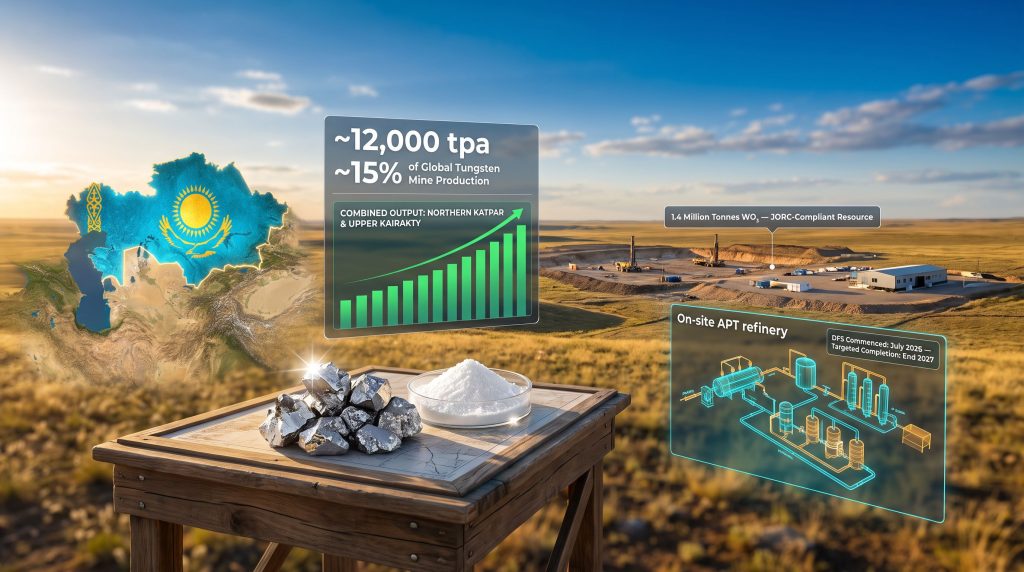
Vertically integrated projects capable of converting ore into APT at the mine site, rather than exporting raw concentrate for refining in China, represent a qualitatively different value proposition. This is precisely the model being advanced at Northern Katpar, where the DFS scope includes detailed design for an on-site APT refinery in Kazakhstan.
Inside the Severniy Katpar Joint Venture Structure
The Northern Katpar asset sits within the Severniy Katpar LLP joint venture, in which Cove Kaz Capital Group holds a 70% controlling interest. The remaining 30% is retained by Tau-Ken Samruk, Kazakhstan's national mining company and a subsidiary of the sovereign wealth fund Samruk-Kazyna. This ownership architecture is worth examining carefully, because the presence of a state-owned Kazakh entity as a minority partner carries both practical and signalling value.
From a practical standpoint, Tau-Ken Samruk's involvement provides the joint venture with direct access to Kazakhstan's regulatory and administrative networks. For a project navigating environmental approvals, land access, and permitting in a Central Asian jurisdiction, that institutional connectivity can meaningfully compress timelines. From a signalling perspective, sovereign co-ownership provides a layer of comfort for external capital providers assessing political and sovereign risk.
The Severniy Katpar structure encompasses two distinct tungsten assets:
- Northern Katpar, the primary development asset currently advancing through the DFS process, targeting approximately 5,000 tonnes per annum (tpa) of tungsten production.
- Upper Kairakty, a secondary deposit located approximately 25km from Northern Katpar, with a production target of approximately 7,000 tpa, and currently the subject of intensifying development activities running in parallel with the DFS.
| Asset | Annual Production Target | Relative Location |
|---|---|---|
| Northern Katpar | ~5,000 tpa | Primary project site |
| Upper Kairakty | ~7,000 tpa | ~25 km from Northern Katpar |
| Combined Portfolio | ~12,000 tpa | Severniy Katpar JV |
At combined capacity, the two deposits would contribute roughly 15% of current global tungsten mine production, making the Severniy Katpar portfolio a genuinely material addition to the Western supply base if both assets reach commercial production. Indeed, this scale of contribution is precisely why defence metal supply risks are prompting governments to actively court projects of this nature.
The Resource Foundation: What the 2023 Feasibility Study Established
The DFS does not begin from a blank geological canvas. A feasibility study completed in April 2023 established JORC-compliant mineral resources for the Severniy Katpar portfolio totalling 1.4 million tonnes of tungsten trioxide (WO₃). This resource quantum provides the geological foundation upon which the DFS engineering and economic modelling will be built.
JORC compliance, governed by the Australasian Joint Ore Reserves Committee, is one of the most rigorous international standards for the public reporting of mineral resources and ore reserves. Its adoption signals that the underlying resource estimate has been independently verified against a defined set of professional standards, which is a prerequisite for most institutional financing processes.
The progression from a feasibility study to a full definitive feasibility study represents a material step-change in both engineering rigour and capital commitment. The table below illustrates how cost estimate accuracy improves across successive study stages:
| Study Stage | Primary Purpose | Engineering Detail Level | Cost Estimate Accuracy |
|---|---|---|---|
| Scoping Study | Concept validation | Conceptual | ±35 to 50% |
| Preliminary Feasibility Study | Project viability screening | Preliminary | ±25 to 35% |
| Definitive Feasibility Study | Investment decision support | Detailed | ±10 to 15% |
The narrowing of cost estimate accuracy from ±35–50% at scoping stage to ±10–15% at DFS stage is not a minor technical refinement. It is the threshold at which project risk becomes quantifiable enough for institutional lenders and development finance institutions to commit capital on bankable terms.
DFS Architecture: Timeline, Scope, and Engineering Assignments
The Northern Katpar tungsten project DFS in Kazakhstan formally commenced in July 2026, with site preparation activities beginning in the same month. These preparatory works included land surveys, road establishment, drill pad construction, and the establishment of a site office to support the technical programmes that follow. A core drilling programme was scheduled to commence in August 2026, providing the subsurface data inputs that will feed directly into the DFS mine planning models.
Completion of the DFS is targeted before the end of 2027, after which the study package feeds into front-end engineering and design (FEED). The FEED phase then precedes detailed engineering, construction, commissioning, and ultimately the commencement of commercial operations.
Three specialist engineering firms have been appointed to lead distinct technical workstreams:
- DRA Global serves as lead contractor, with primary responsibility for mineral processing design and overall project delivery coordination. DRA brings deep experience in designing processing circuits for refractory and specialty minerals, where flowsheet optimisation directly influences both capital intensity and operating cost per unit of output.
- ERM leads the geology, mine planning, and technical programme workstreams, alongside responsibility for environmental and social governance frameworks. ERM's track record in navigating regulatory and financial licensing processes for large-scale resource projects is particularly relevant given Kazakhstan's evolving environmental permitting landscape.
- Knight Piésold is assigned to geotechnical analysis, hydrology, and tailings storage facility engineering, with a specific mandate to address operational safety and environmental risk management associated with tailings infrastructure. Tailings storage facility design has become an area of intense regulatory and investor scrutiny globally following high-profile failures at other operations.
All three engineering appointments remain subject to finalisation of definitive contractual agreements.
Kazakhstan as a Critical Mineral Development Jurisdiction
Kazakhstan occupies a unique geopolitical position in the current critical mineral landscape. As a Central Asian republic with established relationships with Western financial institutions, multilateral development bodies, and significant extractive industry experience, it offers a combination of resource endowment and institutional accessibility that few comparable jurisdictions can match.
The country has a demonstrated track record of attracting foreign direct investment into its mining and resources sector, with frameworks in place for international joint venture structures of the kind represented by Severniy Katpar. From a geopolitical standpoint, Kazakhstan's multi-vector foreign policy has historically allowed it to maintain productive relationships with both Russian and Western counterparts. However, the current environment has sharpened its attractiveness as a non-Chinese critical mineral source for Western procurement, particularly given growing interest in tungsten in defence and aerospace applications.
Investors evaluating the Northern Katpar tungsten project DFS in Kazakhstan should nonetheless apply appropriate sovereign risk analysis. Regulatory frameworks, permitting timelines, and political dynamics in Central Asian jurisdictions can differ materially from those in Australia, Canada, or the United States. Consequently, due diligence at the jurisdictional level is as important as the technical assessment of the ore body itself.
The next major ASX story will hit our subscribers first
The Financing Architecture: Development Finance and Commercial Capital
The DFS is being structured specifically to support a Final Investment Decision and to facilitate the due diligence processes required by potential financing partners. Among the institutions identified as prospective participants are the US International Development Finance Corporation (DFC) and the Export-Import Bank of the United States (EXIM Bank).
Both institutions have increasingly oriented their mandate frameworks toward critical mineral supply chain development as a national security and industrial policy priority. The DFC, which operates with a current exposure ceiling of $60 billion, has been expanding its critical minerals portfolio across multiple jurisdictions in response to US legislative direction. EXIM Bank's involvement would likely be structured around supporting US-linked equipment supply and offtake arrangements.
It is important to note that no formal financing commitment from either institution has been confirmed in relation to the Northern Katpar project at this stage. The identification of these institutions as potential partners reflects the project's strategic alignment with their mandate criteria, not a confirmed funding arrangement.
The Tau-Ken Samruk 30% stake also plays a role in the financing calculus. Sovereign co-ownership provides prospective lenders with a form of political risk mitigation that purely private projects cannot replicate, reducing one of the key uncertainties that development finance institutions typically price into their credit assessments.
Scenario Analysis: Three Pathways from DFS to Production
Scenario 1: DFS Delivers on Schedule and FID Proceeds
If the DFS completes before the end of 2027 as targeted and produces a bankable outcome, the pathway to a Final Investment Decision in 2028 becomes credible. Combined production capacity of approximately 12,000 tpa would represent a meaningful incremental contribution to global tungsten supply, reducing Western procurement dependence on Chinese-origin material and establishing Kazakhstan as a credible alternative supply jurisdiction.
Scenario 2: DFS Encounters Delays or Financing Gaps Emerge
Delays at the DFS stage, whether driven by drilling data complexity, engineering scope changes, or financing partner timelines, would extend the period of Western supply vulnerability. Competing projects in other jurisdictions, including potential developments in Canada, Portugal, and Rwanda, could accelerate in response to the same market signals, altering the competitive landscape for Northern Katpar.
Scenario 3: DFS Completes but APT Refinery Permitting Is Decoupled
A scenario in which mine production commences ahead of the APT refinery reaching operational status would reduce the project's ability to capture downstream value. Raw concentrate exports would be subject to the same refining bottleneck that characterises most non-Chinese tungsten production today, diluting the strategic value proposition of the integrated mine-plus-refinery model.
Frequently Asked Questions: Northern Katpar Tungsten DFS
What is ammonium paratungstate and why does it matter for the project?
Ammonium paratungstate (APT) is the most widely traded intermediate form of refined tungsten, produced by chemically processing tungsten ore concentrates. It serves as the feedstock for producing pure tungsten metal, tungsten carbide, and a range of other industrial compounds. The Northern Katpar project is designed to include an on-site APT refinery, allowing the project to sell a refined product rather than raw concentrate, capturing significantly more value per tonne of ore processed.
How does JORC compliance affect the project's financing prospects?
JORC-compliant resource estimates are prepared according to internationally recognised standards that require independent verification by a qualified person. For financing institutions, JORC compliance is typically a minimum requirement before geological estimates can be incorporated into project economics. The 1.4 million tonne WO₃ resource base reported in April 2023 under JORC standards provides the bankable geological foundation that the DFS engineering and cost modelling builds upon.
What distinguishes a DFS from earlier feasibility studies?
A DFS is the highest-rigour engineering and economic study conducted before a construction decision. Its cost estimates carry accuracy of approximately ±10–15%, compared with ±25–35% for a preliminary feasibility study. It produces detailed mine planning, processing design specifications, environmental assessments, and a project execution plan structured to support both a Final Investment Decision and engagement with institutional financing partners.
What are the key risks for the Northern Katpar project at this stage?
Material risks include:
- The possibility of DFS completion delays driven by drilling data complexity or engineering scope changes
- Uncertainties in the Kazakh regulatory and permitting environment
- The absence of confirmed financing commitments from any institution at this stage
- Potential decoupling of the APT refinery timeline from mine commissioning
- The broader market risk that tungsten prices could shift materially between DFS completion and construction commencement
This article is intended for informational purposes only and does not constitute financial advice. Statements relating to forward-looking timelines, production targets, and financing prospects involve inherent uncertainty and should not be relied upon as guarantees of future outcomes. Investors should conduct independent due diligence before making any investment decisions.
Want to Stay Ahead of the Next Major Critical Mineral Discovery?
Discovery Alert's proprietary Discovery IQ model delivers real-time alerts on significant ASX mineral discoveries across critical metals and strategic commodities, turning complex geological data into actionable investment insights — explore the historic returns major discoveries have generated and begin your 14-day free trial at Discovery Alert to position yourself ahead of the broader market.