August 4, 2026
When Wage Disputes Become Supply Chain Events: The Port Hedland Pressure Test
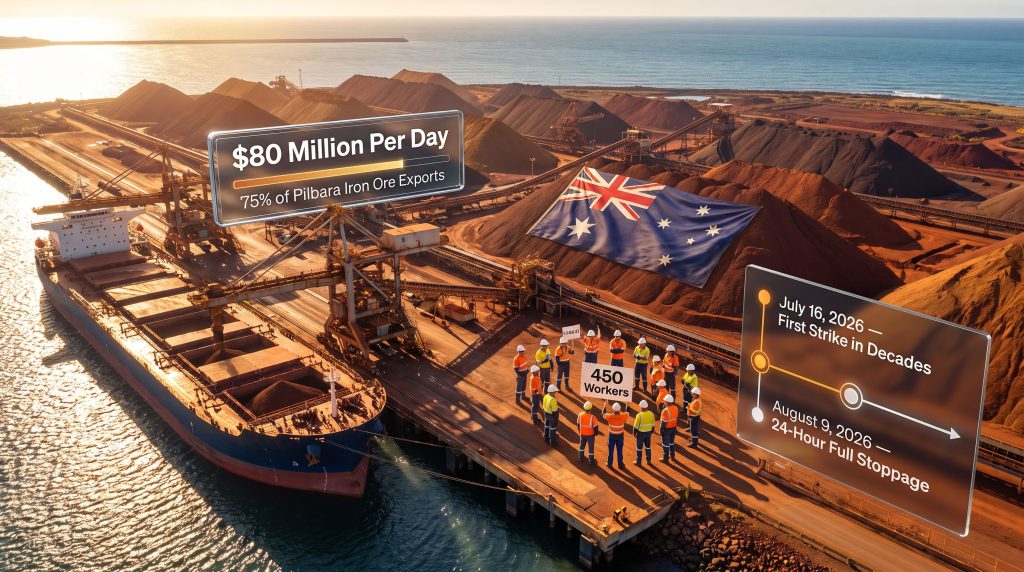
Global commodity markets are rarely disrupted by a single mine or a single ship. They are disrupted by chokepoints, and no chokepoint in the iron ore world carries more weight than Port Hedland. When industrial relations fracture at a facility responsible for processing roughly $80 million in iron ore exports every single day, the consequences extend well beyond a payroll negotiation in Western Australia's Pilbara region. They ripple through steel mills in China, pricing desks in Singapore, and investor portfolios across three continents.
The BHP Port Hedland strike developing across August 2026 is precisely this kind of event. Its immediate financial impact may be containable. Its longer-term signal about labour dynamics in Australia's resource sector is considerably harder to discount.
When big ASX news breaks, our subscribers know first
The Strategic Weight of Port Hedland
To understand why the BHP Port Hedland strike matters beyond the immediate industrial dispute, it helps to appreciate the physical geography of the global iron ore trade. The Pilbara region of Western Australia sits atop one of the world's largest and highest-grade iron ore deposits, and Port Hedland is the primary valve through which that material reaches Asian steel producers.
Furthermore, Australia's iron ore dominance in global commodity markets means that disruptions here carry outsized international consequences. The numbers are stark:
- Port Hedland handled approximately 75% of all iron ore exports from the Pilbara in the year to June 2026
- BHP alone ships an estimated $80 million worth of iron ore through the port daily
- BHP ranks as the world's third-largest iron ore producer, with Port Hedland functioning as its central seaborne export artery
- The port serves multiple major producers, including Fortescue and Hancock Prospecting, though the current dispute is specific to BHP's workforce
What makes Port Hedland uniquely sensitive is the concentration of throughput within a single export infrastructure system. Unlike diversified commodity supply chains where alternative routing can absorb disruption, Pilbara iron ore producers are structurally dependent on this terminal complex. Any sustained interference with loading operations creates an almost immediate signal effect on seaborne iron ore pricing, particularly for Chinese steel mills that have limited short-term substitution options for Australian ore grades.
Seven Months Without Resolution: Understanding the Bargaining Deadlock
Enterprise agreement negotiations between BHP and the Combined Ports Unions representing roughly 450 operators and maintenance workers commenced in early 2026. By the time industrial action materialised in July, bargaining had been ongoing for more than seven months without producing a signed agreement, making this one of the more protracted resource-sector wage disputes in recent Australian industrial relations history.
The workers' claims are rooted in conditions that are difficult to replicate in any urban employment context:
- Extreme heat exposure during Pilbara summers, where temperatures regularly exceed 45 degrees Celsius and create genuine physiological risk
- Extended roster cycles that separate workers from families for weeks at a time, a feature common to fly-in-fly-out (FIFO) work models across Australian mining
- Remote location premiums, which workers argue should structurally elevate their compensation above city-based equivalents rather than be aligned with or below them
- Enforceable protections, meaning legally binding clauses within the enterprise agreement that prevent future dilution of wages or conditions through reclassification or restructuring
The FIFO model, which is standard across Pilbara operations, carries psychological and logistical costs that are rarely captured in base wage comparisons. Research into FIFO workforce wellbeing has consistently identified relationship strain, sleep disruption from shift rotations, and social isolation as compounding factors that workers argue justify above-market compensation structures.
The dispute is unfolding against a backdrop of elevated Australian cost-of-living pressures, which have sharpened worker sensitivity to real wage outcomes at exactly the moment BHP is trading at a record share price and holding its position as both the world's largest listed mining company and Australia's largest listed company by market capitalisation.
As The Conversation notes, the stakes extend well beyond a single enterprise agreement, touching on fundamental questions about how resource wealth is distributed between capital and labour in Australia's mining sector.
Timeline of the BHP Port Hedland Industrial Action
| Date | Development |
|---|---|
| Early 2026 | Enterprise agreement negotiations begin, covering ~450 workers |
| July 16, 2026 | First strike action in the Pilbara iron ore sector in decades, lasting eight hours |
| Late July 2026 | Unions flag further protected action for August |
| August 4, 2026 | Talks described as productive but unresolved; industrial action confirmed to proceed |
| August 8, 2026 | 24-hour ban on loading iron ore vessels at Port Hedland commences |
| August 9, 2026 | Full 24-hour work stoppage at Port Hedland Bulk Export Terminal from 05:30 AWST (21:30 GMT, August 8) |
| August 18, 2026 | Next scheduled negotiation meeting; BHP annual results release |
The July 16 stoppage is historically significant in its own right. Strike action in the Pilbara iron ore sector had been effectively absent for decades, partly due to the legal architecture of Australia's enterprise bargaining framework and partly due to the high compensation levels that resource companies have historically used to pre-empt organised industrial action.
The fact that workers voted for protected action after seven months of stalled talks signals that the conventional deterrents are no longer functioning as designed. Notably, participation in the July 16 stoppage was lower than anticipated, and BHP confirmed that ship loading continued during that eight-hour window. This outcome moderated the immediate market reaction, but it also created a benchmark against which August participation rates will be closely measured.
What the August 8-9 Action Actually Involves
The August escalation is structured as a deliberate two-phase disruption, designed to maximise operational uncertainty while remaining within the legal parameters of protected industrial action under Australian law.
Phase 1 (August 8): A continuous 24-hour ban specifically targeting vessel loading operations. This does not constitute a full work stoppage but prevents iron ore from being loaded onto ships, effectively creating a vessel queue and disrupting shipping schedules.
Phase 2 (August 9): A complete 24-hour work stoppage at the Port Hedland Bulk Export Terminal, commencing at 05:30 AWST. This is a broader cessation of operations and carries greater disruption potential than Phase 1.
Across both phases, the unions project that approximately 16 iron ore shipments could be delayed or disrupted. Around 150 workers are expected to participate in the August action, drawn from the broader bargaining unit.
Quantifying the Disruption Risk
| Metric | Estimated Figure |
|---|---|
| Daily iron ore export value at Port Hedland | ~$80 million USD |
| Projected shipments affected (August 8-9) | ~16 vessels |
| Workers expected to participate | ~150 |
| Pilbara iron ore export share via Port Hedland | 75% |
| Total planned action duration | 48 hours across two phases |
BHP has stated it has contingency measures in place to maintain operational continuity during the action, a position consistent with its response to the July 16 stoppage. The effectiveness of those contingencies will be a critical data point for investors assessing operational resilience. Consequently, the WA iron ore logistics network as a whole will face elevated scrutiny throughout this period.
The Fair Work Commission's Role and the August 18 Pivot Point
Australia's national workplace tribunal, the Fair Work Commission (FWC), is actively involved in mediating the dispute. BHP has cited the Commission's assistance as evidence that the bargaining process has a structured path forward, and has argued that the planned industrial action is unnecessary given the framework now in place.
The unions, however, confirmed on August 4 that despite productive discussions, substantive issues remain unresolved and industrial action will proceed as planned. This distinction matters: the parties have identified a conceptual pathway, but have not yet converted that pathway into agreed terms.
The FWC possesses the authority to suspend or terminate protected industrial action if it determines the economic impact crosses a threshold of material harm to the Australian economy. This power has not yet been invoked, and the two-day duration of the August action may fall below the threshold required to trigger that intervention. However, if the dispute escalates beyond August into recurring or prolonged stoppages, the FWC's suspension powers become a more active variable.
BHP's decision to schedule its updated enterprise agreement proposal for August 18, the same date as its annual financial results release, creates a uniquely pressurised communications moment. Any escalation in disruption in the days leading up to that date will intensify analyst and investor scrutiny of the company's labour relations posture and its ability to manage operational risk at its most consequential export facility.
The next major ASX story will hit our subscribers first
Industrial Relations Risk as an Investor Consideration
For investors holding BHP exposure, the BHP Port Hedland strike introduces a category of risk that quarterly production reports rarely capture with adequate granularity. Iron ore contributes the largest single share of BHP's earnings, and Port Hedland is the mechanism through which that iron ore reaches the market. Any sustained interference with throughput translates directly into shipment volume shortfalls and, ultimately, revenue impacts.
Furthermore, shifting iron ore price trends throughout this period will be closely watched by commodity analysts seeking to gauge the market's sensitivity to supply-side disruption. Key indicators that investors and analysts should monitor include:
-
Participation rates in August 8-9 action relative to the July 16 stoppage. A material increase in worker turnout would indicate strengthening union resolve and a higher probability of ongoing escalation.
-
BHP's operational continuity disclosures following the action. Any admission that disruption exceeded what contingency plans could absorb carries direct earnings relevance.
-
Tone and substance of the August 18 proposal. Whether BHP offers enforceable commitments on wages and job classifications, or maintains a position that unions view as insufficient, will determine the trajectory of the dispute through the remainder of 2026.
-
Fair Work Commission intervention signals. Any formal move toward suspending protected action would indicate the regulator has assessed the cumulative economic impact as material.
-
Asian steel market pricing reactions. Spot iron ore price movements in the days following the August action will indicate whether seaborne market participants are pricing in supply disruption risk.
The contrast between BHP's record market capitalisation and the wage grievances of its Pilbara workforce is not merely a public relations challenge. It is a structural tension that reflects broader questions about how resource supercycles distribute returns across capital and labour, questions that are increasingly visible in Australia's current industrial relations environment.
Does the Strike Affect Fortescue or Hancock Prospecting?
A question that has circulated in commodity market discussions is whether the BHP Port Hedland strike creates any secondary disruption risk for rival producers that also ship through the port. The answer, at least for the current action, is no direct operational impact.
The dispute is specifically tied to BHP's enterprise agreement covering its port and rail workforce. Fortescue and Hancock Prospecting operate under separate labour arrangements and are not covered by the BHP agreement. Their loading operations at Port Hedland are not subject to the same industrial action.
However, a scenario worth monitoring is one in which prolonged or escalating BHP action creates secondary port congestion that affects vessel scheduling across the terminal complex more broadly. Port logistics are interconnected, and extended vessel queuing caused by BHP loading bans could, under specific circumstances, create scheduling friction for other users of the port's infrastructure. This remains a tail-risk scenario rather than a near-term probability, but it illustrates why the dispute carries potential spillover dimensions beyond BHP's own operations.
What Resolution Looks Like, and What Continued Escalation Means
A negotiated settlement before or shortly after August 18 would most likely require BHP to make meaningful concessions on at least one of the unions' primary bargaining claims, with enforceability of wage protections appearing to be the central sticking point. Base pay quantum is important, but the unions' emphasis on legally binding protections suggests they are focused on structural safeguards against future erosion as much as immediate pay increases.
If the August 18 meeting fails to bridge the key gaps, the unions retain the legal right to escalate further protected action. Prolonged disruption at the world's largest iron ore export hub would generate pricing signal effects across Asian steel markets. In addition, the China steel and iron ore market would face particular pressure, given that Chinese mills have limited short-term alternatives for the specific iron ore grades that BHP's Pilbara operations produce.
The global iron ore market impact of a prolonged stoppage would moreover compound existing trade pressures already weighing on seaborne commodity flows in 2026. As Reuters has reported, union representatives have confirmed the August 8-9 action, underlining that both sides remain some distance apart on core terms.
The BHP Port Hedland strike is, at its core, a dispute about whether the economic returns generated at one of the world's most valuable resource infrastructure nodes are being shared equitably with the workforce that operates it. How that question is answered over the coming weeks will matter not just for BHP's August 18 results presentation, but for the broader template of resource-sector enterprise bargaining across Australia in the years ahead.
Disclaimer: This article contains forward-looking statements, market impact assessments, and scenario analyses that are subject to uncertainty. Nothing in this article constitutes financial advice. Readers should conduct independent research and consult qualified financial advisers before making investment decisions.
Want to Stay Ahead of Significant ASX Mineral Discoveries in Real Time?
Discovery Alert's proprietary Discovery IQ model instantly scans ASX announcements across more than 30 commodities, delivering actionable alerts the moment a significant discovery is made — explore historic discovery returns on the Discovery Alert discoveries page to understand the scale of opportunity, then begin your 14-day free trial at Discovery Alert to position yourself ahead of the broader market.