August 4, 2026
Oil Markets in the Age of Diplomatic Uncertainty: Reading the Signals Behind Crude Price Swings
Few forces reshape energy markets as rapidly as geopolitical tension in the Middle East. When the flashpoint involves one of the world's most consequential maritime chokepoints and the world's largest economy, the resulting price volatility can be swift, severe, and difficult to predict. The ongoing conflict between the United States and Iran has created precisely these conditions, and the latest round of mixed diplomatic messaging is once again sending crude benchmarks swinging between fear and cautious optimism.
Understanding why Trump Iran talks oil prices move in lockstep requires more than tracking headlines. It demands a working knowledge of how geopolitical risk gets priced into crude markets, how maritime disruptions translate into supply anxiety, and why diplomatic ambiguity can itself become a tradeable catalyst. Furthermore, the geopolitical oil price drivers at play here are far more layered than a simple tension-and-relief cycle.
When big ASX news breaks, our subscribers know first
Why the Strait of Hormuz Turns Diplomatic Words Into Price Events
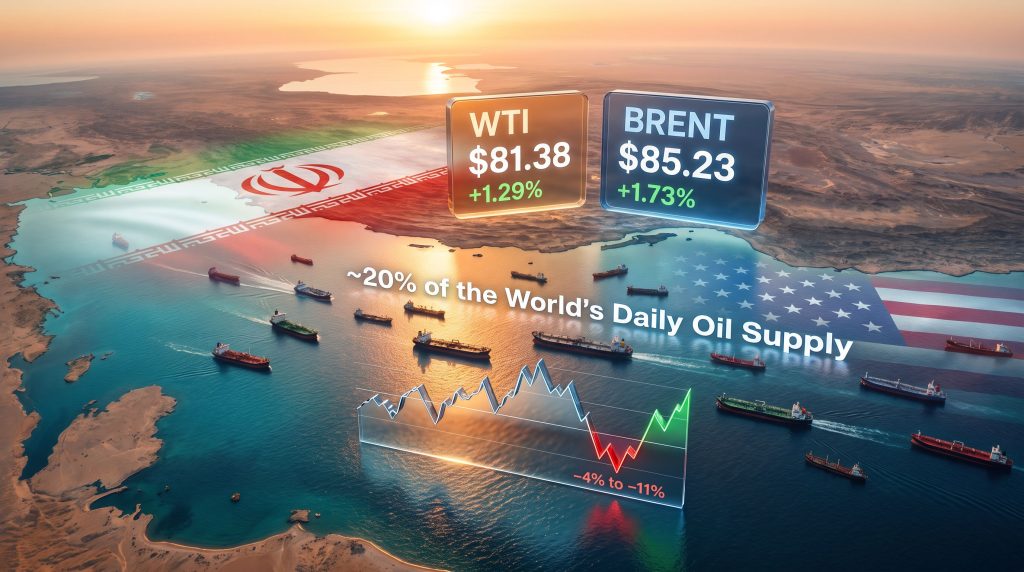
The Strait of Hormuz is a roughly 33-kilometre-wide passage connecting the Persian Gulf to the Gulf of Oman. Despite its modest geographic dimensions, it serves as the transit corridor for approximately 20% of the world's daily oil supply, including the bulk of crude exports from Saudi Arabia, Iraq, Kuwait, the UAE, and Iran itself.
When this chokepoint faces credible disruption risk, energy traders do not wait for physical barrels to stop flowing before adjusting prices. They reprice immediately, embedding a forward-looking premium that reflects the probability-weighted cost of supply interruption. This is what analysts call the geopolitical risk premium, and it is the engine behind the sharp crude price movements that have defined energy markets throughout the first half of 2026.
"The geopolitical risk premium is not simply a fear response. It is a rational pricing mechanism that accounts for insurance costs, rerouting expenses, tanker availability constraints, and the lag between a diplomatic event and its physical impact on supply chains."
The U.S. Central Command's active management of the Strait, including the redirection of 44 commercial vessels as part of an ongoing blockade, the disabling of two vessels, and the boarding of two others, has kept this premium structurally elevated. Even partial diplomatic progress capable of reducing blockade intensity would theoretically compress this premium, which explains why a single presidential statement can move crude prices by several percentage points within hours.
The Diplomatic Fog: What Washington and Tehran Are Actually Saying
The current state of U.S.-Iran negotiations as of early August 2026 is characterised by a fundamental contradiction between what Washington asserts and what Tehran acknowledges. President Trump stated publicly, including in remarks made from the Oval Office, that discussions are actively underway at Iran's own request, involving a coalition of regional stakeholders including Saudi Arabia, the UAE, and Qatar.
Iran's response has been consistent denial. President Masoud Pezeshkian confirmed Tehran's commitment to defending its borders while stating the country does not seek to broaden the conflict. Meanwhile, Iranian Foreign Ministry spokesperson Esmail Baghaei explicitly told reporters that no immediate plan for negotiations with the United States exists.
Tehran's only acknowledged diplomatic engagement is with Oman, focused specifically on Strait of Hormuz navigation rather than any comprehensive peace framework. This is a critical distinction, as Oman has historically played a quiet but effective intermediary role between Washington and Tehran. Its involvement signals a channel exists, however, limiting that channel to Hormuz navigation discussions falls well short of the broader diplomatic resolution that would meaningfully reduce the geopolitical risk premium priced into crude.
The trade and geopolitical pressures surrounding this standoff are, consequently, compounding the uncertainty traders are navigating on a daily basis. The table below summarises the divergent official positions and their respective market effects as of August 4, 2026:
| Actor | Official Position | Market Impact |
|---|---|---|
| President Trump | Talks actively underway at Iran's request | Reduced risk premium; oil declined |
| Iran's President Pezeshkian | No conflict expansion sought; borders will be defended | Partial uncertainty sustained |
| Iranian Foreign Ministry | No direct U.S. negotiations planned | Oil rebounded on renewed supply anxiety |
| U.S. Central Command | 44 vessels redirected; blockade active; 2 disabled, 2 boarded | Supply disruption risk structurally elevated |
A Year of Price Swings: How Diplomatic Signals Have Driven Crude in 2026
The pattern connecting Trump Iran talks oil prices has repeated itself with remarkable consistency across multiple sessions throughout 2026. Each time credible progress toward de-escalation has emerged, crude benchmarks have fallen as the risk premium compresses. Each time negotiations appear to stall or Iran publicly rejects direct engagement, prices rebound.
The latest oil price shocks offer a useful reference point for understanding just how violently diplomatic signals can move benchmarks. Key episodes in this pattern include:
- February 2026: Initial signals that the U.S. and Iran were engaged in back-channel discussions sent Brent crude down more than 4% in a single session, one of the sharpest single-day declines of the year at that point.
- May to June 2026: As deal talk advanced and both sides appeared to engage more substantively, Brent crude declined between 4% and 11% across multiple trading sessions, reflecting growing trader confidence that a resolution was within reach.
- Early August 2026: Trump's decision to call off planned military strikes on Iran in favour of allowing diplomatic talks lifted market sentiment sharply, pushing oil prices down. That decline reversed within 24 hours after Iran's foreign ministry again denied direct negotiations, with WTI recovering to $81.38 per barrel (up 1.29%) and Brent rising to $85.23 per barrel (up 1.73%) as of approximately 1:35 a.m. ET on August 4.
What makes this dynamic unusual by historical standards is the role that social media now plays in the process. Trump's Truth Social posts have functioned as near-real-time policy signals, with traders monitoring them for indications of imminent military action or diplomatic shifts. Statements made outside formal press channels now carry direct and measurable market-moving weight, compressing the reaction window from days to minutes.
Three Scenarios and Their Price Implications for Energy Investors
Investors seeking to position around the Trump Iran talks oil prices dynamic need to think in scenarios rather than forecasts. The range of possible diplomatic outcomes carries materially different price implications, and conviction in any single outcome is difficult to justify given the volume of contradictory signals currently in play.
Scenario 1: Full Diplomatic Resolution
A credible and comprehensive agreement that lifts the Strait of Hormuz blockade and restores Iranian oil exports to global markets would represent the most bearish outcome for crude prices. The geopolitical risk premium would unwind substantially, and both Brent and WTI would face meaningful downward pressure.
Analysts tracking the situation have cautioned, however, that even under this scenario, structural changes to shipping routes, elevated insurance premiums, and reduced tanker availability built up over months of conflict could prevent an immediate full price reversal.
Scenario 2: Prolonged Stalemate with Partial Engagement
This scenario reflects the current market reality. Mixed signals persist, the Oman channel remains active but limited, and neither side takes definitive steps toward either escalation or resolution. Oil prices stay range-bound with sharp intraday volatility on every headline, and the risk premium remains partially embedded in crude benchmarks.
Scenario 3: Diplomatic Collapse and Renewed Military Action
If negotiations fail entirely and military strikes resume at greater intensity, the Strait of Hormuz disruption risk would surge. Supply shock fears would dominate trader sentiment, Brent crude would likely spike well above current levels, and energy inflation would become a broader macroeconomic concern with potential contagion across equity and fixed income markets.
Disclaimer: These scenarios are analytical constructs based on publicly available information and are not investment advice. Energy markets are subject to rapid and unpredictable changes, and past price patterns do not guarantee future outcomes.
The "Buy the Rumour, Sell the News" Problem in Geopolitical Energy Trades
One underappreciated dimension of the current crude market environment is how investor positioning itself creates feedback loops. When traders price in de-escalation by selling crude aggressively on diplomatic optimism, they create conditions where any setback — such as a denial from Tehran's foreign ministry — generates a disproportionately sharp reversal. This dynamic partly explains the rebound seen on August 4 after Monday's decline.
For investors who entered long positions on the geopolitical risk premium early in the conflict, staying positioned becomes progressively more complex as the situation drags on. The asymmetry of the trade shifts over time: the potential upside from further escalation competes against the risk of sudden de-escalation. This is a classic example of why energy markets reward early positioning but punish late conviction. Monitoring crude oil price trends over recent months illustrates just how frequently this reversal pattern has emerged.
The next major ASX story will hit our subscribers first
Regional Escalation Vectors Beyond the U.S.-Iran Core Conflict
The bilateral U.S.-Iran dynamic is not the only source of risk currently embedded in crude prices. In addition, several regional developments are compounding baseline supply anxiety and contributing to the broader impact on oil markets:
- Ukraine conducted strikes on Iranian vessels in the Caspian Sea, an action Tehran characterised as a hostile and criminal act, introducing a new geographic front into the broader conflict picture.
- Saudi Arabia carried out military strikes on Houthi targets in Yemen following Iran-backed militia attacks on Red Sea shipping, adding a second major maritime disruption risk to energy markets already strained by Hormuz tensions.
- A reported explosion in Kuwait, described by an Iraqi pro-militia outlet as audible from Basrah Province, has raised concerns about potential spillover risk to Gulf energy infrastructure.
- Iran claimed responsibility for an attack on Amazon infrastructure in Bahrain, an incident that blurs the boundary between energy sector risk and technology sector exposure in the Gulf.
Each of these vectors represents an independent source of supply anxiety that could sustain elevated crude prices even if U.S.-Iran diplomacy advances.
The Broader Economic Dimension: Energy Inflation and Gulf Ambitions
Elevated oil prices do not remain contained within energy markets. When crude benchmarks stay persistently high, the cost increases flow through to transportation, manufacturing, agriculture, and consumer goods. This transmission mechanism means that the Trump Iran talks oil prices dynamic carries implications well beyond portfolio management for energy traders.
Analysts have also noted that the sustained conflict is disrupting Gulf state ambitions to position the region as a global hub for artificial intelligence and technology investment. Infrastructure development and foreign capital attraction require stability, and a prolonged war environment undermines both.
Perhaps less discussed is the inequality dimension. Even a successful diplomatic resolution may not deliver immediate consumer relief. Ongoing U.S.-Iran peace discussions suggest that if structural changes to shipping and supply chains sustain a portion of the current energy cost premium, lower-income households — who spend a disproportionate share of their income on fuel and energy-dependent goods — would continue to bear the heaviest burden long after a ceasefire is announced.
FAQ: Trump Iran Talks and Oil Price Mechanics
Why do oil prices rise when Iran denies peace talks?
When Iran publicly rejects the existence of direct negotiations with the U.S., traders interpret this as a reduced probability of near-term diplomatic resolution. This keeps the perceived risk of ongoing Strait of Hormuz disruption elevated, sustaining the geopolitical risk premium in crude prices.
What is a geopolitical risk premium?
It is the additional cost embedded in crude oil prices above fundamental supply and demand levels, reflecting the market's assessment of supply disruption probability caused by conflict, sanctions, or infrastructure threats.
How much global oil supply moves through the Strait of Hormuz?
Approximately 20% of the world's daily oil supply transits the Strait, making it the single most consequential maritime chokepoint for global energy markets.
What is the Oman channel in U.S.-Iran diplomacy?
Oman has historically served as a neutral intermediary between Washington and Tehran. Current reports indicate that Iran's only acknowledged diplomatic engagement is through Oman, specifically limited to Strait of Hormuz navigation rather than a broader peace framework.
Why do Trump's social media posts move oil markets?
In the current conflict environment, posts made outside formal press channels function as near-real-time policy signals. Traders monitor them for indications of imminent military action or diplomatic shifts, meaning informal statements now carry direct and measurable market-moving weight.
Want to Stay Ahead of the Next Major Market-Moving Discovery?
While geopolitical tensions continue reshaping energy markets, Discovery Alert's proprietary Discovery IQ model scans ASX announcements in real time, delivering instant alerts on significant mineral discoveries — turning complex data into actionable investment opportunities the moment they emerge. Explore historic examples of major discoveries and their market returns, then begin your 14-day free trial to position yourself ahead of the broader market.