August 4, 2026
When Chokepoints Become Weapons: Understanding the Iran War's Grip on Global Oil
Energy markets have long understood that geography is destiny. The concentration of roughly one-fifth of the world's traded oil and liquefied natural gas through a single, narrow maritime passage has always represented a systemic vulnerability that no amount of diversification could fully eliminate. What analysts modelled as a tail-risk scenario for decades is now playing out in real time, and the financial consequences are rippling far beyond the Middle East.
The escalating conflict involving the United States and Iran has transformed the Strait of Hormuz from a theoretical pressure point into an active fault line beneath the global energy system. Saudi Aramco profits soar in second quarter as Iran war squeezes oil supply headlines have captured market attention, but the deeper story is structural: this is not merely a price spike driven by sentiment. It reflects a fundamental rerouting of global energy logistics that is reshaping competitive advantage among producers, importers, and transit economies alike.
When big ASX news breaks, our subscribers know first
The Strait of Hormuz: A Single Point of Failure for the World's Energy System
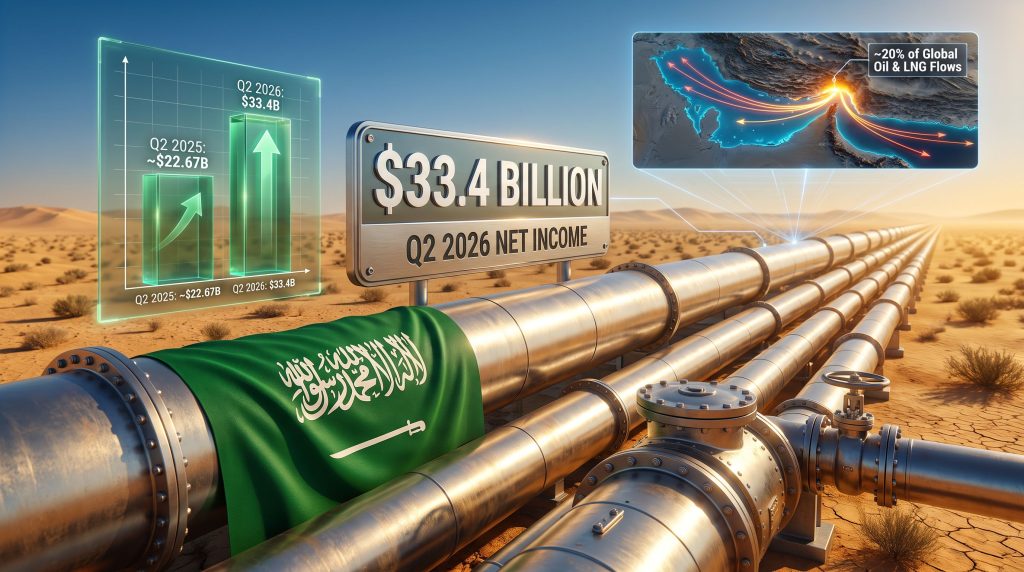
The Strait of Hormuz sits between the Omani coastline and the southern tip of Iran, narrowing to a navigable shipping corridor of roughly 33 kilometres at its tightest point. According to the International Energy Agency, approximately 20% of global oil and LNG flows pass through this passage on any given day, making it the most consequential maritime chokepoint in existence.
To contextualise the severity of the current disruption, it is worth examining how previous stress events at Hormuz have played out:
- The 2019 Abqaiq attacks on Saudi Arabian oil infrastructure temporarily removed around 5% of global oil supply, sending Brent crude up nearly 15% within 24 hours before prices partially recovered.
- The 1973 Arab oil embargo demonstrated how politically-motivated supply restriction, rather than physical disruption, could reshape energy geopolitics for a generation.
- Iranian threats to close Hormuz during the 2011-2012 sanctions escalation caused meaningful risk premium spikes without any physical interdiction occurring.
What differentiates the current situation is duration and geographic breadth. The conflict has spread beyond its primary fronts to draw in additional regional actors, including Iraq and Egypt, compounding supply uncertainty and making market-stabilising diplomatic resolution harder to achieve quickly. Furthermore, these oil geopolitical factors are creating ripple effects that extend well beyond traditional energy price modelling.
The shipping insurance market serves as one of the most sensitive real-time indicators of geopolitical risk. When war-risk premiums escalate on vessels transiting sensitive corridors, the cost of delivered energy rises independently of benchmark crude prices, creating a secondary inflation mechanism that standard oil price analysis often underestimates.
Saudi Aramco's Q2 2026 Earnings: Reading Beyond the Headline Numbers
Breaking Down the Key Financial Metrics
The scale of Aramco's quarterly outperformance reflects both elevated commodity prices and the company's operational capacity to sustain output despite regional disruption. According to Euronews, the numbers tell a striking story:
| Financial Metric | Q2 2026 Result |
|---|---|
| Adjusted Net Income | SAR 125.2 billion (~USD $33.4 billion) |
| Analyst Consensus Estimate | USD $31.59 billion |
| Operating Cash Flow | USD $25.4 billion |
| Gearing Ratio (end of Q2 2026) | 6.2% |
| Gearing Ratio (end of Q1 2026) | 4.8% |
| Base Dividend Declared | USD $21.9 billion |
For perspective, Aramco's Q2 2025 net income sat in the range of $22.67 to $24.5 billion, a period that itself represented a year-on-year decline of approximately 22%. The Q2 2026 result of $33.4 billion therefore represents not just a recovery but a meaningful upward step-change, driven primarily by conflict-elevated fossil fuel prices.
What the Earnings Beat Actually Signals
Beating analyst consensus by approximately $1.8 billion on a single quarter's adjusted net income is a meaningful margin for a company of Aramco's scale. Several overlapping factors contributed to this outperformance:
- Price elevation: Geopolitical supply constraints pushed benchmark crude prices materially above levels assumed in most pre-quarter consensus models.
- Export continuity: Unlike producers more exposed to Hormuz transit, Aramco maintained near-maximum export throughput via alternative infrastructure.
- Sector-wide profitability surge: The broader oil supermajor universe reported elevated Q2 2026 profits, confirming that price-driven tailwinds rather than Aramco-specific operational alpha were the primary driver.
- LNG price co-movement: Natural gas prices moved in sympathy with crude disruption concerns, benefiting integrated energy producers.
The Gearing Ratio Expansion: Strategic Investment or Warning Signal?
The gearing ratio rising from 4.8% to 6.2% in a single quarter warrants careful interpretation rather than alarm. In isolation, rising leverage during a period of elevated earnings and strong cash flow generation typically signals accelerated capital deployment rather than financial distress.
For Aramco specifically, the more pertinent question is whether this gearing trajectory reflects investment in infrastructure that will sustain long-term production capacity, or whether it indicates rising dividend commitments are beginning to strain the balance sheet. At 6.2%, Aramco's gearing remains very low by international supermajor standards, but the directional shift in a single quarter is a capital structure signal worth tracking over subsequent reporting periods.
The East-West Pipeline: Infrastructure Built for Exactly This Moment
How a 1,200-Kilometre Pipeline Became Aramco's Strategic Masterstroke
Saudi Arabia's East-West Pipeline stretches approximately 1,200 kilometres (746 miles), connecting the oil-producing heartland of the Eastern Province to Yanbu on the Red Sea coast. This engineering asset was not a reactive construction project. It was conceived and built decades ago with the specific strategic purpose of providing an export alternative if the Strait of Hormuz were ever rendered impassable.
Current operational parameters of the pipeline include:
- Maximum sustained export capacity of 7 million barrels per day
- Red Sea terminal access at Yanbu, enabling direct loading onto supertankers for Asian, European, and African markets
- Integration with onshore storage facilities that buffer production variability against export scheduling constraints
- Multiple pumping station redundancies along the route to ensure operational continuity
The decision to design this capacity level into the pipeline was prescient. At 7 million barrels per day, the East-West Pipeline alone can accommodate a substantial share of Saudi Arabia's total export volume, effectively decoupling the kingdom's revenue stream from Hormuz dependency in a crisis scenario.
Aramco's leadership noted that sustaining production and exports during the conflict has validated the company's multi-decade infrastructure planning approach, citing the East-West Pipeline, storage capacity, and export terminal network as critical enablers of business continuity.
Why Most National Oil Companies Cannot Replicate This Model
The strategic redundancy built into Aramco's infrastructure represents a competitive moat that took generations to construct and cannot be rapidly replicated. Key structural advantages include:
- Geographic depth: Saudi Arabia's landmass provides sufficient distance from Hormuz to support an alternative overland export route that many Gulf neighbours cannot match.
- Capital history: Decades of sustained infrastructure investment, supported by substantial sovereign wealth and long-term planning horizons unavailable to most commercial operators.
- Storage integration: Distributed storage capacity allows production to continue even when export scheduling faces temporary disruption, preventing the wellhead shutdowns that devastate shorter-term cash flows.
Winners, Losers, and the Cascading Economics of a Supply Shock
Who Benefits From Sustained Hormuz Disruption?
Not all market participants experience a geopolitical supply shock symmetrically. The current environment has created pronounced divergence, and these oil market disruptions have generated a clear split between beneficiaries and pressure points:
Structural beneficiaries:
- Gulf state producers with Hormuz bypass infrastructure, particularly Saudi Arabia and the UAE
- Oil supermajors with diversified upstream portfolios across multiple geographies
- LNG exporters operating outside the Hormuz corridor, including U.S. Gulf Coast facilities and Australian LNG projects
- Shipping operators with war-risk premium pricing power on alternative route vessels
Pressure points:
- Asian economies with high Hormuz import dependency, including Japan, South Korea, and India, where refinery feedstock costs are rising sharply
- Nations without meaningful strategic petroleum reserves or long-term supply contracts providing price insulation
- Energy-intensive manufacturing sectors globally, facing input cost escalation that compresses margins independent of end-market demand conditions
Scenario Analysis: Three Trajectories for Oil Markets
| Scenario | Key Assumptions | Price Outlook | Aramco Revenue Impact |
|---|---|---|---|
| Rapid De-escalation | Ceasefire within 60-90 days, Hormuz reopens | Prices retreat toward pre-conflict levels | Revenue normalises; dividend sustainability tested at lower prices |
| Prolonged Conflict | Multi-front war persists 6-12+ months | Elevated price floor sustained; pipeline rerouting becomes structural | Continued earnings outperformance; infrastructure investment accelerates |
| Regional Escalation | Additional state actors deepen involvement | Severe supply shock; price spike above recent highs | Short-term windfall; long-term demand destruction risk emerges |
Disclaimer: Scenario projections involve significant uncertainty and should not be treated as financial forecasts. Actual market outcomes depend on geopolitical developments that are inherently unpredictable.
The Dividend Question: $21.9 Billion Quarterly and the Sustainability Calculus
Aramco's board approved a base dividend of $21.9 billion for the second quarter of 2026, payable over the subsequent three months. This commitment sits at the intersection of corporate capital allocation and Saudi sovereign fiscal strategy.
The Saudi government's budget is structurally dependent on Aramco dividend distributions, making dividend sustainability a matter of national fiscal policy rather than purely corporate governance. Several stress-testing considerations apply:
- At what sustained oil price level does $25.4 billion in operating cash flow remain sufficient to cover a $21.9 billion quarterly dividend while also funding capital expenditure?
- A rising gearing ratio across multiple quarters, combined with declining oil prices, could create pressure to either reduce dividends or accelerate debt accumulation.
- The interaction between performance-linked dividend components and the base dividend structure adds complexity to forward cash flow modelling.
Investors in Aramco and observers of Gulf state fiscal policy should treat the gearing ratio trajectory as a leading indicator. A sustained move above 10% would represent a meaningful shift in Aramco's historically conservative capital structure and would warrant closer scrutiny of dividend coverage assumptions.
The next major ASX story will hit our subscribers first
Energy Transition Paradox: Do War-Driven Price Spikes Accelerate or Distort Decarbonisation?
High fossil fuel prices historically correlate with accelerated investment in renewable energy alternatives, as the economics of substitution improve. However, conflict-driven price spikes introduce a complicating dynamic that differs from carbon-pricing or supply-management-driven cost increases.
When prices rise because of geopolitical risk rather than structural scarcity, the signal to energy transition investors is ambiguous. Capital that might flow toward long-dated renewable infrastructure projects instead gets directed toward energy security spending, strategic petroleum reserve rebuilding, and short-cycle fossil fuel development. This represents a temporary diversion rather than a structural acceleration of decarbonisation.
Meanwhile, OPEC's market influence creates an unusual internal dynamic for the wider coalition. Saudi Arabia simultaneously benefits financially from the supply disruption as a major producer with bypass capability, while also holding the role of OPEC+ stabilisation anchor. Non-affected OPEC+ members face pressure to consider whether the current environment justifies production adjustments, creating internal coalition tension that adds further uncertainty to medium-term supply forecasts.
Furthermore, OPEC demand forecasts are being revised in response to evolving conflict conditions, with analysts closely watching whether sustained price elevation begins to trigger demand destruction in key Asian import markets. In addition, the broader global oil price shock is reshaping investment priorities across the energy sector in ways that may persist well beyond any diplomatic resolution of the current conflict.
Frequently Asked Questions
What Was Saudi Aramco's Q2 2026 Net Income?
Aramco reported adjusted net income of approximately $33.4 billion (SAR 125.2 billion) for the April to June 2026 quarter, exceeding analyst expectations of $31.59 billion. As reported by The Guardian, this result marked a significant earnings recovery driven by conflict-elevated energy prices. Saudi Aramco profits soar in second quarter as Iran war squeezes oil supply has consequently become one of the defining financial narratives of mid-2026.
How Is Saudi Aramco Bypassing the Strait of Hormuz Disruption?
Aramco is routing exports through its 1,200-kilometre East-West Pipeline to Red Sea terminals, sustaining maximum export capacity of 7 million barrels per day without reliance on Hormuz shipping lanes.
How Much of Global Oil Trade Passes Through the Strait of Hormuz?
Approximately 20% of global oil and LNG flows transit the Strait of Hormuz, according to the International Energy Agency, making it the world's most critical energy chokepoint.
How Does Q2 2026 Compare to Aramco's Q2 2025 Performance?
Aramco's Q2 2025 net income was approximately $22.67 to $24.5 billion, representing a year-on-year decline of roughly 22% at that time. The Q2 2026 result of $33.4 billion marks a significant earnings recovery driven by conflict-elevated energy prices.
Which Other Countries Have Been Drawn Into the Iran Conflict?
Beyond the primary conflict fronts, hostilities have expanded to involve Iraq and Egypt, among other regional actors, intensifying supply disruption concerns and reducing the probability of rapid diplomatic resolution.
Key Metrics for Investors and Analysts to Monitor
- Gearing ratio trajectory: The move from 4.8% to 6.2% in a single quarter is a directional signal requiring multi-quarter monitoring
- East-West Pipeline utilisation rates: Sustained maximum-capacity operation indicates ongoing structural Hormuz bypass dependency rather than a temporary measure
- Conflict geography: Each additional country drawn into the conflict zone represents an incremental supply risk premium that oil price models must incorporate
- Dividend coverage ratio: The $21.9 billion quarterly base dividend must be stress-tested across oil price scenarios below current conflict-elevated levels
- Supermajor earnings convergence: Sector-wide Q2 2026 outperformance points to price-driven tailwinds rather than Aramco-specific operational advantages, which has important implications for how sustainable current profitability levels are across varying price environments
- War-risk shipping insurance premiums: A leading indicator of market-implied disruption duration that often moves ahead of benchmark crude price signals
This article contains forward-looking analysis and scenario projections that involve inherent uncertainty. Nothing in this article constitutes financial advice. Readers should conduct their own research and consult qualified financial professionals before making investment decisions.
Want to Track the Next Major Resource Opportunity Before the Market Moves?
The Iran-Hormuz crisis is reshaping global energy economics in real time, and for investors watching commodity markets, the next significant discovery could emerge from the ripple effects across the broader resources sector. Discovery Alert's proprietary Discovery IQ model delivers instant, real-time alerts on significant ASX mineral discoveries, transforming complex resource data into actionable insights — begin your 14-day free trial today and position yourself ahead of the market.