August 4, 2026
When Commodity Cycles Turn, They Turn Hard
Iron ore has a long history of humbling even the most disciplined resource investors. The commodity's price swings are not just dramatic in isolation — they transmit directly into the earnings, dividends, and share prices of the companies built around it. Understanding this transmission mechanism is essential before interpreting any single percentage decline in context.
For investors watching Fortescue Ltd (ASX: FMG) navigate a difficult stretch of 2026, the headline figure of Fortescue shares down 22% from their mid-May peak demands more than a surface reading. The forces compressing FMG's valuation reflect a convergence of structural commodity shifts, macroeconomic headwinds, and genuine uncertainty about China's steel-intensive growth model — none of which resolve quickly or cleanly.
When big ASX news breaks, our subscribers know first
The Iron Ore Dependency Problem: Why Single-Commodity Exposure Amplifies Volatility
Fortescue's business model is built almost entirely on the extraction and export of iron ore from Western Australia's Pilbara region. While the company has made headlines with its green energy and hydrogen ambitions, and holds some copper-related interests, iron ore continues to account for the overwhelming majority of its revenue.
This structural concentration creates a near-perfect correlation between iron ore spot prices and Fortescue's earnings capacity. When iron ore rises, margins expand rapidly because the cost base is largely fixed. When prices fall, that same operating leverage works in reverse — margin compression accelerates faster than revenue declines suggest.
The Leverage Effect in Practice
This leverage dynamic is often misunderstood by retail investors who focus on revenue rather than margin sensitivity. A 10% decline in iron ore prices can translate into a disproportionately larger reduction in free cash flow, depending on where prices sit relative to Fortescue's all-in sustaining costs. This is why FMG's share price can move sharply on relatively modest commodity price shifts.
Fortescue's copper exposure, while strategically significant for the long term, remains too small in absolute revenue contribution to meaningfully offset iron ore price weakness in the near term. The diversification story is real, but it is not yet a financial buffer.
Mapping the Decline: From $22.99 to $17.99
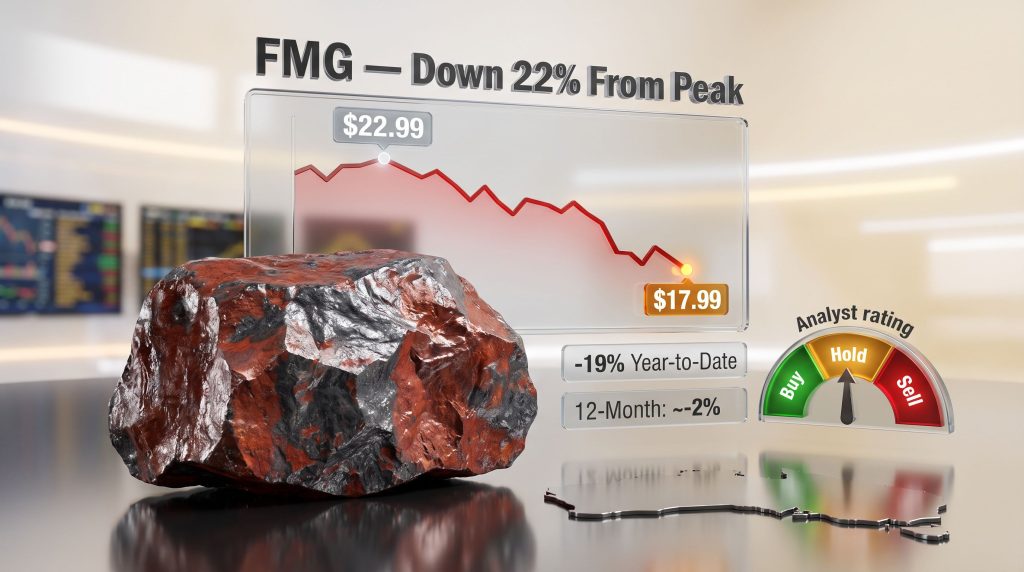
The mid-May 2026 peak in Fortescue's share price did not emerge in a vacuum. Iron ore price decline data shows prices simultaneously spiked to a two-year high, driven by a combination of restocking activity in China and broader commodity optimism. Fortescue shares followed, reaching $22.99 — the year-to-date high.
What followed was a coordinated unwind. As iron ore prices retreated sharply from that two-year high, Fortescue shares tracked the decline with similar velocity.
Key Price Data Snapshot (August 2026)
Metric Value Year-to-Date High (mid-May 2026) $22.99 Current Share Price ~$17.99 Decline From Peak ~22% Year-to-Date Performance -19% 12-Month Performance ~-2%
The distinction between the year-to-date loss of 19% and the peak-to-current decline of 22% is worth noting. The year-to-date figure is anchored to January 1, 2026 levels, while the peak-to-trough figure captures the magnitude of the correction from the most recent high. Both metrics tell part of the story, but neither alone explains the full picture.
What Macro Forces Are Driving Iron Ore Lower?
Several forces are operating simultaneously to pressure iron ore prices, and by extension, Fortescue's valuation.
China's Shifting Steel Demand Profile
China consumes roughly half of the world's steel output, and the iron ore that feeds its blast furnaces. For decades, China's urbanisation and infrastructure buildout created seemingly insatiable demand for iron ore. That structural tailwind is now moderating. The China steel demand outlook has shifted considerably as the country's property sector enters a prolonged adjustment phase.
While government stimulus measures have been announced periodically, their capacity to restore the scale of steel demand seen during peak construction cycles remains limited. Steel output growth is tapering, and with it, the marginal demand for high-volume iron ore imports. Furthermore, China demand prospects suggest this moderation may persist well beyond the near term.
The Supply Glut Building Through 2030
On the supply side, major iron ore producers — including the major Pilbara operators — have continued expanding output capacity. The combination of rising global supply and moderating Chinese demand creates the conditions for a structural price softening, not merely a cyclical dip.
Trading Economics data indicates that iron ore prices are forecast to soften through the second half of 2026 and decline gradually through to 2030. This multi-year trajectory is consequential for a company like Fortescue, whose earnings are tightly linked to spot price levels.
Geopolitical Risk and Broad Market Uncertainty
Ongoing conflict in the Middle East has added another layer of complexity. Rising oil prices inflate operational costs for energy-intensive mining operations, while broader market uncertainty suppresses risk appetite. For a capital-heavy business like iron ore mining, cost inflation at a time of price softening is a particularly unfavourable combination. These iron ore market pressures have been further compounded by evolving trade policy dynamics.
How Analysts Are Rating Fortescue Shares Right Now
Broker opinion on Fortescue is deeply divided, which itself signals the level of genuine uncertainty surrounding the stock's near-term direction.
The Three-Way Broker Split
According to Market Index data, broker ratings are evenly distributed across buy, hold, and sell recommendations. The average price target from this cohort sits at $18.78, implying roughly 4% upside from current levels — a modest implied return that reflects neither strong conviction in recovery nor an urgent sell thesis.
TradingView data paints a more cautious picture. Among 17 analysts tracked, the distribution breaks down as follows:
- 8 analysts hold a neutral/hold rating
- 7 analysts carry a sell or strong sell recommendation
- 2 analysts maintain a buy rating
- Average price target: $18.28 (approximately 2% implied upside)
The $7.45 Price Target Gap
Perhaps the most revealing datapoint in the current analyst landscape is the spread between the most optimistic and most pessimistic price targets.
| Scenario | Price Target | Implied Move From ~$17.99 |
|---|---|---|
| Most Bullish Analyst | $23.01 | ~+28% |
| Average Consensus | $18.28 – $18.78 | ~+2% to +4% |
| Most Bearish Analyst | $15.56 | ~-14% |
A $7.45 gap between the highest and lowest targets is not typical for a major ASX blue-chip stock. It reflects the binary nature of the commodity cycle debate: those who believe Chinese stimulus will materialise and iron ore will stabilise sit at the optimistic end, while those who expect structural demand erosion occupy the lower end of the range.
Wide analyst price target ranges in commodity stocks are frequently a signal that the market has not yet reached consensus on whether a decline is cyclical or structural. This distinction matters enormously for positioning decisions.
Is Fortescue's Earnings Capacity Being Structurally Repriced?
Beyond the near-term commodity price debate, a more significant question is emerging: whether Fortescue's long-run earnings capacity is being fundamentally repriced by institutional investors.
Margin Compression Dynamics
Iron ore pricing below certain thresholds compresses Fortescue's free cash flow disproportionately. This directly affects the company's capacity to sustain its historically high dividend payout ratios, which have been a major draw for income-focused investors. If the market begins to price in sustained price softening, dividend expectations will need to be recalibrated — and with them, the share price multiples income investors are willing to pay.
Green Energy Strategy and Capital Allocation Debate
Fortescue's investment in green hydrogen and renewable energy has been a point of ongoing debate among institutional investors. The strategy reflects genuine long-term ambition, but the capital allocation required to fund these ventures competes with shareholder returns in the near term. Some analysts argue this has weighed on sentiment during a period when investors are demanding capital discipline from commodity producers.
Peer Comparison: BHP and Rio Tinto
Fortescue's concentrated iron ore exposure distinguishes it from diversified peers like BHP and Rio Tinto, both of which carry meaningful exposure to copper, aluminium, and other commodities that have performed differently across the cycle. However, Australia's iron ore dominance as a global supplier remains a structural advantage, even during periods of price softening. During periods of iron ore weakness, BHP and Rio Tinto's diversification provides a degree of earnings resilience that Fortescue structurally cannot replicate at current scale.
The next major ASX story will hit our subscribers first
What Could Reverse the Trend? Key Upside Catalysts
The bear case for Fortescue shares is well-understood by the market. What is less frequently examined is the constellation of factors that could trigger a meaningful re-rating higher.
Chinese Economic Stimulus
The single most powerful near-term catalyst for Fortescue would be a substantive Chinese economic stimulus programme with a genuine construction and infrastructure focus. Beijing has the policy tools available; the question is whether political will and economic necessity align to deploy them at sufficient scale to move iron ore demand metrics.
Iron Ore Price Recovery Scenarios
For iron ore to recover meaningfully, at least one of the following conditions would need to shift:
- Chinese steel demand strengthens beyond current forecasts, driven by infrastructure or property sector recovery
- Major global supply disruptions reduce available iron ore tonnage
- Currency movements improve the economics of Chinese steel production at current iron ore prices
- Speculative positioning in futures markets triggers a short-covering rally
Copper Exposure as a Rerating Event
Fortescue's copper ambitions, if they progress toward meaningful production scale, could eventually shift how the market values the company. Copper's role in electrification infrastructure gives it a structurally different demand outlook compared to steel-linked iron ore. A credible copper production milestone could prompt analysts to apply a different valuation framework to a portion of Fortescue's business.
Upcoming Reporting Season
Investors will focus on several key metrics when Fortescue reports:
- Realised iron ore prices versus benchmark
- C1 cash costs per wet metric tonne
- Free cash flow generation and dividend guidance
- Progress updates on green energy and copper projects
- Capital expenditure trajectory
Fortescue Share Price Scenarios: The Next 12 Months
| Scenario | Iron Ore Price Direction | Implied FMG Share Price Range | Key Assumption |
|---|---|---|---|
| Recovery Case | Stabilises / Rebounds | $21 – $23 | China stimulus materialises at scale |
| Base Case | Gradual softening | $17 – $19 | Demand tapers as forecast |
| Downside Case | Accelerated decline | $15 – $16 | Supply glut + demand contraction coincide |
How Long-Term Investors Should Frame a 22% Decline
A sharp share price decline in a resource company does not automatically constitute an opportunity, nor does it automatically constitute a reason to exit. The analytical task is distinguishing between two fundamentally different types of decline.
A cyclical correction reflects a temporary dislocation between price and intrinsic value driven by short-term commodity fluctuations. History suggests these corrections eventually reverse when the commodity cycle turns.
A structural deterioration reflects a more permanent impairment of earning power — driven by factors like sustained demand erosion, competitive displacement, or irreversible cost base expansion. These declines do not necessarily reverse.
A significant price decline in a commodity-linked stock does not automatically constitute a buying opportunity. Investors should assess whether the decline reflects a temporary cyclical correction or a more persistent structural shift in demand fundamentals before adjusting portfolio positions.
The current situation for Fortescue shares down 22% contains elements of both. The near-term commodity cycle is clearly in a corrective phase. However, the longer-term trajectory of Chinese steel demand and the structural expansion of global iron ore supply introduce genuine uncertainty about the medium-term earnings baseline. Consequently, investors face a genuinely complex analytical challenge when evaluating current entry or exit points.
Frequently Asked Questions: Fortescue Shares Down 22%
Why Have Fortescue Shares Fallen So Sharply in 2026?
The primary driver is the close correlation between iron ore spot prices and Fortescue's earnings. Iron ore spiked to a two-year high in mid-May 2026 before retreating sharply. Fortescue's shares followed the same trajectory, falling approximately 22% from their peak of $22.99 to around $17.99. Broader headwinds including Middle East geopolitical tensions, cost inflation, and softening Chinese steel demand have compounded the pressure.
What Is the Current Analyst Consensus on FMG?
Analyst opinion is evenly divided between buy, hold, and sell ratings. Average price targets range between $18.28 and $18.78, implying modest upside of 2% to 4% from current levels. The spread between the most bullish ($23.01) and most bearish ($15.56) targets spans $7.45, reflecting deep uncertainty about the commodity cycle outlook.
How Does the Iron Ore Price Outlook Affect Fortescue's Share Price?
Iron ore prices are forecast to soften through the second half of 2026 and decline gradually through to 2030 as Chinese steel demand moderates and global supply capacity grows. Given Fortescue's concentrated exposure, sustained price weakness at the commodity level translates directly into earnings compression and reduced dividend capacity. For further context, the ASX's resources sector guidance provides useful background on how commodity-linked stocks are classified and monitored.
Is Fortescue Still Considered a Blue-Chip ASX Mining Stock?
Fortescue remains one of the largest companies on the ASX by market capitalisation and is a significant component of the ASX 200. Its blue-chip status as a major resources stock is not in question. However, its concentrated commodity exposure means it carries higher earnings volatility than more diversified mining peers such as BHP and Rio Tinto.
What Is the Difference Between Fortescue's Year-to-Date Loss and Its Decline From Peak?
The year-to-date loss of approximately 19% measures performance from January 1, 2026. The 22% decline from peak measures the correction from the mid-May 2026 high of $22.99. The difference reflects the fact that FMG shares performed relatively well in the early part of 2026 before the peak, meaning the correction has been sharper than the full-year figure suggests.
How Does Fortescue's Performance Compare to BHP and Rio Tinto?
BHP and Rio Tinto carry diversified commodity portfolios that include copper, coal, aluminium, and other minerals alongside iron ore. This diversification provides partial insulation during iron ore-specific downturns. Fortescue's more concentrated exposure means its share price tends to amplify iron ore price movements in both directions relative to its more diversified peers. The World Steel Association's annual statistics offer additional context on global steel production trends that underpin this dynamic.
Key Takeaways for Investors
- Fortescue shares have fallen approximately 22% from their mid-May 2026 peak of $22.99 to around $17.99, with a year-to-date decline of approximately 19%
- The decline is primarily driven by iron ore's retreat from a two-year high, reflecting Fortescue's structural earnings sensitivity to commodity price movements
- Analyst opinion is split across buy, hold, and sell ratings, with average price targets of $18.28 to $18.78 implying limited near-term upside
- The $7.45 spread between the most bullish and most bearish analyst targets reflects genuine market uncertainty about whether this is a cyclical correction or a structural repricing
- Iron ore prices are forecast to soften through late 2026 and decline gradually through to 2030 as Chinese steel consumption moderates and global supply expands
- Geopolitical instability in the Middle East, inflationary cost pressures, and institutional repositioning have amplified downward momentum
- Long-term investors should carefully evaluate whether current price levels reflect a recoverable cyclical dip or a more persistent earnings impairment before adjusting exposure
This article contains general financial information only and does not constitute personal financial advice. Past share price performance is not indicative of future returns. Investors should consider their personal circumstances and seek independent financial advice before making investment decisions. All price figures and analyst data referenced reflect publicly available information as of early August 2026.
Want to Capitalise on the Next Major ASX Mineral Discovery Before the Broader Market?
While iron ore cycles create uncertainty for concentrated producers like Fortescue, Discovery Alert's proprietary Discovery IQ model delivers real-time alerts on significant ASX mineral discoveries — instantly translating complex data across 30+ commodities into clear, actionable insights for both short-term traders and long-term investors. Explore historic discoveries and their exceptional returns to understand the opportunity, then begin your 14-day free trial today to position yourself ahead of the market.