August 4, 2026
The Political Economy of War-Driven Oil Profits: Why Washington Is Targeting Big Oil's Windfall
Every major geopolitical conflict that disrupts energy supply chains eventually produces the same uncomfortable political dynamic: private energy companies record extraordinary profits while consumers absorb punishing fuel costs. This cycle has played out after every significant oil shock since the 1970s, and the Iran war crude shortage unfolding in mid-2026 is proving no different. What makes the current episode analytically distinctive is not the windfall itself, but who is calling it out.
President Donald Trump says oil majors making too much money from Iran war crude shortage — a striking statement from an administration traditionally aligned with domestic energy expansion and corporate deregulation. In August 2026, Trump publicly directed criticism at major oil companies, with the target of his criticism including integrated majors such as Exxon Mobil and Chevron. For energy market analysts, this friction signals something more complex than political posturing.
When big ASX news breaks, our subscribers know first
How the Iran War Reshaped Global Crude Market Structure
Understanding why Trump says oil majors are making too much money from the Iran war crude shortage requires first understanding the mechanics of how armed conflict converts supply disruption into profit windfall. The geopolitical oil price tensions at play here are considerable, reshaping market structures in ways that disproportionately benefit integrated producers.
The Iran war introduced multiple simultaneous stress points into global energy markets:
- The Strait of Hormuz risks, through which roughly 20 to 21% of global seaborne oil supply transits, faced access constraints that elevated shipping risk premiums and reduced effective throughput
- Regional refining infrastructure damage created a dual constraint on both crude processing capacity and refined product availability, compressing supply at multiple points in the value chain
- Forward contract markets repriced in response to sustained geopolitical uncertainty, with risk premiums embedded in crude benchmarks well beyond normal volatility ranges
- Diesel and aviation fuel experienced disproportionate price pressure relative to crude benchmarks, a pattern consistent with historical refinery-constrained supply events
This is a critical structural point often missed in surface-level coverage. Supply shocks generated by conflict do not uniformly harm all energy market participants. For integrated oil majors with diversified upstream production assets outside the conflict zone and significant downstream refining exposure, a constrained supply environment can simultaneously elevate crude revenues and expand per-barrel refining margins, resulting in profit amplification at multiple stages of the value chain.
Exxon, Chevron, and the Margin Expansion Dynamic
What Do the Profit Figures Actually Show?
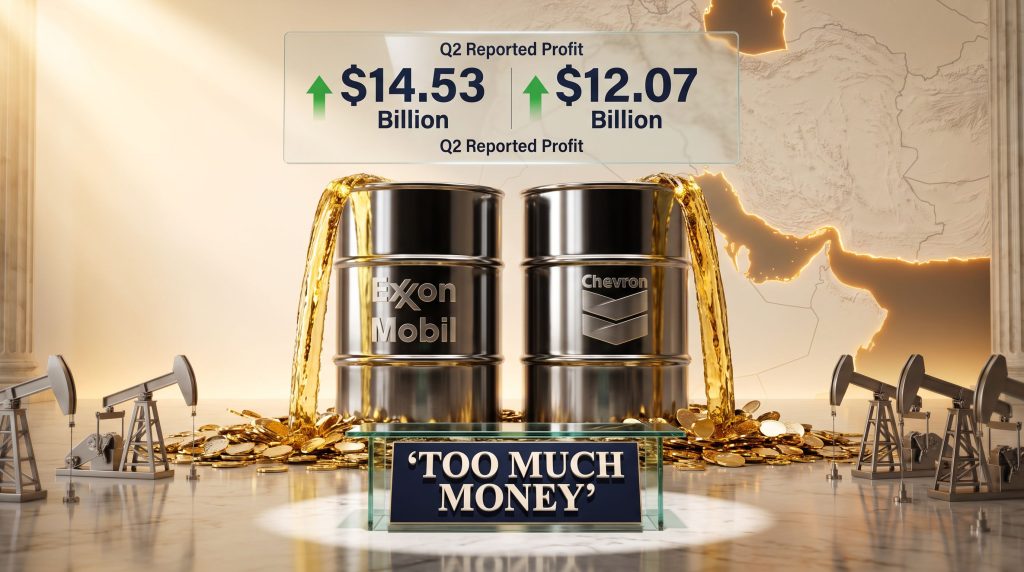
The financial outcomes for major integrated producers during the Iran war supply disruption were substantial. Reported second-quarter profit figures illustrate the scale of margin expansion:
| Company | Reported Q2 Profit | Context |
|---|---|---|
| Exxon Mobil | $14.53 billion | Materially elevated versus prior-year comparable period |
| Chevron | $12.07 billion | Boosted by crude and refined product margin expansion |
These figures reflect a market reality that energy economists describe as the integrated major advantage during supply shocks. Companies with upstream production in non-disrupted basins — including U.S. shale formations, the North Sea, and West African deepwater fields — capture elevated benchmark prices without bearing direct operational disruption risk. Furthermore, when those same companies also own refining assets processing alternative crude grades, their earnings receive a second layer of enhancement through widened crack spreads.
Key Insight: During conflict-driven supply shocks, integrated oil majors with geographically diversified production and refining assets are structurally positioned to capture earnings at multiple points in the value chain simultaneously. This is a feature of vertical integration, not price manipulation, but it produces outcomes that are politically indistinguishable from profiteering in the public eye.
According to reporting by the Wall Street Journal, Big Oil's extraordinary earnings during the Iran conflict have drawn scrutiny from across the political spectrum, with industry executives increasingly concerned about how to navigate the White House's growing frustration.
Windfall Profits vs. Cyclical Gains: A Critical Policy Distinction
Why the Distinction Matters for Regulation
Not all profit increases attract the same regulatory scrutiny. Policymakers, economists, and legislators have historically drawn a meaningful distinction between two categories of earnings growth.
Cyclical profits arise from normal supply and demand oscillations — the rewards of capital investment, operational efficiency gains, or disciplined exploration decisions. These are broadly accepted as legitimate market outcomes that incentivise future investment in productive capacity.
Windfall profits, however, are fundamentally different. They arise from exogenous events, such as wars, natural disasters, or sanctions regimes, that the company neither caused nor contributed to through productive activity. The earnings are extracted from market scarcity created by circumstances entirely external to the firm's operations. The broader oil price shock impacts of such events demonstrate precisely how quickly earnings can diverge from productive merit.
What Is a Windfall Profit in the Oil Industry?
A windfall profit occurs when an energy company's earnings increase sharply due to external disruptions — such as a war or supply shock — rather than through improved operations, capital deployment, or strategic investment. Because these gains are not earned through productive activity but captured from externally created scarcity, they occupy a distinct category in economic and regulatory analysis.
This distinction matters enormously for policy design. Taxing cyclical profits risks suppressing the investment incentives needed to build future supply capacity. Taxing windfall profits theoretically recaptures externally generated scarcity rents without distorting underlying production economics, though in practice the boundary between the two is difficult to define legislatively.
Historical Precedents: When Governments Have Acted on Oil Windfalls
The current political pressure on Big Oil is not unprecedented. Governments across multiple jurisdictions have intervened in oil company earnings during prior supply disruption events:
| Policy Mechanism | Country | Trigger Event | Outcome |
|---|---|---|---|
| Windfall Profit Tax (1980) | United States | 1970s oil embargo aftermath | Generated approximately $80 billion before repeal in 1988 |
| Energy Profits Levy | United Kingdom | 2022 Russia-Ukraine energy crisis | 25 to 35% surcharge on North Sea upstream profits |
| Strategic Petroleum Reserve Release (2022) | United States | Post-COVID supply tightening | 180 million barrels released over approximately six months |
| Excess Profit Tax | EU Member States | 2022 energy price surge | Varied implementation complexity across the bloc |
The 1980 U.S. Windfall Profit Tax is particularly instructive. Enacted during the Carter administration as a response to decontrolled crude prices following the 1970s embargo, it ultimately generated substantially less revenue than projected due to lower-than-anticipated oil prices in the mid-1980s and significant definitional disputes about what constituted a qualifying windfall. The lesson: windfall profit taxation is administratively and legislatively complex even when the political will exists.
What Executive Tools Does the White House Actually Control?
Short-Term Executive Options
When assessing whether Trump's public criticism of oil majors translates into actionable policy, it is important to distinguish between executive branch authority and actions requiring Congressional cooperation.
- Strategic Petroleum Reserve deployment to inject additional domestic supply and suppress crude benchmark pricing
- Export restriction authority under the Energy Policy and Conservation Act, which grants the executive branch power to retain domestically produced crude within U.S. borders during supply emergencies
- Federal Trade Commission referral for investigation into potential price coordination or anti-competitive conduct among major producers
Legislative Pathways and Informal Pressure
Legislative options requiring Congressional action include windfall profit tax legislation targeting per-barrel earnings above a defined threshold, price gouging statutes extended to cover refined fuel products, and mandatory profit-sharing mechanisms tied to earnings benchmarks during conflict-driven shortage periods.
Informal pressure mechanisms, meanwhile, include direct White House engagement with CEO-level executives, public naming of specific companies to generate reputational pressure, and coordination with allied governments. As of the time of Trump's August 2026 remarks, no formal executive order or legislative referral had been confirmed. The criticism remained in the category of public pressure rather than regulatory action.
The next major ASX story will hit our subscribers first
The Consumer Impact: Who Bears the Cost of War-Driven Scarcity
The retail-level consequences of the Iran war crude shortage extend well beyond pump prices. The supply disruption has produced cascading cost pressures across multiple economic sectors:
- Diesel markets have experienced the sharpest price increases relative to crude benchmarks, reflecting refinery capacity constraints that disproportionately affect middle distillate production
- Agricultural supply chains dependent on diesel-powered machinery face compounding input cost pressures, with potential downstream effects on food pricing
- Airline operating costs have increased materially due to elevated jet fuel prices, with carriers facing difficult decisions about route economics and fare structures
- Emerging market economies with limited domestic energy production face acute import cost burdens, amplifying inflationary pressures already present in post-conflict global markets
- Independent refiners processing alternative crude grades have faced feedstock cost increases that partially offset the elevated crack spreads benefiting integrated majors
This distribution of harm is important context for Trump's political calculation. Consumer-facing fuel price increases are visible, frequent, and politically salient in ways that corporate earnings reports are not. The decision to publicly distance from Big Oil profits reflects electoral arithmetic rather than ideological realignment. OPEC market influence further complicates any unilateral executive response, as production decisions by the cartel remain largely outside Washington's direct control.
Three Scenarios for How This Standoff Resolves
The trajectory of the White House-Big Oil tension will depend on how several variables evolve, including the duration of the Iran war, the pace of diplomatic resolution, Congressional arithmetic, and crude price movements. Three plausible scenarios exist:
Scenario 1: Rhetorical Pressure Only
Trump's criticism remains confined to public statements. Oil majors continue reporting elevated profits. No formal regulatory action is pursued. Consumer fuel prices remain elevated but politically manageable, particularly if the conflict shows signs of resolution.
Scenario 2: SPR Deployment and Informal Coordination
The White House releases strategic reserves to suppress crude benchmarks and engages major oil executives in informal discussions about price moderation. Profits compress modestly. Political optics improve without requiring legislative action or industry confrontation.
Scenario 3: Legislative Windfall Tax Push
Congressional allies introduce windfall profit tax legislation. Industry lobbying intensifies. Historical precedent from the 1980 U.S. Windfall Profit Tax suggests implementation is feasible but revenue generation and definitional clarity are deeply complex to execute. The probability of this scenario scales with the duration of elevated prices and the political cost of inaction heading into electoral cycles.
As the BBC has reported, the political dynamics surrounding oil company profits during the Iran conflict have intensified considerably, with legislators on both sides of the aisle expressing concerns about the pace of earnings growth relative to consumer pain at the pump.
Analyst Caution: Windfall profit conditions in oil markets can normalise rapidly. If diplomatic resolution reduces the Iran war's supply disruption, or if demand destruction accelerates from sustained high fuel prices, the earnings environment for oil majors could compress significantly before any regulatory framework is implemented. Investors and policymakers should weigh the lag between political response and market reality carefully.
Why This Moment Establishes a Broader Precedent
The Trump administration's public confrontation with Exxon Mobil, Chevron, and the broader integrated major sector over Iran war profits reflects a recurring fault line in democratic political economies. The tension exists between the legitimate profit rights of private energy corporations, the public interest obligations that emerge during nationally significant supply emergencies, and the practical limits of executive authority to intervene in nominally private market outcomes.
Consequently, what distinguishes the 2026 episode from prior cycles is the identity of the critic. A Republican administration with a strong pro-deregulation energy posture publicly targeting integrated oil majors for excess profitability represents a meaningful departure from conventional political alignment. It signals that the electoral cost of consumer fuel pain has crossed a threshold that supersedes ideological consistency in energy policy.
Whether this translates into substantive regulatory action, or dissipates as the conflict evolves and WTI and Brent futures respond to shifting supply conditions, will determine whether it establishes a durable precedent or remains a political footnote in the history of geopolitical energy shocks.
Disclaimer: This article contains analysis, scenario projections, and historical comparisons for informational purposes only. It does not constitute financial, investment, or legal advice. Profit figures cited reflect reported earnings and should be verified against official company disclosures. Policy scenarios described are analytical projections and do not represent confirmed government actions or intentions.
Want to Stay Ahead of the Next Major Resource Discovery?
While geopolitical shocks reshape energy markets and drive extraordinary profits for integrated majors, Discovery Alert's proprietary Discovery IQ model delivers real-time alerts on significant ASX mineral discoveries — instantly translating complex data into actionable opportunities for investors at every level. Explore historic discoveries and their remarkable returns, then begin your 14-day free trial at Discovery Alert to position yourself ahead of the market.