August 4, 2026
Mine Closure as a Discipline: Why the End of Operations Is Just the Beginning
The mining industry has long measured success in tonnes extracted, revenue generated, and operational years. Yet a growing body of regulatory expectation, investor scrutiny, and community accountability is reshaping how the sector defines a completed project. Increasingly, the question is not simply what a mine produced, but what it leaves behind.
For coal-producing regions like Queensland's Bowen Basin, this shift carries particular weight. Dozens of operations that opened during Australia's coal expansion decades are now approaching or have already reached the end of their productive economic lives. The challenge of what happens next, who pays for it, and how the land is returned to beneficial use, has moved from a footnote in environmental impact assessments to one of the most consequential operational and financial questions in the resources sector.
The Glencore Newlands rehabilitation project sits at the centre of this conversation, offering one of the most detailed and large-scale examples of what responsible mine closure actually looks like when executed in practice.
When big ASX news breaks, our subscribers know first
Understanding the Newlands Site: Four Decades of Coal Production
Located approximately 150 kilometres west of Mackay in Queensland's central Bowen Basin, the Newlands Coal Mine operated continuously from 1983 to 2023, spanning four full decades of coal extraction. During that time, the operation produced roughly 229 million tonnes of both thermal and steelmaking coal, making it a significant contributor to Queensland's coal export economy.
The infrastructure footprint that supported this output was substantial by any measure:
- 25 open-cut pits across a multi-lease area
- Two underground mines accessing deeper seams
- Two coal preparation plants for washing and quality processing
- Supporting road, rail, water, and power infrastructure across the broader site
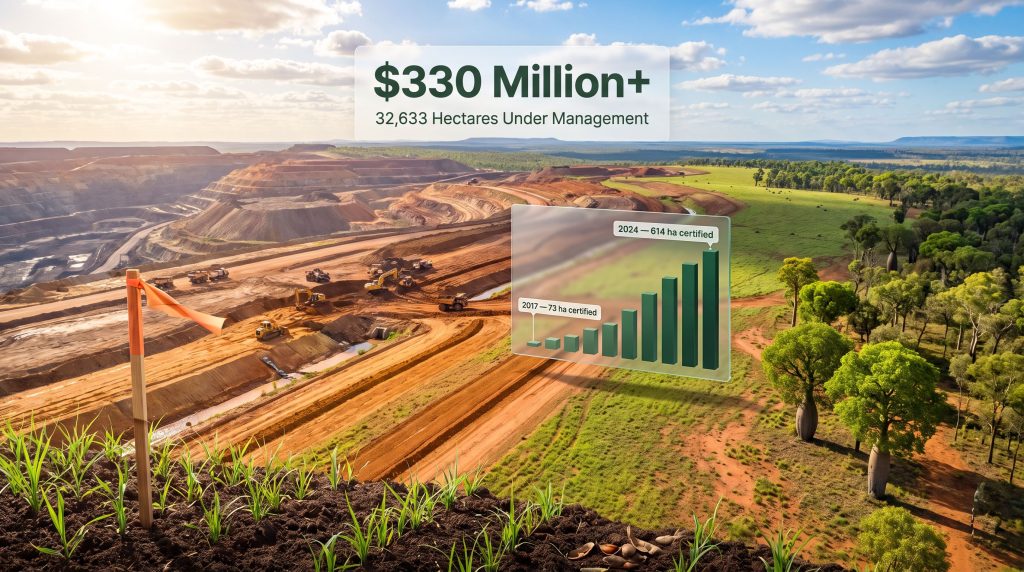
The total area under management across 15 mining leases covers approximately 32,633 hectares, a land parcel comparable in scale to more than 42,000 standard soccer fields. When active coal extraction ceased in 2023, that entire footprint transitioned from an extraction operation into what is now one of Australia's most extensive mine rehabilitation programs.
It is worth understanding that mine rehabilitation is not a single event that follows closure. It is a distinct operational phase with its own workforce, capital budget, regulatory milestones, and multi-year timeline. At Newlands, that phase began well before operations formally ended.
The Financial Scale of the Glencore Newlands Rehabilitation Project
Breaking Down a $330 Million Restoration Commitment
The cumulative capital committed to the Glencore Newlands rehabilitation project has exceeded $330 million, positioning it among the most capital-intensive mine closure programs in Queensland's recorded history.
| Rehabilitation Metric | Detail |
|---|---|
| Total land under management | ~32,633 hectares across 15 leases |
| Land targeted for active rehabilitation | ~8,000 hectares |
| Hectares rehabilitated in 2024 alone | 637 hectares |
| Cumulative Queensland Government-certified area | 614 hectares |
| Hectares submitted for certification in 2024 | 502 hectares |
| Total investment reported through 2024 | More than $234 million |
| Cumulative total investment | Exceeding $330 million |
| Post-rehabilitation land use (grazing) | ~70% of rehabilitated area |
| Post-rehabilitation land use (native woodland) | ~30% of rehabilitated area |
The pace of expenditure is notable. With more than $234 million recorded as invested through 2024, and the cumulative total now exceeding $330 million, rehabilitation spending has clearly accelerated as the site moves fully into its closure phase. This is consistent with industry patterns where the bulk of rehabilitation costs are incurred during the active reshaping and revegetation stage rather than during progressive rehabilitation that occurs alongside production.
Furthermore, understanding mine reclamation importance helps contextualise why these substantial financial commitments are not merely regulatory obligations but genuine investments in long-term land stewardship.
What Mine Rehabilitation Financial Assurance Means in Queensland
A critical but often overlooked element of mine closure economics in Queensland is the financial assurance system. Under Queensland's Environmental Protection Act 1994, mining companies are required to lodge security bonds intended to cover the estimated cost of rehabilitation if an operator defaults or abandons a site.
The adequacy of these bonds has been a persistent policy debate. Industry critics and environmental advocates have long argued that bond amounts are systematically underestimated, particularly for large, complex multi-pit operations. Newlands, by committing more than $330 million in actual rehabilitation expenditure, provides a real-world cost data point that regulators and policymakers can use to benchmark bond adequacy requirements for comparable operations in the future.
Certified Rehabilitation: A Regulatory Milestone With Strategic Implications
What Government Certification of Rehabilitation Actually Means
In Queensland, rehabilitation certification is the formal regulatory process by which the state government confirms that a defined area of mined land has been successfully rehabilitated to a standard that meets or exceeds the conditions of the site's environmental authority. Certified land can, under certain conditions, be released from mining lease obligations, effectively returning it to productive use under standard land tenure arrangements.
Achieving certification requires demonstrating that:
- Landform stability has been achieved through spoil reshaping and compaction
- Topsoil has been reinstated to appropriate depth and quality
- Drainage infrastructure functions correctly and does not generate acid or saline runoff
- Vegetation cover meets species composition and density benchmarks
- Long-term monitoring data supports the stability and sustainability of the rehabilitated area
This is a demanding standard, and many mining operations across Australia struggle to achieve it even years after operations cease. Newlands has pursued certification progressively, meaning the process began while the mine was still producing coal. In addition, approaches to natural capital in mining are increasingly informing how rehabilitation targets are set and measured.
Newlands' Certification Timeline: A Bowen Basin First
The Glencore Newlands rehabilitation project achieved something genuinely precedent-setting in 2017 when 73 hectares of rehabilitated mine spoil received formal Queensland Government certification while the operation was still actively mining. This was the first instance of this type of certification being awarded to a coal mine during active operations anywhere in the Bowen Basin.
The milestone trajectory since then has been significant:
| Year | Certification Milestone |
|---|---|
| 1983 | Newlands commences coal production |
| 2017 | 73 hectares certified during active operations, first in the Bowen Basin |
| 2021 | Additional 138 hectares submitted for regulatory certification |
| 2023 | Mine reaches end of scheduled economic life; full closure phase begins |
| 2024 | 637 hectares rehabilitated; 502 hectares submitted for certification |
| 2026 | Cumulative certified area reaches 614 hectares; total investment exceeds $330 million |
The significance of certifying rehabilitation during active operations extends beyond the symbolic. It demonstrates to regulators, investors, and communities that progressive rehabilitation is not merely a compliance statement but a genuine operational commitment that can be independently verified.
What the Land Will Become: Post-Mining Use Planning
Returning the Bowen Basin Hinterland to Productive Agricultural Use
Before Newlands was developed, the land it occupies was predominantly cattle grazing country, typical of the semi-arid Bowen Basin hinterland of central Queensland. The post-rehabilitation land-use vision for the site reflects this pre-mining character, with approximately 70% of the rehabilitated area planned for return to productive cattle grazing pasture.
This is not simply a matter of scattering grass seed over a reshaped pit. Productive pasture establishment on rehabilitated mine spoil requires:
- Careful topsoil management and storage to preserve viable seed banks and microbial communities
- Spoil material assessment to identify and manage potentially acid-forming or saline layers
- Landform design that replicates natural drainage patterns and avoids erosion-prone slopes
- Species selection calibrated to local climate, soil chemistry, and grazing end-use requirements
- Multi-year monitoring to assess pasture establishment rates and intervene where needed
The Native Woodland Dimension: Bottle Trees and Biodiversity Corridors
The remaining 30% of the rehabilitated footprint is being restored as native woodland, with biodiversity corridors integrated into the broader site plan. The revegetation program features species characteristic of the local bioregion, including the iconic Brachychiton rupestris, commonly known as the Queensland bottle tree.
Glencore has documented this aspect of the rehabilitation program through a documentary titled Back to the Bottle Tree, which captures the ecological and human dimensions of the restoration effort. Bottle trees are slow-growing, culturally significant species of Queensland's inland woodlands, and their reestablishment serves as both an ecological indicator of rehabilitation success and a visible symbol of landscape recovery.
Biodiversity corridor planning at this scale is technically complex. Corridors must be designed to connect fragmented habitat patches, support native fauna movement, and function across the full spatial extent of a 32,000-hectare site. Long-term monitoring obligations attached to the environmental authority conditions will require Glencore to track vegetation and fauna outcomes well beyond the point when the bulk of physical rehabilitation work is complete.
Workforce Continuity: The Human Dimension of Mine Closure
Why Retaining Operational Workers Adds Technical and Social Value
One of the less-discussed but practically significant aspects of the Glencore Newlands rehabilitation project is the deliberate retention of operational workforce members through the closure phase. Many of the same personnel who ran the mine's production activities are now engaged in its restoration.
This approach carries genuine technical advantages that are easy to underestimate:
- Site-specific geological knowledge: Workers familiar with where particular spoil types were deposited, where underground voids exist, and where drainage historically pooled bring irreplaceable institutional knowledge to the reshaping and regrading process.
- Infrastructure familiarity: Understanding the location and condition of buried pipelines, culverts, and electrical infrastructure reduces the risk of costly or dangerous surprises during earthworks.
- Operational continuity: Consistent workforce engagement avoids the knowledge gaps that arise when rehabilitation is handed over entirely to contractors unfamiliar with the site's history.
The social dimension matters equally. The Newlands mine has historically been a major employer in the Glenden area and surrounding communities. Maintaining local employment through the closure phase softens the economic transition for those communities, preserving social licence during a period when mining operations in regional Queensland are under heightened public scrutiny.
The workforce continuity model at Newlands challenges the conventional narrative that mine closure necessarily means immediate and large-scale job losses. Where rehabilitation programs are properly resourced and planned, they can sustain meaningful local employment for years beyond the end of production.
The next major ASX story will hit our subscribers first
What Newlands Tells the Broader Australian Coal Sector
A Reference Case for Multi-Decade Closure Programs
Australia's Bowen Basin and Hunter Valley coal regions contain dozens of operations at various stages of approach to end-of-life. As the energy transition and coal market transformation reshape coal's long-term demand profile, the question of how these sites will be closed, who will fund the work, and whether rehabilitation outcomes will be achieved to a certifiable standard is becoming urgent.
The Glencore Newlands rehabilitation project provides a framework that other operators and regulators can examine across several dimensions:
- Early rehabilitation planning: Beginning certification processes during active operations, not just after closure, reduces the backlog of rehabilitation liability at end-of-mine-life.
- Progressive land-use integration: Defining post-mining land use clearly and early, whether grazing, woodland, or other purposes, disciplines the rehabilitation design process.
- Financial transparency: Reporting cumulative rehabilitation expenditure publicly provides a real-world cost signal for the industry and regulators.
- Community engagement: Involving local stakeholders and retaining local workers through closure reduces social conflict and builds community trust in the process.
ESG Frameworks and Mine Closure Liability Reporting
For large diversified mining companies, mine closure liabilities are increasingly material items within sustainability reporting frameworks. The broader mining sustainability transformation underway across the sector means standards including those developed by the International Sustainability Standards Board (ISSB), the Global Reporting Initiative (GRI), and the Task Force on Climate-related Financial Disclosures (TCFD) all now touch on how companies account for, fund, and manage end-of-asset-life obligations.
Demonstrating progressive rehabilitation with independently verified certification milestones, as Newlands has done, provides credible evidence of active liability management rather than deferred obligation. In an environment where institutional investors and lenders apply increasing scrutiny to environmental provisioning, this distinction carries real financial weight. Effective mining waste management practices are an integral part of this accountability framework.
A note for investors and analysts: Mine rehabilitation provisions represent contingent liabilities on corporate balance sheets. How those liabilities are being actively managed, as opposed to simply accrued, is a meaningful differentiator in ESG assessment. The Newlands program offers a concrete example of liability management in action, though readers should conduct their own assessment of any company's financial reporting before drawing investment conclusions.
Key Takeaways: What Mine Closure Best Practice Looks Like at Scale
The Glencore Newlands rehabilitation project distils several practical lessons for how large-scale mine closure should be approached across the Australian resources sector:
- Scale demands early action: Rehabilitating more than 8,000 hectares across 15 leases cannot be improvised at closure. It requires strategies embedded into mine planning years in advance.
- Progressive certification is achievable and strategically valuable: Newlands proved in 2017 that formal government certification of rehabilitated land is possible during active operations, not just after them.
- Real-world cost data matters: With more than $330 million invested at a single site, Newlands provides one of the clearest publicly available benchmarks for the financial magnitude of responsible large-scale mine closure in Australia.
- Workforce retention delivers dual value: Experienced mine workers bring irreplaceable site knowledge to rehabilitation while sustaining local employment and community stability through closure.
- Land-use clarity drives accountability: Defined outcomes, approximately 70% productive grazing pasture and 30% native woodland, give regulators, communities, and investors measurable benchmarks against which progress can be assessed.
Readers seeking ongoing coverage of mine rehabilitation practices, ESG developments, and coal transition challenges across Australia's resources sector can explore further reporting and industry analysis through Australian Mining at australianmining.com.au.
Want to Stay Ahead of Significant ASX Mineral Discoveries Before the Broader Market?
Discovery Alert's proprietary Discovery IQ model delivers real-time alerts on significant ASX mineral discoveries, instantly converting complex mineral data into actionable insights for both short-term traders and long-term investors — explore historic examples of major discovery returns to understand the potential at stake, then begin your 14-day free trial at Discovery Alert to position yourself ahead of the market.