August 4, 2026
The Supply Chain Vulnerability That Changed Everything
For decades, Western industrial economies treated critical minerals as a procurement problem, not a national security one. Raw materials flowed reliably through global commodity markets, and the question of who controlled the processing infrastructure rarely entered the boardroom, let alone the defence ministry. That assumption collapsed as the concentration of graphite, tungsten, cobalt, and rare earth processing inside a single geopolitical competitor became impossible to ignore.
The response from allied nations has not been diplomatic rhetoric. It has been capital. The US government backs Queensland's critical minerals push not through aspirational policy language, but through binding financial instruments, development finance institutions, and a bilateral framework that commits sovereign money to specific projects on defined timelines.
Understanding what this means for investors, project developers, and Australia's long-term industrial ambitions requires looking beyond the headlines and into the mechanics of how sovereign financing actually changes project economics. Furthermore, the critical minerals demand surge underway globally means this is not a moment Australia can afford to move slowly on.
When big ASX news breaks, our subscribers know first
What the Australia-US Critical Minerals Framework Actually Commits To
The bilateral arrangement between Australia and the United States is structured around deployable capital rather than diplomatic intent. Both governments have committed to mobilising at least US$1 billion each within a six-month activation window, with eligibility tied to projects producing end products destined for buyers in either country.
The primary US financing vehicle is the Export-Import Bank of the United States (US EXIM Bank), a government agency with a mandate to support US export competitiveness and strategic supply chain objectives. Separately, the US Development Finance Corporation (DFC) provides equity and debt financing for projects in allied nations that align with US strategic interests.
The historic critical minerals framework signed between President Trump and Prime Minister Albanese represents a landmark moment in bilateral economic cooperation, moving well beyond symbolic gestures into structured financial commitments.
The distinction between a diplomatic framework and a financing framework matters enormously to project developers. The former produces communiqués. The latter produces bankable instruments that private lenders can co-invest alongside.
What makes the current arrangement structurally different from prior bilateral trade agreements is the presence of development finance institutions at industry engagement events, not just diplomats. When the DFC attends a project showcase in Brisbane alongside the US Department of Commerce and the US Consul General, the purpose is transactional assessment, not ceremonial participation.
Mapping US Financial Commitments to Queensland Projects
The scale of US interest in Queensland's critical minerals pipeline is already measurable in concrete financial terms.
| Project | Commodity | US Financing Instrument | Indicative Value |
|---|---|---|---|
| Graphinex Esmeralda Graphite Mine (Croydon) + Townsville Processing Plant | Graphite | US EXIM Bank Letter of Interest | US$860 million |
| EQ Resources Mt Carbine Tungsten Project | Tungsten | Australia-US Framework | Confirmed (value TBC) |
| Queensland pipeline (aggregate) | Multiple | US Embassy-confirmed Letters of Interest | Over US$1 billion |
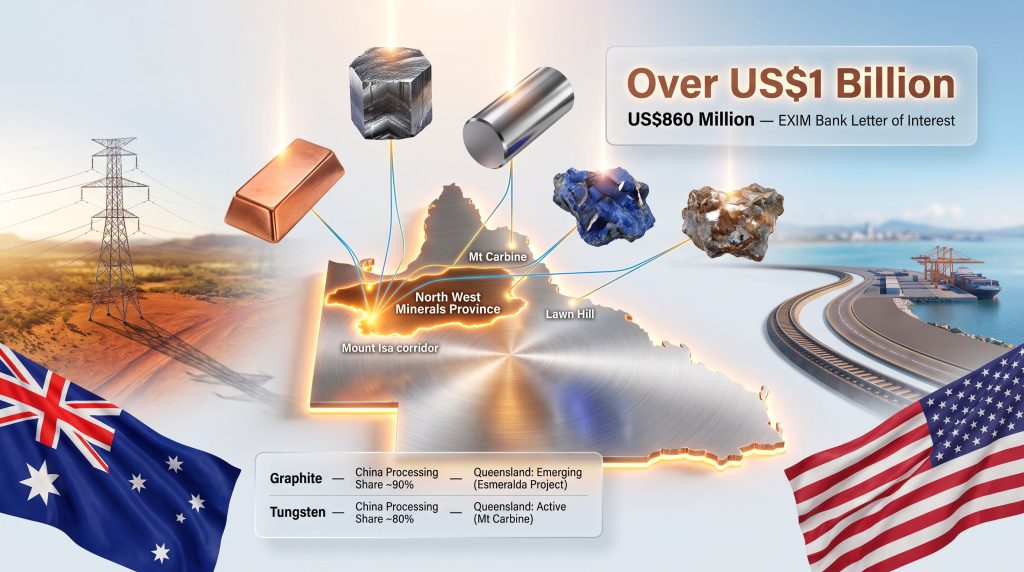
The US$860 million Letter of Interest issued by the EXIM Bank for the Graphinex Esmeralda project represents the single largest signal of US financing intent directed at Queensland to date. This figure is particularly significant given that graphite processing is one of the most strategically acute supply chain vulnerabilities facing Western battery manufacturers, with China controlling approximately 90% of global graphite processing capacity.
What a Letter of Interest Actually Does for a Project
A Letter of Interest (LOI) from the EXIM Bank is frequently misunderstood by retail investors. It is not a loan approval, and it does not guarantee financing will be drawn. What it does is formally confirm that a project meets preliminary eligibility criteria and that EXIM is prepared to consider a full application.
The practical effect on project economics is substantial:
- It signals to private lenders that the project has cleared a sovereign-level credit assessment threshold
- It compresses the risk premium that commercial banks apply to greenfield and brownfield critical minerals projects
- It opens the door to blended finance structures where EXIM capital sits alongside private debt and equity
- It provides institutional investors with a credible anchor against which they can size their own exposure
The conversion rate of Letters of Interest into drawn facilities is the metric investors should monitor most closely. EXIM's track record in allied-nation critical minerals financing suggests conversion timelines of two to four years from LOI to first drawdown, contingent on project feasibility milestones being met.
The Critical Minerals Investment Pathways Event: Who Was in the Room?
The Brisbane event that formalised much of this engagement was jointly convened by the Queensland Exploration Council (QEC) and the American Chamber of Commerce. The composition of the delegations present provides a clearer picture of intent than any press release.
US government delegation included:
- US Development Finance Corporation
- US Department of Commerce
- US Consul General Jeremy Cornforth
Australian institutional participants included:
- Export Finance Australia
- Department of Foreign Affairs and Trade
- Austrade
- Queensland Investment Corporation
Queensland government representation:
- Minister for Natural Resources, Mines, Manufacturing, Regional and Rural Development Dale Last
Queensland Resources Council chief executive officer Janette Hewson noted that US participants took an active role in articulating Queensland's strategic value within global supply chain architecture, emphasising the investment opportunities accessible through combined US, Australian, and Queensland government financing mechanisms.
QEC chair Kim Wainwright highlighted that the Queensland Government's Critical Minerals Strategy provides a meaningful structural foundation, particularly through its emphasis on coordinated industry development, streamlined approval pathways, common-user infrastructure investment, and the $250 million Critical Minerals Fund.
Queensland's $250 Million Critical Minerals Fund: What Is It Designed to Solve?
The most persistent structural problem in critical minerals project development is not the absence of long-term demand. It is the funding gap between exploration-stage discovery and bankable feasibility study. Junior miners routinely stall at this stage because commercial lenders require de-risked geology and proven metallurgy before committing capital.
The Queensland Critical Minerals Fund addresses this gap through four strategic pillars:
- Coordinated industry development to align project timelines with infrastructure and processing capacity
- Accelerated approvals pathways to reduce the regulatory latency that erodes investor confidence
- Common-user infrastructure investment to share the capital burden of roads, power, and water across multiple project developers
- Direct capital deployment through the fund itself, providing bridge financing that commercial lenders will not
The fund's role is complementary rather than standalone. It addresses the domestic project risk dimension while US financing frameworks address the demand-side and sovereign creditworthiness dimensions. Together, they create a stacked de-risking structure that has not previously existed for Queensland's critical minerals sector. In addition, Australia's critical minerals strategic reserve policies further reinforce the sovereign foundations underpinning these financing mechanisms.
The North West Minerals Province: Why Does Geography Create Both Opportunity and Constraint?
Queensland's critical minerals endowment is geographically concentrated in the North West Minerals Province, centred on the Mount Isa corridor. This region contains world-class deposits of copper, zinc, cobalt, and associated critical minerals that have been partially exploited for decades but remain significantly underdeveloped relative to their resource scale.
The province's challenge is structural rather than geological. The region sits entirely off the national electricity grid, meaning mining operations depend on diesel generation at substantially higher operating costs than grid-connected competitors. This single constraint has suppressed the economics of numerous projects that would otherwise be viable at current commodity prices.
The Two Infrastructure Prerequisites for Unlocking the Province
Two projects are considered foundational to realising the province's full potential:
CopperString is a proposed high-voltage transmission line that would connect the North West Minerals Province to the national electricity grid for the first time. Record government investment has already been committed to the project. Grid connectivity would fundamentally transform the operating cost structure for miners in the region, enabling electrification of operations, reducing diesel dependency, and making energy-intensive processing viable at scale.
The Mount Isa to Townsville rail corridor upgrade addresses the transport bottleneck. Bulk mineral concentrates currently face significant logistical constraints moving from mine to port. An upgraded rail corridor would reduce haulage costs, increase throughput capacity, and provide the physical infrastructure backbone required for the Townsville processing hub model to function at commercial scale.
Infrastructure availability is not a secondary consideration in critical minerals investment decisions. For institutional capital assessing Queensland assets, the commissioning timeline for CopperString and rail upgrades will directly determine when projects in the North West Minerals Province become financeable at competitive rates.
The next major ASX story will hit our subscribers first
Why These Five Minerals Are Driving US Strategic Attention
The commodity mix that dominates Queensland's critical minerals profile aligns almost precisely with the US government's own strategic supply chain vulnerability assessment. Consequently, critical minerals and energy security considerations are now inseparable from the investment logic driving US sovereign capital into Queensland.
| Mineral | Primary Global Producer | China's Processing Share | Queensland's Strategic Role |
|---|---|---|---|
| Graphite | China | ~90% | Emerging (Esmeralda, Croydon) |
| Tungsten | China | ~80% | Active (Mt Carbine) |
| Copper | Chile / Peru | ~40% refined | Major (Mt Isa corridor) |
| Cobalt | DRC | ~70% refined | Secondary deposits |
| Zinc | China / Australia | ~40% smelting | Significant (Mt Isa / McArthur River) |
Graphite occupies a unique position in this matrix. Unlike most battery materials where processing concentration is a concern, graphite presents a near-complete processing monopoly. Natural graphite must be purified to battery-grade spherical graphite before it can be used in lithium-ion anodes, and this purification process is almost entirely conducted in China. The Esmeralda project near Croydon, combined with the proposed Townsville processing facility, represents one of the few credible Western-hemisphere alternatives being developed at scale.
Tungsten receives less public attention than battery metals but carries significant defence-sector weighting. It is the primary material in kinetic energy penetrators used in armour-piercing munitions, and its extreme melting point makes it irreplaceable in aerospace and cutting tool applications. Western-controlled tungsten assets are scarce, which is why the Mt Carbine project in Queensland registers prominently in Australia's defence critical materials strategy and US strategic materials planning.
Copper underpins the entire electrification transition. A single electric vehicle contains roughly 83 kilograms of copper, approximately four times more than a conventional internal combustion vehicle. Defence platforms, grid infrastructure, and data centres are all simultaneously increasing copper demand, while the global discovery pipeline for new deposits has been declining for two decades.
Three Scenarios for Queensland's Critical Minerals Trajectory
Investors assessing Queensland's critical minerals opportunity should model across a range of outcomes rather than anchoring to a single base case.
Scenario 1: Accelerated Development (Base Case)
US EXIM and DFC financing converts from Letters of Interest to drawn facilities as feasibility milestones are achieved. CopperString and rail upgrades proceed broadly on schedule. Townsville consolidates as a regional processing hub within five to seven years, anchored by the Graphinex facility. Queensland's aggregate critical minerals output grows significantly within the decade.
Scenario 2: Infrastructure Bottleneck (Risk Case)
Grid and rail constraints delay project commissioning despite available financing. Approval timelines remain lengthy, eroding investor confidence in Queensland relative to peer jurisdictions. Letters of Interest expire or are reissued without conversion to drawn facilities. The province's development velocity falls short of strategic timelines.
Scenario 3: Geopolitical Acceleration (Upside Case)
Escalating US-China trade tensions fast-track allied-nation supply chain diversification beyond current framework commitments. Queensland projects receive priority treatment under expanded bilateral mechanisms. The North West Minerals Province becomes a Tier 1 destination for US strategic capital within three years, with DFC equity participation supplementing EXIM debt facilities.
What Peer Jurisdictions Reveal About Queensland's Competitive Position
| Factor | Queensland | Western Australia | Northern Territory | Canada (Ontario / Quebec) |
|---|---|---|---|---|
| Resource diversity | High (Cu, Zn, Co, graphite, W) | High (Li, Ni, REE) | Moderate (Mn, Cu) | High (Ni, Co, Li, REE) |
| Grid connectivity (key regions) | Limited (NW Province off-grid) | Moderate | Limited | Strong |
| Federal financing support | Strong (AU + US frameworks) | Strong | Moderate | Strong |
| Downstream processing capacity | Emerging (Townsville hub) | Developing | Early stage | Established |
| Active US bilateral financing | Confirmed (>US$1B) | Active | Limited | Active |
Queensland's resource diversity score is genuinely differentiated. Few jurisdictions globally host credible project pipelines across graphite, tungsten, copper, zinc, and cobalt simultaneously. This breadth is strategically valuable because it allows allied-nation supply chain architects to address multiple vulnerability categories through a single jurisdictional relationship.
From Raw Exporter to Strategic Supply Chain Partner
Perhaps the most consequential dimension of the current US-Australia bilateral engagement is its explicit orientation toward downstream processing rather than raw ore export. The incentive structure embedded in the framework, specifically the requirement that projects produce end products destined for US or Australian buyers, pushes economics toward beneficiation and processing on Australian soil.
This is a structural departure from Australia's historical role as a bulk commodity exporter. The Townsville processing hub model, anchored by the proposed Graphinex facility, is the clearest expression of this shift in Queensland. If it succeeds, it provides a replicable template for value-added industrialisation of Queensland's resource base across multiple commodity streams.
Janette Hewson's framing that Queensland aspires to be more than a quarry captures the industrial policy ambition accurately. The financing architecture now being assembled around Australia's critical minerals trade relationships is designed to make that ambition commercially achievable, provided infrastructure delivery keeps pace with project development timelines.
Key Metrics Investors Should Watch
For investors positioning around Queensland's critical minerals opportunity, the following indicators will define the sector's trajectory over the next three to five years:
- LOI to drawn facility conversion rate for the EXIM Bank's US$860 million Graphinex commitment
- CopperString commissioning timeline and grid connection milestones for the North West Minerals Province
- Mount Isa to Townsville rail corridor upgrade funding decisions and construction schedule
- Queensland Critical Minerals Fund deployment pace and the quality of projects receiving capital
- DFC equity participation in Queensland projects as a leading indicator of US strategic commitment depth
- Graphinex Townsville processing facility permitting and construction progress as the downstream anchor for the province
Disclaimer: This article contains forward-looking analysis, scenario projections, and market commentary for informational purposes only. Nothing in this article constitutes financial advice. Investors should conduct their own due diligence and seek independent professional advice before making investment decisions. All figures and statistics cited reflect publicly available information at the time of writing.
Want to Track the Next Major ASX Critical Minerals Discovery in Real Time?
Discovery Alert's proprietary Discovery IQ model instantly identifies significant ASX mineral discoveries across graphite, tungsten, copper, and other strategic commodities — transforming complex data into actionable investment insights before the broader market reacts. Explore historic discoveries and their returns or start your 14-day free trial today to position yourself ahead of the next major find.