
August 4, 2026
Why Offtake Contracts Have Become the New Currency of Critical Minerals Finance
The architecture of critical minerals project development has shifted fundamentally over the past several years. Where exploration upside once attracted capital on its own merits, today's financing environment demands something far more tangible: contracted revenue. Lenders and institutional equity providers operating in a tightened capital environment increasingly require proof of commercial viability before committing funds, and that proof now takes the form of binding offtake agreements. In this context, the Element 25 OM Holdings manganese offtake agreement, executed in August 2026, is not merely a sales contract. It is a financing instrument, a supply chain commitment, and a strategic signal about where manganese sits in the hierarchy of battery-critical materials.
Understanding why this deal carries weight requires stepping back from the immediate announcement and examining the structural forces reshaping how manganese is perceived, priced, and procured across global battery and industrial supply chains. The broader critical minerals demand picture, furthermore, provides essential context for why contracted revenue has become so pivotal to project advancement.
When big ASX news breaks, our subscribers know first
From Bulk Commodity to Battery Input: The Reframing of Manganese
For most of the twentieth century, manganese was classified and traded as a bulk industrial commodity, valued primarily for its role in steel production. Roughly 90% of global manganese consumption has historically been tied to the steel industry, where it functions as an alloying agent and desulphurising element. This industrial heritage has shaped how manganese projects are financed, how offtake agreements are structured, and how analysts assess resource value.
That classification is now under active revision. The emergence of high-manganese battery chemistries, particularly lithium manganese iron phosphate (LMFP) and lithium nickel manganese oxide (LNMO), is creating a new demand profile for manganese that sits entirely outside the steel cycle. These chemistries are attracting serious commercial interest from battery manufacturers seeking to reduce dependence on cobalt and nickel while maintaining competitive energy density and cycle life performance.
The battery raw materials market is consequently reshaping how manganese assets are valued. The critical intermediate product in this transition is high purity manganese sulphate (HPMSM), the battery-grade precursor material derived from manganese concentrate through a hydrometallurgical refining process. HPMSM sits structurally above manganese concentrate in the value chain, commanding a significant price premium and representing the commercial destination that companies like Element 25 are positioning themselves to reach.
Securing concentrate offtake now, while simultaneously advancing downstream processing capabilities, is not a contradiction in strategy. It is a deliberate sequencing decision.
The Strategic Architecture of the Element 25 and OM Holdings Offtake Agreement
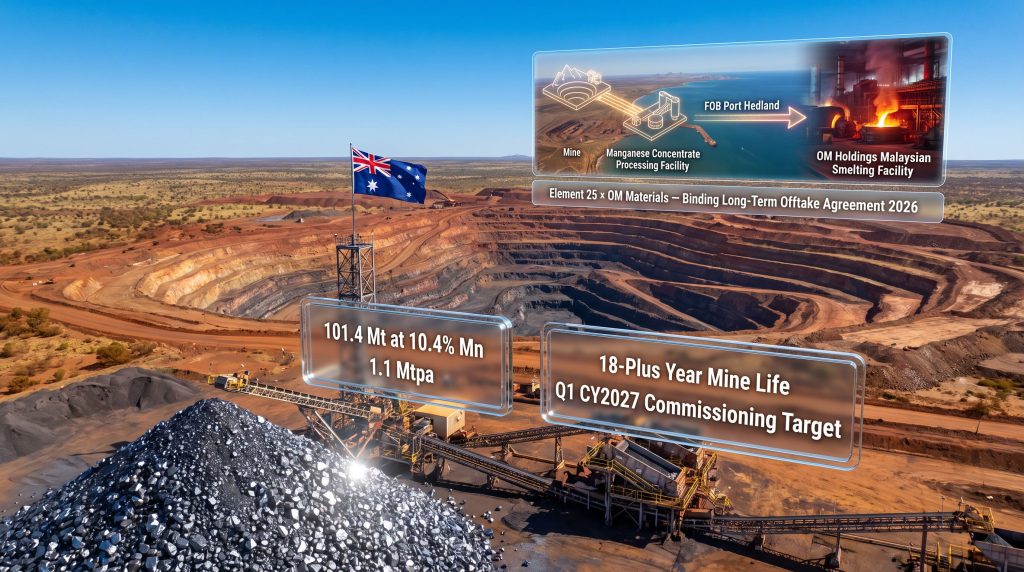
The Element 25 OM Holdings manganese offtake agreement covers all manganese concentrate produced at the expanded Butcherbird operations in Western Australia, capped at approximately 1.1 million tonnes per annum (Mtpa). The buyer is OM Materials (S) Pte Ltd, a wholly owned subsidiary of Singapore-listed and ASX-dual-listed OM Holdings (ASX: OMH).
What Binding Actually Means in Project Finance Terms
The distinction between binding and non-binding commercial arrangements carries significant weight in project finance due diligence. Memoranda of understanding and heads of agreement signal commercial intent but carry no legal obligation to perform. A fully binding offtake contract, by contrast, creates enforceable obligations on both parties and typically incorporates take-or-pay provisions that guarantee a minimum revenue floor regardless of whether the buyer ultimately takes physical delivery of the contracted volume.
Key Structural Point: Take-or-pay mechanics transform an offtake agreement from a commercial preference into a cashflow certainty instrument. Lenders model debt serviceability against contracted cashflows, not spot-market assumptions. A binding take-or-pay structure therefore directly reduces the risk premium embedded in project debt pricing.
Agreement Phase Structure and Commercial Terms
The commercial relationship between Element 25 and OM Holdings did not originate with this announcement. An initial offtake arrangement covering Stage 1 ore production was established in 2021, creating a five-year operational track record that serves as a risk-reduction signal for both project financiers and equity investors evaluating the expanded agreement.
| Agreement Phase | Year | Volume Scope | Term Structure | Pricing Mechanism |
|---|---|---|---|---|
| Stage 1 Offtake | 2021 | 100% of Stage 1 manganese ore | 5-year + 5-year extension option | Discount to Fastmarkets 44% Mn benchmark, FOB basis |
| BBX Concentrate Offtake | 2026 | All manganese concentrate, capped at ~1.1 Mtpa | 5-year + 5-year extension option | Benchmark-linked with revenue certainty provisions |
The pricing framework references the Fastmarkets 44% manganese benchmark, the standard industry reference price for seaborne manganese ore traded on a free-on-board (FOB) basis. FOB pricing means Element 25 bears responsibility for delivering product to the port of shipment (Port Hedland), after which cost and risk transfer to the buyer. This is the conventional pricing basis for Australian manganese ore exports and creates a transparent, auditable framework for pricing disputes and lender cashflow modelling.
The agreement also incorporates product-specification bands governing manganese grade and impurity tolerances, carve-outs for non-conforming material, and provisions that preserve Element 25's strategic flexibility to redirect concentrate toward downstream HPMSM processing as that capability matures. Developments in the manganese ore pricing index will, furthermore, play a key role in how benchmark-linked returns evolve over the agreement's term.
Butcherbird Expansion Project: Scale, Resource Quality, and Timeline
The Resource Base Underpinning the BBX Case
The Butcherbird manganese deposit in Western Australia's Pilbara region is among the larger undeveloped manganese resources in Australia by contained metal. The January 2025 updated feasibility study established an ore reserve of 101.4 million tonnes at 10.4% manganese, containing 10.54 million tonnes of manganese metal in situ. At the planned processing throughput of 1.1 Mtpa of concentrate, the feasibility study supports an 18-plus-year mine life, a duration long enough to underpin multi-decade supply chain relationships and justify the capital expenditure required for a greenfield processing facility.
What is less commonly understood about the Butcherbird deposit is its metallurgical character. The ore is a supergene-enriched manganese carbonate and oxide deposit, meaning the mineralisation occurs at relatively shallow depths with a relatively simple beneficiation pathway compared to harder, deeper, or more mineralogically complex manganese deposits found elsewhere globally. This geological attribute has direct cost implications: lower strip ratios, simpler processing circuits, and reduced energy intensity per tonne of concentrate produced compared with harder-rock competitors.
Contracting Stack: How BBX Has Been Systematically De-Risked
Project financiers evaluate risk across multiple dimensions simultaneously. The sequential execution of contracts at Butcherbird reflects a deliberate methodology designed to eliminate discrete risk categories one at a time. The Butcherbird expansion approval represents a foundational milestone in that de-risking process, building toward a bankability profile that satisfies formal lender due diligence requirements.
| Development Milestone | Status | Risk Category Addressed |
|---|---|---|
| Updated Feasibility Study | Completed January 2025 | Technical and economic parameters |
| Mining Services Agreement | Executed with ReGroup Australia | Operational continuity |
| Ore Haulage Agreement | Executed with ReGroup Australia | Logistics and transport certainty |
| Manganese Offtake Agreement | Executed with OM Materials 2026 | Revenue certainty |
| Remaining Contracts | Near finalisation | Final contracting layer |
| Mechanical Completion and Commissioning | Target Q1 CY2027 | Production commencement |
Each contract in this stack reduces a specific category of development risk. Mining services certainty addresses operational execution risk. Haulage certainty addresses logistics risk. The offtake agreement addresses revenue and market risk. Together they construct the layered risk-reduction profile that lenders require before committing project debt.
Why OM Holdings Is the Logically Coherent Partner for This Structure
Vertical Integration as Commercial Risk Management
OM Holdings operates established manganese alloy smelting facilities in Malaysia, making the company a downstream industrial consumer of manganese concentrate rather than a trading intermediary. This distinction matters enormously for supply chain stability. A smelter operator purchasing concentrate as production feedstock has a genuine operational need for volume continuity that a pure trader does not. This creates a structural alignment of incentives between seller and buyer that supports long-duration offtake structures.
When manganese concentrate is processed through smelting into ferromanganese or silicomanganese alloys, the value-add margin sits with the smelter. OM Holdings' willingness to commit to a long-term concentrate supply relationship reflects confidence in its own downstream processing economics and in Butcherbird's ability to deliver consistent grade and volume. From Element 25's perspective, an offtake counterparty with demonstrated smelting capacity represents a qualitatively stronger credit profile than a trading house, reducing the risk of default or volume reduction during periods of commodity price weakness.
The Commercial Track Record as a Financing Signal
The 2021 Stage 1 arrangement established five years of operational and commercial interaction between Element 25 and OM Holdings before the 2026 expanded agreement was executed. This is not a trivial detail. In long-duration offtake structures, counterparty familiarity reduces a category of risk that is difficult to quantify but real: operational compatibility risk.
Lenders and equity investors evaluating the 2026 agreement can point to an existing performance track record as evidence that both parties understand each other's operational requirements, communication protocols, and commercial expectations. However, it is also worth noting how this compares internationally; for instance, a strategic manganese deposit in Europe demonstrates how similarly structured supply agreements are being applied in diverse geographic contexts.
Revenue Architecture: Certainty, Market Exposure, and Strategic Flexibility
Balancing Lender Requirements Against Equity Upside
One of the most technically nuanced aspects of offtake agreement design in critical minerals projects is the tension between the preferences of debt providers and equity holders. Lenders prefer fixed or floor-price certainty because it supports predictable debt service modelling. Equity investors, by contrast, seek exposure to commodity price upside that a purely fixed-price agreement would eliminate.
The Butcherbird offtake agreement's benchmark-linked pricing structure is specifically designed to navigate this tension. By anchoring pricing to the Fastmarkets 44% Mn index rather than fixing an absolute price, the agreement delivers a degree of revenue predictability while preserving Element 25's ability to benefit from favourable market conditions. This is a structurally sophisticated outcome that reflects the increasing maturity of offtake agreement design in the Australian critical minerals sector.
The HPMSM Optionality Embedded in the Agreement
Perhaps the most strategically significant feature of the agreement's design is what it does not restrict. Element 25 has been explicit in its communications that advancing toward battery-grade HPMSM production remains a core strategic objective. The offtake agreement's carve-out provisions for downstream processing needs mean that the company retains the ability to redirect a portion of Butcherbird concentrate toward its own HPMSM refining pathway as that capability is developed, without triggering a breach of the concentrate offtake arrangement.
This embedded optionality is easy to overlook but commercially significant. It means the concentrate offtake functions as a revenue floor and financing enabler during the early operational years, while preserving the higher-margin HPMSM pathway as an incremental value-add opportunity that can be activated without renegotiating the primary commercial structure.
The next major ASX story will hit our subscribers first
The Australian Manganese Landscape and Competitive Context
Australia's position as a significant manganese producer is anchored by operations in the Northern Territory and the Pilbara, with the Groote Eylandt Mining Company (GEMCO) operation historically representing the largest single source of Australian manganese exports. The Butcherbird project occupies a different geological and commercial niche: a large-tonnage, lower-grade, open-cut operation targeting concentrate production rather than direct-shipping ore, with a stated downstream ambition into battery materials.
The broader ASX-listed manganese development cohort is active. Black Canyon (ASX: BCA) is progressing its Wandanya project and recently reported high-grade manganese and iron results, while other developers are advancing through feasibility and contracting stages. The Element 25 OM Holdings manganese offtake agreement sets a visible commercial precedent for how long-term offtake can be structured in this sector, particularly the five-year-plus-extension architecture and the benchmark-linked pricing framework referenced against Fastmarkets indices.
Sector Observation: The competitive significance of securing a credible, downstream-integrated offtake partner should not be underestimated in a market where multiple Australian manganese projects are competing for the same finite pool of project finance capital. A binding agreement with an established counterparty is a differentiating asset in that competition.
Frequently Asked Questions
What is the Element 25 OM Holdings manganese offtake agreement?
It is a binding long-term sales contract between Element 25's Butcherbird subsidiary and OM Materials (S) Pte Ltd, a wholly owned subsidiary of OM Holdings, covering all manganese concentrate produced at the expanded Butcherbird operations in the Pilbara region of Western Australia, with production capped at approximately 1.1 Mtpa.
How long does the agreement run?
The initial term is five years, with a five-year extension option available subject to agreed performance conditions being satisfied.
What ore reserve underpins the Butcherbird Expansion Project?
The January 2025 updated feasibility study established an ore reserve of 101.4 Mt at 10.4% manganese, containing 10.54 Mt of contained manganese metal, supporting an 18-plus-year mine life at 1.1 Mtpa of concentrate production.
Why is the Fastmarkets 44% Mn benchmark significant?
It is the standard seaborne reference price for manganese ore at a 44% manganese grade specification, widely used across the industry as the pricing anchor for FOB-basis commercial arrangements. Benchmark-linked pricing provides a transparent, independently verifiable reference point for both parties and for project finance lenders modelling revenue scenarios.
When is Butcherbird expected to reach production?
Element 25 is currently targeting mechanical completion and commissioning in Q1 CY2027, subject to finalisation of remaining project contracts and the completion of project financing arrangements.
How does this agreement support Element 25's HPMSM strategy?
By securing revenue certainty through concentrate sales, the agreement establishes a commercial and financial foundation that enables Element 25 to simultaneously advance its downstream HPMSM processing ambitions without being entirely dependent on battery-grade product sales for early-stage revenue generation.
Key Takeaways for Investors and Industry Observers
The Element 25 OM Holdings manganese offtake agreement is best understood not as a standalone commercial event but as the keystone piece in a multi-contract de-risking framework designed to unlock project financing for the Butcherbird expansion.
Several dimensions of this deal deserve particular attention:
- Offtake agreements have evolved into primary project development instruments in critical minerals finance, not secondary commercial accessories executed after financing is secured.
- The five-year-plus-extension structure reflects a deliberate calibration between the security duration lenders require and the flexibility both commercial parties need in a commodity market subject to price cycles.
- OM Holdings' downstream smelting integration makes this a vertically coherent supply chain arrangement, creating structural alignment of incentives that supports long-term agreement durability.
- The sequential contracting approach covering mining services, haulage, and offtake demonstrates a methodical risk reduction framework that sophisticated project financiers recognise and reward.
- The HPMSM optionality preserved within the agreement structure signals that Element 25 views the concentrate offtake as a platform for value chain participation, not a ceiling on its commercial ambitions.
- Geological attributes of the Butcherbird deposit, particularly its shallow supergene-enriched mineralisation and straightforward beneficiation characteristics, support the cost structure assumptions that make the commercial terms in this agreement viable across a range of manganese price scenarios.
This article is for informational purposes only and does not constitute financial or investment advice. Readers should conduct their own independent research and consult a licensed financial adviser before making any investment decisions. Forward-looking statements, timelines, and projections referenced in this article are subject to material risks and uncertainties that could cause actual outcomes to differ materially from those anticipated.
Want to Track the Next Major ASX Mineral Discovery Before the Market Moves?
Discovery Alert's proprietary Discovery IQ model scans ASX announcements in real time, instantly identifying high-potential mineral discoveries across more than 30 commodities — from manganese to battery materials — and delivering actionable insights directly to subscribers. Explore historic discoveries and their extraordinary returns to understand the opportunity, then begin your 14-day free trial at Discovery Alert to position yourself ahead of the broader market.