
August 4, 2026
The Quiet Capital Freeze That Made 2026's Mining Rebound Inevitable
When capital withdraws from a resource-rich jurisdiction at speed, it rarely disappears permanently. It accumulates at the edges, waiting for the friction to ease. That is precisely what happened in Mexico's mining sector between 2022 and 2024, and understanding that compression is essential to interpreting what the Mexico mining investment rebound actually means for operators, allocators, and the broader critical minerals supply chain.
Mexico's position in global commodity markets is not marginal. It is the world's largest primary silver producer, a significant supplier of copper, gold, and zinc, and sits geographically adjacent to the largest manufacturing economy on earth. Those structural advantages do not evaporate during a regulatory downturn. They accumulate pressure until conditions shift, and when they do, the rebound tends to look more dramatic than the underlying improvement in fundamentals actually warrants.
When big ASX news breaks, our subscribers know first
Understanding the Scale of the 2024 Investment Collapse
To appreciate the significance of the 2026 Mexico mining investment rebound, the starting point matters enormously. Foreign direct investment in Mexican mining fell to approximately US$1.5 billion in 2024, representing a 56% year-on-year contraction. Within that aggregate figure, metallic mining FDI experienced an even steeper decline of roughly 83% over the same period. These are not incremental pullbacks. They represent a near-complete withdrawal of international capital from new development activity.
The primary cause was not commodity price weakness or geological disappointment. It was administrative paralysis. An estimated 175 to 176 mining projects entered a state of effective regulatory suspension, blocked at the environmental authorisation and water-use permit stages. New concession issuance also became significantly constrained, limiting the ability of explorers to generate fresh pipeline. The result was a sector that continued producing from legacy assets while its development pipeline quietly seized up.
The severity of the 2024 contraction is precisely what makes the 2026 rebound look statistically dramatic. A depressed base year amplifies percentage-growth figures, and investors should interpret recovery metrics within that context rather than treating them as evidence of a transformed operating environment.
How Do Mining Permitting Risks Shape Investment Confidence?
Understanding mining permitting risks is fundamental to interpreting why capital froze so completely in Mexico during this period. When regulatory friction reaches a threshold where permit resolution timelines become unpredictable, operators defer discretionary spending and international allocators redirect capital to lower-friction jurisdictions. This dynamic compounded Mexico's downturn well beyond what commodity price conditions alone would have caused.
Breaking Down the $6.4 Billion Investment Forecast for 2026
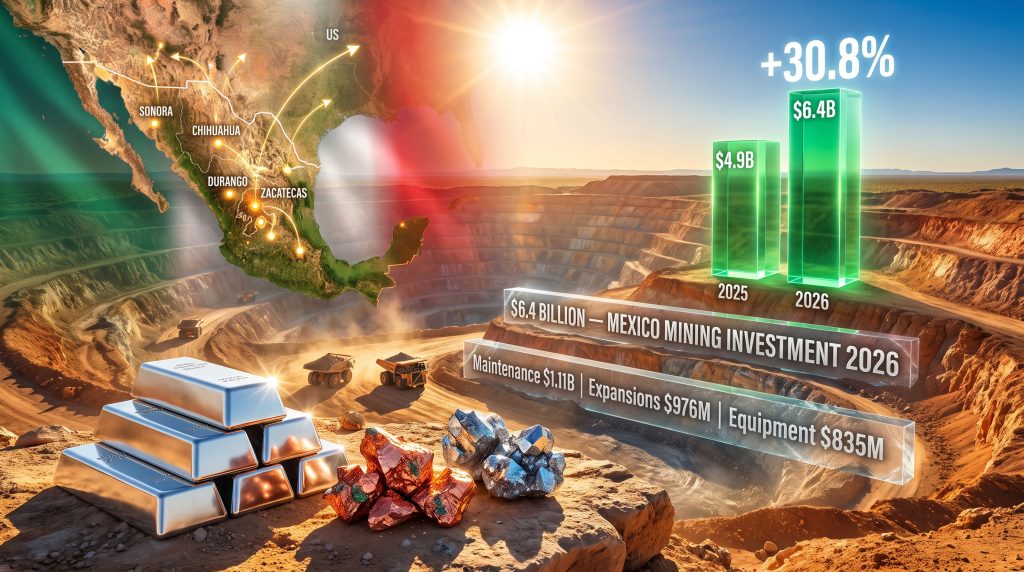
Industry body Camimex projects total mining sector investment in Mexico of $6.4 billion for 2026, representing a 30.8% increase from the $4.9 billion recorded in 2025. That 2025 figure itself fell short of an initial industry estimate of $5.31 billion, underscoring that recovery has proceeded unevenly rather than in a straight line.
It is worth noting a degree of methodological complexity in interpreting these figures. Separate analysis from Scotiabank placed 2025 aggregate mining investment at approximately $6.23 billion, which would represent the highest level in a decade. The divergence between the Camimex figure of $4.9 billion and the Scotiabank figure likely reflects differences in scope, with broader capital flow definitions potentially capturing financing and hedging activity that Camimex excludes from its operational investment count. Both figures should be treated as directional indicators rather than precise equivalents.
The composition of 2026 investment is at least as revealing as the headline number:
| Investment Category | Projected 2026 Spend |
|---|---|
| Maintenance and sustaining capital | $1.11 billion |
| Project expansions | $976 million |
| Equipment purchases | $835 million |
| Other (exploration, infrastructure, ancillary) | ~$3.48 billion (residual) |
Several things stand out from this breakdown. Maintenance capital leads all categories, which signals that operators are prioritising production continuity at existing assets before committing to greenfield development. The $835 million allocated to equipment purchases largely reflects deferred capital expenditure from 2024 finally being deployed, rather than new strategic investment. Furthermore, whilst project expansion spending at $976 million is meaningful, it represents selective advancement of already-permitted pipelines, not a broad renaissance of development activity.
The Permitting Resolution: What Actually Unlocked the Capital
The most operationally significant variable behind the 2026 rebound is not commodity prices or currency movement. It is the partial resolution of the permitting backlog that paralysed the sector through 2023 and 2024.
Of the approximately 176 projects that had been effectively frozen awaiting regulatory clearance, roughly 110 have now received approvals. Around 66 projects remain pending, meaning the unlocking process is real but incomplete. Industry analysis suggests the broader pipeline impact of permit resolutions could ultimately represent as much as US$11 billion in total investment capacity being freed from regulatory stasis, with sector-level investment potentially reaching US$7 billion once all remaining approvals are resolved.
This geography of permit resolution has not been uniform. Consequently, capital is clustering in states with faster administrative throughput, creating what might be described as a two-speed investment landscape within a single country:
- Zacatecas has benefited from its status as Mexico's historic silver heartland, with polymetallic expansion attracting renewed operator attention.
- Sonora is the copper-dominant corridor with direct proximity to US border infrastructure, making it a priority for operators aligned with energy transition supply chains.
- Chihuahua offers a diversified base metals and gold production base that has attracted both domestic and international capital.
- Durango is emerging as a beneficiary for mid-tier operators whose permit applications have cleared the backlog more recently.
An important nuance is that the permitting improvements largely apply to legacy applications that were already in the system, not to a liberalisation of new exploration rights. This distinction has significant implications for the medium-term pipeline.
The M&A Signal: Permitted Ground as a Scarce Asset
One of the less-discussed dynamics of Mexico's current mining cycle is what accelerating merger and acquisition activity actually reveals about structural conditions. On the surface, rising deal volumes can be read as a sign of investor confidence. However, the underlying mechanics tell a more nuanced story.
Deal activity is accelerating primarily because permitted ground is scarce, not because capital is abundant relative to opportunity. Buyers are acquiring assets with existing regulatory approvals because obtaining new permits from scratch remains a lengthy and uncertain process. This means M&A is partially substituting for organic greenfield growth, which is a constraint dressed up as activity. The broader trends in gold M&A activity across global mining markets reflect a similar pattern, where acquirers favour de-risked, permitted assets over exploration-stage opportunities.
When acquirers pay premiums specifically to avoid the permitting process rather than to access superior geology or resource size, it reveals that regulatory friction is being priced directly into deal structures. That premium represents a real cost to the sector's long-term capital efficiency.
For international operators such as Agnico Eagle, Alamos Gold, Torex Gold, and First Majestic Silver, this dynamic makes acquiring fully permitted, producing Mexican assets more attractive than pursuing greenfield exploration under the current concession environment.
The Operator Landscape: Who Is Driving Capital Deployment
The 2026 investment cycle is concentrated among a relatively small group of established operators, reflecting both the capital-intensity barrier to new entrants and the regulatory advantage held by companies with existing permitted assets.
| Company | Primary Commodity Focus | Role in 2026 Cycle |
|---|---|---|
| Grupo Mexico | Copper, silver, zinc | Largest domestic operator; anchor for maintenance and expansion capex |
| Industrias Peñoles | Silver, gold, zinc, lead | Active polymetallic development pipeline |
| Fresnillo | Silver, gold | World's largest primary silver producer; London-listed |
| Torex Gold | Gold | Advancing expansion projects in Guerrero state |
| First Majestic Silver | Silver, gold | Active acquirer under permitting constraint conditions |
| Agnico Eagle | Gold | Canadian major with growing Mexican asset base |
| Alamos Gold | Gold | Progressing development-stage projects |
The presence of multiple internationally listed operators is significant for capital flow dynamics. Companies like Fresnillo (London Stock Exchange), Agnico Eagle, and Alamos Gold bring foreign equity capital into Mexican mining that supplements domestic investment and provides an independent signal of international investor confidence in the jurisdiction.
The next major ASX story will hit our subscribers first
Production Recovery: Why the Output Data Lags the Investment Story
A common error in interpreting mining investment recoveries is conflating capital deployment with immediate production growth. The two are separated by the physical reality of mining development timelines. Underground mine construction, open-pit pre-stripping, processing facility upgrades, and equipment commissioning all introduce lag periods typically measured in 18 to 36 months between investment decision and meaningful production uplift.
Mexico's February 2026 production data from INEGI showed mining and metallurgical output rising approximately 5.5% month-on-month, which is encouraging but does not yet constitute a confirmed trend. Year-on-year output remains roughly flat, and 2025 mining production was forecast to contract before a modest recovery in 2026. The production recovery is structurally lagging the investment recovery by at least one to two years.
Commodity-specific production trajectories worth monitoring include:
- Silver: Mexico's dominant global position is expected to be maintained, with expansion activity at Fresnillo and Industrias Peñoles assets as the primary growth levers.
- Copper: Sonora-based operations represent the most significant volume growth opportunity, aligned with long-cycle electrification demand. The evolving copper market trends globally are adding further urgency to Mexican copper development pipelines.
- Gold: Mid-tier operators advancing permitted development projects in Guerrero and Sonora represent the most active near-term growth pipeline.
- Zinc: Polymetallic operations in Zacatecas and Chihuahua provide production diversification and exposure to battery storage demand.
The Structural Risk That Most Outlooks Underweight: Exploration Spending
The 2026 rebound narrative focuses heavily on maintenance, expansions, and equipment, but one category receives far less attention: exploration spending remains structurally weak. This is the least visible but potentially most consequential constraint on Mexico's post-2028 mining trajectory.
Exploration is the seed capital of future production. When new concession issuance is constrained and exploration budgets are compressed across multiple consecutive years, the geological pipeline that would sustain output growth in the late 2020s and early 2030s is simply not being adequately replenished. The broader exploration investment landscape in 2025 highlighted this same structural concern across multiple jurisdictions, with Mexico representing one of the more acute cases given the concession freeze.
The sector can sustain existing production through maintenance capex, but without a recovery in exploration activity, the compound growth story becomes harder to sustain beyond the current cycle. This creates an asymmetric risk profile: the near-term investment recovery is real and well-supported, but the medium-term production growth story is more fragile than headline investment figures suggest.
Upside Scenarios and Downside Risks
Conditions that could accelerate the recovery:
- Full resolution of the remaining 66 pending permit applications would unlock additional capital and potentially push total sector investment toward the US$7 billion threshold.
- Sustained strength in copper and silver prices improves project economics and incentivises discretionary expansion spending ahead of schedule.
- Nearshoring-driven industrial demand, as US manufacturers continue relocating supply chains closer to home, increases domestic Mexican consumption of base metals and strengthens the investment case for expansion.
- Any meaningful liberalisation of new concession issuance would address the exploration deficit and rebuild the medium-term project pipeline.
Conditions that could derail or slow the recovery:
- Renewed permitting delays or policy reversals affecting the 66 projects still awaiting approval would re-stall capital deployment.
- Commodity price weakness, particularly in silver or copper, would compress project margins and defer discretionary spending.
- Water-use regulatory tightening in arid mining states, particularly Sonora and Chihuahua, poses genuine operational risk for high-volume processing operations.
- Security and infrastructure challenges in certain producing states continue to embed risk premiums into international operator cost structures.
Frequently Asked Questions: Mexico Mining Investment 2026
What is the total mining investment forecast for Mexico in 2026?
Camimex projects total mining sector investment of $6.4 billion, representing a 30.8% increase from the $4.9 billion recorded in 2025. For additional context on the regulatory environment shaping these projections, the US Trade and Commercial Guide on Mexican mining provides useful background on the jurisdiction's investment framework.
Why did Mexico's mining investment collapse so severely before the rebound?
A combination of permitting paralysis, constrained new concession issuance, and regulatory uncertainty caused foreign direct investment in Mexican mining to fall 56% in 2024, with metallic mining FDI declining approximately 83%.
Which Mexican states are attracting the most mining investment in 2026?
Zacatecas, Sonora, Chihuahua, and Durango are the primary beneficiaries of reactivated capital flows as permitting backlogs clear at different rates across jurisdictions.
Is production recovering alongside investment?
Not yet at the same pace. Output rose 5.5% month-on-month in February 2026 but remains roughly flat year-on-year, reflecting the typical 18 to 36 month lag between capital deployment and measurable production growth.
Why is M&A activity rising in Mexico's mining sector?
Deal activity is accelerating primarily because permitted ground is scarce. Acquirers are paying premiums for assets with existing regulatory approvals rather than pursuing new greenfield permits, which reflects regulatory friction being embedded in deal valuations.
How much investment could be unlocked if all pending permits are approved?
Industry analysis suggests the sector could reach approximately US$7 billion in annual investment once remaining approvals are resolved, with the total unlocked pipeline potentially reaching US$11 billion in aggregate. Reporting from Finimize on Mexico's mining rebound provides further context on the timeline expectations associated with this scenario.
A Cautiously Constructive Assessment
The Mexico mining investment rebound is real, but its character matters as much as its scale. Capital is returning to maintenance, sustaining production, and selectively advancing already-permitted projects, not flowing into broad-based greenfield development. The permitting improvement is the single most important structural variable, and the trajectory of the remaining 66 pending approvals will largely determine whether 2026 represents a genuine inflection point or a well-funded pause.
For capital allocators considering Mexican mining exposure, the distinction between operators with fully permitted, cash-generating assets and those dependent on new concession approvals is not a minor nuance. It is the central variable in position sizing. Mexico's strategic commodity position as the world's largest silver producer and a major copper and gold supplier ensures continued international investor attention. Whether that attention translates into durable long-cycle growth depends on whether regulatory conditions allow the exploration pipeline to recover before the current wave of maintenance and expansion capital runs its course.
Disclaimer: This article is for informational purposes only and does not constitute financial or investment advice. Forecasts, projections, and investment figures referenced herein reflect industry estimates and third-party analysis and are subject to material uncertainty. Readers should conduct independent due diligence before making any investment decisions.
Want To Identify The Next Major Mineral Discovery Before The Broader Market Does?
Discovery Alert's proprietary Discovery IQ model delivers real-time alerts on significant ASX mineral discoveries, transforming complex mineral data into clear, actionable insights for both short-term traders and long-term investors. Explore how historic discoveries have generated substantial returns on Discovery Alert's discoveries page, then begin your 14-day free trial to secure your market-leading advantage.