August 4, 2026
The Hidden Infrastructure Gap Reshaping Private Capital in America
The global energy transition has quietly created one of the most consequential investment themes of this decade: a structural mismatch between what modern economies need from the ground and what domestic supply chains can actually deliver. Copper wires every solar panel, wind turbine, and electric vehicle motor. Lithium sits at the heart of every battery cell powering the shift away from fossil fuels. Yet for all the policy ambition surrounding clean energy in the United States, the mineral foundation underneath it remains dangerously thin.
Furthermore, critical minerals and energy security have become intertwined with broader geopolitical considerations, amplifying the urgency for domestic production capacity. This is the context in which Mariana Minerals raises $310m to expand US critical minerals projects takes on significance well beyond a standard venture capital announcement. The round reflects something more structural: sophisticated capital, spanning industrial giants, sovereign-adjacent institutions, and deep technology investors, converging around a generational commercial opportunity.
When big ASX news breaks, our subscribers know first
What the Investor Syndicate Actually Reveals
A Capital Stack Built Across Multiple Investment Theses
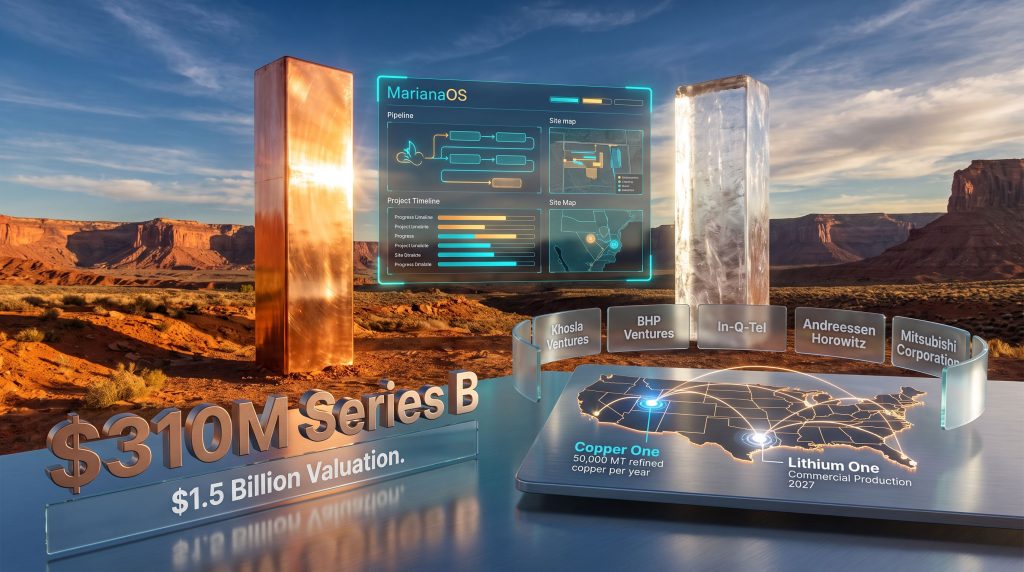
Understanding who participated in Mariana Minerals' $310 million Series B tells a more nuanced story than the headline figure alone. The round was led by Khosla Ventures, with continued participation from Andreessen Horowitz and Breakthrough Energy Ventures. What makes the syndicate structurally interesting, however, is the composition of new entrants.
| Investor Category | Key Participants |
|---|---|
| Lead Investor | Khosla Ventures |
| Continuing Investors | Andreessen Horowitz, Breakthrough Energy Ventures |
| Strategic Industrial | BHP Ventures, Mitsubishi Corporation |
| Sovereign-Adjacent | In-Q-Tel (IQT) |
| Financial Investors | Greenoaks, Halo Fund, Pax Ventures, StepStone Group, Washington Harbour Partners, Greycroft, General Innovation Capital Partners, Earthshot Ventures |
The participation of BHP Ventures, the strategic investment arm of one of the world's largest diversified mining companies, signals that established industry incumbents view Mariana's integrated development model as genuinely credible rather than merely aspirational. For a mining major to back a venture-stage competitor or adjacent developer, the operational thesis must be compelling enough to justify potential future competition with its own assets.
Mitsubishi Corporation's involvement introduces a different dimension. As a Japanese industrial conglomerate with deep exposure to copper supply chains and battery raw materials, Mitsubishi's participation suggests the round carries an implicit offtake and supply chain logic that may crystallise into formal commercial agreements as projects advance toward production.
Perhaps the most analytically revealing participant is In-Q-Tel (IQT), the US government-linked technology investment organisation that funds companies whose work is considered strategically relevant to national security. IQT's involvement does not represent direct government funding of Mariana's projects, but it does underscore that domestic critical minerals availability is being evaluated through a national security lens. In addition, US critical minerals policy has increasingly prioritised domestic supply chain resilience, reinforcing the strategic rationale behind IQT's participation.
The breadth of this investor syndicate, spanning software-oriented venture capital, energy transition funds, industrial supply chain strategics, and sovereign-adjacent capital, suggests that Mariana's investment thesis is simultaneously compelling across four distinct asset allocation frameworks. That kind of cross-sectoral conviction is rare in private markets.
Valuation Context and Capital Milestones
The Series B brings Mariana Minerals' total capital raised to approximately $400 million across parent and project-level financing. The company carries a post-money valuation of approximately $1.5 billion, placing it firmly in unicorn territory and among the most highly valued private critical minerals developers globally.
For context, reaching a $1.5 billion private valuation in the mining and resources sector — which has historically struggled to attract venture-style capital due to long development timelines and capital intensity — represents a meaningful shift in how technology-integrated resource developers are being priced by sophisticated investors.
MarianaOS: The Technology Layer That Changes the Valuation Math
Why Software Integration Matters in Mining Development
Conventional mining development companies are valued primarily on their resource base, the estimated tonnage and grade of minerals in the ground, and their proximity to permitting and production milestones. Mariana Minerals operates from a fundamentally different starting assumption: that operational technology infrastructure can compress development timelines, reduce cost overruns, and enable replicable scaling across a multi-project portfolio.
MarianaOS, the company's proprietary operating platform, is positioned as the mechanism through which this scaling logic is executed. The platform is designed to standardise project development processes across different mineral types, geographies, and asset configurations, functioning somewhat analogously to how enterprise software platforms standardise operational workflows across business units in technology companies. According to Techmeme's coverage, Mariana builds and operates mines using MarianaOS software, a detail that underscores the platform's central role in the company's commercial model.
This software-hardware integration model has several important implications for investors:
- It shifts part of the valuation framework from resource-based metrics toward technology-based multiples, which tend to be higher
- It creates a potential competitive moat that cannot be easily replicated by simply acquiring mineral assets
- It provides a credible mechanism for executing a ten-project ambition within a decade, since a purely operational approach to that scale would face exponential management complexity
- It attracted venture capital firms with deep software expertise, suggesting the platform has been evaluated as genuinely differentiated technology rather than marketing positioning
The critical unanswered question is whether MarianaOS delivers measurable efficiency gains across diverse project configurations. Its performance at Copper One, a brownfield restart in a known geological setting, may not fully predict its effectiveness at more complex or geologically varied sites. This remains the central execution risk underlying Mariana's portfolio ambition.
The Two Flagship Projects: Technical and Commercial Analysis
Copper One: Brownfield Restart Strategy in Southeastern Utah
Copper One represents Mariana's acquisition-and-restart model applied to an idled copper mine in southeastern Utah, acquired in 2025 and restarted in 2026. The brownfield strategy is analytically important: rather than bearing the full geological and permitting risk of greenfield exploration, Mariana targets assets with established infrastructure, known mineralisation, and existing site characterisation data.
The publicly stated production target of 50,000 metric tons of refined copper per year at Copper One is a significant figure when measured against the scale of US domestic copper consumption. The US consumes approximately 1.7 to 1.8 million metric tons of copper annually, with a substantial portion sourced through imports and foreign-processed concentrates. A single project at 50,000 metric tons per year would represent roughly 3% of total US annual copper consumption, a material contribution from one domestic asset.
Copper's role in the energy transition cannot be overstated. Consequently, the copper supply crunch is intensifying pressure on developers to bring domestic production online at scale. A single onshore wind turbine requires approximately 3 to 4 metric tons of copper. Utility-scale solar installations use roughly 4 to 5 metric tons per megawatt of installed capacity. Electric vehicles contain approximately three to four times more copper than internal combustion engine vehicles.
Lithium One: Produced-Water Extraction and What It Means for Supply Chain Diversification
Lithium One in East Texas is built around a less widely understood extraction approach: produced-water lithium recovery. In oil and gas production, large volumes of saline water are brought to the surface as a byproduct of hydrocarbon extraction. This water, historically a disposal challenge for operators, contains dissolved lithium in concentrations that vary significantly by basin and formation.
The produced-water lithium extraction model shares conceptual principles with direct lithium extraction technologies, which are also transforming how lithium is recovered from unconventional sources. The model carries several distinctive characteristics compared to conventional lithium sourcing:
- Lower surface disturbance footprint compared to hard-rock spodumene mining, which requires open-cut excavation and physical processing of ore
- No evaporation pond requirements unlike traditional brine operations in South America, which occupy large surface areas and consume significant water resources in arid environments
- Co-location with existing oil and gas infrastructure, reducing capital requirements for water handling and site access
- A potentially vast feedstock base in East Texas, where produced-water volumes from active and legacy hydrocarbon operations are substantial
Commercial production at Lithium One is targeted for 2027. The timeline is ambitious given that produced-water lithium extraction at commercial scale remains a relatively early-stage technology globally, with few operating precedents at significant production volumes. This introduces genuine technical risk alongside the commercial opportunity.
Produced-water lithium extraction represents one of the more speculative but potentially transformative approaches in the domestic lithium supply chain. If the extraction economics prove viable at scale, East Texas could become a meaningful lithium production hub without the land use and environmental footprint associated with conventional lithium mining.
Portfolio Ambition: Ten Projects in Ten Years
Scenario Analysis for Scale Execution
Mariana's stated ambition to develop ten commercial-scale projects over the next decade is the kind of target that needs to be stress-tested rather than taken at face value. The capital requirements alone are substantial.
| Scenario | Core Assumptions | Projected Outcome |
|---|---|---|
| Base Case | MarianaOS delivers moderate efficiency gains; permitting timelines remain challenging | 6 to 7 projects operational within 10 years |
| Optimistic Case | Platform scales effectively across diverse project types; regulatory environment improves | 9 to 10 projects on schedule |
| Conservative Case | Permitting delays persist; one or more projects face technical or geological challenges | 4 to 5 projects operational within 10 years |
If the first two projects required approximately $400 million in combined capital to reach their current development stage, a ten-project portfolio could plausibly require cumulative capital deployment exceeding $2 billion over the decade. Each subsequent project round will likely require a combination of additional equity raises, project-level debt financing, and potentially structured offtake agreements with strategic partners.
Beyond capital, execution constraints in US mining project development include:
- Permitting timelines: US federal and state permitting processes for new mining operations remain among the most time-consuming in the developed world, with some projects waiting years between application and approval
- Workforce availability: Skilled mining, metallurgical, and engineering talent remains in short supply across the US, particularly for operators building greenfield or early-restart assets
- Grid connectivity: Energy-intensive processing facilities require reliable grid access, and interconnection queues in parts of the western US are significant
- Equipment supply chains: Global demand for mining equipment, particularly specialised processing and extraction hardware, has extended lead times across the sector
The Structural Demand Case for US Domestic Critical Minerals
Electric Vehicles, Grid Infrastructure, and Defence Applications
The critical minerals demand underpinning private capital flows into US critical minerals production is not speculative. It is embedded in measurable trends across three intersecting sectors:
Electric vehicles: US EV sales have been growing consistently, and the vehicle fleet transition creates compounding demand for both lithium and copper that builds over multiple decades rather than peaking at a single inflection point. Battery chemistries continue to evolve, but lithium remains central to the dominant cathode and electrolyte formulations currently in commercial deployment.
Renewable energy and grid modernisation: Utility-scale solar and wind deployment is copper-intensive at every stage, from generation assets through to transmission and distribution upgrades. The US grid modernisation agenda, driven by ageing infrastructure and the integration of distributed energy resources, represents a sustained, multi-decade demand driver for domestic copper production.
Defence and advanced technology: Copper and lithium are embedded in advanced weapons systems, communications infrastructure, and emerging technologies including directed energy applications. The national security dimension of domestic critical minerals availability explains why investment organisations with government adjacency have become active participants in this sector. Furthermore, the World Bank has highlighted the critical importance of mineral supply security in supporting the global energy transition, lending additional institutional weight to the investment thesis.
Competitive Positioning in the US Private Critical Minerals Landscape
Mariana Minerals occupies a structurally distinctive position within the growing cohort of US-focused critical minerals developers. Unlike pure-play mining companies that compete primarily on resource quality and cost of production, Mariana's technology-integrated model creates a different competitive surface. Its valuation of $1.5 billion places it among the most highly valued private critical minerals companies globally, reflecting the technology premium embedded in the MarianaOS platform alongside underlying mineral asset value.
The next major ASX story will hit our subscribers first
Key Milestones and Investor Considerations
For those tracking the US critical minerals investment landscape, the following near-term and longer-term indicators will be most informative in assessing whether Mariana Minerals raises $310m to expand US critical minerals projects translates into operational reality:
Near-term milestones to watch:
- Progress toward Lithium One commercial production by the 2027 target
- Copper One's ramp toward its 50,000 metric ton annual production objective
- Announcement of additional portfolio projects beyond the two flagship assets
- Future financing structures, likely including project-level debt, as capital requirements scale with portfolio expansion
Longer-term structural questions:
- Whether MarianaOS delivers demonstrable, replicable efficiency advantages across diverse project types and geographies
- The degree to which strategic investors, particularly BHP Ventures and Mitsubishi Corporation, deepen their commercial relationships through offtake agreements or further capital participation
- How the company navigates US permitting timelines, which remain a systemic constraint for all domestic mining developers regardless of capital availability
- Whether the $1.5 billion valuation is sustained and expanded as projects transition from development into active production
This article is for informational purposes only and does not constitute financial advice. All forward-looking statements, production targets, and valuation figures referenced herein involve inherent uncertainty. Readers should conduct their own independent research before making investment decisions. Past capital raises and stated project targets are not guarantees of future outcomes.
For ongoing coverage of US and global critical minerals developments, Mining Weekly provides regular reporting on the sector at miningweekly.com.
Want to Spot the Next Major Critical Minerals Discovery Before the Broader Market Does?
Discovery Alert's proprietary Discovery IQ model delivers real-time alerts on significant ASX mineral discoveries across copper, lithium, and more than 30 other commodities, instantly translating complex geological data into actionable investment insights — explore historic discoveries that have generated substantial returns or start your 14-day free trial today to position yourself ahead of the market.