August 4, 2026
When Governments Turn on the Industries They Depend On
There is a recurring tension in modern energy politics that surfaces every time crude oil price trends spike: the governments most committed to domestic fossil fuel production are often the same ones most vulnerable to public anger when fuel costs rise. This contradiction does not resolve neatly along party lines. It is a structural feature of democratic energy policy, and it has resurfaced with striking clarity in the United States during the summer of 2026.
Understanding what is actually happening when Trump says Exxon and Chevron made too much money requires more than a reading of the headlines. It demands an examination of how oil markets generate profits during supply disruptions, what legal tools actually exist to challenge those profits, and what the long-term consequences of political pressure on capital-intensive industries tend to look like.
When big ASX news breaks, our subscribers know first
Why Supply Shocks Create Compounding Profit Effects for Integrated Oil Majors
The Upstream and Downstream Amplification Mechanism
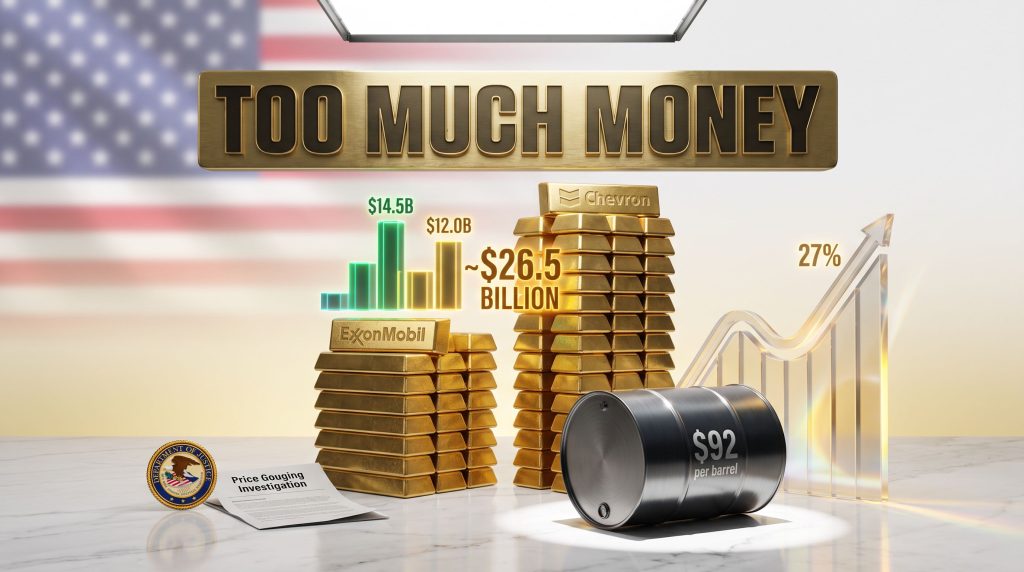
When a geopolitical conflict disrupts supply from a major oil-producing region, the immediate effect is a repricing of crude across global benchmarks. That repricing is rarely subtle. U.S. crude oil averaged approximately $92 per barrel between April and June 2026, representing a 27% increase over Q1 2026 levels, driven by supply uncertainty linked to the Iran conflict.
For a vertically integrated oil major, this kind of price environment does not create a single profit opportunity. It creates two simultaneous ones:
- Upstream gains: Higher crude prices directly increase the revenue generated from every barrel extracted, widening the margin between production cost and sale price across existing wells and fields.
- Downstream margin expansion: Refining spreads — the difference between the cost of crude feedstock and the value of refined products like gasoline and diesel — tend to widen during rapid crude price increases because retail fuel prices lag the adjustment. This asymmetry benefits refiners substantially.
This dual amplification is why the profit figures reported by ExxonMobil and Chevron in Q2 2026 were so large. The earnings surge was not the product of a single tailwind. It was the compounding of two simultaneous structural advantages that integrated majors uniquely capture during supply shock environments. Furthermore, the broader context of oil markets and trade war dynamics added further upward pressure on benchmark pricing throughout the period.
The "Rockets and Feathers" Asymmetry
A phenomenon well-documented in academic energy economics, known as the rockets and feathers effect, describes the tendency for retail gasoline prices to rise quickly when crude prices increase, but to fall slowly when crude prices retreat. This pricing asymmetry is not necessarily evidence of deliberate price manipulation. It reflects a combination of inventory management practices, supply chain dynamics, and the way retail pricing decisions are made across thousands of independent fuel stations.
However, the practical consequence for consumers is real: during periods of crude price elevation, the gap between what integrated oil companies earn and what ordinary drivers pay at the pump tends to widen in ways that feel disconnected from market fairness, even when they are technically consistent with legal market behaviour.
Q2 2026 Earnings: What the Numbers Actually Show
A Comparative Breakdown of the Windfall Results
The Q2 2026 earnings reports released simultaneously on the same Friday created an immediate political flashpoint. The scale of the numbers made that outcome almost inevitable. According to reporting by the Financial Times, the combined results drew immediate scrutiny from Washington.
| Company | Q2 2026 Profit | Q2 2025 Profit | Year-Over-Year Change |
|---|---|---|---|
| ExxonMobil | ~$14.5 billion | ~$7.1 billion | +104% |
| Chevron | ~$12.0 billion | ~$2.5 billion | +380% |
| Combined Total | ~$26.5 billion | ~$9.6 billion | +176% |
Chevron's near 400% year-over-year profit increase is partly a function of its lower comparative base in Q2 2025, which amplifies the percentage gain significantly. ExxonMobil's result, while a more modest percentage increase, represents a larger absolute figure given the company's greater scale and upstream production exposure to elevated crude pricing.
The combined single-quarter profit of approximately $26.5 billion across just two companies represents one of the most concentrated earnings outcomes in recent U.S. energy sector history, occurring within a twelve-week window shaped almost entirely by a single geopolitical variable.
The timing of the dual announcement on a single Friday, combined with the magnitude of the figures, created exactly the kind of concentrated political moment that invites executive-branch response.
Trump's Public Criticism: What Was Said and Why It Matters
The Substance of the Presidential Statement
Speaking to reporters at the White House on August 3, 2026, President Trump directly named both ExxonMobil and Chevron, stating that the companies had profited excessively from higher crude prices caused by a supply shortage tied to the Iran conflict. He expressed personal disapproval and called on both companies to pass savings back to consumers through lower retail fuel prices.
This was not an ambiguous or peripheral comment. It was a targeted, on-record statement naming specific corporations and demanding a behavioural change in their pricing decisions.
Why This Is Politically Unusual for a Republican Administration
The statement is significant for reasons that extend beyond its immediate content. Republican administrations have historically maintained close alignment with the domestic fossil fuel industry, championing deregulation, expanded drilling access, and minimal government intervention in energy market pricing. Public criticism of oil company profitability has traditionally been a tool of Democratic administrations and progressive advocacy groups.
The fact that Trump says Exxon and Chevron made too much money from elevated oil prices during the Iran conflict represents a meaningful departure from that historical alignment. It signals that energy price populism — the political instinct to assign blame for consumer fuel costs to corporate actors rather than market forces or government policy — is now a bipartisan rhetorical strategy. Consequently, Trump administration policy shifts of this nature carry significant implications beyond the energy sector alone.
The Mechanics of Blame Shifting in Energy Politics
Consumer gasoline prices are one of the most psychologically immediate economic indicators in American political life. They are visible, repeated, and personally felt. When prices rise sharply, political pressure follows predictably.
By directing criticism at named corporations, an administration achieves several simultaneous political objectives:
- It distances the government from responsibility for market conditions it cannot directly control.
- It provides a visible, identifiable target for consumer frustration.
- It creates the appearance of action without requiring legislative consensus or regulatory commitment.
- It signals responsiveness to voter concerns without binding the administration to specific policy outcomes.
None of this requires a cynical interpretation. Consumer fuel prices genuinely affect household budgets, and the scale of the Q2 2026 profit figures created a legitimate distributional question about who captures the upside of geopolitical disruption and who absorbs the cost.
The Legal Reality: What Enforcement Tools Actually Exist
Federal Price Gouging Law Is Fragmented
Reports indicate the Trump administration directed the Department of Justice to investigate potential gasoline price gouging by ExxonMobil and Chevron. The political signal sent by that directive is clear. The legal pathway, however, is considerably more complex.
The United States does not have a single comprehensive federal statute governing oil and gas pricing during peacetime conditions. The Federal Trade Commission holds investigative authority over anti-competitive behaviour, but demonstrating coordinated price manipulation in commodity markets — where prices are set through global benchmarking mechanisms rather than individual corporate decisions — is legally demanding. In addition, understanding how tariffs work in relation to energy sector costs adds another layer of complexity to the regulatory picture.
How the U.S. Approach Compares Internationally
Other jurisdictions have taken more structural approaches to oil windfall profits, with varying degrees of success:
| Jurisdiction | Policy Response | Outcome |
|---|---|---|
| United Kingdom | Energy Profits Levy (windfall tax) | Generated significant revenue; ongoing investment impact debate |
| European Union | Temporary solidarity contribution on fossil fuel profits | Inconsistent enforcement across member states |
| United States (1980) | Windfall Profits Tax Act under Carter administration | Generated less revenue than projected; repealed in 1988 |
| United States (2026) | DOJ price gouging investigation announced | Outcome pending at time of publication |
The U.S. historical precedent from 1980 is instructive. The Carter-era Windfall Profits Tax was enacted in response to the post-oil shock earnings surge of domestic producers. It generated substantially less revenue than initial projections suggested and was ultimately repealed eight years later, partly due to arguments that it suppressed domestic production incentives.
Disclaimer: The DOJ investigation referenced above was announced but had not produced confirmed enforcement findings or outcomes at the time this article was published. Readers should treat references to its potential regulatory impact as forward-looking and subject to change.
The Economic Tension at the Heart of the Debate
Why the Industry's Structural Defence Has Merit
Integrated oil majors operate on capital cycles measured in decades, not quarters. The investments required to develop new production capacity, build refining infrastructure, and maintain existing field output run into the hundreds of billions of dollars across the industry collectively. Those investment decisions are made during periods of lower prices, with the expectation that elevated price environments will eventually provide the returns necessary to justify the capital commitment.
Suppressing profits during high-price periods through political pressure or punitive taxation does not simply reduce earnings in the short term. It alters the investment calculus for future production capacity. If the market signal that high prices send to producers — specifically, produce more — is disrupted by policy intervention, the long-term supply response may be weaker than it would otherwise be.
Why the Consumer Advocacy Argument Also Has Merit
The counterargument is distributional rather than purely structural. A combined quarterly profit of approximately $26.5 billion concentrated in two companies during a period when many households were experiencing genuine fuel cost pressure represents a transfer of wealth from consumers to shareholders that is difficult to defend on equity grounds, even if it is technically consistent with how commodity markets function.
The rockets and feathers dynamic compounds this concern. If prices rise faster than they fall, and if refining margins widen during the adjustment period, then the market structure itself creates a systematic advantage for integrated producers at the expense of end consumers, as detailed by OilPrice.com, without any explicit coordination or misconduct being necessary.
The next major ASX story will hit our subscribers first
What This Means for Energy Investors and Long-Term Capital Allocation
The Regulatory Risk Premium Is Now Real
When a sitting president publicly names specific corporations and calls on them to change their pricing behaviour, that act carries weight in equity markets regardless of whether it produces binding legal outcomes. It introduces a regulatory risk premium into valuations for energy sector equities. Investors must now price in the possibility that profitable quarters could trigger executive-branch pressure, DOJ investigations, or future legislative proposals around windfall profit taxation.
This uncertainty has a direct effect on capital expenditure planning. Energy sector investment decisions made in 2026 will shape U.S. production capacity through the end of the decade. Furthermore, tariff-driven market volatility has already introduced additional unpredictability into the broader investment environment. If senior leadership at integrated oil majors faces unpredictable political blowback during high-profit periods, the incentive to commit capital aggressively to new domestic production becomes correspondingly weaker.
The Contradiction Within the Administration's Own Energy Strategy
The Trump administration has simultaneously pursued an energy dominance framework emphasising expanded domestic oil and gas production while publicly criticising the profitability that makes that production attractive to private capital. These two positions exist in structural tension.
Maximising domestic production requires maximising the financial incentives that draw private capital into exploration, drilling, and refining capacity. Publicly attacking the profits that represent the realised version of those incentives sends a contradictory signal to the market. Energy analysts and investors will be watching carefully to see whether the DOJ investigation produces substantive findings or functions primarily as a political pressure mechanism that dissipates once the immediate consumer sentiment cycle has passed. Ultimately, the assertion that Trump says Exxon and Chevron made too much money may prove less significant for its legal consequences than for what it reveals about the shifting politics of energy in America.
This article reflects publicly available information as of early August 2026. Financial figures are drawn from reported earnings data. Forward-looking references to regulatory outcomes, policy developments, and market impacts are speculative and should not be interpreted as investment advice.
Want to Stay Ahead of Major Resource Discoveries Before the Market Moves?
While geopolitical supply shocks reshape energy profits overnight, the next transformative mineral discovery on the ASX could deliver equally dramatic returns — Discovery Alert's proprietary Discovery IQ model scans daily ASX announcements in real time, instantly converting complex geological data across 30-plus commodities into clear, actionable insights for investors at every level. Explore historic examples of exceptional discovery returns and begin your 14-day free trial today to position yourself ahead of the broader market.