August 4, 2026
The Reservoir That Refuses to Perform: Inside Venezuela's Stalled Oil Revival After Maduro
Few paradoxes in global energy are as striking as Venezuela's: a nation sitting atop the world's largest proven crude oil reserves, unable to convert geological abundance into sustained production. The question driving energy analysts, geopolitical strategists, and capital allocators alike is not whether Venezuela can recover its oil sector, but whether the institutional conditions required to make that recovery real will ever fully materialise. The Venezuela oil revival after Maduro fall has generated enormous attention, yet the gap between expectation and execution has never been wider.
When big ASX news breaks, our subscribers know first
Why 300 Billion Barrels Doesn't Translate Into Barrels Per Day
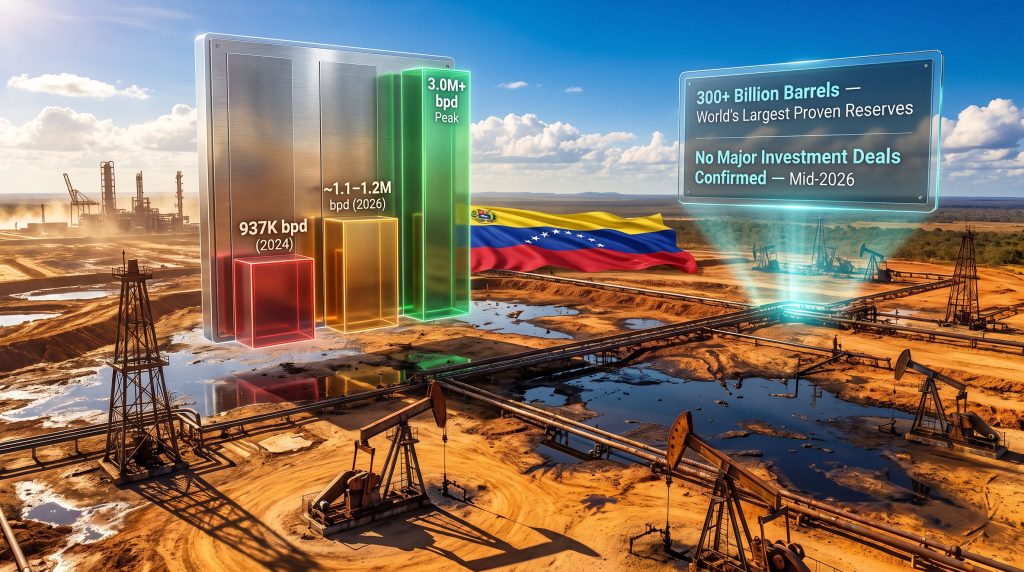
Venezuela's proven reserves, certified at over 300 billion barrels, represent the largest single national endowment on the planet. Yet the country's actual crude output tells a very different story. Production is estimated at approximately 1.07 to 1.2 million barrels per day (bpd) in 2026, a modest improvement from the 2024 average of around 937,000 bpd. At its late-1990s peak, Venezuela was pumping more than 3 million bpd, meaning current output sits at less than 40% of historical capacity.
The core of Venezuela's resource story lies in the Orinoco Belt, a vast sedimentary basin in the country's east that holds the world's largest concentration of extra-heavy crude oil. This is not conventional light oil. The crude found here has an API gravity typically in the range of 8 to 10 degrees, making it among the heaviest commercially producible oil on earth. For comparison, West Texas Intermediate trades around 39 to 41 API gravity.
Extra-heavy crude from the Orinoco Belt requires either blending with lighter diluents or processing through specialised upgrader facilities that convert it into a synthetic crude suitable for conventional refining. This technical reality has profound commercial implications, and understanding the history of Venezuela's oil industry helps contextualise just how far the sector has fallen.
U.S. Gulf Coast refineries were specifically configured over decades to process Venezuelan heavy crude, creating a natural but now severely disrupted supply chain. With those trade flows fractured by sanctions and political crisis, Venezuelan barrels have been rerouted, discounted, or simply not produced at all. Even under an optimistic recovery scenario, Venezuelan incremental output would represent less than 1% of global supply, limiting any immediate upward pressure on world prices.
Key Insight: Venezuela's production challenge is not geological scarcity. It is the compound effect of infrastructure collapse, workforce emigration, legal uncertainty, and institutional breakdown layered over a resource base that remains entirely intact underground.
What the Political Transition Has and Hasn't Changed
Nicolás Maduro's removal marked a pivotal moment in Venezuelan political history, and its downstream effects on the energy sector have been real, if far more modest than initial optimism suggested. The Venezuela policy shift under the interim administration has signalled a clear preference for private and foreign investment in the upstream sector, and U.S. sanctions have been progressively eased to permit expanded participation by international firms.
The operational results have been tangible. Chevron, operating under a specific licence that pre-dated the broader sanctions relaxation, has expanded output through efficiency improvements to approach 300,000 bpd, without committing fresh capital to greenfield development. Venezuela's aggregate production has climbed meaningfully from its 2024 average, a genuine improvement.
However, the table below illustrates the persistent gap between what has changed and what remains unresolved:
| Metric | Current Status (2026) |
|---|---|
| Estimated crude output | ~1.07–1.2 million bpd |
| Late-1990s peak output | ~3.0+ million bpd |
| Chevron operational output | ~300,000 bpd |
| Major new IOC investment deals signed | None confirmed |
| Preliminary agreements (smaller firms) | Several signed |
| Legacy compensation claims resolved | Unresolved |
| Investment protection framework | In transition |
Shell and Repsol have been linked to exploratory conversations with the interim government, but no binding agreements have been publicly confirmed. Furthermore, the architecture of a recovery is visible in outline, but the structural load-bearing elements are still absent.
The Institutional Memory Problem and Why It Matters More Than Opportunity
To understand why major international oil companies are not rushing into Venezuela, it is necessary to understand the depth of the institutional scarring they carry. Venezuela has effectively run two distinct waves of asset nationalisation against foreign investors.
The first occurred under Hugo Chávez, who systematically forced renegotiations of upstream contracts and eventually seized operating control of major projects in the Orinoco Belt between 2005 and 2007. ExxonMobil and ConocoPhillips walked away rather than accept the new terms, initiating international arbitration proceedings that have not been fully resolved nearly two decades later.
The second wave came through subsequent deterioration under Maduro, involving forced operating conditions, unpaid obligations, and infrastructure collapse that effectively destroyed the value of assets that international companies had spent decades developing. Consequently, the combined effect of these two cycles has left deep institutional scars across the investment community.
Francisco Monaldi of Rice University's Baker Institute has articulated the central problem: corporate boards at the world's largest oil companies will not sanction multibillion-dollar commitments in Venezuela unless the risk-adjusted return is genuinely exceptional, and the current legal and governance environment does not yet meet that threshold. The memory of two successive expropriation cycles is baked into the capital approval processes of every major energy company still evaluating Venezuela.
Compounding this problem is what analysts have described as an asset competition dynamic. Multiple international companies are pursuing the same high-quality Orinoco Belt and Monagas state assets simultaneously, which might seem like it would accelerate deal-making. In practice, it has had the opposite effect.
Each company is leveraging competitive interest to push for more favourable tax treatment, ownership structures, and regulatory terms before committing. José Ignacio Hernández of Aurora Macro Strategies has characterised the situation as resembling an open house with a large crowd of attendees but no buyers following through on a purchase, capturing precisely how genuine corporate interest has failed to convert into capital commitment.
The Infrastructure Rehabilitation Cost Barrier
Beyond governance risk, the physical state of Venezuela's oil infrastructure presents a formidable financial obstacle. Decades of underinvestment, mismanagement, and the operational deterioration accelerated by sanctions have left pipelines, upgrader facilities, export terminals, and well stock in severe disrepair.
Rehabilitating previously nationalised assets requires absorbing enormous upfront capital before a single incremental barrel reaches the export market. ExxonMobil is reported to have scaled back its ambitions in Venezuela after internal analysis concluded that the cost of rehabilitating available assets could not be justified by the projected returns under current fiscal and legal conditions.
The structural risk factors that remain unresolved include:
- Legal framework uncertainty: Investment protection legislation is in transition, with no guarantee that contracts signed under the current interim government would be honoured by future administrations
- Governance durability: The long-term political stability of the interim government cannot be assumed
- Profit repatriation mechanisms: The infrastructure for converting Venezuelan bolivar earnings into repatriable hard currency remains underdeveloped
- Workforce depletion: Venezuela has experienced a substantial brain drain of its skilled petroleum engineering workforce, with tens of thousands of technical specialists emigrating during the crisis years of the mid-2010s through early 2020s
- Diluent supply: Extra-heavy Orinoco crude requires blending with lighter hydrocarbons before it can flow through pipelines, and Venezuela's domestic supply of suitable diluents is severely constrained
Where Smaller Independents Fit Into the Recovery Picture
Facing the reluctance of the largest operators, the Trump administration has pursued an alternative strategy: encouraging smaller, privately held independent oil producers to move more quickly and deploy capital on a faster timeline. Several such firms have already executed preliminary agreements with Venezuela's interim government, and their willingness to accept higher risk profiles at smaller scale represents a genuine near-term contribution to production growth.
In addition, resource-backed deals structured elsewhere in the world offer a potential template for how Venezuela might attract capital with greater speed. However, the technical and financial limitations of independents in the context of Venezuela's specific resource base are significant. It requires:
- Heavy upgrader infrastructure capable of processing crude below 10 API gravity into exportable synthetic oil
- Long-term capital commitment horizons measured in decades, not years
- Deep technical expertise in thermal recovery and blending operations
- Substantial balance sheets capable of absorbing years of pre-production capital expenditure
Smaller independents typically lack the combination of all four. Analysts broadly agree that transformative output growth from the Orinoco Belt will ultimately depend on the participation of the largest international oil companies, making the current independent-led approach a necessary but insufficient component of any genuine recovery.
Scenario Analysis: Three Pathways for Venezuela's Oil Output
Scenario 1: Accelerated Recovery
Requires rapid legal reform, resolution of legacy compensation claims, and sustained sanctions relief. Under this pathway, production could reach 1.5 to 2.0 million bpd within three to four years. Probability: low to moderate, given the pace of institutional reform to date.
Scenario 2: Incremental Growth (Base Case)
Continued operational improvements by existing operators, selective entry of independents, and gradual legal framework development. Output could reach approximately 1.3 to 1.5 million bpd by late 2027. Probability: moderate to high, consistent with current momentum.
Scenario 3: Stagnation
Political instability, failure to resolve legacy disputes, or a sustained low-price environment reduces investment incentive. Production plateaus near current levels or declines as existing infrastructure deteriorates without maintenance capital. Probability: moderate, given the structural vulnerabilities that persist.
| Recovery Milestone | Estimated Timeframe |
|---|---|
| Reach 1.5 million bpd | 2–3 years (optimistic case) |
| Reach 2.0 million bpd | 5–7 years (base case) |
| Return to 3.0+ million bpd | 10+ years (full structural rebuild) |
| Full sector rehabilitation | Decade or more |
The next major ASX story will hit our subscribers first
The Guyana Contrast: What Venezuela Could Have Been
No comparison more sharply illustrates Venezuela's institutional failure than a side-by-side look at Guyana, its smaller neighbour to the east. Guyana holds roughly 11 billion barrels of proven reserves, a fraction of Venezuela's endowment, yet is attracting the largest international oil companies at scale with committed multi-year capital programs.
| Factor | Venezuela | Guyana |
|---|---|---|
| Proven reserves | 300+ billion barrels | ~11 billion barrels |
| Current production | ~1.1–1.2 million bpd | ~650,000 bpd (rapidly growing) |
| Political risk | High | Low-to-moderate |
| Infrastructure condition | Severely degraded | Largely new-build |
| IOC investment appetite | Cautious | Strong |
| Production growth trajectory | Slow and uncertain | Fast and committed |
Callout: Guyana demonstrates a foundational truth that Venezuela's situation makes painfully clear: in the energy investment world, governance quality and legal predictability attract more capital than reserve size alone.
The underlying geology of Venezuela's Orinoco crude also creates a specific market access constraint that Guyana does not face. Because Orinoco extra-heavy crude requires upgrading before it can be refined in most global facilities, Venezuela's potential customer base is inherently narrower than for conventional light-to-medium producers. This refinery-configuration dependency was one reason the U.S. Gulf Coast became such a natural market historically, and its disruption has had outsized consequences.
China's Strategic Stake and OPEC's Quiet Resistance
Two external actors have powerful reasons to influence the pace and direction of Venezuela's oil recovery in ways that are rarely discussed openly.
China's state-owned enterprises, particularly CNPC, became deeply embedded in Venezuela's oil sector under Maduro through oil-for-loan arrangements that involved billions of dollars in financing secured against future crude deliveries. A Western-aligned recovery scenario would logically displace or dilute these interests, creating potential for geopolitical friction over debt resolution and asset ownership.
How Beijing responds to the transition, and whether it elects to renegotiate legacy arrangements or pursue more adversarial debt enforcement, will be a material variable in the recovery timeline. Furthermore, the broader geopolitical investment risk that Venezuela represents cannot be separated from these competing great-power interests.
Within OPEC+, Venezuela's trajectory is equally consequential. The OPEC production strategy currently prioritises market balance, meaning even a modest Venezuelan production increase of 500,000 additional bpd would add meaningful supply to a market the cartel is already managing carefully.
Saudi Arabia and other core OPEC members have structural reasons to prefer a slow, controlled Venezuelan recovery over a rapid one. Moreover, OPEC market influence over pricing dynamics means Venezuela's upstream decisions carry downstream consequences far beyond its own borders. This dynamic is rarely acknowledged in mainstream analysis, but it represents a geopolitical headwind operating quietly in the background of every negotiation.
The Five Prerequisites for a Real Recovery
Analysts examining the Venezuela oil revival after Maduro fall have converged on a set of structural requirements without which no recovery scenario above the base case is achievable. According to reporting on Venezuela's post-Maduro trajectory, oil is indeed flowing again, but the broader conditions for sustained investment remain fragile. The five core prerequisites are:
- Legal certainty: Enforceable investment protection legislation with internationally credible arbitration mechanisms that insulate contracts from domestic political interference
- Legacy claim resolution: A structured financial settlement addressing the compensation disputes from Chávez-era nationalisations, estimated to involve billions of dollars in outstanding arbitration awards
- Infrastructure recapitalisation: Multi-year capital programs to rehabilitate pipelines, upgrader facilities, export terminals, and well stock across both the Orinoco Belt and Monagas state
- Human capital rebuilding: Targeted programs to attract back the Venezuelan petroleum engineering and technical workforce lost to emigration during the crisis years
- Fiscal framework competitiveness: Royalty, tax, and profit-sharing structures that make Venezuelan projects genuinely competitive against lower-risk alternatives in Guyana, Brazil's pre-salt, and the U.S. Permian Basin
The next 24 months represent a critical inflection point. If Venezuela's interim government can demonstrate progress across these five dimensions, it may unlock the first wave of genuine major IOC capital commitments. If it cannot, investor attention will progressively migrate toward the more predictable opportunities that the broader Latin American energy sector offers in abundance.
Venezuela's oil story is ultimately not about what lies beneath the ground. It never was. The Orinoco Belt's reserves have been known and mapped for decades. What determines whether this resource becomes a production reality is entirely above ground: the laws, the institutions, the governance, and the trust that only time and consistent action can rebuild. The Venezuela oil revival after Maduro fall will ultimately be judged not by geological potential, but by the quality of the institutional framework built to unlock it.
This article is intended for informational purposes only and does not constitute investment advice. All production figures, timelines, and scenario projections involve inherent uncertainty and should not be relied upon as forecasts. Readers should conduct independent research before making any investment decisions related to the energy sector or emerging market opportunities.
Want to Stay Ahead of the Next Major Resource Discovery Before the Market Catches On?
While Venezuela's institutional gridlock keeps billions of barrels locked underground, significant mineral discoveries are being made right now on the ASX — and Discovery Alert's proprietary Discovery IQ model delivers real-time alerts the moment they're announced, turning complex data across 30+ commodities into actionable opportunities for both short-term traders and long-term investors. Explore what historic discoveries have returned for early investors on Discovery Alert's dedicated discoveries page, and begin your 14-day free trial today to position yourself ahead of the broader market.