August 4, 2026
The Capital Architecture Powering Critical Minerals Trade
The global commodity system has always operated on the premise that capital follows returns. For most of the past two decades, that logic kept the bulk of trade finance concentrated in liquid, well-understood markets: oil, grains, base metals. Critical minerals, despite their growing industrial significance, occupied a peripheral position in most institutional lending portfolios. That positioning is now changing rapidly, and the mechanics behind that shift reveal something important about how supply chains for the energy transition are actually being built.
Understanding why banks financing commodity traders in critical minerals supply chains has become one of the most consequential dynamics in global commodity markets requires starting not with deal announcements, but with the underlying architecture of how trade finance works and why its risk profile has fundamentally shifted.
When big ASX news breaks, our subscribers know first
What Trade Finance Actually Does in a Critical Minerals Supply Chain
When a commodity trader moves lithium carbonate from a Chilean brine operation to a South Korean battery precursor plant, the physical shipment represents only part of the transaction. The financial layer that enables it is equally complex, and it is structured to minimise the window of lender exposure.
Banks do not extend open-ended credit to commodity traders the way a commercial lender funds a property purchase. Instead, they deploy instruments precisely engineered for the physical movement of goods:
- Letters of credit (LCs): A buyer's bank guarantees payment to a seller's bank upon presentation of verified shipping documents, eliminating counterparty risk at the point of delivery
- Pre-export finance (PXF): Capital advanced to a producer or trader ahead of shipment, with repayment structured against export sale proceeds
- Revolving credit facilities (RCFs): Flexible multi-currency credit lines drawn and repaid continuously as trade cycles complete, calibrated to a trader's working capital requirements
- Inventory-backed lending: Secured financing against warehoused physical commodity holdings, where the commodity itself serves as collateral
- Trade receivables financing: Monetisation of outstanding buyer invoices, converting future cash flows into immediately deployable capital
The self-liquidating structure of most trade finance instruments is what distinguishes them from project finance. When repayment is tied to the proceeds of a specific shipment or sale, default exposure is bounded by a short transaction window rather than a multi-decade construction and production ramp-up timeline. This is precisely why commercial bank appetite for trade finance has historically been stronger than for project-level mine development.
| Feature | Trade Finance | Project Finance |
|---|---|---|
| Tenor | 30 to 180 days (typical) | 10 to 25 years |
| Security | Receivables, inventory, sale proceeds | Project assets, offtake contracts |
| Risk profile | Lower, transaction-linked | Higher, tied to construction and ramp-up |
| Commercial bank appetite | Stronger across most lenders | Requires ECA or DFI co-participation |
| Critical minerals application | Trader working capital, physical flows | Mine development, processing plant construction |
The Oversubscription Signal: What the Data from 2025 and 2026 Actually Tells Us
The clearest empirical signal of shifting lender sentiment is the pattern of oversubscribed credit facilities appearing across major commodity trading houses. Oversubscription in a syndicated facility means that lender demand for exposure exceeded the initial facility size, forcing an upward revision. This does not happen in sectors where risk appetite is weak.
The headline figures from the most recent cycle of facility closings illustrate the scale of this shift:
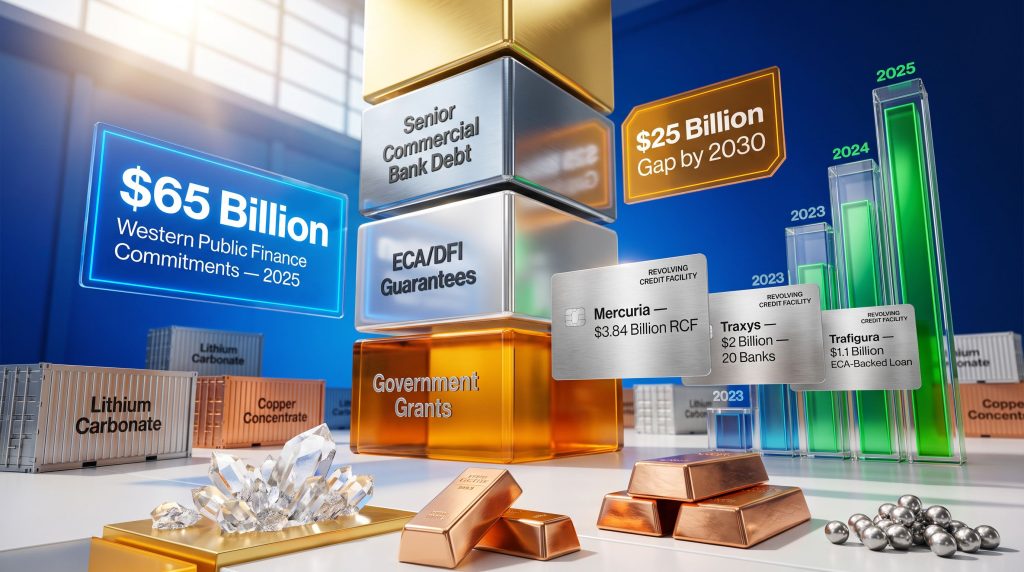
- Traxys closed a multicurrency syndicated revolving credit facility at $2 billion in July 2026, oversubscribed and expanded by $185 million, with 20 banks increasing their individual commitments compared with 2025 levels
- Mercuria completed a $3.84 billion multicurrency revolving credit facility in June 2026, significantly oversubscribed and increased by $340 million, with both new and existing banking partners upsizing their positions
- Gerald Group secured a $50 million, three-year financing arrangement backed by UAE export credit agency Etihad Credit Insurance and provided by Abu Dhabi Commercial Bank, broadening its funding base across energy transition and technology metals
The working capital requirements driving these expanded facilities are not incidental. As commodity traders move into longer-term strategic positions across battery materials, their balance sheet requirements scale proportionately. A 10-year offtake agreement creates a financing obligation that a 90-day revolving facility was never designed to service alone.
The fact that 20 banks simultaneously increased commitments to a single Traxys facility is not merely a headline number. In syndicated lending, each participating bank conducts its own credit assessment. Collective expansion across that many independent lenders represents a structural reassessment of risk-adjusted returns in critical minerals trade flows, not a coincidental alignment of sentiment. Furthermore, according to Fastmarkets' critical minerals financing analysis, this trend reflects a broader institutional rethinking of how strategic commodities are categorised within bank lending frameworks.
Export Credit Agencies: The Mechanism That Changed the Risk Calculation
Commercial bank appetite does not exist in isolation. A significant portion of the renewed institutional confidence in critical minerals trade finance is traceable to the expanding role of export credit agencies, whose mandates have evolved from traditional export promotion into active supply chain security instruments.
Trafigura's financing trajectory provides the most detailed public case study of this dynamic. Since 2022, the trading house has secured approximately $8 billion in ECA-backed financing. In February 2026, it signed a $1.1 billion ECA-backed loan specifically structured to anchor raw material import flows into Germany. Trafigura's chief financial officer, Stephan Jansma, stated in April 2026 that ECAs are continuing to expand their involvement, driven by the security of supply argument that governments are advancing to attract commodities into their economies.
This trajectory illustrates a critical structural point: ECA participation does not replace commercial bank debt. It de-risks it. When an ECA absorbs first-loss exposure or provides a payment guarantee, the residual risk profile for co-lending commercial banks shifts materially, making participation viable for institutions that would otherwise remain on the sideline. For instance, US EXIM-backed antimony financing demonstrates how targeted ECA intervention can unlock commercial capital for materials that would otherwise struggle to attract private sector participation.
The Blended Finance Stack in Practice
Understanding how public and private capital interact in critical minerals financing requires mapping the full capital structure:
- Equity layer – Mining company shareholders, private equity, strategic investors providing risk capital
- Mezzanine or subordinated debt – Higher-yield, higher-risk capital from specialist funds
- Senior commercial bank debt – Secured lending requiring strong collateral, offtake backing, or ECA co-participation
- ECA and DFI guarantees – Risk-mitigation instruments from institutions including the US Export-Import Bank, the US Development Finance Corporation, and Etihad Credit Insurance
- Government grants and concessional capital – Direct public finance deployed to crowd in private co-investment
| Institution | Type | Primary Role |
|---|---|---|
| US Export-Import Bank (EXIM) | Export credit agency | Financing US critical mineral export infrastructure |
| US Development Finance Corporation (DFC) | Development finance | Equity and debt for strategic supply chain investment |
| Etihad Credit Insurance (UAE) | Export credit agency | Supporting metals trade flows including energy transition materials |
| MSP Finance Network | Multilateral initiative | Coordinating capital across Minerals Security Partnership nations |
| European development banks | Various | Funding refining and processing capacity within Europe |
Offtake Agreements as the Architecture of Future Supply Chains
The most consequential transformation in how commodity traders are engaging with critical minerals is not visible in facility sizes. It is embedded in the growing use of long-term offtake agreements as instruments of supply chain construction. An offtake agreement does more than guarantee a buyer for future production. It provides the collateral backbone that allows project finance to be structured and commercial bank debt to be syndicated.
Recent transactions illustrate the strategic scale of these commitments:
- Trafigura secured an agreement with Smackover Lithium covering 80,000 tonnes of lithium carbonate across a 10-year period
- Trafigura also executed a 10-year offtake agreement covering 1,500 tonnes of lithium carbonate and 2,000 tonnes of nickel contained in mixed hydroxide precipitate (MHP) with Nth Cycle
- Traxys agreed to purchase 100% of Phase 1 production from Lilac Solutions' planned Utah lithium project, directly anchoring a domestic US lithium supply chain
- Mercuria secured 95,000 wet metric tonnes of copper concentrate from Bulgaria's Ellatzite mine in December 2025
Mixed hydroxide precipitate deserves specific attention here. MHP is an intermediate nickel and cobalt product produced through high-pressure acid leach processing, increasingly significant as a feedstock for battery precursor cathode active material (pCAM) manufacturing. The fact that trading houses are securing 10-year MHP offtake positions signals a deliberate strategy to control material flows at the midstream processing stage, not merely at the mined ore level.
Advances in direct lithium extraction technology are also reshaping how offtake positions are structured, as improved processing efficiency alters the volume and grade profiles that traders must accommodate in long-term contracts.
Offtake agreements function as the connective tissue between upstream resource development and downstream manufacturing. Without them, commercial banks lack the assured revenue stream needed to justify long-tenor lending. With them, the entire capital stack becomes financeable.
The Retrenchment Period: Why the Recovery Matters
The current wave of oversubscribed facilities represents a genuine reversal, not merely an extension of a prior trend. The banking sector's retreat from commodity trade finance between approximately 2018 and 2022 was material and consequential.
BNP Paribas closed its Geneva-based commodity trade financing desk in 2020, citing lending losses during a cyclical market downturn. In the same year, ABN Amro exited trade and commodity finance entirely to reduce risk exposure. These were not isolated decisions. They reflected a structural repricing of commodity sector risk by major European lenders following a series of financing scandals and cyclical losses that eroded confidence in the asset class.
The vacuum left by these departures was not neutral in its effects. During the battery raw materials price slump of 2018 to 2020, Chinese state-backed capital continued to deploy across lithium, cobalt, and rare earth supply chains without the cyclical hesitation that characterised Western private sector behaviour. The competitive advantage this created at the processing and refining tier has proven remarkably durable.
During the 2022 commodity price boom, major institutional lenders including ING and MUFG re-entered the space, expanding credit lines to commodity traders as risk-return dynamics improved. The critical minerals policy environment has extended and deepened that recovery by adding a strategic rationale that sits above the purely financial one. Monitoring the battery raw materials market through each cycle has become essential for lenders assessing when and how to deploy capital into this space.
The next major ASX story will hit our subscribers first
The Refining Gap: Where Western Investment Is Still Falling Short
A clear-eyed assessment of where banks financing commodity traders in critical minerals supply chains actually reaches its limits points directly to mid-stream processing and refining. The IEA has explicitly identified a structural imbalance in Western supply chain diversification efforts, with investment heavily concentrated in mining while refining and processing capacity continues to lag.
This imbalance matters because China's competitive advantage is not primarily located in resource ownership. It is located in processing capacity. Decades of coordinated domestic investment have given Chinese operators dominant global market share across lithium hydroxide conversion, rare earth separation, cobalt refining, and graphite processing. Western miners can produce concentrate. Without refining infrastructure, that concentrate often has no viable non-Chinese processing pathway.
| Supply Chain Stage | Western Investment Concentration | China's Competitive Position |
|---|---|---|
| Geological exploration | Moderate | Dominant, exceeding $15 billion in domestic investment in 2024 alone |
| Mine development | High, primary policy focus to date | Established and continuing to expand |
| Primary processing and refining | Low, explicitly identified as a gap | Dominant across lithium, rare earths, cobalt |
| Downstream manufacturing | Emerging and growing | Deeply entrenched over multiple decades |
China exceeded $15 billion in domestic geological exploration investment across all minerals in 2024 alone, according to IEA data. This represents only one layer of an investment programme that spans the entire supply chain from resource extraction to downstream manufacturing, built over 25 years of consistent strategic deployment.
Commercial banks are reluctant to finance greenfield refining and processing projects in Western jurisdictions for reasons that are structurally distinct from their reluctance to finance trading positions. Processing plants carry long construction timelines, technology execution risk, and uncertain operating cost profiles. Without an anchor customer providing long-term volume commitments at known prices, the revenue certainty required to service project-level debt is absent. This is precisely where ECA and DFI participation becomes essential rather than merely supplementary.
Consequently, the European raw materials facility represents one attempt to address this structural gap, by providing a coordinated public finance mechanism specifically targeting the processing and refining stages that private capital has been slowest to reach.
The $25 Billion Gap and the Durability Question
By 2030, analysis from Securing America's Future Energy (SAFE) estimates that more than $25 billion in additional investment will be required to meet the demand generated by planned clean energy manufacturing capacity in the United States and Europe. This is not a total investment figure. It represents the shortfall above current committed capital.
Western government public finance commitments to critical minerals energy security reached $65 billion in 2025, according to IEA data, representing more than four times the level recorded in 2023. This acceleration in public finance reflects a structural shift in policy posture, with governments accepting that market forces alone will not deliver the supply chain diversification required for energy security and industrial competitiveness.
Will Adams, Fastmarkets' head of market insights, has framed the central uncertainty plainly: the policy signal from governments has improved financing conditions and drawn commodity traders deeper into supply chain development, but whether private sector support proves resilient through a cyclical downturn remains genuinely unresolved. The 2018 to 2020 battery raw materials price decline demonstrated that private capital can retreat rapidly, and that Chinese state-backed financing reliably fills the vacuum. Greater government involvement and ECA co-participation are designed to make Western private capital stickier, but the durability of that effect has not yet been stress-tested against a prolonged commodity price decline.
The IEA has also noted, through its critical minerals analyst Alexandra Hegarty, that no single financing approach can be universally applied across critical minerals. Market sizes, processing complexity, geopolitical sensitivity, and commodity maturity vary significantly across lithium, rare earths, cobalt, nickel, and graphite. A financing framework that works for lithium carbonate trade flows may be structurally inadequate for rare earth separation capacity or battery-grade graphite processing. Furthermore, as detailed in the OECD's economic security analysis, differentiated, commodity-specific solutions are required, and the institutional architecture to deliver them across all materials simultaneously does not yet fully exist.
Frequently Asked Questions
What types of financing do banks provide to commodity traders in critical minerals supply chains?
Banks primarily extend short-term, transaction-secured instruments including revolving credit facilities, pre-export finance, letters of credit, inventory-backed lending, and trade receivables financing. These structures are designed so that repayment flows directly from sale or export proceeds, keeping default exposure tightly bounded within specific transaction windows.
Why are commodity trader credit facilities being oversubscribed in 2025 and 2026?
Oversubscription reflects the convergence of rising working capital requirements for larger strategic trading positions, improving risk-adjusted returns across critical minerals trade flows, and the policy-driven elevation of these commodities as national security priorities, which has elevated the sector's standing in institutional lending assessments.
How do export credit agencies differ from commercial banks in this context?
Commercial banks prioritise secured, short-tenor, transaction-linked lending where repayment certainty is high. ECAs and development finance institutions are mandated to accept higher and longer-duration risk in exchange for strategic supply security outcomes, making them essential for mine development, processing facility construction, and infrastructure financing that commercial banks would not independently provide.
What is the biggest unresolved gap in critical minerals supply chain financing?
The IEA has identified refining and processing capacity as the most significant structural gap. Mining investment has attracted substantial public and private capital, but the midstream stages where China holds dominant global market share remain severely underfinanced in Western supply chains.
Will bank financing for critical minerals persist through the next price downturn?
This is the defining uncertainty. The 2018 to 2020 battery raw materials price slump demonstrated that private sector financing commitment can contract rapidly during cyclical downturns, with Chinese state-backed capital filling the resulting vacuum. Greater ECA co-participation and government involvement are intended to create greater resilience to cyclical volatility, but whether this effect proves durable at scale remains to be tested. Ultimately, the future of banks financing commodity traders in critical minerals supply chains will depend as much on geopolitical stability as on commodity price performance.
Disclaimer: This article is intended for informational purposes only and does not constitute financial or investment advice. All figures, forecasts, and projections referenced are sourced from third-party organisations and should not be relied upon as guarantees of future outcomes. Readers should conduct independent due diligence before making investment decisions.
Want To Track The ASX Discoveries Fuelling The Critical Minerals Supply Chain?
Discovery Alert's proprietary Discovery IQ model delivers real-time alerts the moment significant mineral discoveries hit the ASX, transforming complex geological and commodity data into actionable investment insights for both short-term traders and long-term investors. Explore historic discovery returns on Discovery Alert's dedicated discoveries page and begin a 14-day free trial to position yourself ahead of the market.