
August 4, 2026
The Global Supply Gap That Makes Brazilian Nickel Impossible to Ignore
Battery-grade nickel supply is fracturing along two distinct fault lines: geography and carbon intensity. As electric vehicle manufacturers deepen their scrutiny of where raw materials originate and how they are processed, the global nickel market is undergoing a structural reassessment that reaches well beyond simple price cycles. Understanding nickel properties and uses is increasingly critical, as the concentration of nickel production in a single country, combined with growing pressure on supply chain transparency, has created a rare window for projects that can offer something the dominant producers cannot.
That opportunity is verified low-carbon sulfide nickel from a politically stable, well-regulated jurisdiction outside Southeast Asia. Brazil's Carajás Mineral Province sits at the centre of this emerging opportunity, and Centaurus Metals' Projeto Jaguar níquel is advancing rapidly to fill it.
When big ASX news breaks, our subscribers know first
Why the Nickel Sulfide Supply Gap Is Widening
The distinction between nickel sulfide and nickel laterite is not merely geological; it carries profound commercial and environmental implications. Sulfide deposits, formed through magmatic processes deep in the earth's crust, yield nickel that can be processed into high-purity Class I material and battery-grade nickel sulfate at significantly lower energy cost than laterite ores. Understanding how magmatic nickel deposits form helps explain why these assets are so commercially attractive compared to laterite alternatives requiring high-pressure acid leaching (HPAL) or pyrometallurgical refining via the rotary kiln electric furnace (RKEF) route.
How Does Indonesian Production Compare?
The Indonesian nickel industry dominates global nickel output, but the majority of that production flows through the RKEF pathway, producing nickel pig iron (NPI) and, increasingly, mixed hydroxide precipitate (MHP) through HPAL. While these processes have expanded total nickel supply, they generate higher greenhouse gas emissions per tonne of nickel produced.
Automakers and battery manufacturers operating under Scope 3 emissions frameworks are beginning to discriminate between these sources, and that discrimination is expected to intensify as downstream sustainability targets tighten through the late 2020s. This structural backdrop elevates every credible nickel sulfide project outside Indonesia. Few, however, combine the resource scale, permitting status, infrastructure access, and capital readiness that Centaurus Metals' Projeto Jaguar níquel has assembled in Brazil's Pará state.
Project Origins and Strategic Location Within Carajás
Jaguar's provenance carries its own signal. The project was acquired from Vale in 2020, inheriting geological knowledge and early infrastructure work from one of the world's largest diversified miners. Located within the Carajás Mineral Province, a region already recognised as one of the most mineral-endowed corridors on earth, the Jaguar nickel sulphide project sits within approximately 30 km² of tenement area encompassing multiple deposits and active exploration targets.
Carajás hosts some of the highest-grade iron ore deposits globally and has demonstrated the capacity to support large-scale, long-life mining operations. For a nickel sulfide project, operating within this established mineral province offers advantages in terms of existing geological understanding, skilled local workforce availability, and proximity to critical infrastructure corridors.
Resource Scale, Ore Quality, and JORC Classification
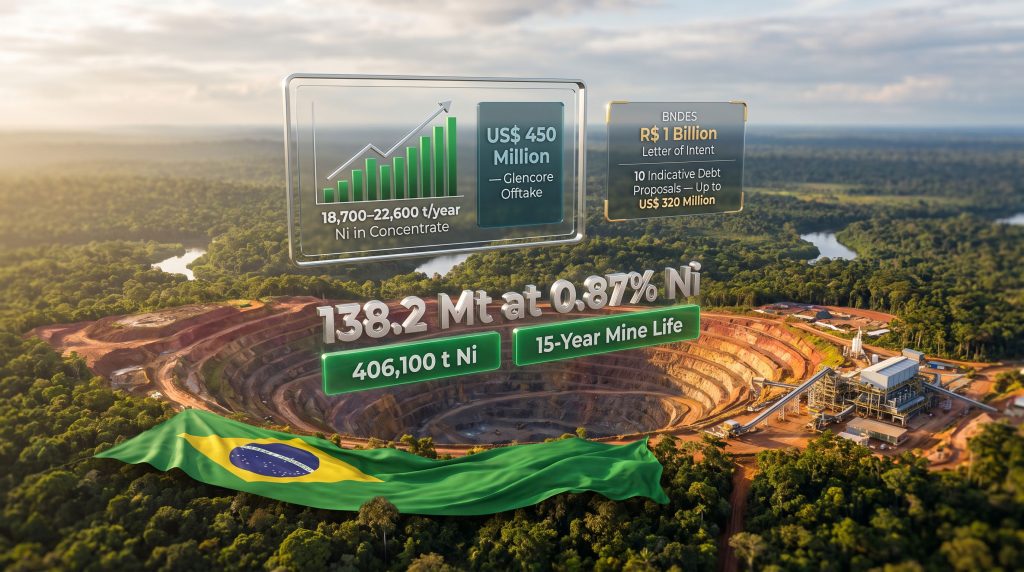
Understanding the resource base is foundational to assessing Jaguar's long-term value proposition. The project supports a total global resource of 138.2 Mt at 0.87% Ni, containing 1.20 Mt of nickel. Within that inventory, the JORC Proved and Probable Ore Reserve stands at 52.0 Mt at 0.78% Ni, delivering 406,100 tonnes of contained nickel, the foundation for 15 years of open-pit operation.
What is particularly notable from a geological perspective is the underground resource sitting beneath the planned open pits. This material grades significantly higher than the surface operation:
| Resource Category | Tonnage (Mt) | Ni Grade (%) | Contained Nickel (kt) |
|---|---|---|---|
| Total Global Resources | 138.2 | 0.87 | 1,200 |
| Proved + Probable Reserve (JORC) | 52.0 | 0.78 | 406.1 |
| Underground Resources (below pits) | 21.5 | 1.46 | 313.0 |
| Underground Measured & Indicated | 15.5 | 1.50 | 233.0 |
The grade differential between the open-pit reserve at 0.78% Ni and the underground resource at 1.46-1.50% Ni is a detail that often receives insufficient attention in headline summaries. This higher-grade underground inventory represents a natural progression pathway that could materially extend mine life and improve unit economics in the project's later years, particularly as underground mining techniques become more economically viable at scale.
The sulfide mineralogy itself is another technical advantage. Nickel sulfide ores respond well to conventional flotation concentration, a well-understood processing route that delivers predictable recoveries and a saleable concentrate product. This contrasts sharply with the processing complexity and capital intensity associated with laterite refining circuits.
Operational Design and Cost Structure
Jaguar's operational design prioritises capital efficiency and cost competitiveness. The processing circuit is configured at 3.5 Mtpa throughput using conventional flotation, targeting annual production of between 18,700 and 22,600 tonnes of nickel contained in concentrate across its initial 15-year open-pit life.
Several design choices reinforce the project's first-quartile cost positioning:
- Mining is contracted to a Brazilian mining services company using a contract mining model, transferring operational risk and avoiding large owner-operated fleet capital requirements
- Tailings storage facilities are constructed using material sourced directly from the mining operation itself, reducing both logistics costs and the environmental footprint associated with imported fill materials
- Minimal oxidised waste removal is required to access the ore, which reduces pre-strip ratios and accelerates access to productive ore zones
- Grid power connection has already been approved, providing access to Brazil's national electricity grid, which is predominantly fed by hydroelectric generation
"The combination of contracted mining, self-sourced tailings material, low strip ratios, and renewable grid power places Jaguar in a structurally advantaged cost position relative to many global peers, particularly those relying on diesel power or complex pre-stripping programs."
A direct comparison with typical sulfide nickel project benchmarks illustrates this positioning:
| Attribute | Projeto Jaguar | Typical Sulfide Project Benchmark |
|---|---|---|
| Reserve Grade | 0.78% Ni | 0.5-1.0% Ni |
| Underground Grade | 1.46-1.50% Ni | Variable |
| Initial Mine Life | 15 years | 10-20 years |
| Cost Quartile | 1st Quartile | 2nd-3rd Quartile (global average) |
| Environmental Licence | Secured | Frequently pending |
| Grid Power Connection | Approved | Frequently under negotiation |
Regulatory Clearances as a Competitive Moat
One of the most underappreciated aspects of Jaguar's development status is the depth of its regulatory approvals. The project holds three critical enablers that are frequently cited as the primary causes of delay and cost overrun in Latin American mining projects:
- Mining concession granted — the legal right to extract mineral resources is confirmed
- Environmental licence secured — the project has cleared Brazil's environmental licensing framework, a process notorious for its complexity and duration
- National grid connection approved — power infrastructure access is confirmed, eliminating a major capital and timeline uncertainty
For investors and financiers assessing development-stage mining projects, this trifecta of approvals dramatically de-risks the pathway to construction. Many comparable greenfield projects in Latin America spend years and significant capital navigating exactly these approval processes, frequently with uncertain outcomes.
The next major ASX story will hit our subscribers first
Capital Structure: Debt Financing, BNDES, and the Glencore Offtake
Centaurus Metals' Projeto Jaguar has attracted a competitive financing process. The debt financing mandate, managed by financial adviser Orimco, has generated ten indicative non-binding proposals totalling up to US$320 million, with multiple individual proposals exceeding US$250 million. This level of lender interest for a development-stage project reflects both the asset quality and the credibility of the regulatory foundation underpinning it.
The Banco Nacional de Desenvolvimento Econômico e Social (BNDES), Brazil's national development bank, issued a non-binding letter of intent for financing of R$1 billion (approximately US$190 million). This participation signals the level of institutional interest from domestic financial infrastructure in the project, noting that this letter of intent is non-binding and does not constitute confirmed funding.
The strategic equity process, supported by Standard Chartered Bank, is progressing in parallel, with multiple transaction structures under consideration. The goal is for a strategic equity partner to also serve as a foundation for additional offtake agreements, creating an integrated commercial and ownership structure.
What Are the Glencore Offtake Terms?
The anchor commercial agreement is already in place. Furthermore, the maiden nickel offtake secured from Glencore establishes the following terms:
| Contract Parameter | Detail |
|---|---|
| Offtake Partner | Glencore |
| Contracted Volume | 20,000 t/year of nickel concentrate at ~32% |
| Contained Nickel | ~6,400 t/year |
| Share of Total Capacity | ~1/3 of projected production |
| Contract Duration | 5 years |
| Estimated Contract Value | US$450 million |
| Projected Supply Commencement | 2029 |
| Remaining Uncontracted Capacity | ~2/3 available for additional buyers |
The decision to leave approximately two-thirds of production without an offtake commitment at this stage reflects a deliberate commercial strategy. With strong demand signals from battery supply chains and growing appetite for non-Indonesian, low-carbon nickel, retaining flexibility allows Centaurus to capture potential market premiums through future agreements, potentially linked to the strategic equity process itself.
ESG Positioning and the Low-Carbon Nickel Argument
The ESG profile of Jaguar's nickel output deserves more detailed examination than it typically receives. Several structural features combine to create what is genuinely a differentiated product in carbon intensity terms:
- Sulfide flotation processing avoids the energy-intensive refining routes required for laterite ores
- Grid power sourced predominantly from Brazil's hydroelectric-dominant national electricity system carries a substantially lower carbon intensity than coal or natural gas-backed grids
- Tailings construction from mine-sourced material eliminates transport-related emissions from imported fill
- Minimal oxidised waste removal reduces fuel consumption in the pre-production phase
"In a market where OEM procurement teams are increasingly required to demonstrate Scope 3 emissions accountability, the ability to point to a verified low-carbon nickel source from a transparent regulatory jurisdiction represents a commercial advantage that is difficult to quantify today but is almost certain to become more valuable through the 2030s."
This positions Jaguar not merely as a nickel supplier but as a strategic alternative within battery supply chains seeking geographic and carbon diversification away from Indonesian production.
Beyond the Open Pit: The Underground Extension Thesis
The longer-term value case for Jaguar rests substantially on the underground resource. The 21.5 Mt at 1.46% Ni sitting beneath the planned open pits contains 313,000 tonnes of nickel, of which 15.5 Mt at 1.50% Ni (233,000 tonnes) is already classified at the Measured and Indicated confidence level.
The grade improvement from open pit to underground — from 0.78% to approximately 1.46-1.50% Ni — is highly significant. Higher-grade underground ore typically yields better concentrate quality, improved metallurgical recoveries, and stronger unit economics per tonne processed. The integration of underground development planning with the open-pit schedule will be a key focus following the Final Investment Decision.
Post-FID improvement opportunities identified for the project include:
- Processing circuit optimisation and metallurgical recovery enhancement
- Resource expansion through exploration drilling in adjacent tenement areas
- Potential evaluation of royalty and streaming structures as complementary financing instruments
Risk Assessment: What Investors Need to Monitor
No development-stage mining project is without risk. A structured assessment of Jaguar's key risk categories helps frame the investment thesis accurately:
| Risk Category | Level | Mitigation Factor |
|---|---|---|
| Regulatory/Permitting | Low | Mining concession and environmental licence already secured |
| Financing | Moderate | 10 indicative proposals; BNDES non-binding letter of intent |
| Nickel Price | Moderate-High | Partial offtake with Glencore as revenue anchor |
| Construction Execution | Moderate | Contract mining model with experienced Brazilian operator |
| Currency (BRL/USD) | Moderate | USD revenues against BRL costs creates natural partial hedge |
| Offtake Concentration | Low-Moderate | Only 1/3 of production committed; 2/3 available for diversification |
| Geopolitical | Low | Stable Brazilian jurisdiction with established institutional framework |
The financing risk deserves particular attention. While the debt process has attracted strong interest, all current proposals remain non-binding and indicative. The FID target of end of Q3 2026 represents a firm milestone against which progress can be measured. Failure to close financing within this window would not invalidate the project's fundamental quality but would introduce timeline uncertainty and potential capital market re-rating risk.
In addition, those tracking nickel market recovery will recognise that Jaguar's timeline aligns closely with an anticipated tightening of battery-grade supply through the late 2020s, which could further support project economics at the point of first production.
This article contains forward-looking statements and financial projections based on publicly available information. Readers should conduct their own due diligence and seek professional financial advice before making any investment decisions. Mining project economics are subject to commodity price volatility, execution risk, and financing conditions that may differ materially from projections.
Frequently Asked Questions About Centaurus Metals Projeto Jaguar Níquel
What is the Centaurus Metals Projeto Jaguar nickel project?
Projeto Jaguar is a nickel sulfide mining development located in Pará state, Brazil, within the Carajás Mineral Province. Originally part of Vale's asset portfolio, it was acquired by Centaurus Metals in 2020 and has been advanced to near-construction readiness. It holds a JORC reserve of 52.0 Mt at 0.78% Ni (406,100 tonnes of contained nickel) within a total resource inventory of 1.2 Mt of nickel, making it one of the most advanced nickel sulfide projects outside of Indonesia and Australia.
When is the Final Investment Decision expected?
Centaurus Metals has set a target of completing the financing process and issuing the Final Investment Decision by the end of the third quarter of 2026.
What are the terms of the Glencore offtake agreement?
The binding contract with Glencore covers the supply of 20,000 tonnes per year of nickel concentrate at approximately 32% nickel content, equating to around 6,400 tonnes of contained nickel annually. The agreement runs for five years with an estimated total value of US$450 million and is expected to commence supply in 2029. This volume represents roughly one-third of Jaguar's projected total production capacity.
What is the annual production target for Projeto Jaguar?
The project is designed to produce between 18,700 and 22,600 tonnes per year of nickel contained in concentrate over an initial 15-year open-pit operating life.
Does Jaguar have underground expansion potential?
The project hosts 21.5 Mt at 1.46% Ni (313,000 tonnes of contained nickel) in underground resources below the planned open pits. Of this, 15.5 Mt at 1.50% Ni (233,000 tonnes) is classified as Measured and Indicated. The significantly higher grade of the underground material compared to the open-pit reserve represents a meaningful mine-life extension and unit economics improvement opportunity.
What role does the BNDES play in the financing?
Brazil's national development bank has issued a non-binding letter of intent for R$1 billion (approximately US$190 million) in financing. This participation forms part of a broader competitive debt process that attracted ten indicative proposals totalling up to US$320 million. All current proposals remain non-binding and indicative pending final credit approval and transaction close.
The Next 12 Months: What Will Define Jaguar's Trajectory
The period between now and the end of Q3 2026 represents the most consequential phase in Jaguar's development history. The convergence of a binding anchor offtake with Glencore, a well-advanced debt financing process with strong institutional interest, a progressing strategic equity mandate, and a fully permitted project create conditions that are rare in the global nickel development pipeline.
What differentiates Jaguar from many of its peers is not any single attribute but the combination of scale, grade, cost positioning, permitting completeness, and carbon profile arriving simultaneously at a moment when the nickel market is actively seeking exactly these characteristics from jurisdictions outside Indonesia. Furthermore, those exploring battery metals investment opportunities will find that Jaguar's combination of attributes is increasingly difficult to replicate elsewhere in the current development pipeline.
The underground resource adds a dimension of optionality that is not yet fully priced into most analyses of the project. A mine that begins as a first-quartile open-pit operator and transitions into a higher-grade underground operation in its later years has a fundamentally different long-term earnings trajectory than a single-mode asset. That transition planning, to be formalised post-FID, may ultimately define whether Jaguar becomes a 15-year project or a generational nickel asset within the Carajás landscape.
For those tracking the evolution of battery-grade nickel supply chains, Centaurus Metals' Projeto Jaguar níquel represents one of the clearest examples currently available of how disciplined project development, strategic commercial anchoring, and ESG-aligned operational design can intersect to create a compelling investment case in a sector that remains structurally undersupplied at the quality end of the market.
Want to Stay Ahead of the Next Major Battery Metals Discovery?
Discovery Alert's proprietary Discovery IQ model delivers real-time alerts on significant ASX mineral discoveries — cutting through the complexity of the global nickel supply shift and identifying actionable opportunities before the broader market reacts. Explore historic examples of exceptional discovery returns and start your 14-day free trial today to position yourself ahead of the next major find.