August 4, 2026
The Arctic as a New Frontier: Understanding the Race for Western-Controlled Critical Minerals
Few geological environments on Earth have been as systematically overlooked as the eastern Greenland coastline. For decades, early survey data collected during the 1970s and 1980s sat largely dormant in public archives, pointing to gold and tungsten anomalism across vast stretches of Caledonian intrusive terrain that nobody had systematically followed up. That window of inactivity is now closing rapidly, as a confluence of supply chain anxieties, geopolitical realignment, and modern geological frameworks transforms Greenland from a cartographic curiosity into one of the most strategically compelling exploration addresses on the planet.
The GreenX Metals Greenland gold and critical minerals portfolio sits squarely at the centre of this unfolding story. Understanding what makes it potentially significant requires unpacking several interlocking dimensions: the geological model being applied, the commodity context driving institutional interest, and the specific project mechanics that differentiate this land package from comparable Arctic exploration plays.
When big ASX news breaks, our subscribers know first
Why Eastern Greenland Represents a Genuine Geological Opportunity
The Caledonian Intrusion Belt: Underexplored by Design, Not by Geology
Eastern Greenland hosts an extensive belt of Caledonian-age granitic intrusions formed during the collision of ancient tectonic plates roughly 400 to 500 million years ago. These intrusions are structurally analogous to the granite-hosted systems found across Canada's Yukon Territory and Alaska's Tintina Gold Belt, two of the most productive reduced intrusion-related gold corridors ever identified.
The critical distinction is that the Tintina and Yukon systems have been drilled, modelled, and partially mined, while eastern Greenland's comparable geological architecture remains almost entirely untested by modern methodologies. The exploration concepts applied in the 1980s were fundamentally different from what geologists use today, meaning that historical non-discovery does not equate to absence of mineralisation. It simply reflects the limitations of the tools and models that were available at the time.
The RIRGS Model: A Modern Framework That Changes Everything
The Reduced Intrusion-Related Gold System (RIRGS) model is a geological classification framework that has fundamentally reshaped how exploration teams evaluate granitic terrains for gold potential. At its core, the model identifies a specific chemical signature: gold deposits genetically linked to granitic intrusions that formed under low-oxygen (reduced) conditions. These systems frequently host large, bulk-tonnage gold deposits at depth, often accompanied by a characteristic suite of pathfinder elements including tungsten, bismuth, arsenic, and antimony.
This pathfinder suite is critically important because it allows geologists to use stream sediment sampling as a first-pass screening tool. When anomalous concentrations of gold, tungsten, arsenic, and silver appear together in drainage sediments, they collectively signal that a RIRGS-style mineralised system may be present at depth in the upstream catchment. Furthermore, the Greenland critical minerals race has intensified precisely because these geological signals are now being interpreted through far more sophisticated analytical frameworks than those available to earlier explorers.
Why this matters at Eleonore North: Stream sediment sampling across GreenX's tenure has returned anomalous gold, silver, tungsten, and arsenic — a textbook RIRGS pathfinder suite. Crucially, the presence of scheelite (calcium tungstate) alongside gold is a diagnostic indicator that the system is operating in a reduced geochemical environment consistent with RIRGS-style mineralisation.
What makes GreenX's position particularly distinctive is that the company has secured exclusive rights over a suite of Caledonian intrusions that have never been evaluated through the RIRGS lens. This represents a genuine analytical first-mover advantage: the targets exist, the historical data is in the public record, and the modern framework for interpreting that data has simply never been applied here before.
A Closer Look at the Eleonore North Project Tenure
Project Scale and Structure After the 2026 Licence Expansion
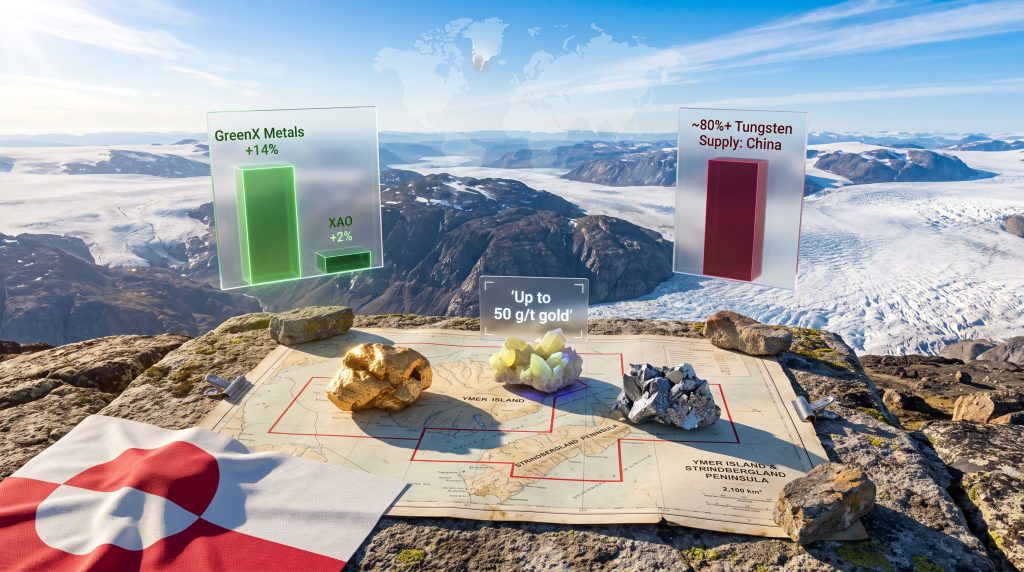
Following the granting of two additional exploration licences in 2026, the Eleonore North gold project now spans approximately 2,100 km² across four licences, covering portions of Ymer Island and the Strindbergland Peninsula in eastern Greenland. This expanded footprint represents an increase of 1,600 km² over the previous tenure.
| Project Parameter | Detail |
|---|---|
| Total Tenure Area | ~2,100 km² across four licences |
| New Area Added (2026) | 1,600 km² |
| Location | Eastern Greenland (Ymer Island and Strindbergland Peninsula) |
| Primary Target Commodities | Gold, tungsten, antimony |
| Historical Peak Assay | Up to 50 g/t gold |
| Ownership | 100% (revised acquisition agreement, July 2024) |
| Exploration Model Applied | Reduced Intrusion-Related Gold System (RIRGS) |
Key Prospects and Their Significance
The expanded licence area encompasses several distinct prospects, each with different levels of historical documentation:
-
Noa Prospect: Hosts confirmed outcropping gold mineralisation alongside high-grade antimony. This is the primary near-term focus for systematic follow-up and represents the most advanced target within the portfolio.
-
Margeries Prospect: Historical fieldwork documented high-grade tungsten and antimony at this location. The presence of scheelite (the tungsten-bearing mineral calcium tungstate) alongside antimony reinforces the RIRGS interpretation and makes this a high-priority evaluation target.
-
Newly Licensed Caledonian Intrusions: The 1,600 km² expansion secures exclusive access to a series of intrusions that represent genuinely untested ground under modern geological frameworks. These are not re-evaluations of previously drilled failures; they are targets where systematic modern sampling has simply never occurred.
The Arctic Rift Copper Project rounds out GreenX's Greenland portfolio, providing exposure to copper mineralisation that broadens the company's alignment with energy transition commodity themes beyond its core gold and critical minerals focus.
Tungsten and Antimony: Why These Minerals Command Strategic Attention
Supply Concentration and the Geopolitical Premium
Both tungsten and antimony carry Critical Raw Material designations from both the United States and the European Union, a classification that reflects their essential roles in defence, industrial, and emerging technology applications combined with highly concentrated supply chains dominated by China. Indeed, Greenland's strategic minerals have attracted increasing institutional attention precisely because the island sits within a politically stable, Western-aligned jurisdiction that can offer a credible alternative to Chinese-controlled supply chains.
| Mineral | Primary Industrial Uses | Supply Concentration Risk | Critical Designation Status |
|---|---|---|---|
| Tungsten | Defence alloys, aerospace components, cutting tools, high-strength industrial applications | China controls approximately 80%+ of global refined supply | US and EU Critical Raw Material |
| Antimony | Flame retardants, semiconductors, ammunition primers, emerging battery technology | Heavily concentrated in Chinese production | US and EU Critical Raw Material |
| Gold | Electronics, monetary reserves, jewellery | Broadly diversified global supply | Not formally designated critical |
China's implementation of export controls on tungsten has created measurable supply chain stress across Western defence and manufacturing sectors. The practical consequence is that projects hosting confirmed tungsten mineralisation in politically stable, Western-aligned jurisdictions are now evaluated not just on their geological merits but also on their strategic positioning within broader supply security frameworks.
What Most Investors Don't Know About Tungsten Economics
Tungsten's strategic importance stems from its physical properties, which make substitution in high-performance applications genuinely difficult. Unlike many industrial metals where alternative materials exist, tungsten's combination of extreme hardness, high melting point (the highest of any metal at approximately 3,422°C), and density creates applications where no commercially viable substitute currently exists. This physical irreplaceability underpins the strategic classification and gives tungsten exploration projects a fundamentally different demand profile compared to more commoditised metals.
Scheelite, the calcium tungstate mineral identified at Eleonore North's Margeries Prospect, is one of only two primary tungsten ore minerals (the other being wolframite). Scheelite-hosted tungsten deposits are generally considered more amenable to processing than wolframite deposits, a metallurgical characteristic that carries downstream economic relevance if a resource is ultimately defined.
The 2026 Field Season and What the Upcoming Results Could Mean
What Has Been Completed and What Comes Next
Reconnaissance sampling and geological mapping across both the existing and newly licenced tenure have been completed for the 2026 field season. The upcoming release of laboratory assay results will represent the first systematic modern evaluation of targets across the expanded 2,100 km² land package.
The results are anticipated to address several critical unknowns:
-
Whether stream sediment anomalism observed across the new licence areas is consistent with the RIRGS pathfinder suite seen at established prospects
-
Whether the historical assay value of up to 50 g/t gold at established targets reflects a coherent, spatially continuous mineralised system or isolated occurrences
-
The spatial relationship between gold, tungsten, and antimony anomalism across the full four-licence package
-
Whether any of the newly licenced Caledonian intrusions demonstrate geochemical signatures that justify elevation to priority drill target status
Investor perspective: First-pass assay results from 1,600 km² of previously untested ground constitute a meaningful information event. The binary nature of this outcome — either confirming multi-intrusion RIRGS-style anomalism or failing to do so — means these results will directly influence how the market prices the exploration inventory embedded in the expanded tenure.
The Staged Evaluation Pathway Beyond 2026
GreenX has outlined a disciplined, staged approach to evaluating the portfolio that extends well beyond the current assay result cycle:
- Near-Term (Q3-Q4 2026): Laboratory assay results from the 2026 field season released; priority drill targets identified across the newly licenced intrusion suite
- Medium-Term (2027): Metallurgical testwork to evaluate gold and tungsten recovery characteristics; potential maiden drill programme design and execution
- Longer-Term: Systematic evaluation of the mineral corridor extending across all company-controlled licences; potential maiden resource definition drilling contingent on drill programme outcomes
How GreenX's Approach Differs From Conventional Greenland Exploration
Greenland has attracted a growing community of explorers targeting the island's rare earth element deposits, particularly in southern Greenland where large ionic clay and carbonatite-hosted rare earth systems have drawn significant institutional attention. GreenX's strategy diverges meaningfully from this mainstream focus in two important respects.
First, the company's dual commodity thesis combining high-grade gold exploration with a genuine critical minerals angle in tungsten and antimony provides commodity diversification within a single project footprint. A gold discovery at Noa or Margeries carries intrinsic value independent of any critical mineral premium, while tungsten and antimony confirmation adds a strategic dimension that pure gold explorers cannot access. In addition, the broader context of European critical raw materials policy is actively reshaping which exploration jurisdictions attract institutional capital, with Western-aligned Arctic projects benefiting directly from this structural shift.
Second, the application of the RIRGS model to a previously unevaluated geological belt represents a methodological innovation rather than an incremental extension of existing exploration work. Successful application of this framework in analogous Caledonian terrains elsewhere in the North Atlantic region provides geological validation for the approach, even if direct geological comparators within Greenland itself are limited by the absence of prior modern exploration.
The four-licence package covering 2,100 km² also provides scale that is genuinely difficult to replicate in more mature exploration jurisdictions. Securing exclusive rights over an entire suite of intrusions before the geological thesis has been market-tested creates a land position that would be far more expensive and logistically complex to assemble at a later stage of the exploration cycle.
The next major ASX story will hit our subscribers first
GreenX Metals Market Performance: Context and Caveats
Over the 12 months to August 2026, GreenX Metals shares delivered approximately 14% appreciation, compared to roughly 2% for the All Ordinaries Index (ASX: XAO) over the same period. This differential reflects early-stage market recognition of the strategic value embedded within the Greenland portfolio, though it is important to contextualise this performance within the broader characteristics of small-cap exploration investing.
Junior explorers at the reconnaissance and early-stage sampling phase carry a risk profile that differs fundamentally from producing miners or even advanced developers. The primary risks include:
- Geological risk: Anomalism identified through surface sampling does not guarantee the presence of economically recoverable mineralisation at depth
- Capital market risk: Junior explorers are dependent on equity markets to fund ongoing programmes, and sentiment shifts can affect funding access
- Execution risk: Arctic exploration logistics introduce operational complexity and cost structures that differ from more accessible jurisdictions
- Commodity price risk: Gold and tungsten prices directly influence the economic thresholds that define a viable mineral resource
Furthermore, antimony supply risks have become an increasingly prominent consideration for institutional investors assessing the strategic value of dual-commodity exploration projects that carry both gold and antimony exposure within a single tenure footprint.
Risk Disclosure: This article contains general information only and does not constitute financial advice. Exploration-stage companies carry inherent geological, capital, and execution risks. Past share price performance does not guarantee future returns. Investors should conduct independent research and consider their personal financial circumstances before making investment decisions.
Structural Advantages That Define the Investment Thesis
Taken together, the GreenX Metals Greenland gold and critical minerals portfolio presents a combination of attributes that is relatively uncommon in the small-cap exploration universe:
| Attribute | Why It Matters |
|---|---|
| 2,100 km² four-licence tenure | Exploration scale rarely achievable in competitive jurisdictions |
| RIRGS model applied to undrilled intrusions | Genuine analytical first-mover advantage |
| Historical 50 g/t gold assays in public record | Low-cost baseline for modern target generation |
| Tungsten and antimony Critical Raw Material designations | Strategic commodity premium above pure geological value |
| 100% ownership structure | Full value capture from any discovery |
| Upcoming Q3 2026 assay results | Near-term catalyst with binary information value |
The intersection of a modern geological framework applied to a historically documented but never systematically followed-up mineral corridor, in a jurisdiction with sovereign stability and alignment with Western supply chain priorities, creates a thesis that operates simultaneously across geological, geopolitical, and market timing dimensions. For a broader perspective on Greenland's emerging role in global resource markets, Greenland's critical minerals potential has been the subject of growing analyst commentary as Western governments accelerate efforts to diversify away from Chinese-controlled supply chains.
Whether the 2026 field season assay results validate that thesis or require recalibration remains to be seen. However, the structural setup — a 2,100 km² first-mover position over an undrilled Caledonian intrusion suite with confirmed gold and critical mineral pathfinder suites — is precisely the kind of asymmetric exploration opportunity that the junior mining market was built to evaluate.
Want to Catch the Next Major ASX Mineral Discovery Before the Market Does?
Discovery Alert's proprietary Discovery IQ model delivers real-time alerts on significant ASX mineral discoveries — including critical minerals and gold exploration plays — instantly transforming complex geological data into actionable investment insights for both short-term traders and long-term investors. Explore how historic mineral discoveries have generated substantial returns and begin your 14-day free trial today to position yourself ahead of the broader market.