August 4, 2026
Why Geopolitical Chokepoints Are the Biggest Variable in Global Oil Pricing
When a single maritime corridor concentrates roughly one-fifth of the world's daily oil and liquefied natural gas flows, it becomes less of a trade route and more of a pressure valve for global energy markets. The Strait of Hormuz has long been understood by energy economists as the world's most consequential geographic bottleneck, but it takes a genuine supply disruption to reveal the full financial mechanics of that vulnerability. The U.S.-Iran conflict in 2026 provided exactly that — and the earnings results across the oil supermajor sector have made the consequences impossible to ignore.
Understanding why BP profit more than doubles amid Trump Big Oil criticism requires looking beyond a single quarterly report. It demands an examination of how geopolitical oil price drivers translate into margin at every point in the energy supply chain, how integrated oil majors monetise volatility in ways that pure producers cannot, and why political pressure from an unexpected source is now reshaping the narrative around fossil fuel earnings.
When big ASX news breaks, our subscribers know first
How the Iran Conflict Rewired Global Energy Economics
The Strait of Hormuz as a Financial Amplifier
The Strait of Hormuz is not simply a shipping lane. It is, in economic terms, a single point of failure for a significant portion of global energy supply. Approximately 20% of the world's oil and LNG transits this narrow passage daily, connecting the Persian Gulf's largest producers to markets across Asia, Europe, and beyond.
When conflict escalates in and around this corridor, the effect on pricing is immediate and disproportionate. Markets do not wait for actual barrel shortages to appear — traders, refiners, and governments begin pricing in the risk of future disruption, creating a supply risk premium that lifts crude benchmarks well above what current inventory levels alone would justify.
This is the mechanism that underpinned the dramatic earnings acceleration seen across the supermajor sector in the second quarter of 2026. Pre-conflict crude benchmarks gave way to materially elevated Q2 spot prices as fighting severely disrupted shipping through the strait, triggering a cascading effect across the upstream value chain. Furthermore, the crude oil price trends emerging from this period have reshaped how analysts model geopolitical risk into forward earnings estimates.
Trading Desks: The Hidden Engine of Supermajor Earnings
One of the least understood aspects of integrated oil major earnings is the role of commodity trading operations. Most coverage focuses on production volumes and upstream margins, but trading desks at companies like BP can generate returns that dwarf what barrels-in-the-ground alone would produce during periods of high volatility.
Oil trading operations at major integrated energy companies can produce exceptional financial results during supply disruption events, even when underlying production volumes remain essentially unchanged. This explains why earnings can surge dramatically without any meaningful increase in the number of barrels a company actually pumps out of the ground.
The mechanics work like this: trading desks profit from price differentials across time horizons (contango and backwardation structures), geographic arbitrage between regional markets, and directional positioning on futures contracts. When volatility compresses and expands rapidly, as it does during geopolitical crises, these positions generate outsized returns. Additionally, integrated majors can capture margin at multiple points simultaneously — extracting crude upstream, refining it mid-chain, and selling finished products at retail or wholesale. Each link in this chain adds margin capture that a pure-play exploration company simply cannot access.
Breaking Down BP's Q2 2026 Financial Performance
The Numbers Behind the Headlines
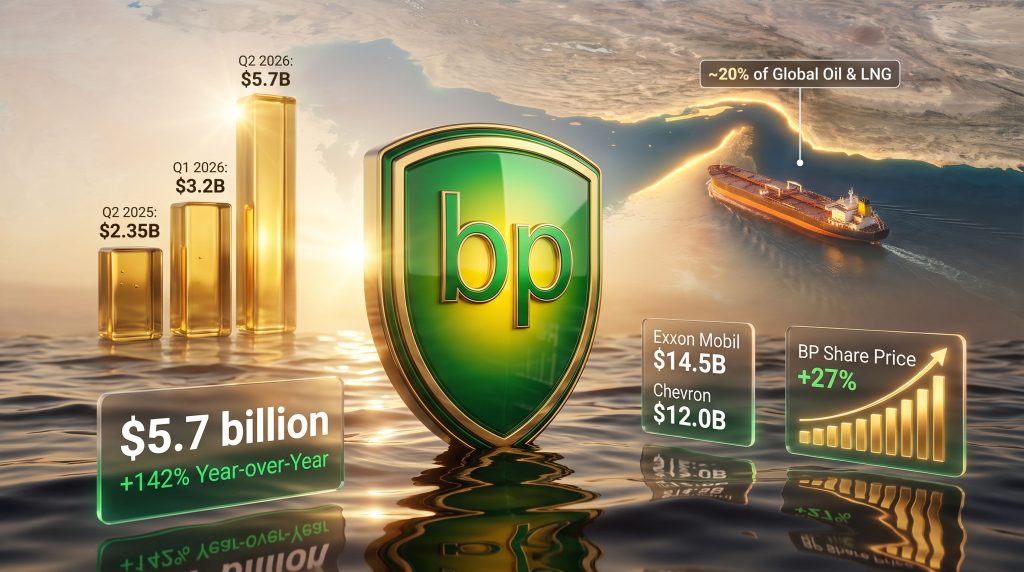
BP's underlying replacement cost profit of $5.7 billion for the April-to-June 2026 period represented a striking 142% increase year-over-year, surpassing the LSEG analyst consensus estimate of approximately $5.0 billion by roughly $700 million.
| Metric | Q2 2026 | Q2 2025 | Q1 2026 |
|---|---|---|---|
| Underlying Replacement Cost Profit | $5.7 billion | $2.35 billion | $3.2 billion |
| Analyst Consensus Estimate | ~$5.0 billion | — | ~$2.6 billion |
| Beat vs. Consensus | +$700 million | — | +$600 million |
| Year-over-Year Change | +142% | — | — |
| BP Share Price (YTD) | +27% | — | — |
The metric used here, underlying replacement cost profit, warrants specific explanation. Unlike standard GAAP net income, this measure strips out the effect of inventory price changes by valuing oil and gas sold at the cost of replacing those barrels rather than their historical acquisition cost. During periods of rapidly rising commodity prices, this approach removes a significant distortion from reported earnings, providing analysts and institutional investors with a cleaner read on operational performance. It is the preferred metric across the sector for precisely this reason.
How BP's Result Stacks Up Against Sector Peers
BP's performance did not occur in isolation. The earnings acceleration was a sector-wide phenomenon, reflecting macro conditions rather than company-specific operational brilliance alone.
| Company | Q2 2026 Profit | Year-over-Year Change |
|---|---|---|
| BP | $5.7 billion | ~+142% |
| Exxon Mobil | $14.5 billion | More than doubled |
| Chevron | $12.0 billion | ~+380% vs. $2.5B prior year |
Chevron's near-fourfold earnings increase is particularly striking and underscores how dramatically commodity price movement can amplify returns for companies with significant upstream exposure and active trading operations. When every major player in the sector simultaneously posts results of this magnitude, the cause is structural and macroeconomic, not a product of one company outperforming another.
The Political Paradox: Trump Turns on Big Oil
A Break from Traditional Alignment
Perhaps the most unusual dimension of this earnings cycle is the political pressure emanating from a traditionally pro-fossil-fuel administration. President Trump's public criticism of Exxon and Chevron for profiting excessively during the Iran conflict represents an ideologically significant departure from his administration's general posture toward the energy industry.
The core tension is straightforward. Trump has consistently championed domestic fossil fuel production as an economic and national security priority. Yet elevated crude prices create equally elevated pump prices, and high fuel costs generate direct household financial pain that resonates powerfully with his voter base. These two positions exist in fundamental conflict when geopolitical events drive oil prices sharply higher. In addition, the trade war impact on oil adds a further layer of complexity to an already volatile pricing environment.
Whether the administration's criticism of supermajor profits translates into substantive regulatory action or remains political rhetoric is the single most important scenario variable for energy sector investors to monitor through the remainder of 2026.
Historical precedent offers limited guidance here. U.S. presidents have occasionally threatened intervention in energy pricing, particularly during periods of consumer fuel price stress, but translating that rhetoric into enforceable action in commodity markets is legally and practically complex.
The DOJ Inquiry: Regulatory Risk Assessment
Reports of a Department of Justice inquiry into potential price gouging by major oil companies add a layer of regulatory risk to what would otherwise be a straightforwardly positive earnings narrative. The legal bar for establishing price gouging in commodity markets is, however, exceptionally high.
Key distinctions matter here:
- Market-driven price increases occur when supply constraints reduce available product relative to demand, pushing prices higher through standard competitive dynamics.
- Anti-competitive pricing behaviour requires evidence of collusion, market manipulation, or deliberate supply withholding to sustain artificial price levels.
- Commodity markets by their nature reflect global supply and demand signals rather than producer-controlled pricing, making individual company accountability for price levels legally difficult to establish.
The practical risk to BP specifically may be limited, as a UK-listed company with its primary operations outside the direct jurisdiction of the DOJ. However, the broader regulatory temperature this creates for the sector deserves monitoring, particularly regarding potential windfall profit tax discussions in both the UK and US legislative environments.
BP's CEO and the Consumer Price Dilemma
BP CEO Meg O'Neill addressed the political pressure directly in a televised appearance, acknowledging the genuine financial burden that elevated pump prices create for ordinary households. Her substantive point was that oil is a globally priced commodity, meaning no single producer controls the price at which their barrels trade.
The company's stated response focused on operational levers within its control: maximising reliability across upstream production assets and optimising refinery run configurations to prioritise diesel and jet fuel, the products experiencing the most acute consumer demand.
This response illustrates the strategic communication challenge facing energy executives in the current environment. Record profits and public empathy for consumer fuel costs are difficult to hold simultaneously, regardless of the legitimate market mechanisms driving both outcomes. Consequently, the safe-haven market response to this broader uncertainty has seen capital rotate into non-correlated assets alongside the energy sector rally.
BP's Simplification Strategy: Delivering on Its Promise
The Logic of Concentrating Capital in Core Assets
BP's strategic retreat from its earlier diversification into renewable energy assets has been a defining corporate narrative over the past 18 months. The financial logic behind this pivot is clearer in a high-price environment: upstream oil and gas operations and integrated refining assets generate materially superior returns during commodity supercycles than nascent renewable energy investments, which carry longer payback periods and lower near-term cash generation.
The simplification strategy rests on three pillars:
- Asset divestiture to generate cash and reduce complexity.
- Debt reduction to strengthen the balance sheet and improve financial flexibility.
- Cost base reduction through operational consolidation and headcount rationalisation.
The Gelsenkirchen Sale: Portfolio Rationalisation in Practice
The completed sale of BP's Gelsenkirchen refinery and associated businesses to Klesch Group is a tangible example of this strategy executing as intended. The transaction is projected to reduce BP's underlying annual operating expenditure by approximately $1 billion, a meaningful improvement to the structural cost base that will support earnings resilience even if commodity prices moderate.
Gelsenkirchen is one of Germany's largest refining facilities, and its divestiture signals BP's intent to exit European downstream infrastructure that does not align with its long-term asset concentration strategy. For Klesch, a commodity-focused investment firm, the acquisition represents an opportunity to operate a large-scale refinery at what may prove to be a favourable entry point in the asset cycle.
Governance Turbulence: The Manifold Dismissal
The abrupt removal of chairman Albert Manifold in May 2026, after only eight months in the role, introduced a complicating factor to BP's strategic execution narrative. The board cited serious concerns related to governance standards, oversight conduct, and internal processes. Manifold publicly disputed the allegations, creating an unresolved public dispute that institutional investors are watching carefully.
Governance instability at the board level can create uncertainty around strategic continuity and decision-making integrity, factors that often matter as much to long-term institutional investors as quarterly earnings performance.
BP has stated that stabilising its executive leadership structure is a priority, but until that resolution is demonstrably achieved, it represents a distinct risk category separate from the commodity price dynamics driving the current earnings cycle.
Three Scenarios for Energy Markets Through the Rest of 2026
How the Hormuz Situation Resolves Will Define Sector Earnings
The Strait of Hormuz, which has historically seen periodic tensions but rarely sustained disruptions at this scale, represents a structural vulnerability with no viable large-scale alternative routing for Gulf producers. The absence of a meaningful bypass option concentrates geopolitical risk in ways that differ from other global supply chains. Furthermore, OPEC's market influence over production quotas continues to interact with these disruption dynamics in ways that further complicate the pricing outlook.
| Scenario | Key Driver | Oil Price Implication | Supermajor Earnings Impact |
|---|---|---|---|
| Prolonged Conflict | Diplomatic stalemate persists | Elevated prices sustained | Continued high-margin quarters |
| Negotiated Ceasefire | U.S.-Iran diplomatic engagement | Meaningful price correction | Earnings normalisation |
| Escalation to Broader Conflict | Regional spillover into wider theatre | Extreme price spike | Short-term windfall, long-term demand destruction risk |
The Demand Destruction Counterforce
Sustained high energy prices are not indefinitely self-reinforcing. At sufficiently elevated levels, demand destruction begins to moderate consumption: industrial users shift processes or reduce output, consumers alter driving behaviour, and governments release strategic petroleum reserves or implement fuel subsidies to provide relief. Historically, this has acted as a natural ceiling on commodity price escalation.
More structurally significant is the argument that extended high price periods accelerate the adoption of alternative energy and electrification. If pump prices remain punishing for long enough, the economic case for electric vehicles and energy efficiency investment strengthens materially, potentially pulling forward demand destruction on a multi-year timeline. This is the longer-term risk embedded in the current supermajor earnings bonanza that few quarterly analyses adequately capture.
The next major ASX story will hit our subscribers first
Frequently Asked Questions
Why did BP's profit more than double in Q2 2026?
BP's underlying replacement cost profit rose to $5.7 billion, up from $2.35 billion in the same period of 2025, representing a 142% year-over-year increase. The primary drivers were elevated global crude and natural gas prices resulting from supply disruptions tied to the U.S.-Iran conflict, strong oil trading desk performance, and improved refinery throughput optimisation. Indeed, BP profit more than doubles amid Trump Big Oil criticism has become one of the defining financial stories of the year.
What makes the Strait of Hormuz so critical to oil prices?
Roughly one-fifth of the world's daily oil and LNG flows transit through this narrow maritime passage. Any disruption, whether through conflict, sanctions enforcement, or blockade activity, immediately creates a supply risk premium in global crude pricing that benefits every producer with barrels on the market.
What is a windfall profit tax and could it affect BP?
A windfall profit tax is a government levy on profits deemed to be excessive relative to normal market conditions, typically justified on the basis that the profit arose from extraordinary external circumstances rather than improved business performance. Several European governments applied such taxes to energy companies following the 2022 energy crisis. Whether similar legislative responses emerge in the UK or US in response to 2026 earnings levels remains an active risk for the sector to monitor.
What does BP's simplification strategy involve?
The strategy centres on divesting non-core assets, including refinery operations and earlier-stage renewable investments, to concentrate capital in BP's highest-margin oil and gas businesses, reduce net debt, and structurally lower the operating cost base. The Gelsenkirchen refinery sale is the most recent material transaction within this programme.
Key Takeaways for Energy Investors
- Geopolitical risk premiums are the dominant earnings driver in Q2 2026, not operational improvements in isolation.
- Oil trading desks can generate returns that far exceed what production volumes suggest during supply disruption events, making integrated majors qualitatively different investment vehicles from pure-play producers.
- Political pressure on supermajors is intensifying from an unexpected direction, with potential regulatory tail risks requiring ongoing monitoring.
- BP's simplification strategy is delivering measurable cost reductions, with the Gelsenkirchen sale representing approximately $1 billion in annualised operating cost reduction.
- Governance stability at BP remains an active watch item for institutional investors despite the positive earnings backdrop.
- The Strait of Hormuz scenario will remain the most consequential macro variable for energy sector earnings through the balance of 2026.
Disclaimer: This article is intended for informational purposes only and does not constitute financial advice. Energy sector earnings and commodity prices are subject to significant volatility driven by geopolitical, regulatory, and macroeconomic factors. Past earnings performance is not indicative of future results. Readers should conduct their own due diligence before making investment decisions.
Want to Stay Ahead of the Next Major Resource Discovery Before the Market Catches On?
While geopolitical disruptions continue to reshape commodity markets and energy sector earnings, Discovery Alert's proprietary Discovery IQ model delivers real-time alerts on significant ASX mineral discoveries, translating complex resource data into actionable investment insights — explore the historic returns major discoveries have generated and begin your 14-day free trial to position yourself ahead of the broader market.