
August 4, 2026
When the Safety Net Fails: Rethinking Gold's Role in Crisis Portfolios
For generations of investors, gold has occupied a near-mythological position in portfolio theory. It was the asset that held firm when everything else collapsed, the financial equivalent of a storm shelter. But what happens when the shelter itself develops cracks? A growing body of academic research now challenges the assumption that gold functions as a reliable universal safe haven, and the evidence emerging from the Covid-19 pandemic era is forcing a fundamental reassessment of how investors should construct crisis-resilient portfolios.
Understanding why this matters requires stepping back from the immediate question of gold's price performance and examining what a true safe haven is actually supposed to do. Furthermore, the pandemic may have permanently altered gold's relationship with broader financial markets, making it essential to revisit the concept of gold safe haven after Covid-19 through a fresh analytical lens.
When big ASX news breaks, our subscribers know first
What Makes an Asset a True Safe Haven?
In modern portfolio theory, a safe haven asset must satisfy a specific and demanding set of criteria. It cannot simply preserve value in isolation. It must actively move in opposition to, or at minimum independently of, the riskier assets it is meant to protect against. This inverse or uncorrelated behaviour is precisely what gives a safe haven its defensive utility.
Historically, gold earned this designation through consistent performance across multiple crisis periods. During geopolitical shocks, financial system stress events, and inflationary episodes spanning decades, gold tended to attract capital flows as investors fled equities and other risk assets. This pattern reinforced its reputation so thoroughly that gold's safe haven status became almost an axiom of conventional investment wisdom.
For an asset to genuinely qualify as a safe haven, three conditions broadly need to hold:
- Its correlation with equity markets must remain low or negative during periods of stress
- It must be sufficiently liquid to absorb large capital inflows without distorting its own price mechanics
- Its protective behaviour must be consistent across different types of market disruption, not merely selective
The Covid-19 pandemic tested all three of these conditions simultaneously, and the results were deeply instructive. For additional context on these dynamics, gold safe haven insights from recent market analysis offer a useful complement to the academic evidence.
Gold's Two-Phase Pandemic Performance: A Study in Divergence
Phase One: Gold Behaves as the Textbooks Predicted
During the initial shock phase of the pandemic, spanning roughly from December 2019 through to mid-March 2020, gold performed largely as investors expected. As equity markets absorbed the first wave of pandemic anxiety, gold maintained its inverse relationship with risk assets. Multiple independent analyses confirm that during this early window, gold demonstrated the kind of protective characteristics its reputation promised.
This phase was characterised by a relatively clean flight-to-safety dynamic. Uncertainty was high, but the nature of the crisis was still being processed by markets. Gold responded to that uncertainty in textbook fashion.
Phase Two: Liquidity Pressures Shatter the Correlation
Everything changed from mid-March 2020 onward. As the pandemic evolved from a health crisis into a full-scale economic emergency, financial markets experienced acute liquidity stress. Institutional investors and funds facing margin calls and redemption pressures were forced to liquidate whatever assets they could sell, including gold.
This broad-based liquidation dynamic drove correlations between gold and major equity sectors sharply higher, precisely the opposite of what a safe haven is supposed to do. The protective relationship broke down not because gold fundamentally changed in nature, but because the type of crisis had shifted from uncertainty-driven fear to liquidity-driven panic. Research published by the World Gold Council confirms that safe haven demand surged initially before these liquidity dynamics took hold.
Research from the University of Cape Town's Department of Finance and Tax indicates that gold's deterioration as a safe haven asset extended well beyond the acute crisis phase, with structural realignment in how gold co-moves with financial markets persisting into the post-pandemic period.
The Research Framework: Hard vs. Soft Commodities Across US Sectors
The UCT study offers one of the more comprehensive examinations of commodity safe haven behaviour across the pandemic timeline. Researchers examined two distinct commodity categories against a broad set of major US industry sectors, using two sophisticated quantitative techniques to track how co-movement patterns shifted across pre-pandemic, pandemic, and post-pandemic windows.
The Commodity Universe Examined
| Commodity Type | Assets Included |
|---|---|
| Hard Commodities | Gold, Silver, Platinum |
| Soft Commodities | Corn, Soybeans, Wheat, Livestock |
The Sector Benchmarks Used
- Energy
- Healthcare
- Real Estate
- Technology
- Financials
- Industrials
- Consumer Discretionary
- Consumer Staples
The dual-methodology statistical approach is important from a research validity standpoint. By cross-validating findings using two separate quantitative techniques, the researchers significantly strengthened the reliability of their conclusions. Single-method studies in this domain are vulnerable to methodology-specific distortions, and the dual approach mitigates that risk meaningfully.
Sector-by-Sector: Where Gold's Safe Haven Status Collapsed
Financials and Industrials: The Most Pronounced Breakdown
Post-pandemic analysis revealed that gold began moving in closer alignment with financial and industrial sectors, two of the very sectors it was historically expected to buffer investors against. This shift toward positive co-movement represents a structural inversion of gold's traditional protective role. When a safe haven starts trending with the assets it is supposed to offset, its defensive utility effectively disappears.
Energy and Consumer Discretionary: A Partial Exception Worth Noting
Optimal portfolio modelling revealed a nuanced picture for energy and consumer discretionary exposures. For these specific sector combinations, gold's ideal portfolio allocation actually increased during the pandemic period. This finding is significant because it suggests gold did not lose all defensive utility uniformly. Rather, its effectiveness became sector-dependent in a way that blanket allocations could not capture.
Healthcare and Consumer Staples: The Counterintuitive Finding
Perhaps the most surprising result of the research concerns sectors that investors might intuitively assume would benefit most from gold exposure during a health crisis. For healthcare and consumer staples portfolios, optimal modelling showed that the ideal gold allocation actually decreased during the pandemic. This directly contradicts the assumption that gold is an appropriate hedge across all defensive sectors.
Portfolio Implication: Gold's hedging value during Covid-19 proved to be sector-dependent rather than universal. Investors who held gold as a blanket crisis hedge across all exposures were likely less protected than they assumed, and in some cases may have inadvertently increased their correlation risk.
Precious Metals Compared: Silver and Platinum Follow the Same Trajectory
Gold's deteriorating performance was not an isolated anomaly. Both silver and platinum exhibited strikingly similar patterns, with increased positive co-movement with major industry sectors undermining their defensive credentials.
| Metal | Pre-Pandemic Safe Haven Status | Post-Pandemic Trajectory |
|---|---|---|
| Gold | Strong and well-established | Deteriorated, now sector-dependent at best |
| Silver | Moderate | Weakened through increased sector co-movement |
| Platinum | Moderate | Weakened through increased sector co-movement |
This convergence across all three precious metals is analytically significant. It suggests the breakdown was not specific to gold's unique market dynamics but reflects a broader structural shift in how precious metals as a group relate to equity sector behaviour in the post-pandemic environment. Furthermore, the industrial demand components of silver and platinum, which tie them more closely to economic cycle fluctuations than gold, may have amplified this effect. Investors interested in exploring these relationships further will find the gold-silver ratio analysis particularly useful for contextualising these divergences.
The next major ASX story will hit our subscribers first
The Unexpected Revelation: Agricultural Commodities as Crisis Diversifiers
Corn and Soybeans: Modest but Measurable Safe Haven Properties
One of the more striking findings from the research concerns assets that rarely appear in sophisticated portfolio conversations: agricultural commodities. Corn and soybeans demonstrated measurable, if modest, safe haven characteristics during the pandemic period. Optimal portfolio modelling indicated that increasing allocations to corn and wheat across all sector exposures during Covid-19 would have meaningfully reduced portfolio risk, challenging the conventional hierarchy of crisis assets entirely.
The mechanism here is worth understanding. Agricultural commodity prices respond to a distinct set of drivers compared to equities and precious metals. Weather patterns, planting cycles, global food demand, and supply chain logistics influence prices in ways that are structurally less correlated with financial market stress. During a pandemic that disrupted industrial activity and financial systems without immediately destroying agricultural supply chains, this independence provided genuine diversification value.
Wheat: A Conditional Diversifier
Wheat demonstrated safe haven characteristics as well, though with less consistency than corn and soybeans. Its protective value appeared to vary across different sector exposures, making it a conditional rather than universal diversifier. This context-dependence parallels gold's own situation, though agricultural commodities maintained better overall defensive credentials across the pandemic period.
Livestock: The Soft Commodity That Failed
Not all agricultural commodities passed the safe haven test. Livestock was the sole soft commodity that failed to demonstrate meaningful crisis protection properties. Like precious metals, livestock showed increased positive coherence with sectors during and after the pandemic, reducing its diversification value in precisely the periods when it would have been most needed.
Soft Commodity Safe Haven Comparison
| Soft Commodity | Safe Haven Evidence | Consistency | Portfolio Implication |
|---|---|---|---|
| Corn | Yes, weak but real | Moderate-High | Increased allocation beneficial across all sectors |
| Soybeans | Yes, weak but real | Moderate-High | Increased allocation beneficial across all sectors |
| Wheat | Yes, weak | Moderate | Sector-dependent utility |
| Livestock | No | Low | Reduced diversification value post-pandemic |
What Optimal Portfolio Construction Looks Like Now
The Pre-Pandemic vs. Pandemic Portfolio Divergence
The shift in optimal portfolio construction between pre-pandemic and pandemic periods is stark. Pre-pandemic models leaned heavily on gold and precious metals as the primary crisis buffer, reflecting decades of empirical support for that approach. During Covid-19, however, optimal modelling shifted toward higher soft commodity weightings, particularly corn and wheat, across virtually all sector combinations.
This is not a minor adjustment at the margin. It represents a fundamental reordering of which asset classes carry the most defensive weight in a crisis-optimised portfolio.
The Case for Multi-Asset Diversification Beyond Precious Metals
The research carries a clear implication for investors who have relied on gold as a single-asset crisis buffer. Concentrating defensive allocations in any one asset, regardless of its historical reputation, creates a form of concentration risk that becomes most dangerous during precisely the systemic shocks when diversification is most needed. In addition, exploring broader commodity diversification strategies can provide a practical framework for restructuring crisis-resilient portfolios.
A more resilient approach would incorporate:
- A reduced but retained gold allocation for its long-term store-of-value properties and partial inflation hedge characteristics
- Supplementary agricultural commodity exposure through liquid instruments such as commodity ETFs or futures-based funds
- Sector-aware allocation decisions that recognise gold's hedging value is not uniform across all equity exposures
- Regular reassessment of correlation structures, given that the post-pandemic realignment of precious metal co-movement with equities may continue to evolve
Strategic Note: The UCT findings do not argue for abandoning gold entirely. Rather, they make a compelling case for repositioning gold as one component within a broader diversification architecture, rather than treating it as a standalone, all-weather crisis shield.
The Conditional Safe Haven Framework: A More Accurate Mental Model
Why the Binary Question Gets the Analysis Wrong
The persistent debate over whether gold is or is not a safe haven may itself be framing the question incorrectly. The binary formulation forces a yes-or-no answer to what is fundamentally a conditional and context-dependent relationship. Academic research increasingly supports what might be called the conditional safe haven framework, where an asset's protective value is assessed relative to the type of crisis, the duration of the stress event, and the specific portfolio exposure being hedged.
Under this framework, gold retains genuine value in specific scenarios while offering far less protection in others. Consequently, understanding gold as a strategic investment within this conditional context becomes far more actionable than treating it as a binary safe haven designation.
Why Covid-19 Was a Structurally Different Crisis
The pandemic differed from prior crisis events in ways that were particularly damaging to gold's protective mechanics. Unlike geopolitical tensions or financial system failures, which tend to channel capital flows in predictable directions, Covid-19 generated simultaneous supply and demand shocks across virtually every sector of the global economy at the same time. This multi-directional disruption overwhelmed gold's traditional inverse relationship with equity markets in ways that more focused crises historically did not.
Historical Crisis Performance in Context
| Crisis Type | Gold's Safe Haven Performance |
|---|---|
| Geopolitical tensions, pre-2020 | Generally strong |
| 2008 Global Financial Crisis | Strong initially, weakened during liquidity crunch |
| Covid-19 Phase I, early shock | Performed broadly as expected |
| Covid-19 Phase II, extended pandemic | Deteriorated significantly |
| Post-pandemic structural period | Continued deterioration, per UCT research |
Frequently Asked Questions: Gold as a Safe Haven After Covid-19
Is gold still considered a safe haven in 2026?
Gold retains its long-term reputation as a store of value over extended time horizons, but recent academic research suggests its short-to-medium-term safe haven reliability has weakened materially, particularly during systemic crises. Its effectiveness in 2026 appears sector-specific and crisis-type-dependent rather than universal. Academic perspectives, such as those available through Vantage Markets' analysis, reinforce this nuanced view of gold's evolving role.
Which commodities outperformed gold as safe havens during the pandemic?
Agricultural commodities, specifically corn and soybeans, and to a lesser extent wheat, demonstrated measurable safe haven characteristics during the pandemic period. They outperformed gold, silver, and platinum as portfolio diversifiers in optimal risk-reduction modelling.
Did gold lose all defensive value during Covid-19?
Not entirely. Gold retained hedging utility for specific sector exposures, particularly energy and consumer discretionary portfolios, where optimal allocation modelling actually favoured increased gold weightings during the pandemic. Its failure was one of universality, not complete ineffectiveness.
Why did gold's protective power weaken during the pandemic?
The pandemic-era liquidity crisis forced broad-based asset liquidations across institutional portfolios, driving correlations between gold and equity sectors sharply higher. This liquidity-driven co-movement undermined gold's traditional inverse relationship with financial markets in a way that conventional uncertainty-driven crises typically do not.
Should investors still hold gold in 2026?
Gold may continue to serve a role as a partial inflation hedge and long-term store of value. However, the evidence from the post-pandemic period suggests investors should consider supplementing gold with a broader range of diversifying assets, including agricultural commodity instruments. Furthermore, an exchange-traded commodities guide can help investors identify practical instruments for implementing these broader diversification strategies.
Key Takeaways: Building Crisis-Resilient Portfolios in the Post-Gold Era
The research emerging from the post-pandemic academic literature carries several practical implications that investors should integrate into their thinking regarding gold safe haven after Covid-19:
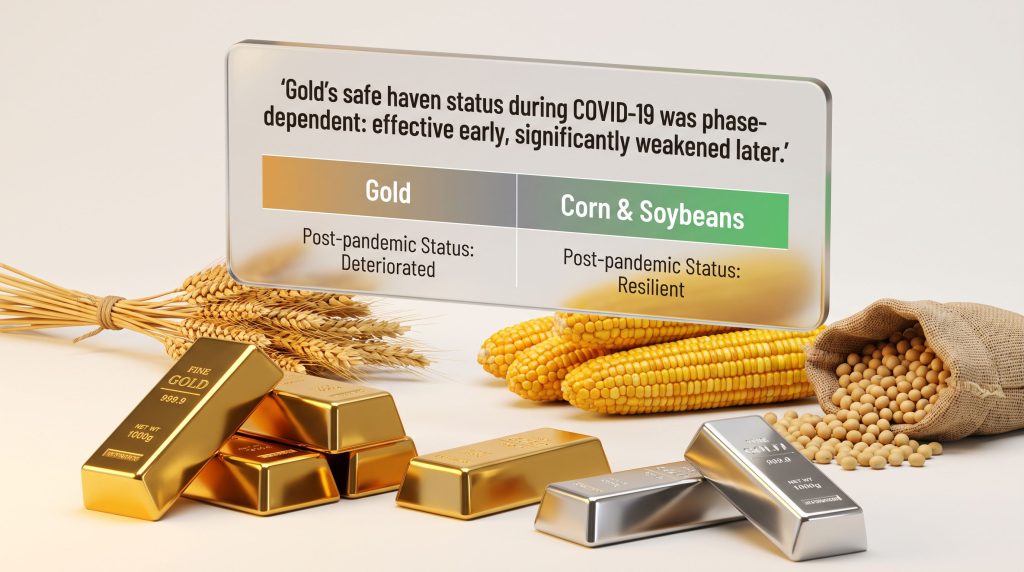
- Gold's protective performance during the pandemic was phase-dependent: broadly effective in the early shock period, significantly weakened as the pandemic extended and liquidity pressures intensified
- Silver and platinum followed a similar trajectory, with all three precious metals showing increased positive co-movement with financial sectors post-pandemic, reducing their universal diversification value
- Agricultural commodities, particularly corn and soybeans, demonstrated superior diversification properties during the pandemic relative to traditional precious metal safe havens
- Optimal portfolio construction during Covid-19 favoured higher soft commodity allocations and sector-specific gold weightings, challenging the pre-pandemic assumption of blanket precious metal exposure
- The broader implication for investors is a need to move beyond the gold-as-universal-safe-haven assumption toward multi-asset, context-aware diversification strategies that account for both crisis type and sector-specific correlation dynamics
Disclaimer: This article is intended for informational and educational purposes only and does not constitute financial advice. Commodity markets are subject to significant volatility and past performance of any asset class, including gold, is not indicative of future results. Investors should consult a qualified financial adviser before making allocation decisions. The research findings referenced reflect academic modelling outputs and should be considered alongside a full range of market perspectives.
Want to Know Which Commodity Discoveries Are Creating Real Opportunities Right Now?
While academic research continues to reshape how investors think about crisis-resilient portfolios and commodity diversification, Discovery Alert's proprietary Discovery IQ model delivers real-time alerts on significant ASX mineral discoveries across gold, agricultural commodities, and more than 30 other commodities — instantly transforming complex market data into actionable insights for investors at every level. Explore Discovery Alert's discoveries page to see how historic mineral discoveries have generated substantial returns, and begin your 14-day free trial today to position yourself ahead of the broader market.