
June 22, 2026
The Hidden Mechanics Behind Energy Conglomerate Pivots in Uncertain Markets
There is a particular moment in the lifecycle of any large integrated energy company when the accumulation of external pressures becomes too significant to manage through conventional hedging alone. At that point, strategic pivots are no longer optional — they become existential. Understanding how global oil demand dynamics, geopolitical fragmentation, and domestic policy turbulence interact to force this kind of repositioning is essential for anyone tracking Asia's energy sector heading into FY2026-27.
Reliance Industries Limited, in its FY26 annual report, has formally flagged that it expects the coming fiscal year to be exceptionally difficult for oil markets. Reliance warns of a volatile oil market in FY27, and when a company contributing approximately 30% of India's domestic gas production uses language this direct, investors and analysts should pay close attention to both the warning and the strategic bet embedded within it.
When big ASX news breaks, our subscribers know first
Three Converging Forces Making FY27 a Pressure Test for Oil Markets
The conditions shaping the FY27 oil market outlook are not the result of any single disruption. They represent the simultaneous activation of three distinct risk categories, each capable of distorting markets on its own, but collectively creating conditions that are genuinely difficult to navigate. Furthermore, understanding each force individually is essential before examining how they interact.
1. Geopolitical Infrastructure Damage With Long Recovery Timelines
Ongoing conflict in the Middle East has caused measurable physical damage to refinery and oil infrastructure. Unlike financial or logistical disruptions that can resolve within weeks, physical infrastructure destruction operates on entirely different timescales. Reconstruction of refinery assets can span multiple quarters, meaning the product supply losses already incurred will continue reverberating through global fuel markets well into FY27.
The geopolitical oil pressures stemming from these regional conflicts have been cited explicitly by Reliance as a primary source of continued market volatility, with extended recovery timelines compounding supply uncertainty across the region.
2. Demand-Side Erosion Driven by Elevated Crude Prices
Persistently high crude prices are functioning as a demand suppressor across key consuming economies. The feedback loop is straightforward: elevated input costs raise end-product prices, which constrains consumption, particularly in price-sensitive emerging markets. Consequently, global oil demand growth is forecast to remain weak through 2026, with some projections suggesting a marginal decline in absolute demand growth rather than the moderate expansion that characterised previous cycles.
The broader oil price movements driven by trade tensions are amplifying this demand-side erosion, adding further complexity to an already difficult supply-demand equation for integrated refiners.
3. India-Specific Policy Variables Creating Domestic Headwinds
Separate from global dynamics, domestic policy instruments are introducing their own layer of earnings uncertainty. The Special Additional Excise Duty (SAED) is a mechanism that allows the Indian government to adjust the effective tax rate applied to domestically produced petroleum products. When SAED rates are raised, the net realisation per barrel of refinery output compresses directly, irrespective of global crude movements.
Additionally, directives governing petrochemical feedstock usage and duty exemptions on select imported petrochemical products are reshaping the competitive landscape for domestic producers. These three policy levers, operating in combination, represent a non-trivial source of margin risk that operates independently of crude price cycles. Moreover, the effects of tariffs and consumer prices filtering through domestic energy policy are adding another dimension of unpredictability to the already complex operating environment.
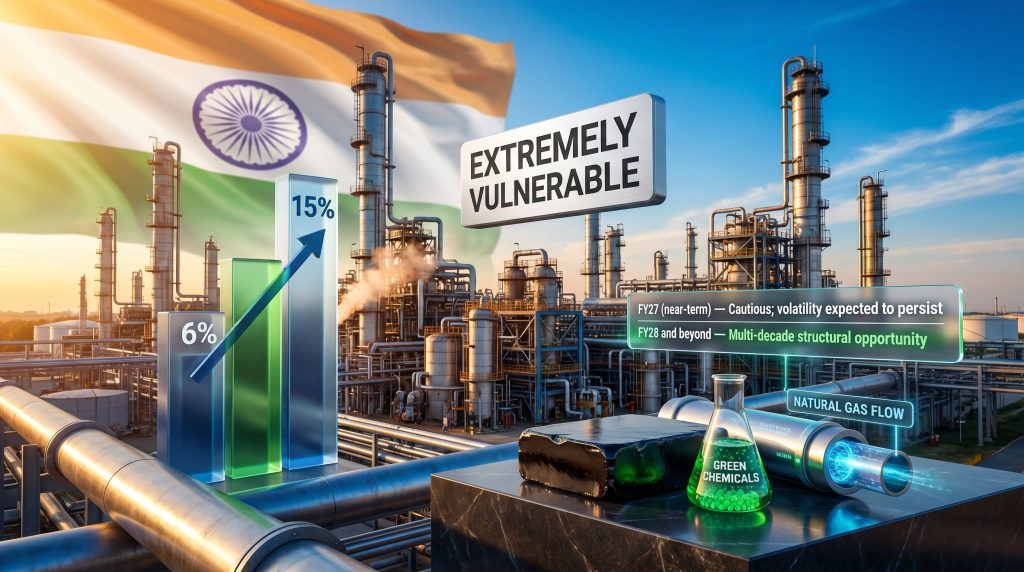
Reliance Industries has characterised the FY2026-27 operating environment as extremely vulnerable to the convergence of geopolitical, macroeconomic, and policy-driven pressures — a level of directness rarely deployed in annual report language from a company of this scale.
Understanding Refining Margin Mechanics in a Disrupted Supply Environment
What Are Fuel Crack Spreads and Why Do They Matter?
For investors less familiar with refining economics, the concept of crack spreads is central to understanding how refinery profitability is determined. A crack spread represents the margin difference between the cost of crude oil input and the market value of the refined products extracted from it — primarily gasoline, diesel, and jet fuel. When crude supply is disrupted or constrained, crack spreads tend to widen because refined product prices remain elevated while crude input availability tightens.
The current environment, characterised by Middle East infrastructure damage and constrained global refining capacity additions, is creating conditions where crack spreads remain elevated in the near term. However, as global supply chains gradually recover, these spreads are expected to compress back toward historical norms, which is precisely why the FY27 outlook combines both near-term opportunity and medium-term margin pressure. As reported by OilPrice.com, Reliance has explicitly warned that tariff uncertainty compounds this volatility, threatening the broader stability of oil market conditions.
How Policy Instruments Reshape the Margin Equation
| Risk Factor | Mechanism | Expected Impact on Margins |
|---|---|---|
| SAED policy adjustments | Direct taxation on domestic refinery output | Reduces net realisation per barrel |
| Petrochemical feedstock directives | Constrains crude slate flexibility | Limits margin optimisation capacity |
| Duty exemptions on petrochemical imports | Raises competitive pressure on domestic producers | Compresses downstream product spreads |
| Middle East supply disruptions | Tightens global refined product availability | Short-term spread support, medium-term uncertainty |
The Structural Moat: Why Complex Refining Architecture Changes the Risk Profile
Not all refineries face equivalent exposure to these pressures. Refining complexity, measured by the Nelson Complexity Index, determines how many different crude grades a refinery can process and how many high-value product streams it can extract. Higher complexity refineries can process cheaper, heavier, and sourer crude grades that simpler facilities cannot handle, creating a structural cost advantage that widens during periods of crude market volatility.
Reliance operates one of the most complex refining systems globally. This architecture delivers several compounding advantages:
- The ability to source crude from a broader range of suppliers reduces dependency on any single supply corridor
- Processing heavier crudes, which typically trade at a discount to benchmark grades, lowers input costs relative to peers
- Higher-value product extraction rates improve realisation per barrel processed
- Flexibility in crude slate selection allows the refinery to respond dynamically to relative price movements across crude grades
This operational design does not eliminate margin pressure during difficult market conditions, but it materially reduces the severity of that pressure relative to less sophisticated regional competitors.
Beyond Oil: The Gas Transition Thesis That Underpins Reliance's Long-Term Positioning
India's Gas Expansion: The Numbers Behind the Structural Shift
While the near-term oil market outlook is characterised by caution, Reliance's longer-term strategic positioning is anchored in a fundamentally different thesis: India's transition toward a higher natural gas energy mix. The energy transition demand dynamics at play across the broader Asian energy landscape are directly reinforcing this strategic direction.
The numbers defining this opportunity are significant:
- Natural gas currently accounts for approximately 6% of India's total energy mix
- The Indian government has targeted an increase to 15% by 2030, representing more than a doubling of gas's proportional role in the national energy economy
- Reliance contributes approximately 30% of India's total domestic gas production, making it the single largest domestic producer
This is not a marginal growth opportunity. Moving from 6% to 15% within the energy mix of a country at India's scale of energy consumption requires an enormous absolute increase in gas volumes. Maintaining a 30% production share while the overall market more than doubles means Reliance's gas business faces a structural demand tailwind largely independent of global commodity price cycles.
Coal Bed Methane: An Often-Overlooked Production Asset
Within Reliance's gas portfolio, Coal Bed Methane deserves specific attention as a less commonly understood asset class. CBM refers to natural gas extracted from coal seams, typically at shallower depths than conventional or deepwater gas reservoirs. The extraction mechanism is fundamentally different from conventional gas production: water must first be pumped from the coal seam to reduce pressure and allow the adsorbed methane to desorb from the coal matrix and flow toward the wellbore.
CBM operations are characterised by:
- Lower individual well flow rates compared to conventional gas wells
- A production profile that typically improves over the first several years before declining
- Substantially lower drilling and infrastructure costs than deepwater assets
- High correlation with India's onshore basin geology, where coal seams are distributed across multiple states
The combination of deepwater gas assets, which offer high-volume production capacity, with CBM assets, which provide geographic and geological diversification, creates a more resilient gas production portfolio than either asset class could deliver independently.
Captive Value Creation and the Green Chemicals Transition
Rethinking the Refinery-to-Chemicals Value Chain
One of the more strategically sophisticated aspects of Reliance's FY27 positioning is the emphasis on captive value creation — which refers to the internal consumption of feedstocks across an integrated refining and petrochemicals platform rather than selling intermediate products at commodity prices into external markets.
The logic is compelling. When a refinery produces naphtha, for example, it can either sell that naphtha as a commodity into global markets at prevailing prices, or it can process that naphtha internally through a cracker unit into ethylene, propylene, and other petrochemical building blocks. Those downstream products typically command higher margins and are subject to different demand dynamics than the upstream commodity feedstock.
By maximising internal conversion rather than external commodity sales, the integrated platform captures more of the value chain rather than surrendering margin to intermediate market participants. According to detailed analysis from The Hindu BusinessLine, Reliance has explicitly flagged margin pressure and global uncertainty for its oil-to-chemicals business in FY27, reinforcing the strategic urgency of maximising captive conversion.
Green Chemicals: The Intersection of Industrial Demand and Decarbonisation Pressure
The expansion into green chemicals represents a longer-horizon strategic investment that connects Reliance's existing industrial infrastructure with the accelerating global trend toward supply chain decarbonisation. In addition, the broader renewable energy transition reshaping industrial sectors globally is creating new competitive dynamics that Reliance is positioning to capitalise on through its green chemicals programme.
Green chemicals are industrial chemical products manufactured using renewable feedstocks, bio-based inputs, or significantly lower-carbon production processes compared to conventional petrochemical routes. The demand drivers for these products are structurally different from conventional petrochemicals:
- Global manufacturers facing Scope 3 emissions accounting requirements are incentivised to substitute conventional chemical inputs with lower-carbon alternatives
- Consumer goods companies operating under sustainability mandates are increasingly specifying green chemical content in their supply chains
- Regulatory frameworks in the European Union and other major markets are beginning to price the carbon intensity of manufactured goods, creating cost advantages for producers using lower-emission inputs
Reliance's existing petrochemical infrastructure provides a meaningful head start in this transition. Converting established production assets toward greener feedstock and process pathways is substantially less capital-intensive than constructing entirely new green chemistry capacity from scratch.
The next major ASX story will hit our subscribers first
Short-Term vs. Long-Term: Reading Reliance's Strategic Time Horizon
| Time Horizon | Primary Variable | Reliance's Stated Position |
|---|---|---|
| FY27 near-term | Global oil demand, refining margins, geopolitical risk | Cautious; significant volatility expected |
| FY27 first half | Middle East disruption premium on crack spreads | Conditional upside if spread elevation persists |
| FY28 and beyond | Gas transition, green chemicals, CBM ramp-up | Constructive; structural demand growth anticipated |
| Long-term | Integrated platform maturity | Financial self-sufficiency and captive value maximisation |
When a company of Reliance's scale and analytical capability uses the term "multi-decade opportunity" to describe its energy and materials business outlook, it is signalling a fundamental reorientation of capital allocation priorities, not simply a tactical response to near-term commodity cycles.
Why Domestic Gas Production Share Creates Systemic Leverage
There is a dimension to Reliance's approximately 30% domestic gas production share that extends beyond straightforward market share analysis. When a single producer accounts for nearly one-third of a nation's domestic output in a strategically critical commodity, it acquires a degree of systemic importance that influences regulatory relationships, infrastructure planning, and long-term offtake visibility in ways that smaller producers cannot replicate.
India's city gas distribution network expansion, industrial gas corridors, and LNG terminal buildout are all predicated on domestic supply availability. A producer operating at Reliance's scale has the ability to structure long-term supply agreements, participate in infrastructure co-investment, and engage with regulatory bodies as a systemic counterparty rather than as a price-taking commodity supplier. This positional advantage compounds over time as gas infrastructure deepens and switching costs for downstream consumers increase.
Key Takeaways for Investors Monitoring the FY27 Energy Landscape
- Near-term oil market headwinds are acknowledged directly — Reliance warns of a volatile oil market in FY27, representing an unusually candid assessment of the operating environment
- Complex refining architecture provides a structural buffer against margin compression that simpler regional refiners cannot access
- SAED and petrochemical policy instruments represent a distinct, India-specific earnings risk factor that operates independently of global crude price movements
- The gas transition from 6% to 15% of India's energy mix by 2030 creates a multi-year volume growth tailwind that is structurally independent of oil price cycles
- CBM assets provide an often-underappreciated onshore production base that diversifies the gas portfolio's geological and operational risk profile
- Green chemicals expansion positions the company at the intersection of industrial demand growth and accelerating global supply chain decarbonisation requirements
- 30% domestic gas production share confers systemic leverage in regulatory relationships and long-term infrastructure planning that is difficult to replicate at smaller production scales
This article is intended for informational purposes only and does not constitute financial advice. Forecasts, projections, and strategic assessments described herein are subject to material uncertainty and should not be relied upon as the sole basis for investment decisions. Readers should conduct independent research and consult qualified financial advisers before making investment decisions.
For ongoing coverage of India's energy transition and the evolving dynamics of the domestic gas market, ET EnergyWorld provides detailed reporting and analysis at energy.economictimes.indiatimes.com.
Want to Stay Ahead of the Next Major Resource Discovery?
While Reliance Industries navigates the complexities of global energy markets, Discovery Alert's proprietary Discovery IQ model scans ASX announcements in real time, instantly identifying significant mineral discoveries across more than 30 commodities — from energy to critical minerals — and delivering actionable alerts directly to subscribers. Explore how historic discoveries have generated extraordinary returns and begin a 14-day free trial to position yourself ahead of the broader market.