June 22, 2026
The Hidden Architecture of Global Tungsten Dependency
Most commodity markets operate on the assumption that price signals will eventually attract new supply. Tungsten does not follow this logic. Its geological scarcity outside of a single dominant producer, combined with the extraordinary technical barriers to substitution, means that supply concentration risks accumulate silently until a geopolitical flashpoint makes them impossible to ignore. That moment has now arrived, and a mine in northern Vietnam sits at the centre of the response.
Understanding why the Masan tungsten mine expansion in Vietnam has captured the attention of investors across four continents requires stepping back from the transaction itself and examining the structural forces that have made non-China tungsten one of the most strategically sensitive commodity positions in the world.
When big ASX news breaks, our subscribers know first
Why Tungsten Is Different From Every Other Critical Mineral
Tungsten holds the highest melting point of any known metal at 3,422 degrees Celsius, a physical property that makes it genuinely irreplaceable rather than merely preferred in a range of industrial and defence applications. Unlike lithium or cobalt, where substitution research is active and commercially viable alternatives exist in certain use cases, tungsten's thermal and mechanical properties have resisted decades of materials science efforts to find a replacement.
The strategic importance of tungsten becomes clear when examining its applications across several entirely distinct demand sectors:
-
Defence manufacturing: Tungsten forms the core of kinetic energy penetrators, armour-piercing projectiles, and high-density warhead components. The metal's extreme density, roughly 1.7 times that of lead, makes it the material of choice for munitions designed to defeat modern armour.
-
Semiconductor fabrication: In chip manufacturing, tungsten is used as a contact plug and interconnect material within the multilayer architecture of advanced logic chips. As node geometries shrink, the precision required in tungsten deposition increases, and so does its criticality.
-
Industrial tooling: Cemented tungsten carbide, produced by combining tungsten with carbon and a metallic binder, forms the cutting edges of drill bits, milling tools, and mining equipment used globally. Roughly 60% of tungsten consumption flows into this application category, according to the British Geological Survey.
-
Electronics and energy: Tungsten filaments, electrodes, and thermal management components appear across lighting, X-ray tubes, and high-temperature industrial processes.
The structural reality of tungsten demand is that it is simultaneously a defence-critical material, a technology-critical material, and an industrial-critical material. Few other elements sit at the intersection of all three categories.
China's Production Dominance and the Supply Concentration Problem
China accounts for an estimated 80% or more of global tungsten mine production, a concentration level that exceeds its dominance in most other critical minerals. The country also controls the overwhelming majority of global tungsten processing capacity, meaning that even ore extracted outside China often flows back into Chinese refining infrastructure before reaching end users.
This processing dependency is a less-discussed but equally important vulnerability. A country might technically produce tungsten ore yet remain structurally dependent on Chinese processing for ammonium paratungstate (APT), the intermediate product from which most downstream tungsten materials are derived.
Western governments began formally classifying tungsten as a critical mineral over the past decade. The United States Geological Survey includes it on the US critical minerals list, while the European Union's Critical Raw Materials Act designates tungsten as a strategic raw material requiring domestic supply chain development. Furthermore, the broader critical minerals demand surge across defence and technology sectors has intensified pressure on governments to act. These classifications create policy frameworks, but they do not automatically create new mines.
Vietnam's Emergence as the World's Second-Largest Producer
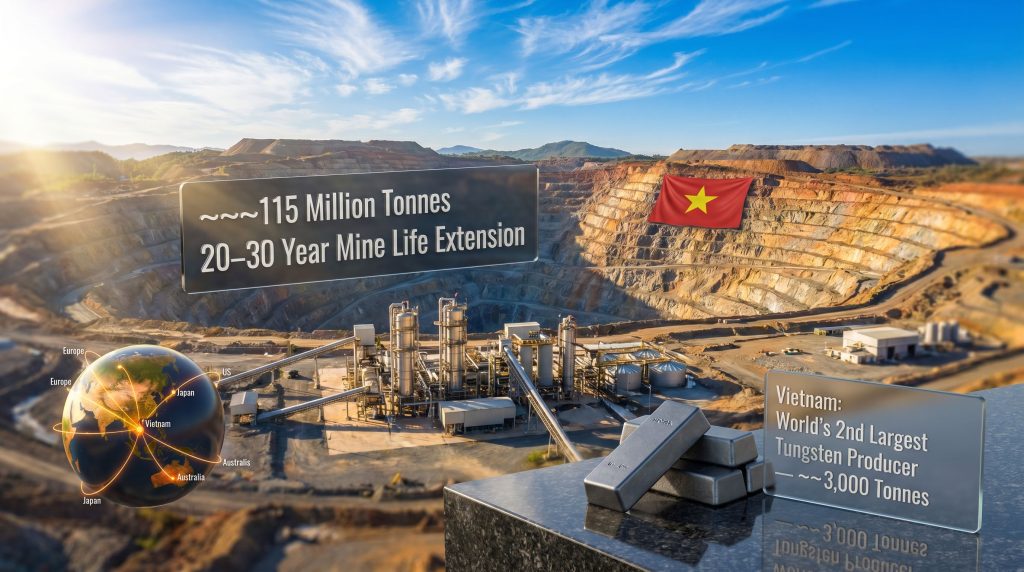
Against this backdrop, Vietnam's position in global tungsten supply takes on considerable significance. According to the US Geological Survey, Vietnam ranked as the world's second-largest tungsten producer in the most recent reporting year, with estimated annual output of approximately 3,000 tonnes. This places it far behind China in absolute volume, but meaningfully ahead of every other non-China jurisdiction.
This is not a recently discovered resource endowment. Vietnam's tungsten geology is well-characterised, and the Nui Phao mine in Thai Nguyen province has been producing tungsten chemicals on an industrial scale for several years. What has changed is the geopolitical context surrounding that production, and the scale of expansion now being contemplated.
The Nui Phao Complex: Scale, Geology, and Polymetallic Economics
The Nui Phao operation, operated by Masan High-Tech Materials, sits within a licensed area of approximately 921 hectares in northern Vietnam. The deposit is classified as a skarn-type tungsten-bismuth-fluorite-copper mineralisation system, a polymetallic geological structure that provides meaningful economic diversification relative to pure tungsten operations.
Skarn deposits form at the contact zones between intrusive igneous rocks and carbonate-bearing sedimentary sequences. The metasomatic alteration processes that create these zones concentrate tungsten in the form of scheelite (calcium tungstate), alongside other economically recoverable minerals. This geological character explains both Nui Phao's richness and its complexity to process, requiring integrated chemical processing rather than simple physical concentration.
The expansion announced by Masan encompasses two distinct components:
| Resource Component | Scale |
|---|---|
| Additional ore targeted at existing Nui Phao pit | ~28 million tonnes |
| West pit resource potential | ~20-21 million tonnes |
| Adjacent Nui Chiem site combined total | ~115 million tonnes (Nui Phao + Nui Chiem) |
| Implied mine life extension | 20-30 years |
The adjacent Nui Chiem site represents the most transformational element of the expansion thesis. Bringing this resource into the production envelope effectively converts Nui Phao from a single-pit operation with a defined depletion timeline into a multi-decade critical minerals platform. Regulatory and legal processes for new area approvals are currently progressing, with underground and adjacent mineralisation exploration forming part of the near-term operational roadmap.
A critical but underappreciated structural advantage of this expansion is the existing on-site processing infrastructure. Masan High-Tech Materials already operates tungsten chemical processing facilities at the site, converting ore into APT and downstream tungsten products. New ore volumes from Nui Chiem can be directed through this existing infrastructure, substantially reducing the capital intensity of expansion compared to a greenfield development requiring both mining and processing construction from scratch.
The Capital Strategy: Who Masan Is Courting and Why
Masan Group, the parent company, is exploring the sale of up to a 5% stake in its mining division to international investors. Active negotiations are reportedly underway with prospective investors from Japan, Australia, Europe, and the United States — a geographic spread that is itself analytically significant.
| Investor Region | Strategic Rationale |
|---|---|
| Japan | Major consumer of tungsten carbide tooling and electronics components; acute awareness of Chinese supply chain risks following rare earth disruptions in 2010 |
| Australia | Active critical minerals investment policy framework; strategic interest in diversifying regional supply chains |
| Europe | EU Critical Raw Materials Act designates tungsten as strategic; automotive and defence sector demand |
| United States | Defence Industrial Base exposure to tungsten in munitions programs; Congressional pressure to reduce Chinese mineral dependency |
The investor geography maps almost perfectly onto the alliance structure of nations most exposed to Chinese tungsten supply disruption. Japan's experience during the 2010 rare earth embargo, when China temporarily restricted exports in response to a territorial dispute, remains a reference point for industrial policy planners across the Indo-Pacific. In addition, considerations around critical minerals and energy security are driving these same governments to accelerate non-Chinese supply chain partnerships.
The 5% stake being offered is deliberately sized to attract strategic rather than purely financial investors. At this scale, incoming capital partners gain meaningful commercial relationships and supply chain optionality without triggering the ownership thresholds that would require formal foreign investment screening in most jurisdictions.
How Are Offtake Agreements Shaping the Investment Case?
Securing long-term tungsten offtake agreements with end users in defence and advanced manufacturing is increasingly central to how critical mineral projects attract institutional capital. For Nui Phao, the combination of processing integration and strategic investor interest creates a foundation from which formal offtake structures can be negotiated at scale.
The next major ASX story will hit our subscribers first
The HOSE Listing: Governance Upgrade as an Investment Catalyst
Simultaneously with the expansion and stake sale process, Masan High-Tech Materials is preparing to transition from Vietnam's Unlisted Public Company Market (UPCoM) to the Ho Chi Minh City Stock Exchange (HOSE), with a target timeline of as early as the first quarter of 2027.
This listing upgrade matters for several reasons that go beyond conventional capital markets mechanics:
-
Price discovery transparency: A main-board listing provides a publicly observable reference price for the company's equity, which is essential for calibrating the valuation of any strategic stake transaction.
-
Institutional investor eligibility: Many institutional funds are restricted from holding positions in unlisted or lightly regulated market segments. A HOSE listing expands the eligible investor universe dramatically.
-
Governance signalling: The disclosure requirements and corporate governance standards associated with a major stock exchange listing provide foreign investors with greater confidence in reporting quality and minority shareholder protections.
-
Liquidity pathway: For strategic investors acquiring a 5% position, the existence of a liquid secondary market provides an eventual exit mechanism that would not exist in an unlisted structure.
According to reporting from The Business Times, Masan High-Tech Materials is actively courting foreign investors ahead of this planned mainboard listing, positioning the company's tungsten assets as a direct play on the AI-driven demand surge for critical materials used in advanced chip fabrication.
Geopolitical Risk Dimensions: The Chinese Acquisition Concern
Reporting from 2025 indicated that Western officials had raised concerns about the potential for Chinese-linked entities to acquire control or significant influence over the Nui Phao complex. This concern reflects a broader pattern of Chinese industrial policy targeting non-China critical mineral assets to extend upstream supply chain influence beyond its own borders.
The active courtship of Western-aligned capital from Japan, Australia, Europe, and the United States can be interpreted partly as a deliberate ownership structuring strategy, designed to establish non-Chinese strategic stakes that would complicate or prevent subsequent Chinese acquisition attempts. Concerns around tungsten in defence and aerospace applications have, consequently, become a primary driver of government-level interest in securing non-Chinese sources of supply.
Risk Note: Investors considering any involvement in this asset should be aware that the strategic sensitivity of Nui Phao as one of the world's largest non-China tungsten operations means ownership changes may attract regulatory scrutiny from multiple jurisdictions, including potential foreign investment review processes in investor home countries. This is not a guarantee of approval for any specific transaction structure.
Competitive Positioning: How Nui Phao Compares in the Non-China Tungsten Landscape
| Evaluation Criterion | Nui Phao Assessment |
|---|---|
| Resource scale | Large – 115Mt combined target across two sites |
| Mine life visibility | High – 20-30 year extension potential |
| Processing integration | Yes – APT and tungsten chemical processing on-site |
| Geological type | Skarn deposit – polymetallic with multiple revenue streams |
| Geopolitical alignment | Favourable – Vietnam not subject to Western sanctions |
| Liquidity pathway | Improving – planned HOSE listing target Q1 2027 |
| Regulatory risk | Moderate – new area approvals still in progress |
Few non-China tungsten operations can compete with Nui Phao across all of these dimensions simultaneously. The combination of scale, processing integration, and multi-decade mine life creates a profile that is structurally rare in the global tungsten landscape.
Other notable non-China tungsten operations, including assets in Canada, Portugal, and Korea, either lack the resource scale, the processing infrastructure, or the regulatory certainty to serve as systemic alternatives to Chinese supply. Furthermore, soaring tungsten prices are adding fresh commercial impetus to the Nui Phao sale process, reinforcing the asset's appeal to investors seeking exposure to constrained, strategically critical supply.
Vietnam's Industrial Ambition and the Value Chain Question
The expansion framing used by Masan's leadership explicitly connects the Nui Phao development to Vietnam's broader national industrial policy direction, linking resource extraction with domestic deep processing and the generation of higher value-added output within the country's borders. This framing positions the project as consistent with Vietnam's ambitions to move up the critical minerals value chain rather than simply exporting raw or intermediate materials.
This mirrors strategies being actively pursued by other resource-rich nations. Australia's critical minerals processing push, Indonesia's nickel export restrictions designed to force domestic smelting investment, and Morocco's phosphate processing strategy all reflect the same underlying logic: extracting more economic value from mineral endowments by capturing downstream processing margins domestically.
For foreign investors, this policy orientation creates both opportunity and constraint. The opportunity lies in partnering with a processing-integrated asset that already captures downstream value. The constraint is that Vietnam's national interest in maintaining domestic value capture will likely shape the terms under which foreign capital can participate. The Masan tungsten mine expansion in Vietnam must therefore be evaluated with this policy context firmly in view.
Key Takeaways for Investors and Industry Observers
The Masan tungsten mine expansion in Vietnam represents a convergence of geological, geopolitical, and financial factors that rarely align so cleanly in the critical minerals sector:
- Vietnam produces an estimated 3,000 tonnes of tungsten annually, ranking second globally behind China according to the US Geological Survey
- The combined Nui Phao and Nui Chiem resource target of approximately 115 million tonnes transforms the operational horizon of one of the world's most significant non-China tungsten operations
- A potential 20-30 year mine life extension repositions the asset from a depleting operation into a long-duration critical minerals platform
- Existing on-site APT processing infrastructure provides substantial capital efficiency advantages for the expansion
- Active investor negotiations span Japan, Australia, Europe, and the United States, reflecting tungsten's elevated strategic status across defence, semiconductor, and industrial sectors
- A planned HOSE listing targeting Q1 2027 will improve governance transparency and institutional investor accessibility
- The skarn-type polymetallic geology at Nui Phao provides revenue diversification that single-commodity tungsten operations cannot match
Disclaimer: This article is for informational purposes only and does not constitute financial or investment advice. Investors should conduct their own due diligence and seek independent professional advice before making any investment decisions. Resource estimates, timelines, and financial projections discussed herein are subject to change and involve inherent uncertainty.
Want to Stay Ahead of the Next Major Critical Minerals Discovery?
Discovery Alert's proprietary Discovery IQ model scans ASX announcements in real time, instantly identifying significant mineral discoveries across tungsten, rare earths, and more than 30 other commodities — transforming complex geological data into actionable investment insights for both short-term traders and long-term investors. Explore how historic mineral discoveries have delivered extraordinary returns on Discovery Alert's dedicated discoveries page, and begin your 14-day free trial today to position yourself ahead of the broader market.