August 6, 2026
Federal land exchange policies in the United States have evolved into sophisticated mechanisms for balancing public resource access with conservation imperatives. These frameworks, primarily governed by the Federal Land Policy and Management Act of 1976, create pathways for strategic resource development while maintaining environmental stewardship. The Resolution Copper land exchange project exemplifies how these policies function as instruments of national resource security, requiring Congressional authorization for transactions involving significant mineral deposits on federal lands.
Federal Land Exchange Mechanisms Shape Strategic Resource Access
Understanding how federal land exchange policies operate requires examining the complex regulatory architecture that governs public lands management. Congressional authorization becomes necessary when proposed exchanges involve substantial mineral resources or exceed standard administrative thresholds established under FLPMA.
The Resolution Copper land exchange project demonstrates this process in practice. Initial legislation passed in 2014 with bipartisan support, yet the actual land transfer required twelve years to complete, concluding in March 2026. This timeline reflects the extensive stakeholder consultation requirements and legal challenges inherent in federal resource development projects.
| Exchange Component | Resolution Copper Case Study |
|---|---|
| Congressional Authorization | Required due to scale and strategic significance |
| Environmental Assessment | Multi-year process with conservation offsets |
| Stakeholder Consultation | Tribal governments, local communities, environmental groups |
| Legal Challenge Period | Appeals process through federal court system |
| Implementation Timeline | 12 years from authorization to completion |
The mechanisms underlying these exchanges involve complex appraisal protocols that assess both the economic value of mineral resources and the environmental significance of conservation lands. Federal agencies must demonstrate that exchanges provide equal value while advancing broader national interests in resource security and environmental protection.
Strategic precedent analysis reveals that successful federal land exchanges in extractive industries typically require sustained political support across multiple administrations, comprehensive stakeholder engagement, and robust legal frameworks that withstand judicial review. The Resolution Copper land exchange project survived appeals to the US Court of Appeals for the Ninth Circuit, which sided with the federal government on March 13, 2026, demonstrating the importance of thorough legal preparation in complex resource development projects.
When big ASX news breaks, our subscribers know first
Investment Threshold Economics Drive Underground Copper Development
Mega-scale underground mining projects operate under fundamentally different economic parameters than surface operations. Investment thresholds for deep underground copper development typically require initial capital commitments exceeding $500 million, with operational horizons extending beyond twenty years to achieve acceptable risk-adjusted returns.
The Resolution Copper land exchange project illustrates these economics through its announced $500 million investment over two years for enabling works. This pre-development capital focuses on surface drilling for resource assessment, community support programs, infrastructure improvements, and initial underground development. The investment creates approximately 100 new jobs during this phase, representing the preliminary economic impact before major construction begins.
Furthermore, effective copper investment strategies must account for the comprehensive regulatory framework governing such projects. The mining permitting process requires extensive documentation and stakeholder engagement, particularly when dealing with federal land exchanges of this magnitude.
Critical Investment Benchmarks: Projects requiring substantial initial capital investment demand multi-decade operational certainty and comprehensive regulatory approval to satisfy institutional investor requirements for underground mining ventures.
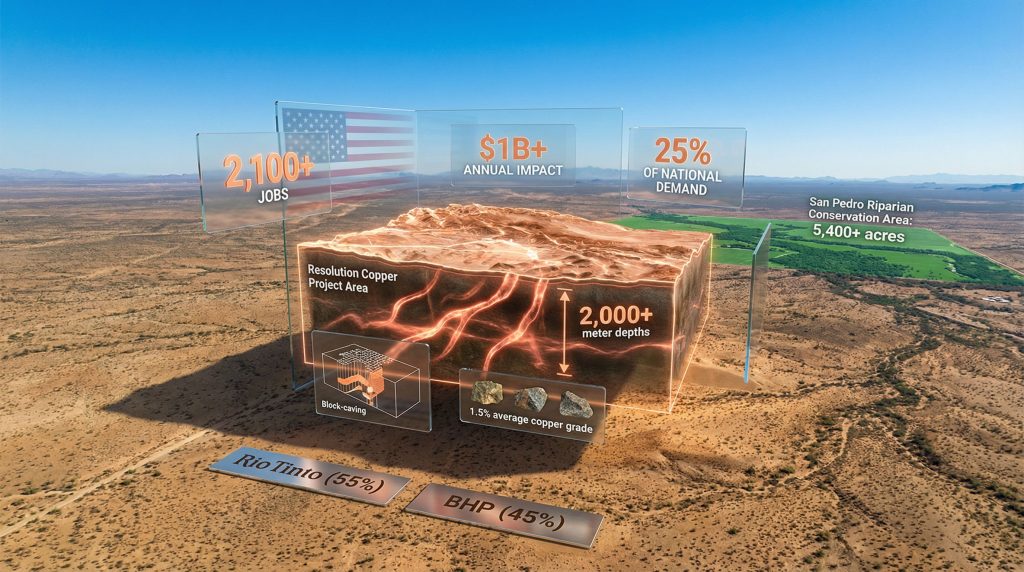
Economic impact modeling reveals the progression from pre-development through full operations. Current pre-development activities generate localised employment and economic activity, while full operational capacity projects annual economic contributions of $1 billion to Arizona's economy according to Rio Tinto statements. This represents a significant economic multiplier effect for regions historically dependent on mining activities.
The project's positioning as capable of satisfying up to 25% of America's copper demand for decades demonstrates the strategic economic significance driving investment decisions. Such capacity represents substantial import substitution potential, particularly as domestic demand for copper increases through electrification and renewable energy infrastructure development.
| Development Phase | Employment Impact | Economic Activity |
|---|---|---|
| Pre-Development | 100 jobs | $50M+ annual activity |
| Construction | Projected 1,000+ jobs | $200M+ annual activity |
| Full Operations | Thousands of jobs | $1B+ annual impact |
Risk-adjusted return calculations for underground copper projects must account for commodity price volatility, regulatory compliance costs, and infrastructure development requirements. The twelve-year timeline from Congressional authorization to land exchange completion demonstrates how regulatory certainty affects investment risk profiles and project economics.
Cultural Heritage Considerations Create Complex Stakeholder Dynamics
Sacred site conflicts and cultural heritage preservation requirements introduce systematic project risks that extend far beyond traditional environmental impact assessments. Federal consultation obligations under the National Environmental Policy Act and National Historic Preservation Act create mandatory stakeholder engagement processes that can significantly influence project timelines and operational parameters.
The Resolution Copper land exchange project demonstrates these dynamics through extensive consultations with Native American Tribes and local communities, including the Town of Superior. The twelve-year implementation timeline partly reflects the complexity of balancing resource development with cultural heritage protection. The project transferred 5,400 acres of culturally significant land to National Conservation Areas, creating permanent protection for sites important to tribal communities.
What triggers federal consultation obligations?
Projects on federal lands requiring environmental impact statements automatically trigger consultation requirements with affected tribal governments under Section 106 of the National Historic Preservation Act.
How do sacred site designations affect project timelines?
Sacred site considerations can extend consultation periods significantly, as demonstrated by the Resolution Copper land exchange project timeline, requiring comprehensive cultural impact assessments and mitigation measures.
What mitigation measures satisfy cultural preservation requirements?
Acceptable mitigation typically involves land transfers to conservation status, funding for cultural preservation programs, and ongoing tribal involvement in project monitoring.
Stakeholder alignment strategies in major resource projects require multi-party negotiation frameworks that address diverse interests simultaneously. The Resolution Copper approach involved direct engagement with tribal governments, local municipalities, and environmental organisations throughout the development process. This comprehensive engagement model helps identify potential conflicts early and develop collaborative solutions.
Moreover, the importance of gold and copper exploration in maintaining America's strategic resource security cannot be overstated. Additionally, recent developments in the US mineral executive order highlight the growing federal emphasis on domestic resource development.
Legal challenge probability modeling suggests that projects involving federal land exchanges face elevated litigation risk, particularly when cultural heritage sites are involved. The successful defence of the Resolution Copper land exchange through the federal appeals process demonstrates the importance of thorough legal preparation and comprehensive stakeholder engagement in mitigating these risks.
Underground Mining Technology Enables Large-Scale Operations
Advanced underground mining technologies have evolved to support mega-scale operations at depths previously considered economically unfeasible. Modern block caving and sublevel caving methods enable efficient extraction from large, low-grade ore bodies while minimising surface environmental impact.
The Resolution Copper land exchange project represents one of the world's largest undeveloped copper deposits, requiring sophisticated underground mining approaches to access ore bodies located at significant depth. The project's focus on underground development rather than open-pit mining reduces surface disturbance while enabling extraction from extensive ore zones.
| Mining Method | Efficiency Characteristics | Environmental Impact |
|---|---|---|
| Block Caving | High-volume, low-cost extraction | Minimal surface disturbance |
| Sublevel Caving | Selective ore recovery | Reduced waste generation |
| Infrastructure Requirements | Extensive underground development | Long-term operational capability |
Production scale optimisation for underground operations requires comprehensive ore grade analysis and processing capacity planning. While specific grade information for Resolution Copper requires verification from technical reports, the project's scale suggests substantial copper content capable of meeting significant portions of national demand over multi-decade operational periods.
Technical feasibility assessments for deep underground development must address unique challenges including ventilation systems, water management, and materials handling at depth. Modern mining technology enables operations at previously prohibitive depths through advanced automation, remote monitoring, and safety systems designed for challenging underground environments.
Environmental footprint minimisation through underground methods offers significant advantages over surface mining approaches. In addition, the mining sustainability transformation demonstrates how modern projects like Resolution Copper integrate environmental stewardship with resource extraction through underground focus and associated land exchange benefits.
Domestic Production Strengthens Supply Chain Resilience
Strategic resource security analysis reveals how domestic copper production capability reduces import dependency and enhances supply chain resilience during geopolitical disruptions. The Resolution Copper land exchange project's potential to satisfy up to 25% of national copper demand represents substantial import substitution opportunity.
National Security Implications: Domestic copper production at this scale strengthens supply chain resilience by reducing dependence on international sources during periods of geopolitical uncertainty or trade disruption.
Market positioning assessment indicates that North American copper production benefits from transportation cost advantages, regulatory predictability, and established infrastructure networks. These competitive advantages become particularly valuable as global supply chains face increasing disruption risks.
The project's location near historic mining infrastructure provides additional logistical benefits through existing transportation corridors and processing capabilities. Arizona's established mining industry creates synergies for workforce development, equipment availability, and technical expertise.
Copper demand projections driven by electrification trends, renewable energy infrastructure, and electric vehicle adoption create favourable long-term market conditions for domestic production. The Resolution Copper project's multi-decade operational horizon aligns with these demand growth trajectories, supporting investment viability.
Furthermore, Resolution Copper has maintained transparency throughout the process, providing regular updates on project milestones and community engagement initiatives.
Export opportunity evaluation suggests that excess production beyond domestic consumption could serve North American markets, further enhancing the project's strategic value. Regional market integration creates additional revenue diversification opportunities while maintaining supply security benefits.
Environmental Offset Programs Create Conservation Value
Conservation land portfolio analysis demonstrates how well-structured land exchanges can generate net environmental benefits while enabling resource development. The Resolution Copper exchange created a positive conservation outcome through the transfer of 5,400 acres of environmentally sensitive land to National Conservation Areas.
| Conservation Component | Acreage | Environmental Benefit |
|---|---|---|
| San Pedro Riparian Area | Portion of 5,400 acres | Critical habitat protection |
| Las Cienegas Conservation Area | Portion of 5,400 acres | Ecosystem connectivity |
| Cultural Site Preservation | Integrated protection | Heritage conservation |
| Net Conservation Gain | 3,000+ acres | Permanent federal protection |
Biodiversity impact assessment reveals that conservation area expansion provides habitat connectivity improvements and species protection benefits that exceed the environmental impact of controlled underground mining operations. The permanent federal protection status ensures long-term conservation management under professional stewardship protocols.
Environmental offset programs in federal land exchanges must demonstrate equivalent or superior conservation value compared to areas allocated for resource development. The Resolution Copper exchange achieved this standard through careful site selection focusing on riparian corridors and culturally significant landscapes.
Long-term conservation management protocols ensure that transferred lands receive appropriate federal stewardship, including habitat monitoring, public access maintenance, and protection enforcement. These management frameworks provide sustainable conservation outcomes while enabling responsible resource development.
The next major ASX story will hit our subscribers first
Regulatory Pathway Optimisation Reduces Development Risk
Effective navigation of complex regulatory environments requires systematic approaches to permitting, stakeholder engagement, and compliance management. The Resolution Copper project's twelve-year journey from Congressional authorisation to land exchange completion illustrates both the challenges and successful strategies for managing regulatory complexity.
What permits are required beyond the land exchange?
Additional permits include mining permits from state agencies, water use permits, air quality permits, and various federal environmental compliance certifications.
How do state and federal requirements interact?
Federal land exchanges enable access, while state agencies regulate mining operations, creating dual jurisdiction requirements that must be coordinated throughout the development process.
What triggers additional environmental review?
Significant changes to operational plans, expansion beyond approved boundaries, or new environmental concerns can trigger supplemental environmental assessment requirements.
Stakeholder engagement protocols that proved successful include early and continuous consultation with tribal governments, transparent communication with local communities, and proactive environmental organisation dialogue. This comprehensive approach helps identify concerns before they become formal legal challenges.
Compliance risk mitigation strategies involve establishing robust environmental monitoring systems, maintaining detailed reporting protocols, and implementing adaptive management frameworks that respond to changing regulatory requirements or environmental conditions.
Consequently, the successful defence against legal challenges through the federal appeals process demonstrates the value of thorough legal preparation and comprehensive stakeholder engagement in regulatory pathway optimisation.
Joint Venture Structures Optimise Capital Allocation
Partnership structures in mega-scale mining projects enable risk distribution while combining complementary capabilities from multiple industry participants. The Resolution Copper joint venture between Rio Tinto (55%) and BHP (45%) demonstrates how strategic partnerships optimise capital allocation and technical expertise.
Risk distribution analysis shows how joint venture structures share financial exposure across development phases while combining operational expertise from different organisational backgrounds. This partnership model enables projects to access larger capital pools while distributing technical and market risks.
Strategic synergy identification includes combining Rio Tinto's copper expertise with BHP's operational capabilities, creating enhanced technical capacity for complex underground development. Technology sharing opportunities and market access optimisation provide additional partnership benefits.
Decision-making authority allocation in joint ventures requires clear governance frameworks that enable efficient operational management while respecting partner interests. The Resolution Copper structure provides operational clarity while maintaining strategic alignment between major stakeholders.
Future Scenarios Shape Long-Term Viability
Commodity market scenario modelling indicates favourable long-term demand conditions for copper driven by electrification trends, renewable energy infrastructure development, and electric vehicle adoption. These structural demand drivers support multi-decade operational viability for major copper projects.
Copper demand growth projections suggest sustained price support over operational timeframes relevant to the Resolution Copper land exchange project. Electric vehicle adoption curves and renewable energy deployment rates create baseline demand scenarios that justify substantial capital investments in domestic copper production.
Regulatory environment evolution trends indicate continued emphasis on environmental stewardship and tribal consultation requirements, making early-stage stakeholder engagement increasingly valuable for project success. The Resolution Copper approach provides a framework for managing these evolving requirements.
Technology disruption assessment suggests that mining automation and processing efficiency improvements will enhance operational economics over time. Environmental monitoring innovations provide opportunities for improved regulatory compliance and operational optimisation.
However, the Resolution Copper land exchange project establishes important precedents for balancing resource development with environmental stewardship and cultural heritage protection. The successful completion demonstrates that comprehensive stakeholder engagement, robust legal preparation, and long-term commitment can achieve complex federal land exchanges while creating positive conservation outcomes.
Strategic implications for future resource development policy include the demonstrated viability of Congressional authorisation for strategically significant projects, the importance of environmental offset programs in achieving stakeholder alignment, and the value of sustained multi-party engagement throughout extended development timelines.
Investment and development decisions involve substantial risks and uncertainties. This analysis is for informational purposes only and should not be considered investment advice. Readers should conduct independent research and consult qualified professionals before making investment or business decisions.
Looking to Capitalise on Strategic Resource Development?
Discovery Alert's proprietary Discovery IQ model delivers instant notifications on significant ASX mineral discoveries, helping investors identify actionable opportunities as major resource developments unfold globally. Start your 14-day free trial with Discovery Alert today and position yourself ahead of the market with real-time insights into transformative mining discoveries.