August 6, 2026
From Gold Major to Polymetallic Powerhouse: The Strategic Weight of First Concentrate at McIlvenna Bay
Copper markets have spent the better part of a decade signalling a structural supply crisis. Mine depletion rates are outpacing discovery timelines, processing infrastructure lags behind electrification demand, and the pipeline of construction-ready projects capable of filling the gap has remained frustratingly thin. Against this backdrop, the copper supply crunch has made every new polymetallic operation that crosses from development into production carry significance well beyond its own balance sheet. The production of the first copper concentrate at McIlvenna Bay project on June 7, 2026, is precisely such a moment, and its implications extend across commodity markets, corporate strategy, and Canada's ambitions as a critical minerals producer.
When big ASX news breaks, our subscribers know first
Understanding What First Concentrate Actually Means Operationally
The phrase "first concentrate" is frequently misread by market observers as synonymous with commercial production. In practice, the two events are separated by a technically demanding interval that can span weeks to months and carries its own distinct risk profile.
Mining operations move through a sequence of commissioning phases before achieving the throughput and recovery rates required for commercial status. Wet commissioning involves running water and inert materials through the processing circuit to test mechanical integrity, flow dynamics, and equipment calibration without exposing the plant to actual ore. Hot commissioning then introduces real ore feed, activating the full chemical and mechanical process under live conditions for the first time.
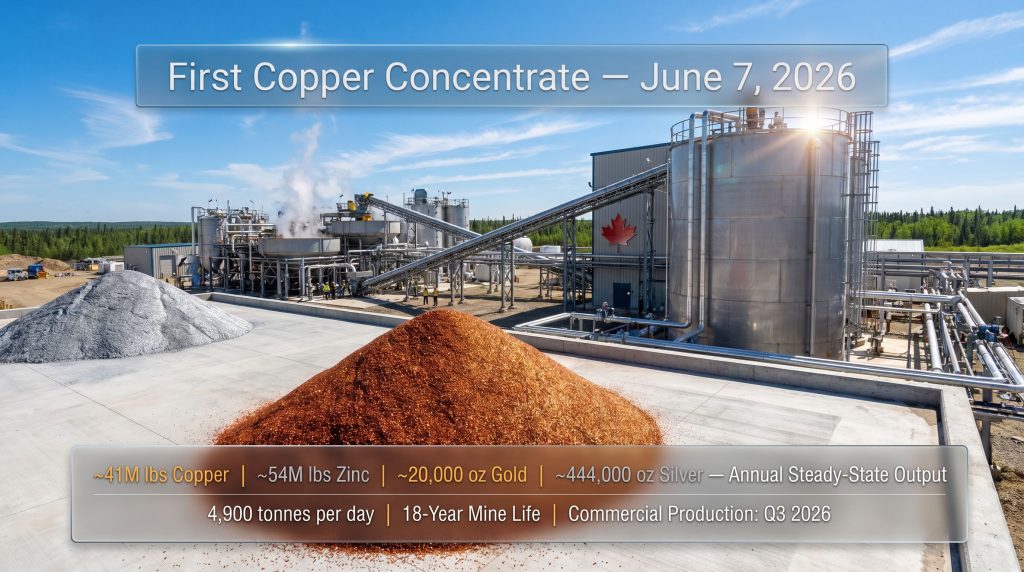
At McIlvenna Bay, wet commissioning was completed and hot commissioning commenced in the lead-up to June 7, 2026, when the plant produced its first copper concentrate at McIlvenna Bay project. This sequence confirms that the flotation circuit is functioning as designed, but the operation now enters the most technically sensitive phase of its early life: optimising the circuit under actual ore conditions before locking in commercial throughput rates.
What Does Ramp-Up Optimisation Involve?
For a polymetallic operation of this complexity, that optimisation work is non-trivial. McIlvenna Bay's ore body contains copper, zinc, gold, and silver, each requiring precise separation through sequential flotation stages. The core variables during ramp-up include:
- Reagent dosing calibration across copper and zinc flotation circuits
- Depressant and activator sequencing to achieve selective mineral separation
- Feed rate management to maintain consistent pulp density and retention time
- Grinding circuit optimisation to ensure adequate liberation of sulphide minerals
- Thickener and filtration performance tuning ahead of concentrate dispatch
Each of these variables directly affects metal recovery rates, which in turn determines whether the operation achieves the production levels outlined in Foran Mining's 2025 feasibility study.
McIlvenna Bay: Key Project Parameters at a Glance
| Metric | Detail |
|---|---|
| Location | ~375 km northeast of Saskatoon, Saskatchewan |
| Deposit Type | Copper-zinc-gold-silver polymetallic (VMS-style) |
| Nameplate Processing Capacity | 4,900 tonnes per day |
| Projected Mine Life | 18 years |
| Annual Copper Output (Steady State) | ~41 million pounds |
| Annual Gold Output | ~20,000 ounces |
| Annual Silver Output | ~444,000 ounces |
| Annual Zinc Output | ~54 million pounds |
| Construction Completion (Feb 2026) | 91% |
| Commercial Production Target | Q3 2026 |
The multi-metal output profile across copper, zinc, gold, and silver gives McIlvenna Bay a revenue diversification architecture that few single-jurisdiction Canadian mines can match. This is not simply a copper mine with byproduct credits; it is a genuinely polymetallic asset where each commodity contributes meaningfully to overall project economics.
The Foran Mining Acquisition: Deal Structure and Strategic Logic
Eldorado Gold's path to McIlvenna Bay runs through one of the more consequential corporate transactions in Canadian mining during the first half of 2026. The company announced its intention to acquire Foran Mining Corp. in February 2026, with the deal closing in April at a total consideration of US$3.8 billion, marking it as one of the largest mining acquisitions executed in Canada within that period.
What makes this transaction strategically noteworthy is not just its scale but its timing. Eldorado entered the deal at a moment when McIlvenna Bay was already deep into its construction phase, with infrastructure more than 50% complete at the time the acquisition was announced. This positioning gave Eldorado the ability to acquire a near-term producing asset rather than absorbing the full development risk of a greenfield project, compressing the time between capital commitment and production revenue.
What Drove Eldorado's Strategic Rationale?
The strategic rationale for a gold-focused senior producer absorbing a copper-zinc development project reflects several converging considerations:
- Commodity cycle positioning: Copper's structural demand growth tied to EV manufacturing, grid infrastructure, and renewable energy installation creates a long-duration tailwind that gold alone cannot provide.
- Revenue base transformation: Gold production is inherently tied to precious metals sentiment and central bank policy cycles. Adding substantial base metal exposure changes the company's correlation to broader industrial growth.
- Portfolio de-risking through diversification: A multi-commodity revenue stream reduces the financial impact of a sustained downturn in any single metal.
- Near-term cash flow acceleration: With McIlvenna Bay targeting commercial production in Q3 2026 and the Skouries gold-copper project in Greece targeting mid-2026, Eldorado was acquiring assets that would contribute to free cash flow within months of deal close.
Eldorado's CEO George Burns has stated publicly that McIlvenna Bay, combined with the Skouries project, is intended to fundamentally transform the company's financial profile rather than simply adding incremental production volume. The emphasis on high-margin output and free cash flow generation signals that the acquisition thesis is built around operating leverage at elevated commodity prices, not just reserve accumulation.
Disclaimer: Forward-looking statements regarding production timelines, commodity prices, and financial performance are subject to operational, market, and regulatory risks. Investors should conduct independent due diligence before making investment decisions.
Commissioning Phase Status and Ramp-Up Priorities
| Phase | Status as of June 2026 |
|---|---|
| Wet Commissioning | Completed |
| Hot Commissioning | Underway |
| Flotation Circuit Optimisation | Active focus |
| Paste Plant Construction | Ongoing |
| Underground Infrastructure | Finalisation in progress |
| Commercial Production Target | Q3 2026 |
The paste plant, still under construction during the ramp-up phase, deserves particular attention. In underground polymetallic mining, paste plants process tailings into a cement-like backfill material that is pumped underground to fill excavated stopes. This process serves several critical functions simultaneously:
- It provides structural support for underground workings, improving geotechnical stability
- It dramatically reduces surface tailings storage requirements, lowering environmental liability
- It allows the mine to extract ore from adjacent stopes more safely and efficiently
- It supports regulatory compliance with increasingly stringent tailings management standards
The completion of the paste plant is therefore not merely a construction checkbox. It directly influences the efficiency with which the underground mine can operate at scale, and its absence during early ramp-up represents a meaningful operational constraint that the team will be managing alongside processing circuit optimisation.
Portfolio Context: Where McIlvenna Bay Sits Within Eldorado's Asset Base
Eldorado Gold enters the second half of 2026 as a materially different company than it was twelve months earlier. The addition of McIlvenna Bay to an existing portfolio spanning Canada, Greece, and Turkey creates a multi-jurisdictional, multi-commodity profile that is unusual among mid-tier gold producers.
Eldorado Gold's Operating and Development Asset Base Post-Acquisition
| Asset | Location | Commodity Profile | Status |
|---|---|---|---|
| Lamaque Complex | Quebec, Canada | Gold | Operating |
| Olympias Mine | Greece | Gold-Silver-Lead-Zinc | Operating |
| Efemçukuru Mine | Turkey | Gold | Operating |
| Kışladağ Mine | Turkey | Gold | Operating |
| Skouries Project | Greece | Gold-Copper | Targeting mid-2026 commercial production |
| Perama Hill Project | Greece | Gold-Silver | Development |
| McIlvenna Bay Project | Saskatchewan, Canada | Copper-Zinc-Gold-Silver | Ramp-up, targeting Q3 2026 |
The most strategically significant dynamic within this portfolio is the simultaneous targeting of commercial production at both McIlvenna Bay and Skouries within the same 2026 calendar window. These two assets together represent Eldorado's largest near-term additions to production and cash flow, but managing concurrent ramp-ups across two continents introduces capital allocation complexity that the company's operations teams will need to navigate carefully.
The combined copper exposure from McIlvenna Bay's ~41 million pounds annually and Skouries' copper production represents a fundamental shift in Eldorado's commodity revenue composition. In practical terms, this moves the company from a business whose financial results are overwhelmingly driven by gold price movements toward one where industrial metal prices become a material driver of quarterly earnings.
The next major ASX story will hit our subscribers first
The Geology Behind McIlvenna Bay's Value: Understanding VMS Deposits
McIlvenna Bay is a volcanogenic massive sulphide deposit, commonly abbreviated as VMS. These geological formations are created by ancient seafloor hydrothermal systems, where metal-rich fluids expelled from the ocean floor precipitate sulphide minerals in concentrated zones. Furthermore, VMS deposits are characteristically polymetallic, containing copper, zinc, lead, gold, and silver in varying proportions depending on their specific geological setting.
What distinguishes economically significant VMS deposits like McIlvenna Bay from lesser counterparts is the combination of grade, geometry, and scale. The Flin Flon Belt straddling Saskatchewan and Manitoba has historically been one of Canada's most productive VMS corridors, hosting major past-producing mines including the original Flin Flon mine operated for decades by Hudson Bay Mining and Smelting.
What Exploration Upside Does the VMS Setting Offer?
From an exploration perspective, VMS systems are particularly valuable because they tend to occur in clusters. Where one deposit exists, the hydrothermal plumbing system that created it often produced multiple mineralised lenses across the same district. This geological reality is central to understanding why Eldorado's district-scale exploration programme carries potentially significant upside beyond the known McIlvenna Bay resource.
Tesla Zone and Bigstone: The Exploration Upside Case
Since closing the Foran acquisition, Eldorado has committed approximately US$17 million to exploration activities across McIlvenna Bay and surrounding mineral claims. This commitment spans multiple programme types:
- Advanced and early-stage drill target testing
- Airborne geophysical survey campaigns
- Ground geophysical surveys to refine subsurface targeting
- New prospect identification across the broader district
The most immediately significant exploration target is the Tesla Zone, a high-grade polymetallic discovery made in 2022 situated directly adjacent to the McIlvenna Bay orebody. Eldorado has described this zone as a compelling longer-term expansion opportunity, with its proximity to existing surface and underground infrastructure representing a meaningful capital efficiency advantage. New discoveries adjacent to operating mines benefit from shared access infrastructure, reducing the incremental development cost compared to standalone greenfield deposits.
An inaugural mineral resource estimate for the Tesla Zone is expected during the second half of 2026, which will represent the first formal quantification of its economic potential and could serve as a significant catalyst for reassessing McIlvenna Bay's long-term value beyond the current 18-year mine plan.
The Bigstone Deposit, located approximately 25 kilometres west of the main operation, offers a medium-term resource expansion opportunity within the same geological corridor. Drilling at Bigstone is intended to expand the existing resource base and build optionality for future mine life extension or standalone development consideration.
The distinction between Tesla Zone and Bigstone is strategically important. Tesla represents near-mine, infrastructure-adjacent upside that could extend or supplement the existing mine plan with relatively modest incremental capital. Bigstone represents a longer-dated, more capital-intensive pathway that requires its own development pathway to become meaningful.
Canada's Critical Minerals Framework and McIlvenna Bay's Policy Alignment
In September 2025, with construction at McIlvenna Bay more than halfway complete, the project was referred to Canada's federal Major Projects Office. This referral is designed to provide a coordinated federal engagement pathway for large-scale resource projects, facilitating more streamlined regulatory interaction across multiple government departments simultaneously.
Both copper and zinc are classified under Canada's national strategy for critical minerals demand, reflecting their essential role in clean energy technologies including electric vehicles, grid-scale battery storage, wind turbines, and solar panel manufacturing. Saskatchewan's inclusion of a major new copper-zinc producer aligns with broader federal objectives to develop domestic supply chains for materials that are currently heavily imported or sourced from geopolitically sensitive regions.
It is worth noting that the Major Projects Office referral facilitates regulatory coordination but does not constitute direct financial backing, strategic project funding, or guaranteed permitting outcomes. The characterisation of this referral should be understood as administrative coordination rather than a formal endorsement of project viability or a commitment of public resources.
Saskatchewan itself brings significant infrastructure advantages to the equation. The province's established mining services sector, existing power grid connections to remote northern communities, and experience with complex underground operations from its uranium and potash industries provide a functional operating environment that newer mining jurisdictions cannot easily replicate.
Frequently Asked Questions: McIlvenna Bay Copper Concentrate and Production Timeline
When was first copper concentrate produced at McIlvenna Bay?
First copper concentrate was produced on June 7, 2026, following the completion of wet commissioning and the commencement of hot commissioning at the on-site processing plant.
When is McIlvenna Bay expected to reach commercial production?
Eldorado Gold is targeting commercial production in the third quarter of 2026, with both copper concentrate and zinc concentrate forming part of the commercial output stream.
What is the nameplate processing capacity at McIlvenna Bay?
The processing plant is designed to handle 4,900 tonnes of ore per day at nameplate capacity.
How long is the McIlvenna Bay mine expected to operate?
The 2025 feasibility study completed by Foran Mining outlined an initial mine life of 18 years, with exploration upside from the Tesla Zone and Bigstone Deposit potentially extending that horizon.
What metals does McIlvenna Bay produce?
McIlvenna Bay is a polymetallic operation producing copper, zinc, gold, and silver concentrates.
How much did Eldorado pay to acquire McIlvenna Bay?
McIlvenna Bay was acquired as part of Eldorado's US$3.8 billion acquisition of Foran Mining Corp., which closed in April 2026.
What is the Tesla Zone at McIlvenna Bay?
The Tesla Zone is a high-grade polymetallic discovery made in 2022, located adjacent to the McIlvenna Bay orebody. An inaugural mineral resource estimate is expected during the second half of 2026.
What does the Major Projects Office referral mean for McIlvenna Bay?
The referral facilitates coordinated federal regulatory engagement to reduce administrative friction during the project's development phase. It does not represent a commitment of government funding or a guarantee of project approval.
Key Takeaways for Investors and Industry Observers
- The first copper concentrate at McIlvenna Bay project, produced on June 7, 2026, marks the transition from construction-phase capital absorption to early-stage operational asset — a critical value inflection point in the mine development lifecycle. Consequently, proper drill results interpretation of ongoing exploration work will be essential to quantifying future upside.
- Commercial production in Q3 2026 would represent the full activation of Eldorado's US$3.8 billion investment thesis and begin contributing to the free cash flow generation the company has signalled as its core strategic objective.
- The polymetallic revenue architecture spanning copper, zinc, gold, and silver structurally differentiates Eldorado's cash flow profile from pure-play gold producers, introducing meaningful exposure to industrial metal demand cycles.
- Simultaneous ramp-ups at McIlvenna Bay and Skouries across two continents create operational complexity but also represent the company's most substantial near-term production growth horizon.
- The Tesla Zone inaugural resource estimate expected in H2 2026 is the next major geological catalyst for assessing whether McIlvenna Bay's true value extends materially beyond the current 18-year mine plan. In addition, conclusions from the definitive feasibility study process remain a critical reference point for evaluating project economics.
- US$17 million in committed exploration spending across the broader district signals that Eldorado is treating McIlvenna Bay as a long-duration platform asset, not a single-mine acquisition with a fixed endpoint.
Furthermore, broader developments at McIlvenna Bay's ramp-up continue to attract significant industry attention, underscoring the project's strategic relevance within the global copper supply landscape.
This article is intended for informational purposes only and does not constitute financial advice. All production forecasts, financial projections, and exploration targets referenced are subject to material risks and uncertainties. Investors should conduct independent due diligence and consult qualified financial advisors before making investment decisions.
Want to Track the Next Major Copper or Polymetallic Discovery Before the Market Reacts?
Discovery Alert's proprietary Discovery IQ model delivers real-time alerts the moment significant mineral discoveries are announced on the ASX, instantly converting complex polymetallic data into actionable investment insights for both short-term traders and long-term investors. Explore how historic discoveries have generated exceptional returns on Discovery Alert's dedicated discoveries page, and begin your 14-day free trial today to position yourself ahead of the next major find.