
July 26, 2026
The Permitting Bottleneck That Has Quietly Shaped US Critical Minerals Strategy
For decades, one of the most persistent constraints on domestic US mineral production has had nothing to do with geology. The resources have often been there. What has consistently held projects back is time, specifically the open-ended, agency-discretionary permitting timelines that have turned promising mineral discoveries into decade-long administrative exercises. In some cases, the gap between initial discovery and first production has stretched to fifteen or twenty years, not because of technical failure, but because of regulatory architecture that imposed no binding accountability on reviewing agencies.
That structural flaw is precisely what the FAST-41 federal permitting framework was designed to address. And for investors and analysts tracking the domestic critical minerals sector, understanding how this mechanism works, and why securing coverage under it represents a genuine operational advantage, has become an essential part of evaluating early-stage resource companies operating on US federal land.
When big ASX news breaks, our subscribers know first
What FAST-41 Actually Does and Why It Changes the Risk Calculus
FAST-41 refers to Title 41 of the Fixing America's Surface Transportation Act, a legislative instrument originally enacted in 2015 that established a structured permitting improvement process for major infrastructure and resource projects on federal land. The Federal Permitting Improvement Steering Council, known as FPISC, administers the programme and maintains a publicly accessible dashboard at permits.performance.gov that tracks milestones for each designated project.
The core mechanism is straightforward but structurally significant. Rather than allowing federal agencies to determine their own review pace with no external accountability, FAST-41 establishes a negotiated framework between the project proponent and the relevant federal bodies. Much like permitting in mining more broadly, this framework includes defined milestones that replace historical ambiguity with structured accountability:
- A defined start date for the permitting review process
- An agreed expected completion date for each major review milestone
- Enhanced coordination requirements across multiple agencies
- Public transparency through the FPISC dashboard, enabling investors and stakeholders to track progress in real time
- Accountability structures that replace the historically open-ended question of agency review duration
Regulatory Framework Note: Before FAST-41, federal permitting timelines for mining projects were effectively unconstrained. Agencies determined their own pace with no binding deadlines. FAST-41 replaces that discretionary model with a contractual-style milestone framework, fundamentally altering the risk profile for project developers and their capital partners.
The practical effect for investors is a reduction in what analysts sometimes call sovereign risk, the uncertainty that project timelines will shift unpredictably due to regulatory inaction or inter-agency miscommunication. For capital-intensive resource projects, this kind of timeline certainty can be the difference between attracting institutional capital and watching it flow elsewhere.
Resolution Minerals FAST-41 Golden Gate: Why Two Designations in One Project Area Is Extraordinary
Against this regulatory backdrop, the position that Resolution Minerals (ASX: RML, OTCQB: RLMLF) has established at its Horse Heaven project in Valley County, Idaho, warrants careful examination. The company has now secured FAST-41 Transparency coverage for both of its primary development targets within the same project boundary, a combination that appears to be without direct precedent in the current FPISC registry.
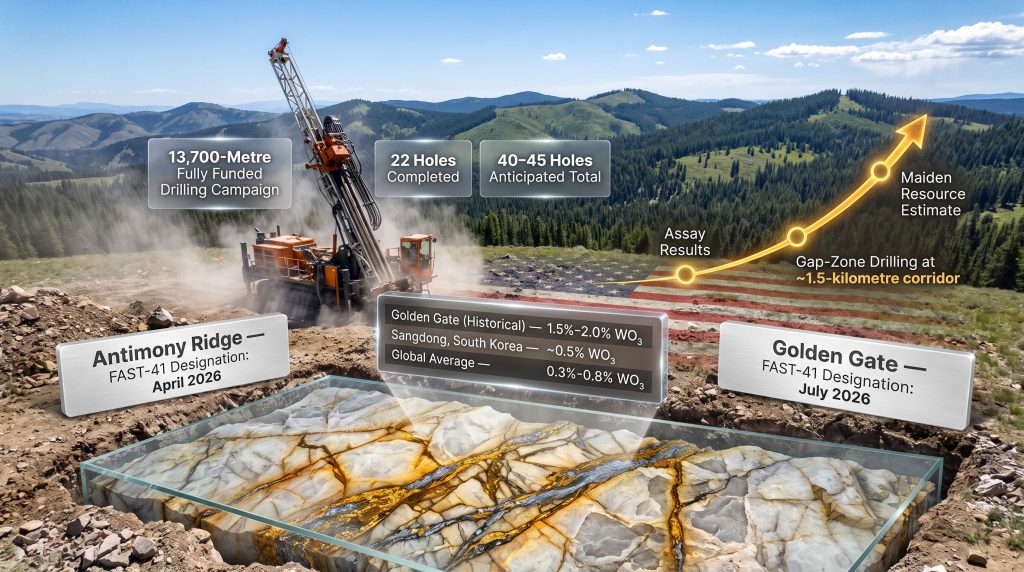
The first designation, covering the Antimony Ridge target, was granted in April 2026. The second, covering the Golden Gate tungsten-gold target, followed in July 2026. Together, they give the company a regulatory standing that goes well beyond what most exploration-stage companies operating on US federal land have achieved.
| Target | Primary Commodities | FAST-41 Designation Date |
|---|---|---|
| Antimony Ridge | Antimony (high-grade, near-surface) | April 2026 |
| Golden Gate | Tungsten + Gold (past-producing mine) | July 2026 |
What makes the dual designation analytically interesting is not simply the administrative achievement. It is what the designation implicitly communicates about how federal agencies have assessed the strategic relevance of each target. Antimony Ridge is characterised by high-grade antimony mineralisation located close to surface, a configuration that could, in theory, support relatively near-term production decisions. Golden Gate, by contrast, brings historical tungsten production grades of between 1.5% and 2% WO3, figures that place it in a different category from most currently operating tungsten projects globally.
The project's location also adds a layer of regional credibility. Horse Heaven sits adjacent to Perpetua's antimony project, an established presence that validates the broader district's geology and logistical viability.
Golden Gate's Historical Grades in Global Context
Tungsten grade is one of the most decisive variables in assessing the economics of a tungsten project, and Golden Gate's historical production record deserves careful benchmarking. The 1.5% to 2% WO3 grades documented from past mining activity at the site are substantially above the thresholds that define economic viability for most current global operations.
| Operation | Location | Approximate Tungsten Grade |
|---|---|---|
| Golden Gate (historical) | Idaho, USA | 1.5% to 2.0% WO3 |
| Almonty Industries (Sangdong) | South Korea | ~0.5% WO3 |
| Typical global average | Various | 0.3% to 0.8% WO3 |
To contextualise these figures: most commercially operating tungsten mines globally work with grades well below 1%. The Sangdong mine in South Korea, operated by Almonty Industries and widely regarded as one of the more significant tungsten projects outside China, operates at approximately 0.5% WO3. Golden Gate's historical grades at two to four times that level represent a meaningful quality premium, assuming modern drilling confirms that those grades are representative of the broader deposit.
It is important to note that historical production grades do not constitute a current mineral resource estimate under modern reporting standards such as JORC or NI 43-101. They are indicative of geological potential, not a confirmed resource. The current drilling programme is specifically designed to translate that historical evidence into a compliant resource estimate. Furthermore, given tungsten's strategic importance to defence and industrial supply chains, the quality of these grades carries implications well beyond standard project economics.
The Polymetallic Dimension: Gold Co-Mineralisation at Golden Gate
One aspect of the Golden Gate system that has received less attention than it warrants is the gold co-mineralisation component. Tungsten and gold occurring together within a fault-controlled structural setting creates a more complex but potentially more economically robust project thesis. Gold revenue can materially improve project economics during periods when tungsten prices are under pressure, and the polymetallic nature of the system may also attract a broader investor base than a pure tungsten play would.
The geological architecture at Golden Gate involves a north-south fault corridor that connects two distinct zones: Golden Gate North and Golden Gate South. These zones are separated by a gap of approximately 1.5 kilometres, and the critical outstanding question for the current drilling campaign is whether these two zones represent isolated mineralised bodies or endpoints of a continuous system. If geological connectivity is confirmed across that gap, the implications for potential resource scale would be substantial.
How a Consolidated NEPA Process Compresses the Development Timeline
Parallel to the FAST-41 designations, the US Forest Service has indicated its intention to assess both Antimony Ridge and Golden Gate under a single National Environmental Policy Act process. This is a significant administrative development that deserves explanation for investors unfamiliar with US federal land management procedures.
NEPA requires that federal agencies assess the environmental impacts of proposed actions on federal land before approving them. In a conventional scenario, two distinct project areas within the same broader property would typically undergo separate NEPA assessments, each with its own scoping process, public comment period, agency review, and documentation requirements. Running these processes sequentially would add years to the overall permitting timeline. Running them in parallel would require duplicated resources and coordination effort.
A consolidated NEPA review, where both targets are assessed within a single process, eliminates this duplication. The Boise National Forest team's decision to pursue this approach reflects a determination that the two areas can be meaningfully assessed together, a finding that is not automatically granted and requires the land manager to conclude that the projects share sufficient geographic, environmental, and operational characteristics to justify unified treatment.
Permitting Architecture Note: A consolidated NEPA review is an administrative determination, not a guarantee of permitting approval. The outcome of the review process remains dependent on environmental assessment findings. However, the structural compression of timelines that results from a single process rather than two independent assessments is a material advantage for project scheduling and capital planning.
Drilling Programme Architecture and Upcoming Catalysts
The current drilling campaign at Golden Gate is structured around a fully funded 13,700-metre programme targeting a total of 40 to 45 holes. As of the latest reporting, 22 holes have been completed, placing the programme roughly at the halfway mark.
The primary technical objective of the campaign is the delivery of a maiden JORC or NI 43-101 compliant resource estimate for Golden Gate. Understanding mining project feasibility studies and the resource estimation process that precedes them is essential context here, as resource estimates under these international reporting standards require sufficient drill hole density, appropriate geological interpretation, and statistical modelling to support classification of mineralisation as an Inferred or higher category resource.
Key upcoming milestones, in approximate sequence, include:
- Initial assay results from ALS laboratory, anticipated by late July or early August 2026, covering holes already drilled
- Gap-zone drilling between Golden Gate North and Golden Gate South, now enabled by newly secured drill permits across the approximately 1.5-kilometre corridor
- Sustained assay releases as the remaining 20-plus holes in the programme are processed and results returned
- Progressive resource estimation as the geological database grows
- Maiden resource estimate publication, representing a major de-risking milestone for the project
- Metallurgical flowsheet advancement running in parallel, under the direction of full-time metallurgist Dr Adam Roper
The volume of holes planned, combined with laboratory processing timelines, creates a multi-month news flow environment for the company. For investors tracking exploration-stage catalysts, this kind of sustained information release schedule is qualitatively different from a single-result binary event.
The next major ASX story will hit our subscribers first
The Hub-and-Spoke Processing Vision: More Than an Exploration Story
What distinguishes Resolution Minerals' strategic positioning from a straightforward exploration play is the company's stated ambition to integrate vertically into critical minerals processing. The hub-and-spoke processing model being developed would position Horse Heaven not merely as a mine but as a regional processing node capable of handling ore from third-party sources as well as its own production.
In practical terms, this model involves developing the hydrometallurgical processing infrastructure to separate and refine antimony and tungsten concentrates to a quality suitable for downstream industrial or defence applications. Dr Adam Roper, the company's full-time metallurgist, is currently developing processing flowsheets for both commodities. Hydrometallurgical processing of antimony involves aqueous chemical processes to extract and purify the metal, an approach that can achieve higher recovery rates and produce purer product streams than conventional pyrometallurgical methods.
The strategic logic of a processing hub extends beyond the economics of any single mine. A regional processor that can aggregate ore from multiple sources creates network effects, reducing per-unit processing costs as throughput increases, and potentially positioning the company as infrastructure rather than simply a resource developer. This distinction matters because infrastructure assets attract different categories of investor and institutional interest than exploration-stage companies.
Why Antimony and Tungsten Occupy a Unique Position in US Supply Chain Policy
Both antimony and tungsten appear on the US Critical Minerals List maintained by the Department of the Interior, reflecting their strategic importance and the degree to which the United States currently depends on foreign sources. China dominates global production of both metals, a concentration that carries geopolitical risk for industries ranging from defence manufacturing to semiconductor production.
Consequently, both metals have become focal points for US supply chain policy. Understanding antimony in defence applications, in particular, helps explain why projects like Antimony Ridge attract federal permitting priority. In addition:
- Antimony is used in flame retardants, ammunition primer, lead-acid battery alloys, and emerging sodium-ion battery chemistries. The United States currently imports the overwhelming majority of its antimony supply.
- Tungsten is indispensable for armour-piercing munitions, high-speed cutting tools, radiation shielding, and the production of certain semiconductor components. Its extreme hardness and high melting point make it irreplaceable in these applications.
The combination of these supply vulnerabilities, an active federal permitting reform framework in FAST-41, and a project with historically documented high-grade mineralisation in a mining-friendly US jurisdiction creates a convergence of factors that explains why Horse Heaven has attracted the regulatory attention it has. Idaho's established mining regulatory environment, combined with the district-level validation provided by Perpetua Resources' nearby permitted operation, further reduces jurisdictional uncertainty relative to projects in less mining-experienced US states.
However, it is worth noting that Resolution Minerals FAST-41 Golden Gate Idaho coverage does not guarantee project approval or production timelines, and investors should evaluate this regulatory milestone within the broader context of ongoing drilling results and resource estimation outcomes.
Investor Consideration: This article contains references to forward-looking milestones, exploration targets, and resource estimation processes. All such references involve inherent uncertainty. Mineral resource estimates are subject to drilling results, geological interpretation, and reporting standard compliance. Permitting outcomes cannot be guaranteed. This content is for informational purposes only and does not constitute financial or investment advice.
Frequently Asked Questions: Resolution Minerals FAST-41 Golden Gate
What is FAST-41 Transparency Coverage?
FAST-41 Transparency Coverage is a federal designation under Title 41 of the Fixing America's Surface Transportation Act. It brings a project into a structured, publicly trackable permitting framework administered by the Federal Permitting Improvement Steering Council. Designated projects have their permitting milestones listed on the FPISC public dashboard, with agreed timelines replacing the historically discretionary agency review process.
How Does FAST-41 Reduce Permitting Timelines in Practice?
The framework works by replacing open-ended agency discretion with a negotiated milestone schedule. Under FAST-41, the project proponent and the relevant federal agencies agree on start dates and expected completion dates for each permitting step. This creates accountability and enables proponents to plan capital deployment around defined regulatory events rather than uncertain agency timelines.
What Is a Maiden Resource Estimate and Why Does It Matter?
A maiden resource estimate is the first formal quantification of a mineral deposit under internationally recognised reporting standards such as JORC or NI 43-101. It translates drilling data into a classified inventory of mineralisation, providing investors, financiers, and regulators with a standardised basis for assessing project scale and potential economics. For exploration-stage companies, publishing a maiden resource estimate is typically one of the most significant value-creation milestones in the project lifecycle.
What Is a Hub-and-Spoke Processing Model in Mining?
A hub-and-spoke processing model involves establishing a central processing facility that handles ore not only from the operator's own mine but also from third-party mines in the surrounding region. This approach spreads fixed processing infrastructure costs across a larger ore volume, improving unit economics, and can position the operator as a critical regional service provider rather than a single-site mine developer.
Why Is the 1.5-Kilometre Gap Between Golden Gate North and South Significant?
If drilling confirms a geological connection between the two zones across this gap, the total mineralised footprint of the Golden Gate system would expand substantially. Two separate mineralised zones connected by a continuous fault-controlled system would represent a materially larger deposit than two isolated bodies. This connectivity question is one of the central technical objectives of the current drill programme.
Want to Be First to Identify the Next Major Critical Minerals Discovery?
Discovery Alert's proprietary Discovery IQ model delivers real-time alerts on significant ASX mineral discoveries — including critical metals like tungsten and antimony — translating complex geological data into actionable investment insights the moment announcements hit the exchange. Explore how historic discoveries have generated substantial returns on Discovery Alert's dedicated discoveries page, and begin your 14-day free trial today to position yourself ahead of the broader market.