May 15, 2026

Resource Dependency and the New Era of Mineral Diplomacy
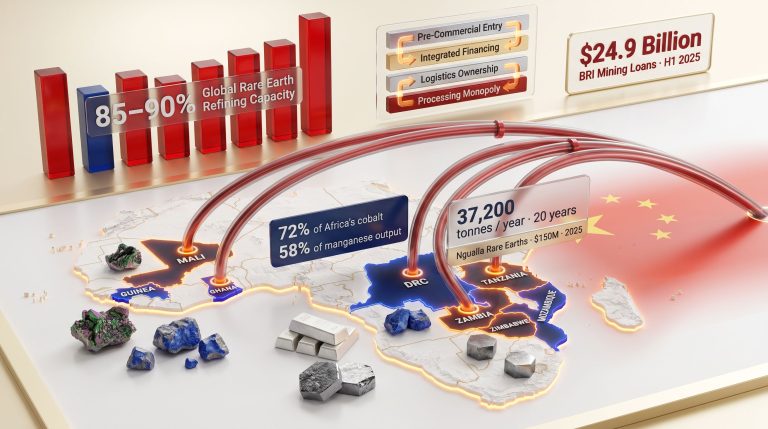
Western nations are fundamentally restructuring their approach to critical mineral security as traditional supply chains face unprecedented geopolitical pressures. The US in talks with Brazil on critical minerals represents a pivotal shift in international resource diplomacy, as traditional supply chains face mounting geopolitical pressures. The strategic importance of rare earth elements extends far beyond commercial applications, forming the technological backbone of modern defense systems, renewable energy infrastructure, and advanced manufacturing capabilities. With China controlling approximately 85% of global rare earth processing capacity, nations like the United States are actively pursuing alternative partnership frameworks to reduce dependency vulnerabilities.
The evolution from conventional mining agreements to comprehensive resource security partnerships reflects a broader shift in international relations. Defence systems requiring dysprosium, terbium, and neodymium for radar technology, missile guidance systems, and advanced weaponry have transformed mineral access from economic convenience to national security imperative. The United States currently produces only 12,000 metric tons of rare earth oxides annually, representing less than 10% of global production, with Mountain Pass in California remaining the nation's sole operational rare earth mine.
Geographic Advantages: Proximity vs. Supply Chain Length
Brazil's positioning as a potential critical mineral partner extends beyond raw resource availability to encompass strategic geographic and logistical advantages. The approximately 4,600 kilometres from Brazilian ports to US Gulf Coast facilities represents a significant transportation advantage compared to the 16,000+ kilometre routes from Chinese production centres. This proximity factor becomes particularly relevant when considering supply chain resilience during periods of international tension or trade disruption.
The nation's mineral wealth encompasses multiple critical elements essential for modern technology applications. Brazil holds an estimated 700,000 tons of lithium reserves, positioning it amongst the world's top five lithium reserve holders. More significantly, Brazil controls approximately 98% of global niobium reserves and produces roughly 90% of world niobium supply, whilst maintaining substantial rare earth reserves estimated at 22 million tons distributed primarily across Goiás, Amazonas, and Minas Gerais states.
Current infrastructure limitations present both challenges and opportunities for partnership development. Brazil currently lacks commercial-scale domestic rare earth separation and processing facilities, with existing infrastructure focused primarily on raw material extraction rather than value-added processing. Port capacity constraints in certain regions further limit export logistics, creating investment opportunities for partners willing to develop integrated processing and transportation infrastructure.
When big ASX news breaks, our subscribers know first
The Serra Verde Framework: Investment Structure and Operational Metrics
The $465 million US investment in Serra Verde represents more than financial backing; it establishes a replicable model for critical mineral partnerships that balance investor returns with strategic supply chain objectives. As Brazil's only commercially producing rare earth operation, Serra Verde provides tangible evidence of successful US-Brazilian cooperation in critical mineral development.
Located in Goiás state, Serra Verde benefits from established geological surveys, existing infrastructure, and proximity to transportation networks. The project's success demonstrates the viability of commercial rare earth production in Brazil whilst highlighting the technological and financial requirements for scaling operations. The investment structure incorporates both equity and debt components, creating aligned incentives between US investors and Brazilian operational partners.
Production capacity expansion typically requires 24-36 months from infrastructure development to full commercial production, depending on the complexity of separation facilities and environmental compliance requirements. The technological capabilities required include beneficiation facilities, chemical processing plants, and environmental remediation systems, representing significant capital investment beyond initial mining operations.
Technology transfer implications extend beyond individual project success to broader US-Brazilian cooperation frameworks. The sharing of rare earth separation technology, environmental management systems, and operational expertise creates potential templates for additional partnerships whilst addressing Brazilian preferences for domestic capability development.
Comparative Partnership Analysis: Strategic Value Assessment
| Partnership Region | Primary Resources | Investment Portfolio | Strategic Advantages | Implementation Challenges |
|---|---|---|---|---|
| Brazil | Rare earths, lithium, niobium | $465M+ confirmed | Hemispheric proximity, resource diversity | Infrastructure gaps, federal-state coordination |
| Australia | Lithium, rare earths | $2B+ estimated | Allied status, established infrastructure | Distance, higher operational costs |
| Canada | Lithium, cobalt, nickel | $1.5B+ announced | USMCA integration, border proximity | Environmental regulations, seasonal logistics |
| Chile | Lithium, copper | Limited partnerships | Established mining sector | Political volatility, policy uncertainty |
Australia's 3.1 million tons of lithium reserves and established rare earth operations through companies like Lynas Rare Earths provide a mature partnership model, but the 15,000+ kilometre supply chain creates logistical complexities absent in hemispheric partnerships. The Australia-US Comprehensive Strategic Partnership facilitates resource cooperation through established diplomatic frameworks, contrasting with the evolving bilateral mechanisms required for Brazilian partnerships.
Canada's 2.9 million tons of lithium reserves and USMCA integration create preferential sourcing arrangements under Chapter 21 environmental provisions. The average 2,100 kilometres to US northern border processing facilities provides geographic advantages, though seasonal logistics and environmental compliance standards create operational constraints absent in Brazilian contexts.
Chile's production of approximately 23% of global lithium supply from 9.9 million tons of reserves demonstrates substantial resource availability, but multiple government transitions during 2021-2025 have created regulatory volatility affecting foreign investment confidence. The 8,000+ kilometre Pacific shipping routes require extended supply chain coordination compared to Atlantic routes from Brazilian ports.
Federal vs. State-Level Partnership Dynamics
The March 2026 preliminary agreement between the United States and Goiás state illustrates the complexity of federal versus subnational partnership approaches. Governor Ronaldo Caiado's political opposition to President Lula creates additional diplomatic complications, with Brazilian federal officials expressing private frustration at perceived attempts to bypass federal authority.
The agreement establishes cooperation across several strategic areas:
- Geological mapping and mineral potential assessment
- Technology transfer connecting local miners with US expertise
- Regulatory improvements streamlining development processes
- Value-added processing capabilities, including rare earth separation facilities
Brazilian federalism grants states significant constitutional authority over natural resource governance within their territories, whilst federal government maintains authority over international trade negotiations. This creates legal space for state-level memorandums of understanding whilst potentially constraining federal-level strategic planning aligned with national industrial policy objectives.
The tension reflects broader Brazilian policy priorities emphasising domestic processing and value-chain integration. Federal authorities prioritise requirements that foreign partnerships contribute to domestic industrial capacity rather than simply extracting raw materials for processing elsewhere. State-level agreements may offer greater flexibility for investors whilst potentially constraining federal ability to implement comprehensive industrial policy.
Economic Disruption Scenarios and Market Impact Projections
Scenario 1: Accelerated Partnership Development
Successful expansion of US-Brazilian critical mineral cooperation could meaningfully impact Chinese market concentration within 5-10 years. Current Chinese control of approximately 85% of rare earth processing creates vulnerability that diversified supply chains could address through sustained investment and infrastructure development.
Price volatility expectations vary significantly based on implementation timelines and production scaling. Lithium and rare earth markets historically demonstrate sensitivity to supply diversification announcements, with sustained price impacts requiring actual production increases rather than partnership agreements alone.
Investment requirements for meaningful supply chain diversification include:
- Processing infrastructure: $500M-1B+ for commercial-scale separation facilities
- Transportation networks: Port upgrades and inland logistics systems
- Workforce development: Technical training for advanced processing operations
- Environmental compliance: Remediation and monitoring systems
Scenario 2: Partnership Implementation Delays
Federal-state coordination challenges, environmental permitting delays, or diplomatic tensions could constrain partnership development timelines. Alternative pathways for US critical mineral security would require expanded partnerships with Australia, Canada, or development of domestic processing capacity for imported raw materials.
Brazilian pivot options toward European or Asian partnerships remain viable, with the critical raw materials facility creating competing frameworks for resource partnerships. Von der Leyen's Brazil visit demonstrates European recognition of Brazilian strategic importance in global mineral supply diversification efforts.
Market concentration risks persist if negotiations fail or implementation faces significant delays. The 50+ identified Brazilian mining projects represent substantial potential, but converting potential to production requires sustained political stability and coordinated investment across multiple governance levels.
Processing Infrastructure Requirements and Technology Integration
Value-chain integration beyond raw material extraction requires sophisticated processing capabilities currently absent at commercial scale in Brazil. Rare earth separation involves complex chemical processes requiring specialised equipment, technical expertise, and environmental management systems typically developed over decades rather than years.
Heavy Rare Earth Elements (HREEs) including dysprosium, terbium, holmium, erbium, thulium, ytterbium, and lutetium require different processing approaches than Light Rare Earth Elements (LREEs) such as lanthanum, cerium, praseodymium, and neodymium. HREEs command higher prices due to scarcity and specialised applications in high-performance military and industrial systems.
Technology transfer frameworks must balance intellectual property protection with Brazilian domestic capability development objectives. Furthermore, the critical minerals energy transition necessitates advanced processing capabilities that align with sustainability goals.
Infrastructure investment needs extend beyond processing facilities to encompass:
- Port capacity expansion for specialised mineral exports
- Railway networks connecting interior mining operations to coastal facilities
- Processing plant construction with environmental compliance systems
- Workforce training centres for advanced technical operations
Timeline for achieving domestic processing capabilities varies by mineral complexity, but rare earth separation facilities typically require 3-5 years from initial construction to full operational capacity, assuming regulatory approvals and financing proceed without significant delays.
Why Are Processing Capabilities Critical?
In addition to basic extraction, advanced processing capabilities represent the key differentiator between resource suppliers and strategic partners. The development of domestic separation and refinement facilities enables countries to move beyond commodity exports toward value-added manufacturing integration.
The next major ASX story will hit our subscribers first
International Competition and Strategic Counter-Responses
European Union competition for Brazilian resources intensified following Von der Leyen's recent Brazil visit, creating competing frameworks for critical mineral partnerships. The EU Critical Raw Materials Act establishes preferential sourcing arrangements for member nations whilst offering technology transfer and investment packages potentially competing with US proposals.
Chinese response strategies to US-Brazilian cooperation include:
- Increased investment in Brazilian mining projects through state-owned enterprises
- Technology partnerships offering advanced processing capabilities
- Belt and Road Initiative integration connecting Brazilian resources to Asian markets
- Alternative supply chain development reducing dependency on Brazilian resources
However, the ongoing US‑China trade impact complicates these dynamics significantly. Historical Chinese investment patterns in Brazilian mining demonstrate sustained commitment to resource security, with state-owned enterprises maintaining significant positions across multiple mineral sectors.
The geopolitical dimension of critical mineral partnerships extends beyond bilateral relationships to encompass broader alliance structures. NATO and AUKUS frameworks increasingly incorporate resource security considerations, whilst China's partnership with Russia creates alternative supply chain networks potentially competing with Western approaches.
Investment Risk Assessment and Timeline Projections
Key Investment Risk Factors
| Risk Category | Impact Level | Probability | Mitigation Approaches |
|---|---|---|---|
| Regulatory Changes | High | Medium | State-level agreements, federal engagement |
| Infrastructure Gaps | Medium | High | Joint infrastructure investment programmes |
| Environmental Compliance | Medium | Medium | Technology transfer for clean extraction |
| Political Transitions | High | Medium | Multi-party engagement, long-term agreements |
| Currency Volatility | Low-Medium | Medium | USD-denominated contracts, hedging |
Short-term projections (1-2 years) focus on preliminary agreement implementation and pilot project development. Serra Verde expansion and additional Goiás state partnerships provide testing grounds for broader cooperation frameworks whilst addressing immediate diplomatic and operational challenges.
Medium-term expectations (3-5 years) encompass processing facility development and production scaling across multiple projects. The transition from raw material extraction to value-added processing requires substantial capital investment and technology transfer, with success dependent on sustained political stability and regulatory consistency.
Moreover, contemporary mining industry trends emphasise environmental sustainability and community engagement, factors that must be integrated into long-term planning frameworks.
Long-term impact assessment (5-10 years) projects meaningful global supply chain diversification contingent on successful partnership implementation across federal and state levels. Reducing Chinese critical mineral dependence requires sustained investment, technological development, and diplomatic coordination extending beyond individual project timelines.
Strategic Implications for Western Hemisphere Resource Security
The evolution of US in talks with Brazil on critical minerals represents broader hemispheric integration trends extending beyond bilateral relationships. USMCA frameworks provide templates for resource cooperation, whilst Brazil's unique position as a major economy outside existing North American trade agreements creates opportunities for expanded economic integration.
Integration with broader US industrial policy and infrastructure investments, particularly the Inflation Reduction Act and Infrastructure Investment and Jobs Act, creates potential synergies between domestic manufacturing capacity and secured resource supply chains. Brazilian partnerships could complement domestic processing facility development whilst providing feedstock for value-added manufacturing in US facilities.
Success factors for partnership sustainability include:
- Political stability maintenance across electoral cycles in both nations
- Environmental and social governance alignment meeting international standards
- Technology transfer effectiveness building genuine Brazilian processing capabilities
- Economic benefits distribution ensuring partnership advantages reach local communities
The precedent established by successful US-Brazilian cooperation extends beyond bilateral implications to influence partnerships with other Latin American nations. Colombia, Peru, and Mexico maintain significant mineral resources that could benefit from similar partnership frameworks, creating potential for comprehensive hemispheric resource security networks.
Furthermore, developing a comprehensive critical minerals strategy requires coordination across multiple government levels and international partners. This strategic approach must balance immediate security concerns with long-term sustainability objectives.
How Will This Impact Global Supply Chains?
The broader implications of successful US in talks with Brazil on critical minerals extend beyond immediate bilateral benefits. Mining.com reports on the evolving negotiations, highlighting the strategic importance of these discussions for global supply chain diversification.
Future partnership evolution will likely incorporate lessons learned from initial implementation phases whilst addressing emerging challenges including climate change impacts on mining operations, evolving environmental standards, and technological advances in mineral processing and extraction methods. Additionally, Argus Media details how multiple Brazilian states are positioning themselves for similar agreements.
The foundation established through current negotiations may determine Western Hemisphere resource security architecture for decades to come. Consequently, the success or failure of these initial partnerships will influence not only immediate supply chain diversification efforts but also the broader geopolitical landscape surrounding critical mineral access and control.
Ready to Capitalise on Critical Minerals Investment Opportunities?
Discovery Alert's proprietary Discovery IQ model delivers instant notifications on significant ASX mineral discoveries, including critical minerals companies positioned to benefit from global supply chain diversification efforts. Explore Discovery Alert's discoveries page to understand why major mineral discoveries have generated substantial returns historically, and begin your 14-day free trial today to secure your market-leading advantage.