
August 6, 2026
Why Resource-Rich Territories Become Governance Voids
Across the developing world, remote territories rich in valuable minerals frequently operate outside traditional regulatory frameworks, creating what economists term "governance voids." These spaces emerge not through accident, but through systematic institutional failures that transform state-weak regions into uncontrolled extraction zones.
The phenomenon occurs when multiple factors converge: territorial disputes that prevent any single authority from exercising control, weak state capacity that cannot project governance to remote areas, and high-value resources that create powerful incentives for informal extraction. Understanding this pattern reveals why unregulated gold mining in Somalia represents a broader global challenge rather than an isolated case.
The Economics of Governance Voids in Resource-Rich Territories
When state institutions collapse or fail to extend authority to remote regions, economic actors often fill the void through informal arrangements. In resource extraction, this creates particularly complex dynamics because valuable minerals generate sufficient revenue to sustain alternative governance systems.
Key Economic Drivers:
- High profit margins from unregulated extraction that exceed formal compliance costs
- Reduced operational overhead without environmental or safety regulations
- Immediate market access through established but unmonitored trade routes
- Lower taxation burden compared to formal licensing systems
These economic incentives become self-reinforcing when legitimate authorities cannot offer competitive alternatives. Mining operators can achieve significantly higher returns by avoiding licensing fees, environmental compliance costs, and formal taxation while accessing the same international markets through informal channels.
How Territorial Disputes Create Mining Free Zones
Contested territories present unique opportunities for resource extraction because competing authorities often lack the capacity to enforce exclusive control. Multiple claimants may issue conflicting regulations, permits, or taxation demands, but none possess sufficient enforcement capability to establish genuine governance.
This regulatory uncertainty paradoxically creates operational certainty for extractive industries. When no authority can definitively establish control, mining operations can proceed without meaningful oversight while maintaining plausible relationships with multiple potential regulators.
Consequently, the result transforms disputed territories into de facto free zones where extraction proceeds under informal arrangements rather than formal regulation.
The Role of Weak State Capacity in Enabling Informal Extraction
State capacity limitations extend beyond simple resource constraints to encompass institutional design failures that prevent effective remote governance. Many post-conflict states lack the administrative infrastructure, technical expertise, and enforcement mechanisms necessary for modern mining regulation.
Critical Capacity Gaps:
- Technical expertise in modern mining regulation and environmental assessment
- Administrative systems for licensing, monitoring, and revenue collection
- Enforcement capabilities for remote territory oversight
- Legal frameworks adapted to contemporary extraction technologies
These gaps create opportunities for sophisticated international actors to establish operations that technically violate no enforceable laws while extracting significant value from state-owned resources.
When big ASX news breaks, our subscribers know first
How Somalia's Federal Structure Enables Unregulated Mining
Somalia's complex federal arrangement creates multiple overlapping authorities without clear jurisdictional boundaries, particularly in remote regions where physical control determines practical governance. This institutional design inadvertently enables large-scale resource extraction outside any regulatory framework.
The Milxo region exemplifies how territorial ambiguity facilitates unregulated gold mining in Somalia. Four separate authorities claim jurisdiction over this gold-rich area: Puntland (autonomous since 1998), Somaliland (self-declared independent since 1991), the Federal Government of Somalia (internationally recognised but with limited remote control), and the SSC-Khatumo administration (federally recognised since 2023 but overlapping with existing claims).
Federal vs Regional Authority Conflicts in Resource Governance
Somalia's federal constitution grants significant autonomy to regional states while maintaining federal authority over natural resources. However, this arrangement lacks clear enforcement mechanisms for remote territories where competing authorities maintain simultaneous claims.
Jurisdictional Complexity:
| Authority | Legal Status | Territorial Claims | Mining Authority |
|---|---|---|---|
| Federal Government | Internationally recognised | National sovereignty | Constitutional mandate |
| Puntland | Autonomous region | Northeastern Somalia | Draft legislation only |
| Somaliland | Self-declared state | Northwestern Somalia | No international recognition |
| SSC-Khatumo | Recently recognised | Overlapping northern regions | Emerging authority |
This institutional arrangement creates what governance experts term "competitive sovereignty" where multiple authorities claim legitimacy without possessing exclusive control. Mining operators can exploit these overlapping claims by maintaining relationships with multiple authorities while avoiding substantive compliance with any single regulatory framework.
The Impact of Overlapping Territorial Claims on Mining Regulation
When examined closely, Milxo's governance reveals how territorial disputes enable systematic regulatory avoidance. Current data shows that only 2 out of 35 identified mining entities in the region hold federal licenses, representing approximately 5.7% compliance with Somalia's formal licensing requirements.
This extraordinarily low compliance rate reflects the practical impossibility of enforcement rather than simple regulatory violation. No single authority possesses sufficient control to mandate compliance, while operators can claim legitimacy through informal arrangements with competing claimants.
Furthermore, research from the Global Initiative against Transnational Organised Crime identified 20 active mining sites operated by at least 18 commercial entities, many employing foreign technical staff and sophisticated extraction methods including mercury amalgamation and cyanide leaching.
How Political Fragmentation Undermines Licensing Systems
Effective mining regulation requires institutional continuity and enforcement capability that Somalia's fragmented political structure cannot provide. Puntland has drafted mining legislation and revenue frameworks repeatedly since 2014, yet none have achieved implementation due to political instability and competing territorial claims.
This legislative failure pattern demonstrates how political fragmentation prevents the institutional development necessary for modern resource governance. Even when technical capacity exists to draft appropriate legislation, implementation requires political consensus and enforcement mechanisms that exceed current state capacity.
Moreover, these challenges reflect broader mining permitting challenges faced across jurisdictions with weak institutional frameworks.
Research shows that the absence of regulation has created conditions conducive to elite capture and armed-group exploitation, transforming institutional weakness into systematic rent extraction opportunities.
The Global Gold Trade's Regulatory Arbitrage Problem
International gold markets inadvertently enable unregulated production by maintaining insufficient due diligence standards for origin verification. This regulatory arbitrage allows gold extracted under questionable circumstances to enter legitimate supply chains through established trading hubs.
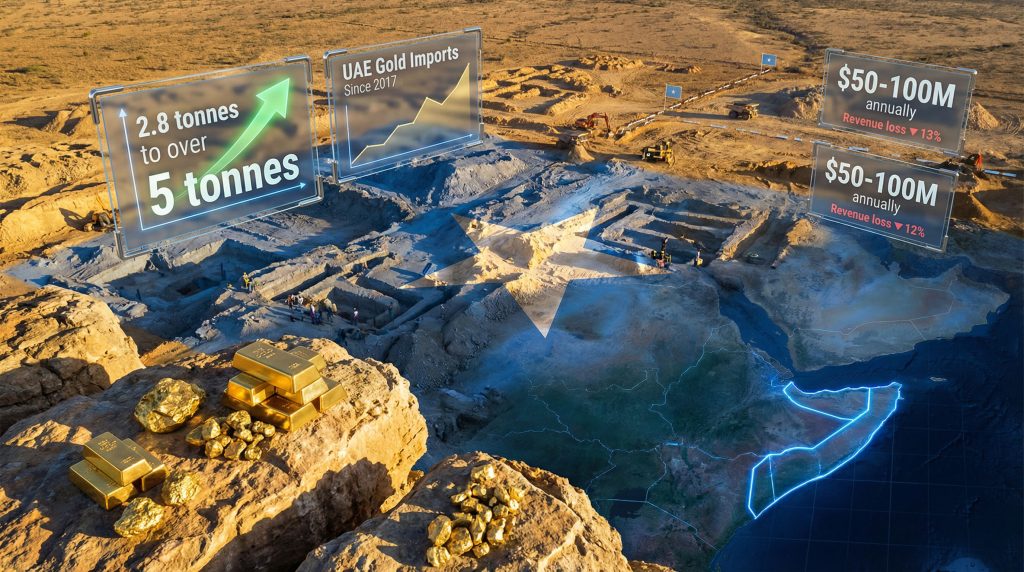
Dubai serves as the primary gateway for Somali gold exports, with UAE imports from Somalia increasing from 2.8 tonnes to over 5 tonnes between 2017 and 2023, representing approximately 78% growth over six years. This dramatic increase coincides with Milxo's expansion from a small settlement to a major mining hub, suggesting direct correlation between unregulated production and international market access.
The Dubai Gold Trade Hub and Regulatory Arbitrage
Dubai's position as a global gold trading centre creates structural opportunities for regulatory arbitrage. The emirate's strategic policies favouring rapid import and re-export enable gold of questionable origin to acquire legitimate documentation through transshipment.
Dubai's Regulatory Environment:
- Streamlined import procedures that minimise origin documentation requirements
- Strategic policies favouring rapid import to support trade hub status
- Limited enforcement of compliance verification despite updated regulations
- Commercial aviation channels that provide legal cover for informal trade
This regulatory structure enables gold from unmonitored sources to enter global supply chains with minimal scrutiny. Even when updated regulations exist, enforcement remains inconsistent, with couriers reporting that proof of origin or compliance checks rarely occur in practice.
International Due Diligence Gaps in Precious Metals Markets
Global gold markets operate under due diligence standards that focus primarily on traditional conflict mineral concerns rather than governance void scenarios. This creates systematic blind spots for gold originating from territories where extraction occurs without any regulatory oversight.
Current international standards assume the existence of some regulatory framework, even if compromised by corruption or conflict. Territories like Milxo, where extraction proceeds without any formal licensing or oversight, fall outside existing due diligence models.
Tracing Conflict Minerals Through Commercial Aviation Routes
The use of commercial aviation for gold transport provides legal legitimacy that maritime or overland routes cannot offer. Gold shipments via passenger flights receive less scrutiny than dedicated cargo operations while maintaining documentation that appears consistent with legitimate trade.
This transportation method enables unregulated gold to acquire the documentation and logistical legitimacy necessary for international market access. The practice exploits gaps between aviation security protocols designed for passenger safety and trade verification systems intended for commercial cargo.
Environmental and Health Consequences of Chemical-Intensive Mining
Unregulated mining operations in Milxo employ extraction methods that pose severe environmental and health risks to local communities. The widespread use of mercury and cyanide in gold processing creates long-term contamination risks that extend far beyond immediate mining sites.
Research documenting these operations reveals that many sites employ foreign technical staff specifically to implement chemical-intensive extraction methods including mercury amalgamation and cyanide leaching. These techniques, while effective for gold recovery, create persistent environmental contamination in regions lacking any oversight or remediation capacity.
Mercury Contamination in Artisanal Gold Processing
Mercury use in gold extraction creates multiple contamination pathways that affect both workers and surrounding communities. When mercury amalgamates with gold particles, the subsequent heating process releases mercury vapor into the atmosphere while residual mercury contaminates local water and soil systems.
Mercury Exposure Pathways:
- Atmospheric release during amalgam heating processes
- Water system contamination through processing waste disposal
- Soil contamination from mercury-containing tailings
- Bioaccumulation in local food chains and livestock
Without regulatory oversight or environmental monitoring, these contamination patterns proceed unchecked. Local communities lack access to protective equipment or health monitoring that might mitigate exposure risks.
Cyanide Leaching Risks in Unmonitored Operations
Cyanide leaching processes extract gold from ore through chemical dissolution, creating highly toxic waste streams that require specialised treatment and disposal. In unregulated environments, these wastes typically receive no treatment before environmental release.
The technique involves exposing crushed ore to sodium cyanide solutions that dissolve gold particles for subsequent recovery. However, this process generates cyanide-contaminated tailings and process water that remain toxic for extended periods without proper treatment.
Long-term Ecological Impact Assessment Challenges
The absence of baseline environmental data makes it impossible to assess the full scope of ecological damage from unregulated mining. Without initial soil, water, and air quality measurements, determining the extent of contamination becomes extremely difficult even when regulatory capacity eventually develops.
This data gap creates long-term governance challenges for any future environmental remediation efforts. Even successful regulatory implementation cannot address historical contamination without understanding its scope and distribution.
Armed Group Exploitation and Elite Capture Networks
Unregulated mining territories become attractive targets for armed groups and political elites seeking alternative revenue streams. The combination of high-value resources and weak governance creates systematic opportunities for rent extraction through informal taxation and protection arrangements.
In Milxo's case, Al-Shabaab maintains a presence in the nearby Golis Mountains and has repeatedly attempted to tax or infiltrate mining operations. Simultaneously, evidence indicates that at least one major mining operator maintains links to Puntland's political leadership, demonstrating how both armed groups and legitimate authorities exploit governance voids.
Taxation and Extortion Models in Conflict Zones
Armed groups develop sophisticated taxation systems that provide alternative governance in exchange for protection services. These arrangements often frame extortion as legitimate taxation, particularly when presented as religious obligations like zakat.
Armed Group Revenue Strategies:
- Direct taxation of mining operations based on production volumes
- Protection fees for security against competing armed groups
- Infiltration attempts to gain ownership stakes in operations
- Religious legitimacy through zakat framing of extortion demands
Phone records and eyewitness accounts indicate ongoing extortion activity in Milxo, often framed as zakat to provide religious legitimacy for revenue collection. This approach exploits local religious traditions to normalise armed group taxation of commercial activities.
The Economics of Protection Rackets in Resource Extraction
Protection rackets in mining territories operate through dual incentives: providing genuine security against competing threats while creating dependency relationships that enable ongoing revenue extraction. Mining operations require stable conditions for equipment investment and worker safety, making protection services valuable even when provided by the same groups creating security threats.
This economic model becomes self-sustaining when state security forces cannot provide alternative protection. Armed groups can offer credible security guarantees for operations within their territorial control while ensuring that competing security providers cannot establish alternative arrangements.
Elite Capture Mechanisms in Fragmented States
Political elite involvement in unregulated mining occurs through ownership stakes, informal partnerships, and regulatory capture that prevents enforcement of existing laws. In Milxo, research indicates that at least one major operator maintains links to the family of Puntland President Said Abdullahi Deni.
This elite capture pattern explains why repeated attempts to draft mining legislation have failed implementation since 2014. Political leaders who benefit from unregulated extraction lack incentives to support regulatory frameworks that would reduce their informal revenue streams.
Elite Capture Methods:
- Direct ownership stakes in mining operations
- Family member involvement in major commercial entities
- Informal partnership arrangements with foreign operators
- Regulatory prevention through legislative obstruction
Alternative Regulatory Models for Post-Conflict Mining
Establishing effective mining governance in fragmented states requires institutional approaches adapted to limited state capacity and competing territorial claims. Traditional regulatory models designed for stable jurisdictions often fail when applied to post-conflict environments with weak institutions and ongoing territorial disputes.
Successful approaches typically combine decentralised implementation with federal oversight, allowing regional authorities to manage day-to-day operations while maintaining national coordination for revenue sharing and environmental standards.
What Can Other Post-Conflict Mining Jurisdictions Teach Us?
Several post-conflict states have developed innovative approaches to mining governance that balance federal authority with regional implementation capacity. These models provide potential frameworks for addressing Somalia's specific governance challenges.
Successful Implementation Strategies:
- Gradual institutional development beginning with basic licensing systems
- Revenue-sharing agreements that provide incentives for compliance
- Technical assistance programs building local regulatory capacity
- International monitoring supporting transparent implementation
Democratic Republic of Congo's experience with mining sector reform demonstrates both the possibilities and limitations of post-conflict governance development. While institutional progress remains incomplete, systematic approaches to capacity building and international support have achieved measurable improvements in mining sector transparency and revenue collection.
Federal vs Decentralised Approaches to Resource Governance
Somalia's federal structure requires institutional arrangements that balance national oversight with regional implementation capacity. This balance must acknowledge that remote territory governance requires local presence while ensuring national standards prevent regulatory arbitrage.
Successful federal arrangements typically delegate operational oversight to regions while maintaining federal authority over licensing standards, environmental regulations, and revenue distribution. Implementation depends on developing clear jurisdictional boundaries and enforcement mechanisms that align with actual territorial control.
Furthermore, understanding industry evolution trends can inform institutional design that anticipates technological and governance changes.
International Cooperation Frameworks for Mining Oversight
International support for mining sector governance can provide technical expertise, monitoring capacity, and market pressure that domestic institutions cannot generate independently. However, external assistance must align with local political realities and institutional capacity.
Effective international frameworks typically combine technical assistance with market-based incentives for compliance. Due diligence requirements in international markets can create powerful incentives for regulatory compliance when combined with domestic capacity building efforts.
The next major ASX story will hit our subscribers first
Regional Economic Development and Community Impact
Unregulated gold mining in Somalia creates complex economic patterns that generate significant activity and employment while concentrating benefits among external actors and political elites. Understanding these distributional effects reveals why governance reforms face both support and resistance from affected communities.
Milxo's transformation from a settlement of few hundred residents in 2016 to a sprawling community of 10,000-15,000 people demonstrates the economic dynamism that unregulated mining can generate. However, this growth occurs without planned infrastructure development or systematic benefit distribution to local communities.
Revenue Distribution Challenges in Disputed Territories
When multiple authorities claim territorial control, revenue distribution becomes a critical governance challenge. Different authorities may promise varying benefit levels to local communities, creating competition for legitimacy while undermining systematic development planning.
Revenue Distribution Complexity:
- Multiple competing promises from different territorial authorities
- Lack of systematic collection mechanisms for community benefits
- Elite capture of revenue streams intended for community development
- Absence of transparent accounting for mining-related payments
Current arrangements in Milxo demonstrate these challenges. State revenue from gold trade remains limited to nominal customs levies at Bosaso airport, representing only a fraction of potential earnings and often missing from official records.
Infrastructure Development Without State Planning
Mining-driven population growth creates immediate infrastructure demands that exceed local capacity for planned development. Roads, housing, water systems, and health services develop through informal arrangements rather than systematic planning.
This unplanned development pattern creates both opportunities and problems. While mining revenues enable rapid infrastructure investment, the absence of planning coordination results in inefficient resource allocation and environmental degradation.
Community Displacement and Social Impact Assessment
Large-scale mining operations can fundamentally alter local economic and social structures, particularly when traditional communities lack formal land rights or political representation. Without social impact assessment or mitigation planning, mining development can undermine existing livelihoods while providing limited alternative opportunities.
The rapid population growth in Milxo suggests significant social transformation, but without systematic assessment, the distributional effects on different community groups remain unknown. Traditional pastoralist communities, women, and youth may experience varying impacts from mining development that current arrangements do not address.
International Market Enablement of Informal Mining
Global commodity markets inadvertently support unregulated mining through insufficient origin verification and due diligence standards. The technical sophistication of modern supply chains creates multiple points where questionable origin materials can acquire legitimate documentation and market access.
This market enablement occurs through structural features of international trade rather than deliberate support for illegal activities. However, the practical effect enables significant volumes of unregulated production to enter global markets with minimal scrutiny.
Buyer Due Diligence Requirements in Global Gold Trade
Current due diligence standards focus primarily on traditional conflict mineral scenarios rather than governance void situations where extraction occurs without any regulatory oversight. This creates systematic blind spots for gold originating from territories like Milxo where mining proceeds without formal licensing or state involvement.
Due Diligence Gaps:
- Governance void scenarios not covered by existing conflict mineral frameworks
- Origin verification relying on documentation that may not exist in unregulated territories
- Transshipment opportunities that obscure ultimate origin through legitimate trading hubs
- Commercial aviation routes that provide legitimate transportation cover
These gaps enable unregulated gold to acquire the documentation and legitimacy necessary for international market access while avoiding the scrutiny typically applied to conflict minerals.
Export Documentation Standards and Enforcement Gaps
Even when regulations require proof of origin and compliance verification, enforcement remains inconsistent across different jurisdictions and transportation methods. The UAE's role as a major gold trading hub illustrates how regulatory updates may not translate into effective enforcement.
Despite recent updates to gold import regulations, enforcement remains patchy, with couriers reporting that proof of origin or compliance checks rarely occur. This enforcement gap enables continued trade in unregulated gold mining in Somalia despite apparent regulatory frameworks.
The Economics of Regulatory Shopping in Precious Metals
International gold markets enable regulatory shopping through multiple trading hubs with varying oversight standards. Producers can route exports through jurisdictions with minimal oversight while accessing the same international markets available to fully regulated operations.
This regulatory arbitrage reduces incentives for compliance with domestic mining regulations, particularly when alternative export routes provide equivalent market access. The ability to access Dubai's gold trading infrastructure enables Milxo producers to reach international markets despite operating outside Somalia's formal regulatory framework.
Prerequisites for Effective Mining Governance in Somalia
Establishing functional mining regulation in Somalia requires addressing fundamental institutional prerequisites that current governance arrangements cannot provide. These prerequisites extend beyond technical regulatory design to encompass political consensus, territorial control, and enforcement capacity.
The repeated failure of Puntland's legislative efforts since 2014 demonstrates that technical capacity alone cannot overcome political obstacles to regulatory implementation. Successful governance development requires aligning institutional design with political incentives and capacity constraints.
Building State Capacity in Resource Management
Effective resource management requires technical expertise, administrative systems, and enforcement mechanisms that Somalia's current institutional structure cannot provide. Developing this capacity requires systematic investment in human resources, institutional design, and infrastructure development.
Capacity Building Requirements:
- Technical expertise in modern mining regulation and environmental assessment
- Administrative systems for licensing, monitoring, and revenue collection
- Enforcement capability for remote territory oversight
- Legal frameworks adapted to federal structure and territorial realities
International experience suggests that capacity building succeeds when aligned with local political incentives and implemented gradually through pilot programs that demonstrate practical benefits.
Balancing Federal and Regional Mining Authorities
Somalia's federal structure requires institutional arrangements that balance national oversight with regional implementation capacity. This balance must acknowledge that remote territory governance requires local presence while ensuring national standards prevent regulatory arbitrage.
Successful federal arrangements typically delegate operational oversight to regions while maintaining federal authority over licensing standards, environmental regulations, and revenue distribution. Implementation depends on developing clear jurisdictional boundaries and enforcement mechanisms that align with actual territorial control.
International Cooperation and Market Pressure
Domestic governance reform efforts benefit significantly from international support and market-based incentives for compliance. However, external assistance must align with local political realities and avoid creating dependency relationships that undermine institutional development.
Effective international cooperation combines technical assistance with market pressure through due diligence requirements that create economic incentives for regulatory compliance. This approach can support domestic reform efforts while avoiding direct intervention in territorial disputes.
Regional Implications for Africa's Resource Governance Future
Somalia's unregulated mining experience provides insights into broader challenges facing African resource governance, particularly in post-conflict environments and territories with weak state capacity. Understanding these patterns helps predict and address similar governance voids in other resource-rich regions.
The combination of territorial disputes, weak institutions, and high-value resources creates systematic vulnerabilities that extend beyond individual country contexts. Regional approaches to resource governance may provide more effective responses than isolated national reform efforts.
Regional Spillover Effects of Unregulated Mining
Unregulated mining operations create regional spillover effects through informal trade networks, environmental degradation, and armed group financing that cross national boundaries. These effects require regional coordination mechanisms rather than purely national responses.
Cross-Border Impact Patterns:
- Informal trade networks that bypass multiple national regulatory systems
- Environmental degradation affecting shared water resources and ecosystems
- Armed group financing supporting instability across regional boundaries
- Regulatory arbitrage that undermines governance efforts in neighbouring states
Regional coordination can address these spillover effects through harmonised standards, information sharing, and coordinated enforcement efforts that prevent regulatory arbitrage between neighbouring jurisdictions.
International Investment Climate Considerations
The prevalence of unregulated mining affects international investment decisions by demonstrating governance risks and creating unfair competition for legitimate operators. These effects extend beyond individual mining projects to influence broader investment climate assessments.
International investors require predictable regulatory environments and property rights protections that unregulated mining undermines. Governance improvements in mining sectors can therefore generate broader economic benefits through improved investment climate perceptions.
In addition, understanding exploration licenses impact on regional stability provides insights into how proper licensing frameworks can support legitimate development.
How Will African Mining Sector Development Evolve?
Somalia's experience suggests multiple possible development trajectories for African mining governance, depending on international support, domestic political developments, and regional coordination efforts.
Potential Development Pathways:
- Gradual institutionalisation through capacity building and technical assistance
- Regional coordination creating harmonised standards across territories
- Market pressure driving compliance through due diligence requirements
- Continued fragmentation enabling ongoing unregulated extraction
The ultimate trajectory depends significantly on whether international markets develop effective mechanisms for identifying and excluding unregulated production while supporting legitimate governance development efforts.
However, broader policy developments, such as the critical minerals order and critical minerals strategy initiatives, demonstrate how resource governance connects to global supply chain security concerns.
Furthermore, detailed analysis from Somalia's Policy Framework Assessment provides comprehensive insights into the institutional requirements for effective mining governance in fragmented state contexts.
Disclaimer: This analysis presents complex governance challenges facing resource-rich territories. Investment decisions should consider multiple factors beyond regulatory considerations, and governance improvements require sustained effort across multiple institutional domains. Readers interested in specific investment implications should consult specialised financial advisors and conduct independent due diligence.
Want to Capitalise on Major Mineral Discoveries Before the Market Reacts?
While governance voids create challenges for regulated mining, sophisticated investors can benefit from significant discoveries in stable jurisdictions through immediate alerts. Discovery Alert's proprietary Discovery IQ model identifies substantial ASX mineral discoveries instantly, providing subscribers with actionable insights that turn complex geological data into profitable opportunities ahead of broader market recognition.