August 9, 2026
Resource Security Takes Center Stage in Global Market Evolution
The contemporary mining landscape reflects a fundamental shift where strategic resource control has become synonymous with economic sovereignty. Traditional market dynamics operated on principles of comparative advantage and open trade systems. However, the accelerated critical minerals energy transition has transformed critical minerals from commodities into strategic assets that determine national competitiveness in emerging technologies.
This transformation has triggered unprecedented capital deployment patterns, with state-directed investment strategies replacing market-driven resource allocation mechanisms across multiple economies. China's overseas mining investment represents the most significant example of this strategic shift, demonstrating how resource diplomacy shapes global market evolution.
Resource security concerns have intensified as renewable energy deployment scales exponentially. Battery technologies, wind turbines, solar panels, and electric vehicle manufacturing require specific mineral inputs that cannot be easily substituted. Supply chain disruptions experienced during recent global crises demonstrated the vulnerability of countries dependent on single-source mineral imports.
The strategic response involves vertical integration of supply chains through direct ownership and control of extraction and processing operations. This investment wave operates across multiple dimensions simultaneously, with geographic diversification spreading risk across continents whilst building redundant supply pathways.
Technical integration ensures processing capabilities align with extraction operations. Financial structuring combines development bank support with commercial partnerships to reduce individual project risk exposure. The resulting framework represents a comprehensive approach to resource diplomacy that extends far beyond traditional mining industry evolution patterns.
When big ASX news breaks, our subscribers know first
Understanding the Investment Architecture Behind Resource Diplomacy
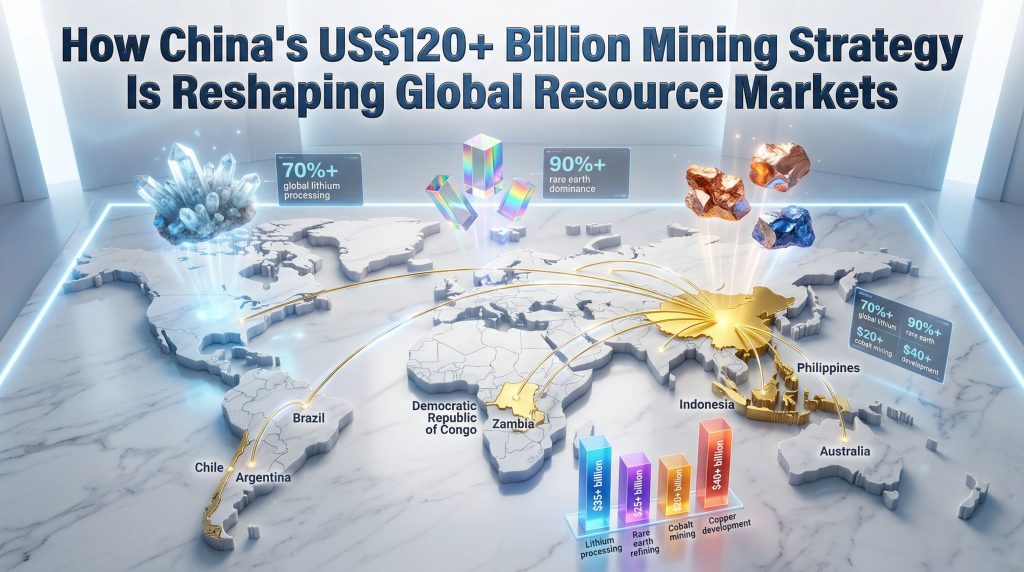
China's overseas mining investment represents the largest coordinated resource acquisition strategy in modern history, with commitments exceeding $120 billion since 2023. This capital deployment targets critical mineral supply chains across lithium, rare earth elements, cobalt, nickel, and copper extraction and processing operations. The investment magnitude demonstrates strategic prioritisation of resource security over traditional financial return optimisation.
The funding architecture combines multiple institutional mechanisms to distribute risk and maximise strategic impact. State-owned enterprises provide primary investment vehicles with established operational capabilities in complex mining environments. Development finance institutions offer concessional funding terms that improve project economics in challenging jurisdictions.
Commercial partnerships with host country entities provide local knowledge and regulatory compliance support. Investment timing reflects calculated strategic positioning ahead of projected supply bottlenecks. Global energy transition momentum creates exponential demand growth for specific minerals whilst traditional mining companies maintain cautious expansion policies.
This creates strategic acquisition opportunities for investors willing to commit substantial capital across extended development timelines. The 15.4 trillion yuan domestic clean energy sector generates downstream demand that justifies upstream resource investments. Furthermore, state-owned enterprise involvement ensures alignment between commercial investments and strategic national objectives.
Companies including China Molybdenum Company, Zijin Mining Group, and Jiangxi Copper Corporation operate as primary investment vehicles with technical expertise and capital resources for large-scale international projects. Their operational track record in complex mining environments provides credibility with host country partners and international financial institutions.
Development bank financing through China Development Bank and Export-Import Bank of China provides favourable terms that improve project economics. Concessional interest rates, extended repayment periods, and flexible collateral requirements enable investments in projects that might not meet commercial banking criteria. This financing model has proven effective across multiple sectors and geographic regions over recent decades.
Private sector participation ensures competitive efficiency whilst maintaining strategic direction. Domestic competition between Chinese companies drives operational innovation and cost optimisation. Joint venture structures with international partners provide technology access and risk sharing.
Strategic Mineral Priorities Driving Investment Allocation
Lithium Supply Chain Integration Strategy
Lithium represents the foundational element for battery technology dominating electric vehicle and grid storage markets. Current global processing capacity concentration creates strategic vulnerability for countries dependent on battery imports. China's overseas mining investment strategy targets 70 percent control of global processing capacity through integrated extraction and refining operations across multiple continents.
Geographic diversification spreads across Australia's hard-rock spodumene deposits, Chile and Argentina's brine extraction operations, and African emerging lithium provinces. This approach reduces dependence on single-source suppliers whilst building redundant processing pathways. Technical integration ensures that extracted lithium ore receives processing through Chinese-controlled facilities regardless of extraction location.
Processing technology represents the critical value-addition component where margins concentrate. Converting raw lithium ore into battery-grade lithium carbonate or lithium hydroxide requires specialised chemical processing expertise and substantial capital investment. China's existing dominance in battery component manufacturing creates natural downstream demand for processed lithium materials.
Investment allocation prioritises processing capacity expansion over pure extraction operations. Processing facilities can source raw materials from multiple mining operations whilst serving diverse battery manufacturing customers. This positioning provides strategic leverage across the lithium supply chain whilst generating superior financial returns compared to extraction-only operations.
Consequently, Australia lithium innovations have become increasingly important as alternative sources seek to compete with Chinese processing dominance.
Rare Earth Elements: Maintaining Processing Dominance
China currently controls approximately 90 percent of global rare earth refining capacity, a dominance achieved through decades of technical development and capital accumulation. Maintaining this position requires continued investment in processing infrastructure and technology advancement as global demand expands with renewable energy deployment.
Rare earth elements cannot be easily substituted in permanent magnet manufacturing, which forms essential components of electric vehicle motors and wind turbine generators. Processing these elements involves complex separation techniques that require specialised chemical engineering expertise and substantial environmental management capabilities.
Vertical integration from mining through magnet manufacturing creates comprehensive supply chain control that prevents competitor access to critical materials. Overseas mining investments provide raw material security whilst domestic processing operations maintain technical leadership and value capture.
Strategic reserve building through overseas operations supports domestic stockpiling objectives whilst providing operational flexibility during market disruptions. The combination of processing dominance and strategic reserves creates substantial leverage in negotiations with downstream manufacturing customers.
Battery Metals Portfolio Diversification
Cobalt supply chain security represents a critical vulnerability given the geographic concentration of production in the Democratic Republic of Congo and Zambia. China's overseas mining investment strategy targets 65 percent supply chain control through direct mining investments and processing facility development across multiple African jurisdictions.
Nickel processing investments focus on Indonesian smelting capacity development where substantial nickel deposits combine with favourable processing economics. Chinese companies have established multiple nickel smelting operations that process local ore for export to battery manufacturing facilities.
Copper infrastructure development supports renewable energy grid expansion requirements whilst providing exposure to traditional industrial demand patterns. Copper serves essential roles in electrical infrastructure, renewable energy systems, and electric vehicle manufacturing that ensure sustained demand growth.
| Mineral Category | Investment Commitment | Global Share Target | Primary Regions |
|---|---|---|---|
| Lithium Processing | $35+ billion | 70%+ | Australia, Chile, Argentina |
| Rare Earth Refining | $25+ billion | 90%+ (maintain) | Malaysia, Myanmar, Africa |
| Cobalt Mining | $20+ billion | 65%+ | DRC, Zambia, Australia |
| Copper Development | $40+ billion | 40%+ | Peru, Chile, Zambia |
Operational Framework for Resource Diplomacy Implementation
The resource diplomacy model operates through structured partnerships that balance Chinese strategic objectives with host country development priorities. This framework has evolved from traditional extractive relationships toward comprehensive development partnerships that include infrastructure, technology transfer, and local capacity building components.
Joint venture structures typically allocate majority control to Chinese partners whilst providing significant equity participation for host country entities. This arrangement ensures operational control for Chinese strategic objectives whilst creating local stakeholder alignment through shared economic benefits. Government guarantees and political risk insurance provide additional security for long-term capital commitments.
Technology transfer requirements vary by project complexity and host country capabilities. Chinese companies selectively share processing techniques and operational methodologies whilst protecting proprietary technologies that maintain competitive advantages. Training programmes and technical assistance create local operational capabilities that reduce dependence on expatriate management.
Environmental and social governance integration addresses international sustainability standards and local community concerns. Adaptation to International Finance Corporation Performance Standards and similar frameworks ensures access to international capital markets whilst meeting host country regulatory requirements.
Local content mandates require specific percentages of employment, procurement, and services sourcing from host country suppliers. These requirements create economic benefits that extend beyond direct mining operations whilst building political support for long-term operational security.
Infrastructure development commitments typically include transportation networks, power systems, and community facilities that enable mining operations whilst providing broader economic benefits. Roads, railways, ports, and power plants serve mining operations whilst supporting general economic development in resource-rich regions.
Risk-sharing mechanisms distribute commercial, technical, and political risks across multiple parties whilst ensuring project viability. Currency hedging, commodity price hedging, and political risk insurance provide protection against various disruption scenarios that could affect long-term profitability.
Geographic Focus Areas and Strategic Impact Assessment
African Mining Belt Transformation
The Democratic Republic of Congo represents the world's dominant cobalt production region, supplying approximately 60-70 percent of global cobalt output. Chinese investments focus on both artisanal mining formalisation and large-scale industrial operations that improve production efficiency whilst addressing ethical sourcing concerns.
Zhejiang Huayou Cobalt's Prospect Lithium Zimbabwe plant in Goromonzi exemplifies the integrated approach combining extraction, processing, and local value addition. This operation demonstrates technical feasibility of processing lithium deposits that were previously considered economically marginal.
Guinea's bauxite resources and the Simandou iron ore project represent large-scale infrastructure development opportunities that combine mineral extraction with comprehensive economic development. These projects require substantial transportation infrastructure investments that provide broader economic benefits beyond mining operations.
Zimbabwe's emerging lithium province has attracted multiple Chinese investors seeking to capitalise on growing battery demand whilst supporting local economic development. Processing facility development creates higher-value employment opportunities compared to raw material exports.
Latin American Resource Partnerships
Chile and Argentina's lithium triangle contains approximately 58 percent of global lithium reserves concentrated in salt flat brine deposits. Chinese joint ventures provide capital and technical expertise for brine extraction operations that require substantial upfront investment and specialised processing capabilities.
Peru's position as a major copper producer creates partnership opportunities in both existing operations expansion and new project development. Chinese companies bring capital resources and processing expertise that enable development of economically marginal deposits.
Brazil's iron ore sector offers partnership opportunities with established mining companies whilst providing access to integrated logistics infrastructure. These partnerships combine Chinese capital with Brazilian operational expertise and market access.
Southeast Asian Processing Hub Development
Indonesia's nickel smelting capacity expansion represents one of the largest Chinese mining investments globally, with multiple facilities processing domestic nickel ore for export to battery manufacturing operations. These investments demonstrate integration of resource extraction with value-added processing.
Malaysia's rare earth processing facilities provide strategic geographic diversification for critical rare earth refining operations. These facilities process raw materials from multiple sources whilst serving regional manufacturing demand.
Philippines copper and gold mining partnerships combine Chinese capital with local operational expertise whilst addressing environmental and social governance requirements that ensure long-term operational sustainability.
Geopolitical Implications and Market Competition Dynamics
Resource security competition has emerged as a fundamental component of strategic rivalry between major economies. China's systematic approach to critical mineral control creates supply chain dependencies that extend beyond commercial relationships into geopolitical leverage.
Western response strategies include the United States' critical minerals initiatives, European Union raw materials partnerships, and allied nation coordination on supply chain diversification. These efforts attempt to create alternative sourcing options that reduce dependence on Chinese-controlled supply chains.
According to recent analysis by the Financial Review, China's aggressive mining acquisition strategy has raised concerns among Western governments about resource security. Supply chain diversification efforts face substantial economic and technical challenges given the capital requirements and technical expertise needed for competitive processing operations.
Alternative supply chains require years of development and substantial financial commitments from governments and commercial investors. Technology competition acceleration focuses on battery chemistry alternatives, processing efficiency improvements, and recycling innovation that could reduce dependence on primary mineral extraction.
These technological developments represent potential disruption risks to current investment strategies. Developing nation positioning reflects growing awareness of resource leverage opportunities combined with concerns about long-term economic sovereignty.
Host countries increasingly negotiate better terms whilst seeking to capture more value from their natural resource endowments. Resource nationalism trends include local content requirements, processing mandates, and export restrictions designed to maximise local value capture from mineral extraction.
These policies create operational complexity whilst potentially improving long-term development outcomes. Regional bloc formation through organisations like the African Union and ASEAN provides collective bargaining power for resource-rich nations negotiating with major economy investors.
The next major ASX story will hit our subscribers first
Future Evolution and Market Transformation Scenarios
Investment priorities through 2030 will likely shift toward next-generation battery materials as solid-state battery technologies mature and require different mineral inputs. Sodium-ion batteries and advanced lithium iron phosphate chemistries could alter demand patterns for specific elements.
Recycling and circular economy investments represent emerging opportunities as battery waste streams mature and urban mining becomes economically viable. Recovery of lithium, cobalt, and rare earth elements from waste electronics and end-of-life batteries could supplement primary extraction operations.
In addition, the deep‐sea mining controversy represents a potential paradigm shift for mineral extraction, with seabed deposits containing substantial quantities of cobalt, nickel, and rare earth elements. However, environmental impact concerns and regulatory uncertainty create substantial development risks.
Regulatory adaptation requirements include enhanced environmental and social governance standards, transparency reporting, and due diligence compliance that address international scrutiny and investment screening policies. These requirements increase operational complexity whilst potentially improving long-term sustainability outcomes.
Local partnership deepening involves moving beyond extraction toward comprehensive value chain development that includes downstream manufacturing, technical education, and industrial ecosystem creation. This approach creates more substantial local economic benefits whilst building political support for long-term operations.
Competitive response and market evolution will likely include Western mining company consolidation, technology innovation acceleration, and alternative supply chain development as traditional players adapt to changing competitive dynamics.
Advanced extraction technologies including automation, artificial intelligence, and environmental monitoring systems could improve operational efficiency whilst reducing environmental impact. These technological developments require substantial research and development investments but could provide competitive advantages.
Alternative supply chain development by non-Chinese companies faces substantial technical and financial barriers but represents strategic priorities for countries seeking supply chain diversification. Success requires coordinated policy support, technical development, and sustained financial commitment.
Market Concentration Outcomes and Strategic Assessment
Supply security achievement metrics will determine whether China successfully achieves its targeted supply chain control levels across critical minerals. Current progress suggests substantial advancement toward processing dominance across multiple mineral categories.
Global competition intensification reflects Western recognition of strategic vulnerabilities in critical mineral supply chains. Policy responses include investment incentives, technology development programmes, and international partnership initiatives designed to create alternative supply options.
Sustainable development integration remains a key challenge as environmental protection requirements potentially conflict with extraction expansion. Balancing resource development with ecological preservation requires technological innovation and regulatory coordination.
Furthermore, the Zijin Mining Global Strategy exemplifies how individual companies are implementing comprehensive international expansion plans that align with national strategic objectives whilst addressing environmental and social governance requirements.
Economic development results for host developing nations will ultimately determine the sustainability of current partnership models. Quantifiable benefits including employment creation, infrastructure development, and technology transfer must justify the long-term strategic trade-offs involved in resource extraction partnerships.
Research from S&P Global Market Intelligence indicates that Chinese mining investments are increasingly focusing on energy transition metals, demonstrating strategic alignment with global decarbonisation trends whilst maintaining competitive positioning in traditional mining sectors.
Disclaimer: This analysis is based on publicly available information and should not be considered investment advice. Mineral market developments involve substantial risks including commodity price volatility, regulatory changes, and geopolitical uncertainties that could significantly affect investment outcomes. Readers should conduct independent research and consult qualified advisors before making investment decisions.
Could Chinese Resource Diplomacy Create Your Next Investment Opportunity?
Discovery Alert's proprietary Discovery IQ model tracks real-time ASX announcements from mining companies navigating these complex global resource dynamics, identifying significant mineral discoveries that could benefit from strategic partnerships or supply chain positioning. With Chinese investments reshaping global mineral markets and creating new competitive advantages for well-positioned companies, begin your 14-day free trial today to stay ahead of emerging opportunities in this rapidly evolving sector.