May 14, 2026
The intersection of resource security policies and industrial supply chains has created unprecedented opportunities for junior mining companies to establish strategic partnerships before traditional development milestones are reached. The recent Sovereign Metals Mitsui MOU exemplifies this trend, reflecting growing recognition that critical minerals projects require early commercial validation to navigate increasingly complex financing environments.
The titanium industry exemplifies this evolution, where aerospace and defence applications demand feedstock consistency and quality specifications that extend far beyond simple commodity trading relationships. Projects capable of meeting these stringent requirements while offering substantial scale are attracting industrial partnerships at preliminary development stages.
This strategic positioning becomes particularly relevant when examining how major trading houses and industrial groups evaluate long-term supply security. The combination of resource scale, product quality, and geopolitical alignment creates development pathways that differ significantly from traditional mining industry evolution patterns.
Commercial Validation Through Industrial Integration: The Sovereign Metals Mitsui MOU Framework
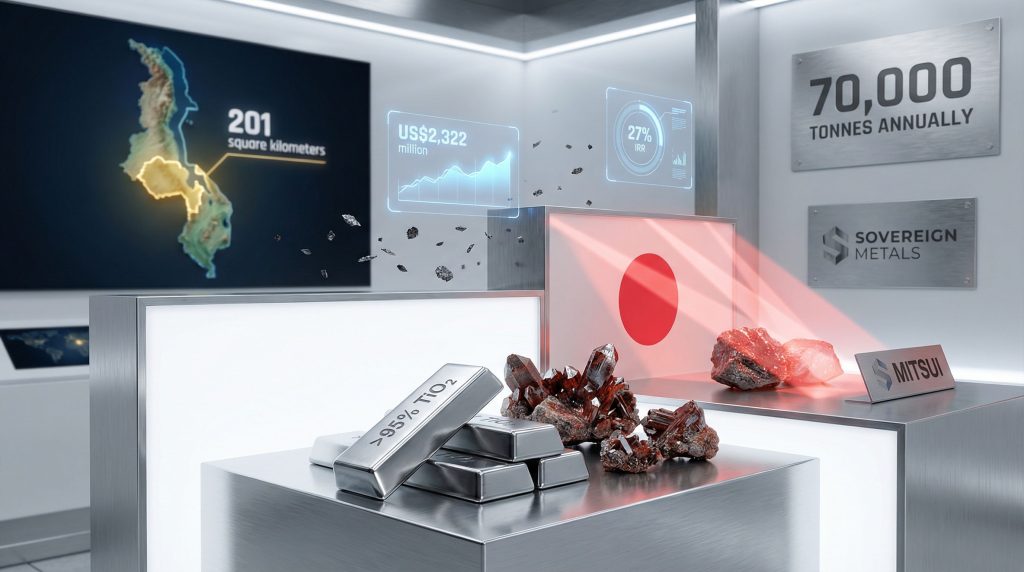
The memorandum of understanding between Sovereign Metals and Mitsui represents a sophisticated approach to critical minerals strategy commercialisation that extends beyond conventional offtake arrangements. The agreement establishes a framework covering up to 70,000 tonnes annually of natural rutile concentrate, targeting production from 2030 with product specifications exceeding 95% titanium dioxide content.
Key Partnership Components:
- Volume Commitment: Up to 70,000 tonnes per annum of natural rutile concentrate
- Quality Standards: Greater than 95% TiO₂ content with low impurity profiles
- Timeline Structure: Initial 4-year term from 2030 production start
- Extension Options: Possible 5-year extension by mutual agreement
- Development Phasing: Stage 1 (12 Mtpa) and Stage 2 (24 Mtpa) throughput flexibility
This structure reflects industrial partnership sophistication where operational flexibility and quality assurance take precedence over simple volume commitments. The staging approach allows both parties to evaluate market conditions and operational performance before committing to full-scale development.
Integration Within Japan's Titanium Manufacturing Ecosystem
Japan's position as the world's second-largest titanium sponge producer creates strategic imperatives around feedstock security that extend beyond pricing considerations. The country's titanium industry maintains some of the most stringent quality specifications globally, particularly for aerospace and defence applications where material consistency directly impacts product reliability.
Japanese Titanium Industry Structure:
| Producer | Specialisation | Market Position |
|---|---|---|
| Toho Titanium | Aerospace-grade titanium | Leading aerospace supplier |
| Osaka Titanium | Defence and medical applications | Specialised end markets |
| Combined Market Share | Aerospace/defence titanium | >60% outside China/Russia |
The technical validation provided by Toho Titanium regarding Kasiya's rutile suitability for high-specification products establishes credibility within this demanding market segment. Natural rutile's inherent characteristics – including high purity levels and low sulphur content – align precisely with chloride process titanium production requirements.
When big ASX news breaks, our subscribers know first
Kasiya Project Economics: Resource Scale Driving Strategic Interest
The January 2025 optimised pre-feasibility study establishes the economic foundation that makes early commercial partnerships viable. With a pre-tax NPV of US$2,322 million and an internal rate of return of 27%, Kasiya demonstrates project economics capable of supporting multiple strategic relationships whilst maintaining attractive investment returns.
Kasiya Resource Base:
- Rutile Resource: 17.9 million tonnes contained material (world's largest known resource)
- Graphite Resource: 24.4 million tonnes contained material (second-largest known resource)
- Mineralised Area: 201 square kilometres of blanket-style mineralisation
- Geological Setting: Soft, friable saprolite with weathered ore and low sulphur levels
Production Economics (Steady-State):
- Rutile Production: 246,000 tonnes per annum
- Graphite Production: 265,000 tonnes per annum
- Operating Cost: US$423 per tonne
- Capital Expenditure: US$665 million to first production
- EBITDA Margin: 64%
- Average Annual EBITDA: US$409 million
The dual-commodity nature of Kasiya provides revenue diversification advantages whilst maintaining operational simplicity. Furthermore, graphite production as a by-product of rutile processing creates additional value streams with minimal incremental capital requirements, carrying an incremental production cost of only US$241 per tonne.
Unique Geological Characteristics Creating Commercial Advantages
Kasiya's blanket-style mineralisation hosted in saprolite presents processing advantages that translate directly into commercial benefits. The soft, friable nature of the ore allows for simplified beneficiation processes whilst maintaining consistent product specifications throughout the mine life.
Consequently, the very low sulphur content characteristic of the deposit becomes particularly valuable in titanium feedstock applications. Sulphur contamination can create brittleness in titanium alloys, making Kasiya's naturally occurring low-sulphur profile a significant competitive advantage for high-specification end markets.
Strategic Development Scenarios: Multiple Pathways to Value Creation
The Sovereign Metals Mitsui MOU framework creates optionality for multiple development approaches, each offering distinct risk-return profiles and timeline implications. Understanding these scenarios provides insight into potential project evolution and investment outcomes.
Scenario 1: Accelerated Partnership-Driven Development
Key Assumptions:
- Mitsui relationship catalyses additional Japanese industrial partnerships
- Rio Tinto exercises development rights, providing technical expertise and operational capability
- Malawi permitting proceeds without significant delays
- Project financing secured through development finance institutions and strategic partner backing
Potential Timeline and Outcomes:
- Production start potentially advanced to 2029
- Enhanced product specifications targeting premium aerospace/defence markets
- Reduced financing costs through strategic partner validation
- Established market position before competing rutile projects reach production
This scenario leverages strategic partnerships to compress development timelines whilst enhancing project credibility in financing discussions. The combination of technical validation and commercial commitment could significantly reduce execution risk.
Scenario 2: Phased Development Strategy
Strategic Framework:
- Initial development focuses on Stage 1 (12 Mtpa throughput)
- Commercial partnerships expand during operational phase based on performance
- Graphite marketing develops in parallel to rutile sales
- Stage 2 expansion (24 Mtpa) triggered by favourable market conditions and operational success
Risk-Return Profile:
- Lower initial capital requirements reduce financing complexity
- Operational experience gained before full-scale development commitment
- Flexible response capability to evolving market demand
- Reduced execution risk through proven operational track record
Scenario 3: Strategic Acquisition Target
Market Dynamics:
- Project scale and commercial validation attract major mining companies
- Multiple parties potentially compete for project control
- Critical minerals policy support enhances strategic value
- Premium valuations possible through competitive processes
Value Creation Mechanisms:
- Accelerated development through major company resources and expertise
- Enhanced financing capabilities and reduced sovereign risk
- Integration into established supply chains and customer relationships
- Potential for premium acquisition pricing reflecting strategic value
Japanese Titanium Industry Integration: Supply Chain Security and Technical Requirements
Japan's titanium industry structure creates specific opportunities for high-grade rutile suppliers willing to meet demanding technical specifications. The country's focus on aerospace and defence applications requires feedstock consistency that extends beyond basic chemical composition to include impurity profiles, particle size distribution, and processing compatibility.
Market Positioning Within Strategic Supply Chains
The integration of Western critical minerals policies creates additional strategic value for projects capable of supplying Japanese industrial requirements. However, recent coordination between the US, EU, and Japan on supply chain resilience places premium value on alternative feedstock sources outside traditional supplier relationships.
This development mirrors the broader energy transition in mining sector, where strategic partnerships demonstrate the viability of alternative supply chains. Similarly, the emphasis on defense critical materials creates parallels with this strategic partnership case in terms of supply chain diversification priorities.
Supply Chain Security Context:
- Japan's reliance on titanium sponge imports creates strategic vulnerability
- US sourcing patterns show heavy dependence on Japanese titanium production
- Western policy coordination emphasises supply chain diversification
- Alternative feedstock sources carry premium strategic value
Natural rutile's technical characteristics align precisely with Japanese manufacturing requirements. The >95% TiO₂ content naturally occurring in high-quality rutile deposits, combined with low contaminant levels, suits chloride process titanium production without extensive beneficiation requirements.
Product Specification Advantages in Premium Markets
The compatibility between Kasiya's rutile characteristics and Japanese production requirements creates opportunities for premium market positioning. Aerospace and defence applications demand consistency that commodity-grade feedstock cannot reliably provide.
Technical Specification Alignment:
- Purity Levels: >95% TiO₂ content naturally occurring
- Impurity Profile: Low sulphur and metallic contaminants
- Processing Compatibility: Direct suitability for chloride process
- End-Market Applications: Aerospace, defence, medical device, advanced manufacturing
Risk Assessment Framework: Development and Commercial Risk Analysis
The non-binding nature of current agreements creates execution risk that investors must carefully evaluate. Whilst the Mitsui MOU provides commercial validation, definitive project success depends on completing multiple development milestones and securing binding commercial arrangements.
Regulatory and Permitting Risk Factors
Malawi Regulatory Environment:
- Mining licence application timeline and approval requirements
- Environmental impact assessment completion and community engagement
- Government stability and mining policy continuity
- Social licence maintenance throughout development
Infrastructure Development Requirements:
- Power supply arrangements and grid connection capabilities
- Transportation infrastructure for bulk commodity export
- Port access and logistics coordination
- Skilled workforce availability and training requirements
Commercial Risk Elements
Market and Pricing Dynamics:
- Titanium demand evolution and pricing volatility
- Competition from other rutile projects globally
- Graphite market development and pricing trends
- Currency fluctuation impacts on project economics
Counterparty and Contractual Risks:
- Non-binding nature of current MOUs
- Rio Tinto's existing rights and potential exercise decisions
- Definitive agreement negotiation outcomes
- Performance guarantee and credit support requirements
Risk Mitigation Strategies
Partnership Diversification:
- Multiple commercial partnerships reduce single-counterparty dependence
- Geographic market diversification beyond Japanese industrial relationships
- Product application diversification across aerospace, defence, and industrial end markets
- Strategic partner equity participation potential
Financial Structure Optimisation:
- Development finance institution involvement reduces political risk
- Staged development approach minimises initial capital requirements
- Strategic partner backing enhances financing credibility
- Export credit agency support potential for infrastructure development
Comparative Analysis: Critical Minerals Partnership Benchmarks
Recent partnerships in critical minerals provide context for evaluating the strategic significance of the Sovereign Metals Mitsui MOU framework. These comparisons illuminate both the potential value creation and execution requirements inherent in similar arrangements.
Benchmark Strategic Partnerships
| Partnership | Commodity Focus | Structure Type | Strategic Value Driver |
|---|---|---|---|
| Albemarle-Toyota | Lithium hydroxide | Long-term supply agreement | EV supply chain integration |
| MP Materials-General Motors | Rare earth magnets | Direct supply partnership | Domestic processing focus |
| Livent-BMW Group | Lithium carbonate | Quality-focused agreement | Premium specification requirements |
| Sovereign-Mitsui | Natural rutile | Framework MOU | Industrial supply chain positioning |
Differentiation Factors in the Sovereign-Mitsui Framework
The Sovereign Metals Mitsui MOU carries several distinguishing characteristics compared to typical critical minerals partnerships:
Unique Partnership Elements:
- Resource Scale: Larger than typical junior-major preliminary agreements
- Market Integration: Direct positioning within established industrial supply chains
- Geographic Scope: Africa-Asia supply chain development corridor
- Dual Commodity Structure: Rutile-graphite combination unique in current partnership landscape
- Technical Validation: Third-party confirmation from actual end-users
The next major ASX story will hit our subscribers first
Investment Thesis Evaluation: Balancing Opportunity and Execution Risk
The strategic value proposition of the Sovereign Metals Mitsui MOU extends beyond simple commercial validation to encompass broader themes of critical minerals security and industrial supply chain integration. However, investment success ultimately depends on execution through complex development and financing processes.
Bullish Case Drivers
Resource and Economic Fundamentals:
- World's largest known rutile resource provides decades of production visibility
- 27% IRR at study stage indicates robust project economics under current assumptions
- Dual-commodity structure provides revenue diversification and risk mitigation
- Natural rutile quality specifications suit premium industrial applications
Strategic Positioning Advantages:
- Early commercial validation through established industrial partnerships
- Critical minerals policy support enhances strategic value proposition
- Japanese market integration provides access to high-specification end markets
- Partnership framework creates potential for additional strategic relationships
Key Monitoring Points for Investment Decision-Making
Technical and Regulatory Milestones:
- Definitive feasibility study completion and economic confirmation
- Malawi mining licence approval timeline and conditions
- Environmental impact assessment outcomes and community agreements
- Infrastructure development agreements and financing arrangements
Commercial Development Progress:
- Transition from preliminary MOUs to binding offtake agreements
- Additional strategic partnership development beyond current framework
- Graphite marketing progress and pricing validation
- Rio Tinto rights exercise decision and potential development participation
Market Condition Evolution:
- Titanium demand growth in aerospace and defence sectors
- Graphite market development for battery and industrial applications
- Critical minerals policy implementation and trade relationship impacts
- Competition from alternative rutile and graphite supply sources
Investment Considerations: The Sovereign Metals Mitsui MOU represents early-stage commercial validation that could accelerate project development timelines and enhance financing prospects. However, significant execution risk remains through feasibility completion, regulatory approval, and definitive commercial agreement establishment. Investors should monitor development milestone achievement and market condition evolution when evaluating investment timing and position sizing.
In addition, the recent announcement demonstrates how major trading houses are positioning themselves within evolving critical minerals supply chains. The combination of substantial resource scale, attractive study-stage economics, and early commercial interest creates a compelling development case. However, successful transition from preliminary agreements to operational production requires navigating complex technical, regulatory, and financing challenges that will ultimately determine investment outcomes.
Want to capitalise on the next major mineral discovery?
Discovery Alert instantly identifies significant ASX mineral discoveries using its proprietary Discovery IQ model, providing actionable insights on companies securing strategic partnerships and early-stage commercial validation. Begin your 14-day free trial today and stay ahead of complex supply chain developments that can drive substantial market movements.