August 6, 2026
Resource Sovereignty in the Age of Supply Chain Weaponization
The global critical minerals landscape has fundamentally shifted from a purely commercial arena to a strategic battlefield where resource control determines technological independence. Nations worldwide are grappling with the reality that access to rare earth elements and lithium has become a matter of national security, particularly as China's dominance in processing capabilities continues to shape global supply chains.
Furthermore, Iran's rare earth and lithium industries represent a fascinating case study in resource nationalism under extreme pressure. The country's "resistance economy" doctrine, formulated during the 2010s, positions critical minerals development as essential infrastructure for technological sovereignty and economic survival under international sanctions.
When big ASX news breaks, our subscribers know first
How Do Economic Sanctions Shape Iran's Critical Minerals Development Strategy?
Sanctions Framework Impact on Mining Infrastructure
Economic sanctions targeting Iran have created a complex web of restrictions that fundamentally alter how the country approaches critical minerals development. The sanctions regime affects multiple layers of the industry, from equipment procurement to technology transfer and financial systems.
Equipment import restrictions represent one of the most significant barriers to scaling Iran's rare earth and lithium industries. Modern mining and processing operations require sophisticated machinery, separation technologies, and analytical instruments that are often subject to dual-use technology controls. These restrictions force Iranian operations to rely on older technologies or attempt to develop domestic alternatives, which significantly increases both development timelines and costs.
Financial isolation compounds these technical challenges by limiting access to international capital markets and banking systems. Large-scale mining projects typically require substantial upfront investment, often in the hundreds of millions of dollars for processing facilities. Iran's exclusion from major financial networks makes it difficult to attract foreign investment or secure project financing on competitive terms.
Secondary sanctions create additional complications for potential international partners. Companies considering collaboration with Iranian mining ventures must weigh the potential benefits against the risk of losing access to U.S. markets and financial systems. This dynamic has effectively reduced the pool of potential technology partners and investors to countries and companies already operating outside the Western financial system.
Regulatory Adaptations Under Economic Pressure
Iran's response to sanctions pressure has involved significant adaptations in regulatory frameworks and industrial policy. The "resistance economy" concept, launched as national policy, explicitly prioritises sectors that reduce external dependencies and enhance domestic capabilities.
The government has implemented domestic content requirements across various sectors, including mining and mineral processing. These mandates require Iranian projects to source a specified percentage of equipment and services from local suppliers, even when domestic alternatives may be less efficient or more costly than international options.
Import substitution policies have been expanded to include critical minerals processing technologies. Iranian research institutions and state-owned enterprises have been tasked with developing domestic alternatives to restricted foreign technologies, leading to increased funding for metallurgical research and pilot-scale processing projects.
State-led industrial policy has shifted toward creating vertically integrated supply chains within Iran's borders. This approach aims to control the entire value chain from extraction through processing to end-product manufacturing, reducing reliance on external suppliers at any stage.
What Role Does Energy Security Play in Iran's Rare Earth and Lithium Policies?
Critical Minerals as Strategic Assets
Iran's energy security strategy increasingly recognises critical minerals as essential components of national energy independence. The country's vast oil and gas reserves provide significant export revenues, but the leadership has identified diversification into renewable energy and advanced manufacturing as necessary for long-term economic sustainability.
Rare earth elements are fundamental to wind turbine manufacturing, particularly for permanent magnet generators that improve efficiency and reduce maintenance requirements. Iran's renewable energy targets, which call for substantial increases in wind and solar capacity, depend on access to these materials either through imports or domestic production.
Lithium development connects directly to Iran's emerging electric vehicle industry and energy storage ambitions. The country has announced plans to develop domestic battery manufacturing capabilities, viewing energy storage as critical infrastructure for grid stability and industrial competitiveness.
Defense sector requirements add another dimension to Iran's critical minerals strategy. Advanced military systems rely heavily on rare earth elements for guidance systems, electronic warfare capabilities, and precision-guided munitions. Domestic production capabilities reduce vulnerability to supply disruptions during international crises.
Resource Nationalism and Value Chain Control
Iran's approach to critical minerals reflects broader trends toward resource nationalism, where governments assert greater control over domestic mineral resources and their development. This strategy aims to capture more value from natural resources while building domestic industrial capabilities.
Government ownership structures play a central role in emerging mineral projects. State-owned enterprises and quasi-governmental organisations typically maintain controlling stakes in major mining and processing ventures, ensuring alignment with national strategic objectives rather than purely commercial considerations.
Export restriction policies have been implemented to prioritise domestic value-added processing over raw material exports. Iran has indicated preferences for developing downstream processing capabilities rather than simply exporting concentrates or partially processed materials to foreign buyers.
Strategic stockpiling initiatives have been established for critical materials deemed essential for national security. These programs aim to build reserves that can support domestic industries during supply disruptions or provide leverage in international negotiations.
How Does Iran's Geological Potential Compare to Global Critical Mineral Reserves?
Rare Earth Elements Resource Assessment
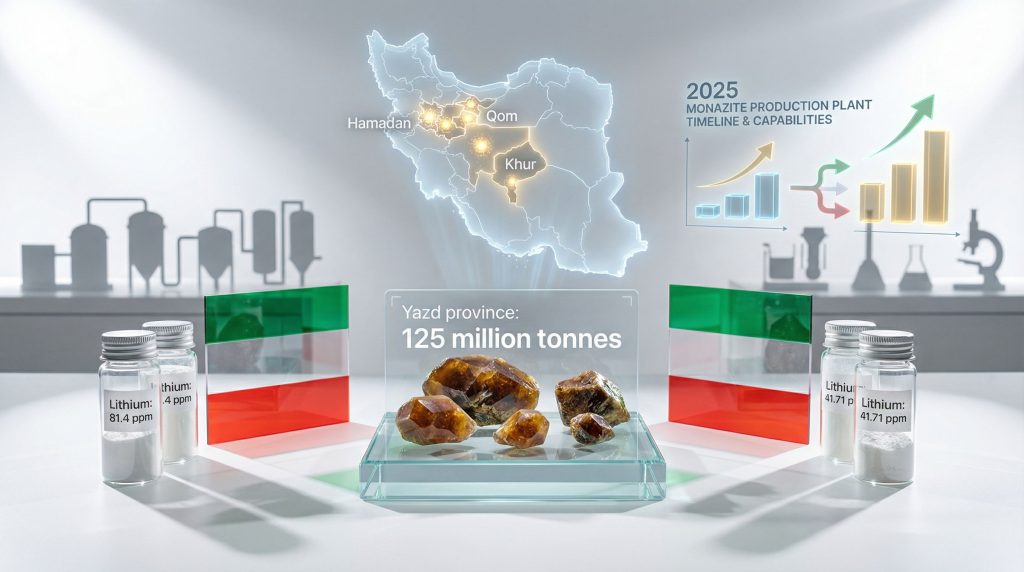
Iran's rare earth potential centres primarily on monazite-bearing deposits in the Yazd province, where geological surveys have identified significant concentrations of heavy mineral sands. The country has also explored phosphate-hosted rare earth deposits and investigated recovery from coal ash and other industrial residues.
| Deposit Type | Location | Estimated Reserves | Processing Status |
|---|---|---|---|
| Monazite concentrates | Yazd province | 125 million tonnes reported | Pilot production phase |
| Phosphate-hosted REE | Central regions | Under evaluation | Exploration stage |
| Coal ash recovery | Industrial sites | Variable grades | Research and development |
The monazite deposits represent Iran's most advanced rare earth development opportunity. These heavy mineral sands contain thorium as well as rare earth elements, requiring specialised processing techniques to handle radioactive materials safely. Iranian researchers have reportedly achieved laboratory-scale separation of individual rare earth oxides from these concentrates.
Quality assessments of Iranian rare earth deposits indicate mixed compositions with both light and heavy rare earth elements present. The specific distribution of individual elements within these deposits will determine their ultimate commercial value, as heavy rare earths typically command premium pricing in global markets.
Lithium Brine and Clay Deposit Analysis
Iran's lithium exploration efforts have focused on salt lake brines in central regions of the country, with additional investigations into clay-hosted lithium deposits. These resources remain at relatively early stages of development compared to rare earth initiatives.
| Site Location | Lithium Concentration | Deposit Type | Development Stage |
|---|---|---|---|
| Qom Salt Lake | 81.4 ppm reported | Brine deposit | Exploration phase |
| Khur region | 41.71 ppm measured | Brine deposit | Feasibility assessment |
| Hamadan province | 8.5 million tonnes claimed | Clay deposit | Unverified estimates |
Brine deposits offer the advantage of lower extraction costs compared to hard rock lithium mining, but require extensive evaporation pond systems and chemical processing facilities. Iranian climate conditions in central salt lake regions could support solar evaporation operations, though water scarcity may present operational challenges.
Clay-hosted lithium deposits, particularly those containing the mineral hectorite, represent a newer category of lithium resources that several countries are investigating. These deposits may offer advantages in terms of processing requirements, but extraction technologies remain less proven compared to brine or hard rock lithium operations.
What Are the Geopolitical Implications of Iran's Critical Minerals Ambitions?
Regional Supply Chain Dynamics
Iran's position at the intersection of Asia, Europe, and Africa provides potential advantages for regional supply chain integration. The country's critical minerals development could serve broader regional strategies, particularly in connection with Chinese Belt and Road Initiative projects.
Middle Eastern supply chain dynamics are evolving as Gulf states pursue economic diversification strategies that include advanced manufacturing. Iran's rare earth and lithium industries could complement these regional developments, providing raw materials for downstream processing in neighbouring countries.
Competition with established Gulf state resource strategies adds complexity to regional dynamics. Countries like Saudi Arabia and the UAE have announced significant investments in mining and processing capabilities, creating potential rivalry for regional market share in critical materials sectors. Moreover, recent Saudi Arabia exploration licenses demonstrate the kingdom's commitment to expanding its critical minerals footprint.
Transportation infrastructure connecting Iran to regional markets could become increasingly important if domestic production scales successfully. The country's position on historical trade routes provides multiple pathway options for reaching Asian and European markets.
International Partnership Constraints and Opportunities
Russia represents one of the most viable partnership opportunities for Iran's critical minerals sector, given both countries' experience operating under Western sanctions. Russian expertise in metallurgical processing and mining technology could support Iranian development efforts.
Chinese investment and technology transfer present both opportunities and strategic dilemmas for Iran. While Chinese companies possess the processing capabilities needed to scale Iranian operations, such partnerships could create new forms of dependency on Chinese technology and market access.
European Union critical raw materials diplomacy faces significant constraints regarding Iran due to sanctions regimes. However, potential future changes in international relations could create opportunities for technology transfer and market access agreements.
Alternative partnership arrangements, including barter trade systems and non-dollar denominated transactions, may provide pathways for Iranian critical minerals to reach international markets despite traditional financial system restrictions.
Which Processing Technologies and Industrial Capabilities Define Iran's Competitive Position?
Domestic Processing Infrastructure Development
Iran's processing capabilities represent a critical bottleneck in scaling its critical minerals industries. The country has established pilot-scale operations for rare earth separation and has announced plans for larger commercial facilities.
Iranian researchers achieved a significant milestone in 2016 by producing a 99 percent pure mischmetal alloy, demonstrating domestic capabilities in rare earth metallurgy and laying groundwork for expanded processing operations.
Separation technology development has focused on adapting established hydrometallurgical processes to Iranian rare earth concentrates. These efforts involve extensive research into optimal chemical processes for the specific mineral compositions found in Iranian deposits.
Industrial scaling challenges include moving from laboratory and pilot-scale operations to commercial production volumes. This transition typically requires substantial capital investment and technical expertise that may be constrained by sanctions limitations.
Quality control and analytical capabilities have been developed to support processing operations. Iranian institutions have invested in advanced analytical equipment needed to verify rare earth purity and composition throughout processing stages.
Technology Transfer Barriers and Innovation Responses
Sanctions-driven innovation has accelerated domestic research and development efforts in metallurgical processing. Iranian universities and research institutes have increased focus on critical minerals processing, often through reverse engineering of restricted technologies.
Academic-industrial partnerships have been strengthened to bridge the gap between research capabilities and commercial applications. These collaborations aim to transform laboratory-scale innovations into viable industrial processes.
Equipment manufacturing initiatives seek to develop domestic alternatives to restricted foreign technologies. Iranian manufacturers have begun producing mining and processing equipment, though often with reduced efficiency compared to international alternatives.
Technical training programmes have been expanded to develop the specialised workforce needed for critical minerals processing. These efforts include both domestic education initiatives and targeted recruitment of international expertise where possible.
The next major ASX story will hit our subscribers first
How Do Global Market Forces Influence Iran's Critical Minerals Strategy?
China's Processing Dominance and Strategic Dependencies
China's control over global rare earth processing creates fundamental constraints for all potential producers, including Iran. Chinese companies process approximately 85 percent of global rare earth production, creating dependencies even for countries with domestic mining capabilities.
Cost competitiveness represents a significant challenge for Iranian operations attempting to compete with established Chinese processing facilities. Chinese operations benefit from decades of experience, economies of scale, and integrated supply chains that reduce per-unit costs.
Technology dependencies emerge even in efforts to build independent processing capabilities. Many critical separation technologies, specialised chemicals, and analytical instruments originate from Chinese suppliers, creating potential bottlenecks for Iranian expansion efforts.
Market access through Chinese channels could provide pathways for Iranian materials to reach global markets, but would require Iranian producers to accept Chinese pricing and terms rather than accessing premium markets directly.
Market Access Challenges Under Sanctions Regime
Export pathway limitations significantly constrain Iranian producers' ability to reach international markets. Traditional shipping, insurance, and payment systems may be unavailable, requiring alternative arrangements that often involve higher costs and increased complexity.
Pricing mechanisms for Iranian critical minerals may differ from standard global benchmarks due to sanctions constraints. Iranian producers may need to accept discounted pricing to compensate buyers for additional risks and transaction costs.
Regional market focus has emerged as a pragmatic approach to overcoming international market access challenges. Neighbouring countries and traditional trading partners may provide more accessible markets for Iranian critical minerals production.
Barter trade arrangements and commodity exchange agreements could provide alternatives to traditional monetary transactions. These mechanisms have been used in other Iranian export sectors and may be applicable to critical minerals trade.
What Investment and Development Risks Shape Iran's Critical Minerals Sector?
Financial and Technical Risk Assessment
Investment risks in Iran's critical minerals sector reflect both sector-specific challenges and broader geopolitical uncertainties. Potential investors must evaluate multiple risk categories that could affect project viability and returns.
| Risk Category | Impact Level | Mitigation Strategies |
|---|---|---|
| Sanctions escalation | High | Domestic technology focus |
| Reserve verification | Medium-High | Independent geological studies |
| Processing scale-up | High | Phased development approach |
| Market access | High | Regional partnership development |
Sanctions escalation represents the highest-impact risk category, as expanded restrictions could further limit access to technology, capital, and markets. This concern has intensified following recent developments like the executive order on minerals announced in the United States, which may affect global supply chains.
Technical scaling risks emerge from the challenges of moving from pilot-scale operations to commercial production. Many promising laboratory results fail to translate into viable industrial operations due to unexpected technical challenges or economic constraints.
Market volatility in critical minerals pricing adds uncertainty to project economics. Rare earth prices in particular have experienced significant fluctuations based on geopolitical tensions and supply chain disruptions.
Regulatory Uncertainty and Policy Stability Concerns
International sanctions evolution creates ongoing uncertainty about the operating environment for Iranian critical minerals projects. Changes in international relations could either improve access to technology and markets or impose additional restrictions.
Domestic policy consistency across different government administrations affects long-term investment confidence. Mining projects typically require decades to develop and operate, making policy stability essential for project viability.
Environmental regulation development for mining operations is still evolving in Iran. Future environmental requirements could impose additional costs or operational constraints on critical minerals projects, particularly those involving radioactive materials like thorium-bearing monazite deposits.
Property rights and contract enforcement mechanisms remain concerns for potential international partners. Clear legal frameworks for foreign investment and dispute resolution are essential for attracting the capital needed for large-scale development.
How Does Iran's Critical Minerals Development Compare to Other Sanctioned Economies?
Comparative Analysis with Russia's Resource Strategy
Russia's experience developing critical minerals capabilities under sanctions provides relevant insights for Iran's strategic approach. Both countries have pursued import substitution policies and domestic technology development to overcome external restrictions.
Technology self-reliance timelines in Russia suggest that developing competitive processing capabilities can take decades without access to international technology transfer. Russian rare earth processing capabilities remain limited despite substantial domestic resources and technical expertise.
International partnership diversification has been central to Russia's sanctions adaptation strategy. Partnerships with China, India, and other non-Western countries have provided alternative sources of technology and capital for resource development projects.
Domestic market development has supported Russian resource projects by providing stable demand for output that might otherwise require export markets. Iran's growing industrial sector could provide similar domestic demand for critical minerals production.
Lessons from Other Resource-Rich Developing Nations
Brazil's rare earth development experience offers insights into the challenges facing countries attempting to compete with Chinese processing dominance. Brazil has struggled to develop commercially viable processing capabilities despite having significant domestic reserves.
India's critical minerals security policy demonstrates how countries can use government coordination and strategic planning to support domestic industry development. Indian efforts include both domestic production initiatives and international partnership strategies.
South Africa's mineral beneficiation policies show both the potential and limitations of government mandates requiring domestic processing. While these policies have increased local value addition, they have also created complications for international investment and export competitiveness.
Technology transfer mechanisms used by other developing countries could provide models for Iran's approach to acquiring needed processing capabilities while maintaining strategic independence.
What Are the Long-Term Strategic Scenarios for Iran's Critical Minerals Industries?
Optimistic Development Pathway
Successful domestic processing scale-up could position Iran as a significant regional supplier of critical minerals within the next decade. This scenario assumes continued government support, successful technology development, and stable operating conditions.
Strategic partnerships with non-Western countries could provide access to technology and markets without compromising Iran's independence objectives. Chinese, Russian, or other partnerships might offer pathways to commercial-scale operations.
Integration into alternative global supply chains outside traditional Western-dominated networks could provide market access for Iranian production. Regional trading blocs and South-South cooperation mechanisms might support this development path.
However, the broader critical minerals energy transition context suggests that global demand will continue expanding rapidly. Domestic demand growth from expanding manufacturing sectors could provide stable markets for Iranian critical minerals production, reducing dependence on export markets that may be restricted by sanctions.
Constrained Growth Scenario
Limited processing capabilities could confine Iran to raw material extraction and export, preventing capture of higher-value downstream activities. This outcome would limit economic benefits and strategic advantages from critical minerals development.
Continued sanctions pressure might prevent the technology transfer and capital investment needed for commercial-scale operations. Iran's rare earth and lithium industries could remain at pilot-scale indefinitely under this scenario.
Competition from other emerging producers, including African countries with Chinese partnership support, could limit market opportunities for Iranian production even if processing capabilities are successfully developed.
Technical challenges in scaling complex processing operations could prove more difficult than anticipated, particularly for mixed rare earth deposits that require sophisticated separation technologies.
Policy Recommendations for Stakeholders
International investors considering exposure to global critical minerals markets should monitor Iran's development progress as a potential future supply source. Changes in international relations could create rapid shifts in market dynamics.
Policymakers in import-dependent countries should evaluate the implications of Iran's critical minerals development for global supply security. Additional suppliers could provide benefits through increased competition and reduced concentration risks.
Industry participants should consider supply chain diversification strategies that account for potential Iranian production in medium-term planning. The ongoing mining industry evolution suggests that new suppliers will become increasingly important for meeting global demand.
Technology companies should assess potential opportunities for future engagement with Iranian critical minerals projects, particularly if international sanctions regimes evolve in ways that permit increased cooperation. Furthermore, developing alternative processing technologies could provide strategic advantages in an increasingly competitive global market.
This analysis is based on publicly available information and should not be considered investment advice. Critical minerals markets involve substantial risks, and development timelines for new projects are often longer than initially projected. Geopolitical factors may significantly affect project viability and market access for Iranian production.
Could Iran's Critical Minerals Development Reshape Global Supply Chains?
As nations worldwide grapple with supply chain vulnerabilities in critical minerals, Iran's strategic development of rare earth and lithium capabilities under sanctions pressure demonstrates how geopolitical tensions are fundamentally altering mineral investment opportunities. Discovery Alert's proprietary Discovery IQ model provides instant notifications when significant ASX mineral discoveries occur, empowering investors to capitalise on market-moving announcements before broader recognition develops across Discovery Alert's comprehensive platform. Begin your 30-day free trial today to position yourself ahead of rapidly evolving critical minerals markets and secure actionable insights that could define your investment strategy.