July 8, 2026
The Rarest Deposit in North American Development Is Still Looking for Its Equity Partner
Most investors tracking critical mineral projects focus on what a company has found in the ground. Fewer ask the more consequential question: what does the financing architecture actually look like, and which specific conditions must be satisfied before a single tonne of ore is processed? For Rhyolite Ridge, that question is now front and centre, and the Ioneer Korean MOUs Rhyolite Ridge DOE loan represents the clearest signal yet that the project's US$996 million DOE loan is inching toward activation, without yet crossing the finish line.
Understanding where Rhyolite Ridge sits in its development lifecycle requires stepping back from individual announcements and mapping the full decision tree, from geological uniqueness through to financing architecture, bilateral diplomacy, and the conditions that will ultimately trigger a Final Investment Decision.
When big ASX news breaks, our subscribers know first
Why Rhyolite Ridge Occupies a Category of Its Own
The Lithium-Boron Co-Deposit: A Geological Rarity With Commercial Consequences
Lithium deposits are not uncommon. Lithium-boron co-deposits are extraordinarily rare. Rhyolite Ridge in Nevada is one of only two known formations in the world where both minerals occur together in commercially exploitable concentrations, and it is the only such deposit currently in active development anywhere in North America.
This geological fact is not merely a talking point. It has direct implications for project economics that most development-stage lithium peers cannot replicate. Furthermore, the lithium carbonate market dynamics make this dual-commodity profile even more strategically significant:
- Boric acid production generates an independent revenue stream alongside lithium carbonate, providing a structural cost buffer when lithium prices cycle downward
- The boron market is far less volatile than lithium, creating a stabilising effect on overall project cash flows
- Co-production economics allow Rhyolite Ridge to remain viable at lithium price levels that would render single-commodity peers uneconomic
- Boron is itself classified as a critical mineral in multiple jurisdictions, adding a second layer of strategic relevance to the project's resource profile
The dual-commodity structure of Rhyolite Ridge is not an incidental geological feature. It is a fundamental risk-mitigation mechanism embedded in the deposit itself, one that single-commodity lithium developers simply cannot engineer their way into.
The project's Feasibility Study outlines production capacity capable of supplying lithium carbonate to support approximately 370,000 electric vehicles per year, which is the scale of upstream supply impact that the US Department of Energy's Advanced Technology Vehicles Manufacturing loan program was designed to enable.
Engineering Maturity and Permitting Status: The Competitive Moat Most Analysts Underweight
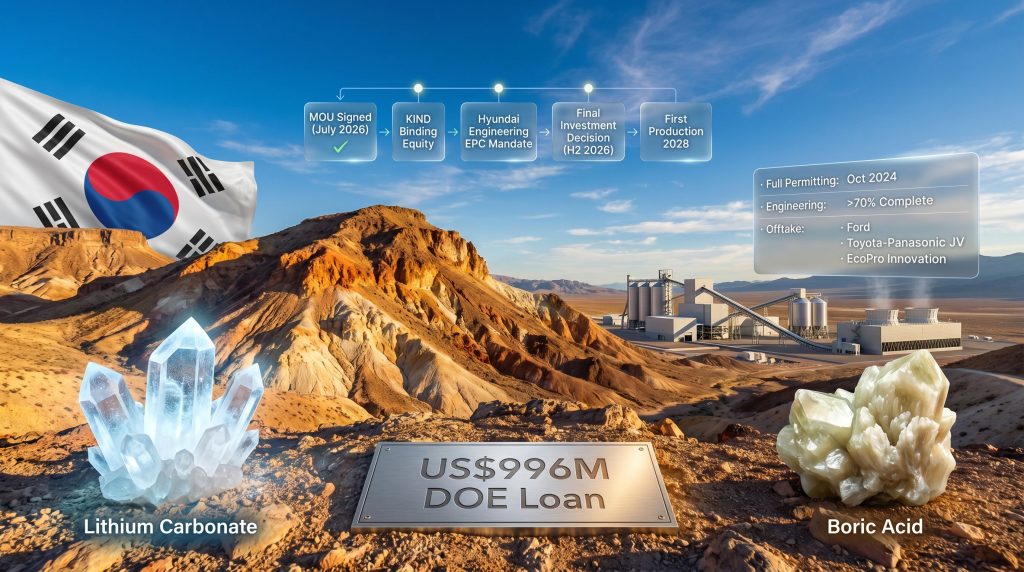
Two metrics consistently separate advanced-stage projects from aspirational ones: permitting completion and engineering progress. Rhyolite Ridge has achieved full permitting, a milestone reached in October 2024 that took years of environmental review and regulatory engagement to accomplish. At the time that permitting was finalised, engineering was reported at more than 70% completion.
For context, most North American lithium development projects are still multiple years away from equivalent permitting outcomes. The combination of full regulatory approval and advanced engineering creates a genuine competitive moat, because these are conditions that cannot be replicated quickly regardless of how much capital a competing project deploys.
| Development Metric | Rhyolite Ridge | Typical North American Lithium Peer |
|---|---|---|
| Full permitting status | Achieved (October 2024) | Often 2 to 5 years away |
| Engineering completion | Over 70% at permitting date | Typically below 30% |
| Co-product revenue stream | Yes, boric acid | Rarely |
| Government loan facility | US$996M DOE conditional commitment | Uncommon at this scale |
| Tier-1 OEM offtake agreements | Ford, Prime Planet, EcoPro | Variable |
| State-backed equity consideration | KIND (South Korea) | Uncommon |
Decoding the US$996 Million DOE Loan Structure
What the Loan Covers and What It Requires
The DOE's Advanced Technology Vehicles Manufacturing program originated as a mechanism to support domestic automotive manufacturing but has since evolved into a broader critical mineral infrastructure financing instrument. The program's structural logic aligns naturally with upstream lithium processing because domestic battery supply chains cannot exist without domestic feedstock. In addition, growing critical minerals demand driven by the energy transition has reinforced the strategic case for this kind of government-backed financing.
The loan commitment to Rhyolite Ridge breaks down as follows:
| Loan Component | Amount | Notes |
|---|---|---|
| Principal Facility | US$968 million | Core construction and processing facility funding |
| Capitalised Interest | US$28 million | Rolled into total commitment |
| Total Commitment | US$996 million | Under the ATVM program |
| Initial Conditional Commitment | US$700 million | First announced January 2023 |
| Upsized Amount | US$268 million | Added in 2025 to reflect full project scope |
The upsizing from US$700 million to US$996 million is itself a signal worth noting. It reflects the DOE's assessment that the full project scope, including on-site lithium carbonate processing infrastructure within the Nevada site boundary, warranted a larger facility than originally envisaged. The DOE loan announcement confirmed this expanded commitment covers the complete project build-out.
The Equity Condition: Why the Loan Cannot Draw Without a Partner
Here is the critical structural detail that market commentary often glosses over. The DOE conditional commitment is exactly that: conditional. Drawdown requires Ioneer to demonstrate a credible equity co-investment partner alongside the debt facility. This is standard practice in project finance at this scale, where lenders require evidence that equity holders have skin in the game before committing debt capital.
The equity vacancy created by Sibanye-Stillwater's 2025 departure from the project is therefore not a minor administrative gap. It is the central unresolved condition sitting between the current MOU stage and actual construction commencement. The Ioneer Korean MOUs are specifically designed to address this vacancy by advancing KIND toward a binding equity subscription agreement.
Investor Note: The DOE loan amount is confirmed and substantial, but it cannot be accessed until binding equity commitments are in place. The MOUs move Ioneer meaningfully closer to that outcome without yet delivering it.
What the Korean MOUs Actually Represent
LOI vs MOU: A Framework Investors Need to Understand
The distinction between a Letter of Intent and a Memorandum of Understanding is not a technicality. In the context of resource project financing, these documents represent different stages of institutional commitment and carry materially different risk profiles.
| Document Type | Internal Due Diligence Required | Reputational Cost to Exit | Typical Next Step |
|---|---|---|---|
| Letter of Intent (LOI) | Minimal | Low | Further commercial discussions |
| Memorandum of Understanding (MOU) | Substantial | Moderate to high | Binding agreement negotiation |
| Binding Subscription Agreement | Complete | Very high | Capital deployment |
The original Korean LOIs were signed in 2025. The conversion to MOUs in July 2026 means that both KIND and Hyundai Engineering have now completed sufficient internal feasibility analysis to formally commit to the next stage of commercial negotiation. That is a different level of institutional seriousness than an expression of interest.
Timeline Discipline as a Signal
An underappreciated dimension of the July 2026 MOU formalisation is that it arrived exactly when the company said it would. The 2025 LOIs specifically flagged July 2026 as the target conversion window. Delivering on that schedule, in a sector where milestone slippage is the norm rather than the exception, communicates something meaningful about project management discipline to institutional capital allocators and government counterparties who need to trust the teams they back.
The Government-to-Government Layer
The signing ceremony held in Sydney on 7 July 2026 was attended by the US Undersecretary of Energy and South Korea's Vice Minister for Land and Infrastructure. Ministerial-level attendance at what would otherwise be a commercial document signing transforms the event's strategic significance considerably.
This bilateral dimension reflects both countries' shared interest in developing critical mineral supply chains that operate outside Chinese control. Australia's own critical minerals strategy provides useful context for how Western-aligned nations are structuring these cooperative frameworks. The framing of Rhyolite Ridge within US-Korea critical mineral cooperation gives the project a geopolitical dimension that extends beyond its commercial fundamentals.
KIND and Hyundai Engineering: Understanding the Two Korean Counterparties
KIND: Why State-Backed Capital Thinks Differently
KIND, the Korea Overseas Infrastructure and Urban Development Corporation, is a South Korean government-sponsored entity with a mandate that extends beyond pure financial return. State-backed capital of this nature typically operates with longer investment time horizons and strategic criteria that include resource security objectives alongside commercial considerations.
For a project like Rhyolite Ridge, this distinction matters. A state-backed equity partner is less likely to exit during lithium price downturns than a purely financial investor, because the strategic rationale for participation persists regardless of short-term commodity pricing. Korea's domestic battery manufacturing industry, home to major producers supplying global EV manufacturers, has a direct national interest in securing Western-sourced lithium carbonate that qualifies under IRA domestic content frameworks.
Hyundai Engineering's Role: Construction Certainty and Cost Control
Hyundai Engineering's potential involvement as an Engineering, Procurement, and Construction contractor carries a distinct type of value. A fixed-price EPC mandate, if ultimately confirmed, would transfer significant construction cost risk away from Ioneer and its equity partners onto the contractor. That risk allocation structure is particularly valuable for a project of this scale and complexity.
The fact that a major Korean engineering firm has progressed from LOI to MOU also signals confidence in the project's technical maturity. EPC contractors do not invest internal due diligence resources in projects they consider technically immature or insufficiently de-risked. The Ioneer Korean MOUs Rhyolite Ridge DOE loan progression, consequently, carries weight beyond the headline document itself.
The Offtake Book: Demand Risk That Is Already Substantially Mitigated
Three Tier-1 Customers Across Three Geographies
While financing discussions dominate current coverage of Rhyolite Ridge, the project's customer lineup represents a material and often underappreciated de-risking factor:
| Offtake Partner | Geographic Origin | Strategic Significance |
|---|---|---|
| Ford | United States | Major US OEM; domestic content alignment with IRA battery credit requirements |
| Prime Planet Energy & Solutions | Japan | Toyota-Panasonic joint venture; Tier-1 battery manufacturing consortium |
| EcoPro Innovation | South Korea | Leading Korean cathode materials producer; links to Korean battery cell supply chain |
This customer base spanning US, Japanese, and Korean battery supply chains means that demand-side risk is already substantially diversified. The geographic spread is also strategically coherent: all three customers have strong incentives to source from a US-based, IRA-compliant lithium carbonate producer rather than rely on supply chains with greater geopolitical exposure.
The IRA Alignment Factor
The Inflation Reduction Act's domestic content requirements for EV battery tax credits create structural, policy-driven demand for US-processed critical minerals. Lithium carbonate produced at Rhyolite Ridge's Nevada processing facility qualifies under these requirements in ways that imported material cannot. This creates a genuine commercial advantage over non-US supply that is not dependent on commodity price movements. Innovations such as direct lithium extraction further underscore how processing technology is reshaping the competitive landscape for domestic producers.
The next major ASX story will hit our subscribers first
The Decision Tree: What Must Happen Before Ground Breaks
From MOU to First Production: The Critical Path
MOU Signed (July 2026) ✓
       ↓
KIND Binding Equity Subscription Agreement
       ↓
Hyundai Engineering Fixed EPC Mandate
       ↓
Final Investment Decision (Target: H2 2026)
       ↓
DOE Loan Drawdown Commences
       ↓
Major Construction Phase Begins
       ↓
First Production: Lithium Carbonate and Boric Acid (Target: 2028)
Three Scenarios From Here
Scenario A: Accelerated Conversion (Bull Case)
KIND completes internal approval processes and converts the MOU to a binding equity subscription within 60 to 90 days. Hyundai Engineering simultaneously confirms an EPC mandate. A Final Investment Decision is achieved in Q3 2026, construction commences before year end, and first production arrives in 2028 as targeted.
Scenario B: Delayed But Intact (Base Case)
KIND's internal government approval processes extend the equity negotiation timeline into Q1 2027. The FID slips to the first half of 2027. First production moves to late 2028 or early 2029. The DOE loan conditional commitment remains intact and the project fundamentals are unchanged, however, the timeline elongates.
Scenario C: Partner Reconfiguration (Downside Case)
Either KIND or Hyundai Engineering, or both, do not convert their MOU to a binding commitment. Ioneer must identify alternative equity partners, replicating a process similar to the post-Sibanye period in 2025. The FID slips beyond 2027 and the DOE loan conditional commitment faces potential review risk given extended inactivity.
Investor Warning: The conversion of MOUs to binding equity and EPC commitments is the single most important catalyst to monitor. Every document prior to a binding subscription agreement retains full optionality for both parties to exit. The re-rating event is FID, not MOU.
Monitoring Framework: The Catalysts That Actually Move the Needle
Re-Rate Trigger Hierarchy
For investors tracking Rhyolite Ridge's progression, the hierarchy of value-crystallising events runs from lowest to highest magnitude as follows:
- MOU formalisation (completed July 2026): Confirms serious bilateral intent; moderate market signal
- Binding equity subscription agreement with KIND: First confirmation that the DOE loan equity gap is filled; high market signal
- Fixed EPC mandate with Hyundai Engineering: Confirms construction cost certainty; high market signal
- Final Investment Decision announcement: Transforms project status from development to construction; very high market signal
- DOE loan drawdown commencement: Confirms all conditions satisfied; very high market signal
- Construction commencement and site mobilisation: Physical proof of capital deployment; sustained re-rating event
- First production of lithium carbonate and boric acid: Revenue generation begins; ultimate value crystallisation
Key Indicators to Monitor Between Now and FID
- Announcement of a binding equity subscription agreement with KIND
- Confirmation of a fixed-price EPC mandate with Hyundai Engineering
- Formal DOE loan drawdown commencement notification
- Official Final Investment Decision announcement
- Construction commencement and site mobilisation confirmation
Quantifying the Equity Gap
The DOE loan of US$996 million represents substantial debt financing, but project finance structures of this nature typically require equity to constitute a meaningful proportion of total project costs. The scale of the equity requirement means that KIND's participation, if it materialises, would need to represent a substantial capital commitment rather than a symbolic stake. A thorough definitive feasibility study underpins these financing expectations, and investors should assess announcements of binding equity with that scale expectation in mind.
Frequently Asked Questions: Ioneer Korean MOUs and the Rhyolite Ridge DOE Loan
What is the Ioneer DOE loan and how large is it?
The US Department of Energy has committed US$996 million to Ioneer's Rhyolite Ridge project under the Advanced Technology Vehicles Manufacturing loan program. This total comprises approximately US$968 million in principal and US$28 million in capitalised interest. The facility was upsized from an initial US$700 million conditional commitment first announced in January 2023. Ioneer's company history provides further context for how the project reached this advanced financing stage.
What are the Korean MOUs and who signed them?
In July 2026, Ioneer formalised Memoranda of Understanding with two South Korean entities. KIND, a state-backed body, is considering an equity investment in the project. Hyundai Engineering is considering a procurement and construction role. These MOUs upgraded previously signed non-binding Letters of Intent from 2025 and were executed on the timeline the company originally indicated.
Is the DOE loan already accessible?
The DOE has issued a conditional commitment for the US$996 million facility. Drawdown requires Ioneer to satisfy conditions including securing a credible equity co-investment partner. The Korean MOUs advance this objective without yet completing it. Binding equity commitments have not been finalised as of the MOU signing date.
When is first production targeted?
Ioneer's target for first lithium carbonate and boric acid production is 2028, contingent on achieving a Final Investment Decision in the second half of 2026 and commencing major construction thereafter. Timeline slippage in the FID process would push first production into 2029 or later.
What makes Rhyolite Ridge different from other lithium projects?
Rhyolite Ridge is one of only two known lithium-boron co-deposits in the world and the only one in active development in North America. The boric acid co-product provides a second independent revenue stream that most lithium development projects lack entirely. The project is fully permitted and more than 70% through engineering, placing it materially ahead of most North American peers on the development timeline.
Who are Ioneer's offtake customers?
Ioneer has signed offtake agreements with Ford, the Toyota-Panasonic battery joint venture Prime Planet Energy & Solutions, and South Korean cathode materials producer EcoPro Innovation. This customer lineup spans US, Japanese, and Korean battery supply chains and provides substantial demand-side de-risking relative to development-stage peers without confirmed customers.
The Strategic Architecture: Why This Is Bigger Than a Single Mining Project
The convergence of forces around Rhyolite Ridge is unusual in critical mineral development. A single Nevada deposit sits at the intersection of US industrial policy through the DOE ATVM loan, Korean resource security strategy through KIND's equity consideration, Tier-1 OEM demand from three geographies, and a bilateral government framework formalised at ministerial level. Very few development-stage projects achieve this kind of multi-stakeholder alignment.
The July 2026 signing ceremony in Sydney, attended by senior government officials from both the United States and South Korea, elevated the Ioneer Korean MOUs Rhyolite Ridge DOE loan from a commercial milestone into a statement about how Western nations intend to construct critical mineral supply chains that function independently of Chinese-dominated processing routes.
That strategic framing does not guarantee a Final Investment Decision. KIND still needs to sign a binding equity agreement. Hyundai Engineering still needs to confirm an EPC mandate. The DOE loan still needs its conditions satisfied. However, the architecture that has been assembled around Rhyolite Ridge, geological rarity, advanced permitting, a large government loan facility, Tier-1 offtake, and now bilateral government involvement in the equity formation process, is not replicated anywhere else in North American lithium development.
The re-rate that unlocks full value is not today's MOU. It is the binding equity commitment that converts this architecture into committed construction capital. Between now and that moment, every incremental step in the right direction narrows the gap between the Ioneer Korean MOUs Rhyolite Ridge DOE loan potential and reality, without eliminating the distinction entirely.
This article is intended for informational and educational purposes only and does not constitute financial advice. Investors should conduct their own research and consider their personal circumstances before making any investment decisions. Forward-looking statements and scenario projections involve assumptions that may not materialise.
Want to Catch the Next Major Mineral Discovery the Moment It Hits the ASX?
Discovery Alert's proprietary Discovery IQ model delivers real-time alerts on significant ASX mineral discoveries, cutting through complex data to surface actionable opportunities for both short-term traders and long-term investors — explore the historic returns major discoveries have generated and begin your 14-day free trial to position yourself ahead of the broader market.